
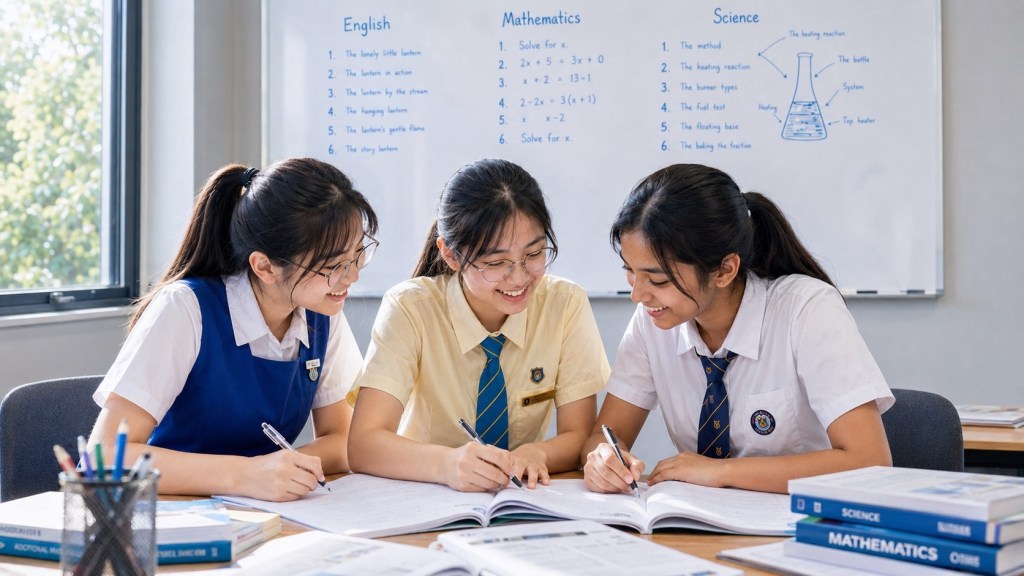
Additional Mathematics tuition in Sengkang for Secondary 3 and Secondary 4 should be matched to the learner’s actual SEC subject level, dependencies and evidence—not treated as one generic A-Math programme. Use this hub for G2 and G3 A-Math learning, repair, transfer and examination preparation. For the wider Mathematics estate and other school stages, return to the Mathematics Hub.
Additional Mathematics Learning Hub
Additional Mathematics is a connected learning system, not a pile of isolated chapters. This hub organises the eduKate Sengkang A-Math learning guides around the mathematical dependencies that matter most: symbolic control, structural recognition, representation, method selection, transfer and examination execution.
Build the algebra engine → connect the mathematical objects → test transfer → repair errors → integrate the subject → perform independently.
The Simple Answer
Secondary 3 Additional Mathematics is the installation year. Students move into a subject where algebra is no longer one chapter among many: it becomes the operating language underneath functions, trigonometry, coordinate geometry and calculus. The strongest learning sequence therefore does not ask only, “Which chapter are we doing?” It also asks, “Which earlier capability must remain available for this chapter to work?”
Secondary 4 then becomes the integration year. By that stage, success depends increasingly on recovering the right tool without a chapter label, combining multiple topics in one route, recognising when a method is unproductive and converting valid mathematics into complete examination evidence.
Current Singapore A-Math Map
For the 2027 Singapore-Cambridge Secondary Education Certificate, Additional Mathematics is available at G2 and G3. SEAB lists G2 Additional Mathematics as K232 (reference code 4051 in 2026 and earlier) and G3 Additional Mathematics as K341 (reference code 4049 in 2026 and earlier). The two routes are not interchangeable; students should use the syllabus and paper structure for the subject level they actually take.
| 2027 SEC route | Subject code | Reference code used in 2026 and earlier | Planning rule |
|---|---|---|---|
| G2 Additional Mathematics | K232 | 4051 | Use the official G2 syllabus, examples and assessment demand. |
| G3 Additional Mathematics | K341 | 4049 | Use the official G3 syllabus, examples and assessment demand. |
For G3 K341, SEAB organises the subject into three broad strands: Algebra, Geometry and Trigonometry, and Calculus, with knowledge from G3 Mathematics assumed. G2 K232 has its own official syllabus and should be taught and revised on its own terms rather than by simply removing selected G3 questions.
Schools may sequence topics differently. This hub therefore uses a dependency map rather than pretending that one school chapter order is universal.
- Algebra: quadratic functions, equations and inequalities, surds, polynomials and partial fractions, binomial expansions, exponential and logarithmic functions.
- Geometry and Trigonometry: trigonometric functions, identities and equations; coordinate geometry in two dimensions; geometry and proof relationships.
- Calculus: differentiation, applications of differentiation, integration and applications of integration.
SEAB: 2027 SEC G2 syllabuses for school candidates
SEAB: 2027 SEC G3 syllabuses for school candidates
The A-Math Dependency Spine
G3 Mathematics foundations → algebraic fluency → quadratic structure → equations and inequalities → exact forms and surds → polynomial structure → functions and graphs → trigonometry and coordinate geometry → calculus → mixed-topic transfer.
This spine is useful because it explains why a student can appear weak in a later topic even when the actual problem is upstream. A differentiation question may collapse after the derivative is found because the resulting equation is handled badly. A trigonometric identity may fail because fractions and factorisation are unstable. A coordinate-geometry question may stall because completing the square is not available quickly enough.
The visible chapter is therefore not always the original weakness.
How to Use the Learning Guides
- First pass: understand the mathematical object and why the method works.
- Second pass: reproduce the method without copying an example.
- Third pass: change the surface — coefficients, representation, wording or direction of the problem.
- Fourth pass: mix the topic with earlier material so the learner must choose the route.
- Fifth pass: record the first point of failure and repair that dependency rather than merely repeating the whole question.
- Return pass: revisit after delay so retrieval, not short-term familiarity, is tested.
What Counts as Mastery?
Mastery is not “I completed the worksheet”. A stronger test is whether the student can recognise the structure when the chapter label disappears, select a valid method, explain the key mathematical condition, execute accurately and notice when an answer violates the original constraints.
- Can the learner name what the expression or graph is telling us?
- Can the learner choose between two plausible methods?
- Can the learner show why a condition such as a discriminant sign matters?
- Can the learner keep exact values exact when approximation would destroy information?
- Can the learner move between algebra, graph and geometric interpretation?
- Can the learner recover after an error without restarting blindly?
The Secondary 3 Job
Secondary 3 has one enormous advantage: time. It is the best stage to make slow, accurate repairs before those weaknesses are multiplied by the rest of the syllabus. A student who improves algebraic manipulation, exact-form reasoning and equation control in Secondary 3 is not merely improving three chapters. The student is increasing the reliability of many later topics at once.
Repair upstream while time is still an asset.
The Secondary 4 Job
Secondary 4 increasingly tests whether the whole system can run on demand. A learner may know every chapter separately and still lose marks because the paper does not announce which chapter is active. The task becomes recognition, routing, integration and evidence.
Practice papers should therefore produce an error map, not only a percentage. Classify mistakes as concept gaps, retrieval failures, representation errors, method-selection errors, manipulation slips, incomplete reasoning, constraint failures or time-control problems. Different causes need different repairs.
The A-Math Learning Standard: Understanding, Transfer and Independent Performance
The guides in this hub are built as long-form teaching articles rather than short revision notes. Each guide aims to carry several layers at once: a simple explanation, first-principles reasoning, formal mathematics, worked routes, error diagnosis, transfer tasks, study instructions and links back into the wider A-Math system.
The objective is not to make Mathematics look impressive. It is to make the learning route inspectable. A student should be able to see what the object is, what operation is legal, what information is preserved, what can go wrong and how the same idea returns elsewhere.
A-Math Diagnosis: Find the First Mathematical Dependency That Fails
Additional Mathematics often creates misleading symptoms because later questions depend on earlier mathematical control. A student may believe calculus is weak when the derivative is correct but the resulting algebra is not. A trigonometry question may appear unfamiliar when the real failure is factorisation. A coordinate-geometry question may collapse because completing the square is not available quickly enough.
| Visible A-Math problem | Possible upstream dependency | What to test first |
|---|---|---|
| Quadratics feel random | Expansion, factorisation, completing the square, discriminant meaning | Can the student move among equivalent quadratic forms and explain what each form reveals? |
| Surds and exact forms produce many errors | Fraction control, algebraic legality, denominator structure | Can exact values be manipulated without premature approximation? |
| Logarithms are memorised but fragile | Index laws, inverse relationships, equation solving | Can the student explain why each logarithm law is legal before using it? |
| Trigonometric identities feel impossible | Factorisation, fractions, identity recognition | Can the student transform one side while preserving equality? |
| Differentiation seems fine but applications fail | Function interpretation, algebra, graph meaning | Can the student connect derivative sign and value to behaviour? |
| Integration answers are wrong late in the solution | Algebraic simplification, constants, limits, exact arithmetic | Where does the first invalid line appear? |
| Full-paper marks are much lower than topical marks | Selection, mixed retrieval, pacing or recovery | Can the student identify the mathematical object and route without a chapter label? |
The first wrong line matters more than the final wrong answer. A tutor who begins from the last line may reteach an entire topic that the student mostly understands. A tutor who finds the first illegal transformation can often repair a smaller, more powerful dependency.
G2 K232 and G3 K341: Two A-Math Routes, One Need for Precision
From 2027, families should not use “A-Math” as if one identical SEC paper applies to every student. The learner’s actual subject level matters. G2 Additional Mathematics K232 and G3 Additional Mathematics K341 are separate syllabus routes. Tuition materials, past-paper references, pacing and topic depth should therefore be matched to the correct route.
- Confirm the subject level first. Check the student’s school information and official SEAB syllabus.
- Do not infer level from school reputation or class name. Use the student’s actual subject enrolment.
- Do not teach G2 merely as “easier G3”. Use the G2 syllabus as the owner of G2 scope and assessment.
- Do not prepare a G3 learner using only legacy 4049 habits. Preserve useful mathematical material, but calibrate against the current K341 syllabus and paper requirements.
The one-owner rule applies inside the subject too: the current SEAB syllabus owns the examination specification. Tuition owns teaching, diagnosis, practice and transfer—not the definition of the official paper.
The Algebra Engine: The Part of A-Math That Quietly Powers Everything Else
A-Math is often taught chapter by chapter, but the learner experiences it through reusable operations. Algebraic equivalence, factorisation, substitution, rearrangement, exact values, solving equations and reading functions appear repeatedly across the subject. When these operations are slow or unreliable, every later chapter becomes more expensive.
- Equivalence: can the student transform an expression without changing its mathematical meaning?
- Factor structure: can a useful factor be seen before brute-force expansion begins?
- Equation legality: can each transformation be justified?
- Exactness: does the student know when a decimal destroys useful information?
- Function view: can an equation also be read as a relationship, graph or transformation?
- Constraint memory: are domain conditions, excluded values and relevant intervals preserved?
This is why an “A-Math calculus problem” can still be an algebra problem. The calculus may identify the right derivative or integral; the algebra determines whether the solution survives long enough to earn the mark.
The First-Move Routine for Unfamiliar A-Math Questions
When a student says “I know the formula but I do not know how to start”, the problem is often not memory. It is route selection. Train the first move separately.
- Name the object: function, equation, identity, graph, rate, tangent, area, polynomial or coordinate relationship.
- List the givens: values, constraints, intervals, coordinates, gradients, roots or conditions.
- Name the target: what exactly must be found, shown or proved?
- Recall relationships: which definitions or theorems connect the givens to the target?
- Choose the cheapest legal move: substitution, factorisation, differentiation, identity transformation, coordinate relation or another justified operation.
- Write one line: reduce blank-page search into a smaller problem.
A strong first move does not guarantee the entire solution. It changes the search space from “everything I know about A-Math” to one mathematical structure that can be tested.
The A-Math Error Taxonomy: Stop Calling Everything Careless
| Error family | Example | Repair |
|---|---|---|
| Structural | Student does not recognise a quadratic, function composition or identity pattern. | Compare representations and classify before solving. |
| Algebraic legality | Invalid cancellation, sign change or transformation. | Require justification of each transformation. |
| Constraint loss | Extraneous root or ignored domain condition. | Carry constraints visibly and check candidates against originals. |
| Notation | Ambiguous brackets, derivative notation or substitution. | Use a notation checklist and rewrite unclear lines. |
| Selection | Correct technique applied to the wrong mathematical object. | Train method comparison before execution. |
| Arithmetic | Small numerical mistake after correct reasoning. | Use targeted checking rather than restarting the whole solution. |
| Recovery | One failed route consumes excessive time. | Set a leaving rule, preserve working and return later. |
An error log becomes powerful only when the categories predict future action. “Careless” does not. “Lost domain restriction after squaring” does.
The A-Math Transfer Ladder
Difficulty should not jump directly from worked examples to full papers. A more reliable progression changes one dimension at a time until the learner can handle integration.
| Level | Condition | Question being tested |
|---|---|---|
| 1. Reproduce | Same structure, new coefficients | Can the student execute the learned method? |
| 2. Recognise | Same mathematics, different surface form | Can the student recognise the object? |
| 3. Select | Two plausible methods available | Can the student choose efficiently? |
| 4. Mix | Several topics interleaved | Can knowledge be retrieved without a chapter cue? |
| 5. Integrate | Multiple ideas in one question | Can dependencies be coordinated? |
| 6. Perform | Timed section or full paper | Can the capability survive examination conditions? |
Moving up the ladder too early creates brittle confidence. Staying at Level 1 for too long creates fluency without selection. Good A-Math tuition knows when to change the condition.
A Workable Weekly A-Math System
Additional Mathematics needs enough frequency to keep symbolic control alive, but it does not require every study session to be long. A sustainable week can separate learning, retrieval, transfer and paper work.
| Weekly job | Example | Why it exists |
|---|---|---|
| Current-topic learning | One new concept or school chapter | Keep pace with live teaching. |
| Algebra maintenance | Short exact-manipulation set | Keep the engine available. |
| Old-topic retrieval | Three to six questions from earlier work | Prevent forgetting. |
| Transfer | Mixed or unfamiliar questions | Train method selection. |
| Error return | Fresh question matching a recent mistake | Verify that correction changed behaviour. |
| Paper work | Timed section or full paper when ready | Calibrate execution and endurance. |
Students who are Blocked need more teaching and fewer full papers. Students who are Stable need more transfer. Students who are Examination-ready need realistic calibration. The weekly mix should follow the state of the capability, not the calendar alone.
Secondary 3 and Secondary 4 Need Different A-Math Decisions
Secondary 3: install the language and dependency network
Sec 3 should build algebraic fluency, exactness, functions, graph relationships and the habit of explaining why transformations are legal. The student has time to revisit prerequisites and should use that time. Premature full-paper drilling can hide the fact that the mathematical engine is still unstable.
Secondary 4: integrate, prioritise and perform
Sec 4 adds a finite calendar. The learner still needs deep repair, but priority matters more. High-leverage dependencies should be repaired first, mixed work should expose selection failures, and fresh full papers should be preserved for verification. Use Secondary 4 Tuition Sengkang for the whole final-year system.
The 4-, 8- and 12-Week A-Math Review
Week 4: the weak link should be clearer
- Can the tutor name the dependency causing the visible errors?
- Does the student know whether they are on the G2 K232 or G3 K341 route?
- Are errors being classified rather than called careless?
- Can the learner reproduce the repaired method without copying?
Week 8: transfer should be improving
- Does the learner recognise the same structure in a changed form?
- Can they choose between methods?
- Are old topics staying retrievable?
- Is tutor prompting decreasing?
Week 12: school and paper evidence should agree
- Does improvement appear outside tuition worksheets?
- Do mixed sets and school assessments show fewer repeated errors?
- Can the student self-correct some failures?
- Can support move toward maintenance or examination calibration?
If the student has completed twelve weeks of A-Math tuition but cannot explain the main weak link, cannot work without familiar templates and repeats the same algebra errors, the programme needs a different intervention—not simply more chapters.
A-Math Paper Control: Timing, Leaving, Returning and Checking
Paper strategy should be built on top of mathematical capability, not used to conceal missing knowledge. Once the learner is ready, the main execution questions become: how long is spent before leaving a stalled route, which working should be preserved, how does the student return, and what checks are cheap enough to recover marks?
- Leaving rule: when a route has stopped producing useful mathematics, preserve the working and move.
- Return rule: come back with a specific question—missing identity, algebraic simplification, alternative representation—not with the same blank search.
- Check rule: verify domains, signs, substitutions, exact values and final conditions where they are high-risk.
- Endurance rule: full-paper practice should be reviewed deeply enough that it changes the next paper.
Specialist SEC Mathematics and A-Math paper depth can continue at BukitTimahTutor; the Sengkang hub retains learner-state, local tuition and next-action routing.
A Parent Decision Guide for A-Math Tuition
- Confirm the actual subject level. G2 K232 and G3 K341 are different official routes.
- Bring evidence. Recent school scripts, homework and the student’s own working reveal more than a general statement that A-Math is hard.
- Ask for the first weak dependency. “Needs more practice” is not precise enough.
- Ask how transfer is tested. The programme should change conditions, not only repeat examples.
- Ask how errors are tracked. Repeated error families should shrink.
- Ask what support will fade. The learner should not need more prompting forever.
- Review after 4–12 weeks. Continue, change, reduce or stop based on evidence.
A-Math tuition is justified when it creates capability the student can carry elsewhere. It is not justified merely because the subject has a reputation for difficulty.
The A-Math Prerequisite Map: What Must Already Be Reliable
Additional Mathematics does not begin from zero. Both G2 and G3 A-Math sit on top of earlier Mathematics capabilities. A tutor should therefore test prerequisites directly instead of assuming that a student who has reached Secondary 3 automatically controls them.
| Prerequisite | Why A-Math needs it | Fast diagnostic |
|---|---|---|
| Algebraic expansion and factorisation | Appears inside quadratics, identities, calculus and equation solving. | Can the student move both directions between expanded and factored forms? |
| Fractions and rational expressions | Needed for algebraic manipulation, partial fractions and identities. | Can the student find common denominators and simplify without illegal cancellation? |
| Indices | Underpins exponential, logarithmic and algebraic work. | Can index laws be explained and applied without pattern guessing? |
| Graphs and coordinates | Needed for functions, intersections, tangents and geometric interpretation. | Can the student connect an equation, table and graph? |
| Equation solving | Returns throughout the subject after other operations generate equations. | Can the learner solve accurately and check candidates? |
| Trigonometric foundations | Needed before identities and equations become manageable. | Can basic ratios, angles and exact-value relationships be retrieved? |
| Notation discipline | A-Math solutions are long enough that ambiguous notation creates secondary errors. | Can another reader follow each transformation without guessing? |
When several prerequisites are weak at once, repair order matters. Start with the dependency that appears most often across current topics. This prevents the student from relearning the same underlying operation separately inside quadratics, trigonometry and calculus.
Worked Examples Should Fade, Not Become Permanent Scaffolds
A worked example is useful when the learner is first building a route. It becomes dangerous when the student cannot work unless the example remains visible. Good A-Math teaching therefore removes support deliberately.
- Model: tutor solves while naming why each step is legal.
- Complete: student fills missing steps in a partly worked solution.
- Reconstruct: student solves the same structure from a blank page.
- Vary: coefficients, representation or direction change.
- Select: the student chooses between plausible methods.
- Mix: the topic appears among unrelated questions.
- Delay: the learner returns days later without the original example.
The key measurement is not how smoothly the learner follows the tutor. It is how quickly the learner stops needing the tutor’s route to remain visible.
Exactness, Approximation and Information Preservation
A-Math often requires the learner to decide when an exact form is mathematically useful. Premature decimal approximation can hide structure, accumulate rounding error or make later algebra harder. The student should therefore understand exactness as information preservation rather than as a formatting preference.
- Keep surds exact while they are still part of symbolic work.
- Keep fractions exact when a later cancellation or comparison may matter.
- Use exact trigonometric values where the task requires them.
- Round only when the question, context or final presentation justifies it.
- Carry enough precision through intermediate steps when approximation is necessary.
A useful checking question is: Did I throw away information before I was finished using it?
Notation Is Part of the Mathematics
In long symbolic solutions, notation is not cosmetic. Brackets, equality signs, function notation, derivative notation and substitution all carry meaning. Sloppy notation can create an error that did not exist in the student’s original idea.
- Use equality only when both sides are actually equal.
- Use implication or separate lines when the relationship is not equivalence.
- Keep brackets around substituted expressions until the structure is safe.
- Distinguish a function from its value at one input.
- Keep derivative and integral notation clear enough to show what variable and operation are active.
- Write constraints where they remain visible during the solution.
Clear working helps the student as much as the marker. It makes the route inspectable, so an error can be found at the first wrong line instead of forcing a complete restart.
A-Math Checking Should Be Independent, Not a Repeat of the Same Route
Repeating the same calculation in the same way often reproduces the same mistake. Strong checking changes the representation or uses a mathematical property that is partly independent of the original route.
| Solution type | Useful independent check |
|---|---|
| Equation roots | Substitute candidates into the original equation and verify constraints. |
| Quadratic result | Check graph/turning-point behaviour or root relationships where relevant. |
| Trigonometric identity | Inspect whether transformations preserve equality and domain conditions. |
| Differentiation | Check dimensions of the expression, sign behaviour or reverse reasoning from the derivative. |
| Integration | Differentiate the result to see whether the original integrand returns. |
| Coordinate geometry | Substitute the final point/line into the original conditions. |
| Numerical approximation | Ask whether magnitude, sign and context are plausible. |
The student does not need to check every line equally. Build a personal risk list from actual error history and spend checking time where it has the highest expected return.
Protect Fresh A-Math Papers for Verification
Past papers and prelim papers are finite evidence. Once solutions are familiar, they remain useful for learning but become weaker tests of independent transfer. Keep some material fresh until the learner has completed the major repairs.
- Diagnostic material: exposes the first broad error pattern.
- Training material: can be paused, annotated and discussed.
- Verification material: stays unseen until the repaired capability is ready to be tested.
- Final calibration material: checks pacing, checking, endurance and recovery near the examination window.
This avoids a common Secondary 4 mistake: consuming every paper early and then having no clean evidence that the student can now solve the mathematics without recognition from previous attempts.
The A-Math Independence Test
A-Math tuition should eventually make the tutor less necessary. The learner is ready for reduced support when several conditions hold together rather than when one test score improves.
- The student can identify the mathematical object without a chapter label.
- The first move is usually appropriate.
- Old algebra remains available after delay.
- The learner can compare two possible methods.
- Errors are found and repaired with increasing independence.
- Mixed questions no longer create disproportionate collapse.
- Paper strategy is executed without external prompting.
- The learner can explain when they genuinely need help.
At that point, tuition can move from repair to maintenance, reduce in frequency or stop. A difficult subject does not justify permanent support if the student can already carry it.
Return to the Main Additional Mathematics System
Additional Mathematics Tuition Sengkang | Secondary 3–4 Learning System
The learning guides below form the teaching library for that wider system. New batches are added as the syllabus map expands.
Secondary 3 Additional Mathematics Learning Guide — Quadratics and exact algebra
Algebra foundation sequence: begin with the quadratic object, add root and inequality conditions, preserve exact values with surds, then extend structure through polynomials and partial fractions.
Secondary 3 Additional Mathematics Learning Guide — Functions and representations
Expansion and representation sequence: extend algebra through the Binomial Theorem, move into exponential-logarithmic inverse structure, build periodic trigonometric reasoning, then translate geometry and nonlinear relationships through coordinates and straight-line transformations.
Secondary 3 Additional Mathematics Learning Guide — Proof and calculus
Proof and calculus sequence: build rigorous geometric argument, then move from derivative rules into stationary-point and rate applications, before reversing the process through integration and area.
Secondary 4 Additional Mathematics Learning Guide | Diagnosis and examination control
Integration-year guides for diagnosing mark loss, protecting algebraic structure, selecting routes across mixed topics and recovering performance under examination conditions.
Secondary 3 Additional Mathematics Learning Guide — Motion and Secondary 4 readiness
Integration and handover sequence: apply calculus to straight-line motion, remove chapter labels through mixed-topic synthesis, convert mistakes into targeted repair evidence, then consolidate the Secondary 3 system for the Secondary 4 examination year.
Secondary 4 Additional Mathematics Learning Guide | Functions and calculus
Core upper-secondary A-Math topic guides for exponential-logarithmic structure, differentiation, integration and trigonometric control.
Choose the next learning step
Use the A-Math subject map for wider orientation, the diagnostic directory when the same error keeps returning, or the A-Math learning and pathway gateway when the learner’s route is unclear.
Match the year, subject level and school sequence before selecting a guide. After a targeted repair, return to the original question and test the change independently.
Return to Secondary Mathematics when the prerequisite is the real problem
Use the Secondary Mathematics S1–S4 capability map when the learner needs the broader Secondary route.
For a narrow prerequisite repair, choose factorisation and structural control, algebraic fractions and formula rearrangement, or linear graphs, coordinates and relationships. Repair only the dependency that is blocking the current A-Math task, then return here.
Secondary 3 Additional Mathematics Learning Guide — Modelling and readiness
Consolidation sequence: connect function families through transformation and inverse structure, strengthen the exact symbolic engine underneath every topic, apply mathematics through modelling, then run a full Secondary 3 mastery checkpoint before the Secondary 4 handover.
Secondary 4 Additional Mathematics Learning Guide | Algebra and coordinate geometry
Structural algebra and representation guides for quadratic control, polynomial theorem reasoning, selective binomial expansion and coordinate-geometry translation.
Secondary 3 Additional Mathematics Learning Guide — Conditions and mathematical communication
Advanced reasoning sequence: reason about families through parameters, sketch graphs from structural anchors, communicate complete mathematical evidence, then strengthen calculator use through estimation, exactness and independent verification.
Secondary 3 Additional Mathematics Learning Guide — Identities and alternative methods
Deep reasoning sequence: prove equivalence through legal transformation, look for symmetry and invariants, work backward from mathematical targets, then compare alternative routes for non-routine problems.
Secondary 3 Additional Mathematics Learning Guide — Questions, representations and revision
Performance sequence: decode the mathematical job before calculating, switch representations to expose hidden information, build durable retrieval through spacing and interleaving, then convert stable mathematics into examination pacing and recovery control.
Secondary 4 Additional Mathematics Learning Guide | Functions, motion and models
Function structure, exact algebra and applied-calculus guides for transformations and inverses, surd control, straight-line kinematics, modelling and parameter reasoning.
Secondary 3 Additional Mathematics Learning Guide — Domains, bounds and substitution
Precision-reasoning sequence: filter solutions through domains and admissibility, reason with feasible intervals and extrema, simplify hidden structures using auxiliary variables, then generalise patterns through conjecture testing and counterexamples.
Secondary 3 Additional Mathematics Learning Guide — Assumptions and verification
Meta-reasoning sequence: identify assumptions and model limits, use units and dimensions to preserve quantitative meaning, verify solutions through independent cross-checks, then diagnose upstream prerequisites so repairs happen at the first weak link rather than the last visible error.
Secondary 4 Additional Mathematics Learning Guide | Geometry and calculus
Proof, advanced calculus and representation-control guides for plane geometry, rates and second derivatives, trigonometric/exponential integration, signed areas and linear-law parameter recovery.
Secondary 3 Additional Mathematics Learning Guide — Conditions and global reasoning
Advanced-logic sequence: distinguish necessary from sufficient conditions and valid converses, separate local information from whole-domain conclusions, solve problems whose answers must satisfy several constraints simultaneously, then analyse how parameter changes move a mathematical family across behavioural thresholds.
Secondary 4 Additional Mathematics Learning Guide | Graphs and final-year readiness
Final-year structure and transfer guides for graph interpretation, domain and solution filtering, non-routine route comparison, full-syllabus diagnostics and examination readiness.
Secondary 3 Additional Mathematics Learning Guide — Cases, evidence and stability
Evidence-and-control sequence: manage every mathematical branch until the solution set is exhaustive, decide whether the given information is sufficient and which facts are redundant, control approximation and error propagation in sensitive calculations, then select the right theorem from the smallest complete set of trigger conditions.
Secondary 4 Additional Mathematics Learning Guide | Batch 07
Logical and examination-control guides for necessary and sufficient conditions, multi-constraint feasibility, calculator discipline, exactness, notation and complete mathematical reasoning.
Secondary 3 Additional Mathematics Learning Guide — Batch 12
Boundary-and-reversal sequence: identify special parameter values where a mathematical family changes type, use monotonicity to understand one-to-one behaviour and inverse existence, reconstruct models from observed outputs and conditions, then connect differentiation and integration as the rate–accumulation duality underneath calculus and motion.
Secondary 3 Additional Mathematics Learning Guide — Batch 13
Learning-intelligence sequence: turn worked solutions into independently reconstructable knowledge, use controlled contrasts to discover which mathematical features change the correct route, calibrate certainty so verification effort follows real risk, then compress solved problems into reusable schemas that transfer across new surfaces.
Examination interface: when the topic is known but the paper still breaks
This Sengkang hub owns worked Secondary 3–4 A-Math teaching. When the learner already knows the topic but needs the paper-facing layer, use the eduKateSG examination-interface guides below, then return here for topic repair and worked practice.
Secondary 4 Additional Mathematics Learning Guide | Batch 08
Resource-use and examination-transfer guides for formula-sheet intelligence, past-paper archetypes, worked-solution fading, topical-to-full-paper progression and prelim calibration.
Secondary 3 Additional Mathematics Learning Guide — Batch 14
Mathematical agency sequence: read dense notation as precise mathematical language, decompose long questions into ordered subgoals and recombine them safely, generate purposeful question mutations that expose structure, then choose economical and robust methods that preserve marks without unnecessary work.
Secondary 4 Additional Mathematics Learning Guide | Batch 09
Examination-evidence and reusable-structure guides for preserving recoverable working, managing complete solution branches, calibrating confidence and verification effort, and compressing solved problems into transferable mathematical schemas.
Secondary 4 Additional Mathematics Learning Guide | Batch 10
Integration-year decision and efficiency guides for hidden prerequisite repair, multi-stage dependency chains, near-miss method discrimination, and shortest-safe-route mark efficiency.
Paper calibration after worked A-Math teaching
This Sengkang hub remains the worked Secondary 3–4 teaching owner. After the topic has been taught and repaired, use the eduKateSG Paper Calibration Layer to test whether the mathematics survives mixed papers, unfamiliar surfaces and independent marking.
- Past year papers: 4049 to SEC G3 K341
- Prelim papers vs legacy O-Level / SEC papers
- Unseen papers and fresh-question readiness
- Self-marking, worked solutions and false mastery
Return here when the calibration result reveals a specific topic, prerequisite or worked-teaching repair.
Secondary 3 Additional Mathematics Learning Guide — Batch 15
Transfer-control sequence: recognise shared structure between different-looking source and target problems, climb from one solved example to a parameter family and general rule, generate the smallest useful self-hint during productive struggle, then diagnose stalled routes and switch strategy only when the evidence justifies it.
When A-Math becomes a tutoring decision
This hub owns Additional Mathematics learning. When the question becomes human support rather than subject content, use The Tutor System. Parents can continue to How to Work With Your Child’s Tutor; students can use How to Work With a Tutor; tutors can use The Tutor Handbook for diagnosis, intervention, support fading and release.
Six Friends A-Math route: Faith
For the learner-facing final-year route, use Faith’s Secondary 4 A-Math Year. It connects algebra, functions, trigonometry and calculus dependencies to mixed practice, checking, prelim recovery and examination execution.
This A-Math hub remains the technical subject owner; Faith’s story shows how the system behaves inside a real Secondary 4 year.
Atlas return routes | Additional Mathematics
- Learning Atlas V2.0 — when an A-Math problem needs to be separated into learner state, dependency and next action.
- Learning Runtime — when the issue is stability, transfer, first moves or support fading.
- Examination Craft — when knowledge is present but timing, question order, checking or recovery fails under paper conditions.
- The Tutor System — when a tutor must act on the identified A-Math dependency.
- BukitTimahTutor — for specialist A-Math depth, SEC G2/G3 pacing and full-paper work.
- Parents’ Guide — when the subject problem becomes a family decision about load, fit, starting, changing, reducing or stopping support.
- Start Here — when the family begins from a visible symptom such as algebra collapse, formula-without-first-move or falling marks.
Additional Mathematics tutorials and locality guides
- Advanced Additional Mathematics Tutorials | 20 Parent Mistakes That Can Make A-Math Harder
- Advanced Additional Mathematics Tutorials | A-Math After Prelims — Turn the Prelim Paper Into a Final Exam Recovery Plan
- Advanced Additional Mathematics Tutorials | A-Math Algebra Mastery — Factorisation, Indices, Equations and Fractions That Unlock the Subject
- Advanced Additional Mathematics Tutorials | A-Math Exam Anxiety — How to Stop Going Blank When You Know the Mathematics
- Advanced Additional Mathematics Tutorials | A-Math Exam Technique — Time Management, Method Marks and Final Checks
- Advanced Additional Mathematics Tutorials | A-Math Formula Sheet — What Is Given and What Students Still Need to Know
- Advanced Additional Mathematics Tutorials | A-Math Functions and Graphs — The Hidden Spine From Quadratics to Calculus
- Advanced Additional Mathematics Tutorials | A-Math Holiday Revision — Repair Weak Foundations or Get a Head Start?
- Advanced Additional Mathematics Tutorials | A-Math Mock Exams — How to Build, Sit and Review a Full Practice Paper
- Advanced Additional Mathematics Tutorials | A-Math Notes and Formula Revision — Build a Study System That Works Under Exam Pressure
- Advanced Additional Mathematics Tutorials | A-Math Paper 1 vs Paper 2 — Different Exam Rhythm, Different Control Problems
- Advanced Additional Mathematics Tutorials | A-Math Past Papers — How to Use Them Without Rehearsing the Same Mistakes
- Advanced Additional Mathematics Tutorials | A-Math Resources — School Notes vs Textbook vs Assessment Books vs Past Papers
- Advanced Additional Mathematics Tutorials | A-Math Results Not Improving Despite Tuition — What Parents Should Change Next
- Advanced Additional Mathematics Tutorials | A-Math Test Corrections — Turn One Wrong Paper Into a Better Revision Plan
- Advanced Additional Mathematics Tutorials | A-Math Tuition vs Enrichment — Does the Student Need Repair, Exam Control or Stretch?
- Advanced Additional Mathematics Tutorials | A-Math Weekly Study Schedule — Balance School, Homework, Old Topics and Exam Practice
- Advanced Additional Mathematics Tutorials | A-Math Weighted Assessments — How to Prepare for WA1, WA2 and School Tests
- Advanced Additional Mathematics Tutorials | Can You Self-Study A-Math? When Independent Study Works and When Help Matters
- Advanced Additional Mathematics Tutorials | Choosing A-Math Tuition in Sengkang — 12 Questions Parents Should Ask
- Advanced Additional Mathematics Tutorials | Common A-Math Mistakes — Why Correct Ideas Still Lose Marks
- Advanced Additional Mathematics Tutorials | Do Strong A-Math Students Need Tuition? When Support Adds Value and When Self-Study Is Enough
- Advanced Additional Mathematics Tutorials | Do You Need A-Math for H2 Mathematics? What the Syllabus Assumes and What JCs May Require
- Advanced Additional Mathematics Tutorials | E-Math vs A-Math — What Actually Changes When Students Move Into Additional Mathematics
- Advanced Additional Mathematics Tutorials | Failing A-Math — Repair, Persist or Reconsider the Subject? A Parent Decision Framework
- Advanced Additional Mathematics Tutorials | From A-Math to JC Mathematics — What Skills Carry Forward After Secondary School
- Advanced Additional Mathematics Tutorials | From O-Level A-Math 4049 to SEC G3 K341 — What Changes in 2027 and What Stays
- Advanced Additional Mathematics Tutorials | From PSLE Mathematics to A-Math: The Foundation Parents Should Build Before Secondary 3
- Advanced Additional Mathematics Tutorials | G2 K232 to G3 K341 — How SEC Additional Mathematics Progression Works
- Advanced Additional Mathematics Tutorials | G2 vs G3 Additional Mathematics Tuition — What Should Be Different Under SEC?
- Advanced Additional Mathematics Tutorials | Hardest A-Math Topics — Why Trigonometry, Logarithms, Calculus and Mixed Questions Feel Difficult
- Advanced Additional Mathematics Tutorials | How Much A-Math Practice Is Enough? Questions, Hours, Past Papers and Diminishing Returns
- Advanced Additional Mathematics Tutorials | How Parents Can Help With A-Math Homework Without Doing the Mathematics for Their Child
- Advanced Additional Mathematics Tutorials | How to Catch Up in A-Math Without Restarting the Whole Mathematics Syllabus
- Advanced Additional Mathematics Tutorials | How to Improve A-Math Quickly — A 30-Day Recovery Plan
- Advanced Additional Mathematics Tutorials | How to Know Whether A-Math Tuition Is Actually Working
- Advanced Additional Mathematics Tutorials | How to Prepare for Secondary 3 A-Math in Secondary 2
- Advanced Additional Mathematics Tutorials | How to Revise A-Math Effectively — From Weak Topic to Mixed-Paper Control
- Advanced Additional Mathematics Tutorials | How to Score A1 in A-Math — What Distinction-Level Performance Actually Requires
- Advanced Additional Mathematics Tutorials | How to Solve Unfamiliar A-Math Questions Without Memorising Every Question Type
- Advanced Additional Mathematics Tutorials | How to Study E-Math and A-Math Together Without Doubling the Workload
- Advanced Additional Mathematics Tutorials | I Know the Formula but I Don’t Know How to Start the A-Math Question
- Advanced Additional Mathematics Tutorials | Is A-Math Useful If You Are Not Going to JC? Polytechnic, Engineering and Technical Pathways
- Advanced Additional Mathematics Tutorials | Is One A-Math Tuition Lesson a Week Enough?
- Advanced Additional Mathematics Tutorials | Primary 1–6 Mathematics Skills That Later Power A-Math
- Advanced Additional Mathematics Tutorials | School A-Math Pace Too Fast? How to Catch Up Without Falling Further Behind
- Advanced Additional Mathematics Tutorials | SEC G1, G2 and G3 Mathematics Pathways: Where Additional Mathematics Fits
- Advanced Additional Mathematics Tutorials | Secondary 3 A-Math First 8 Weeks — Build the Engine Before the Subject Compounds
- Advanced Additional Mathematics Tutorials | Secondary 3 vs Secondary 4 A-Math Tuition — The Teaching Job Should Change
- Advanced Additional Mathematics Tutorials | Should A-Math Tuition Follow School Homework or Use Its Own Materials?
- Advanced Additional Mathematics Tutorials | Should A-Math Tuition Teach Ahead, Keep Pace or Repair Gaps First?
- Advanced Additional Mathematics Tutorials | Should My Child Take A-Math in Secondary 3? A Readiness Decision Guide
- Advanced Additional Mathematics Tutorials | The Last 24 Hours Before an A-Math Exam — What to Do and What Not to Do
- Advanced Additional Mathematics Tutorials | What a 3-Student A-Math Tutorial Should Actually Do
- Advanced Additional Mathematics Tutorials | When Should My Child Start A-Math Tuition? Secondary 2, 3 or 4
- Advanced Additional Mathematics Tutorials | When Should Parents Stop A-Math Tuition? Signs the Student Can Carry the Subject Alone
- Advanced Additional Mathematics Tutorials | Why A-Math Feels Hard After Secondary 2 — The Seven Weak Links Behind Falling Marks
- Advanced Additional Mathematics Tutorials | Why A-Math Homework Takes So Long — Diagnose the Minutes Before Telling Students to Work Faster
- Advanced Additional Mathematics Tutorials | Why Strong A-Math Students Plateau — The Precision Problems Behind the Last Few Marks
- Advanced Additional Mathematics Tutorials | Why Students Forget A-Math They Could Do Last Month — Build Retention Across Old Topics
- Learning G1 A-Math with Ang Mo Kio Tutor
- Learning G1 A-Math with Bedok Tutor
- Learning G1 A-Math with Bishan Tutor
- Learning G1 A-Math with Clementi Tutor
- Learning G1 A-Math with Hougang Tutor
- Learning G1 A-Math with Jurong East Tutor
- Learning G1 A-Math with Serangoon Tutor
- Learning G1 A-Math with Tampines Tutor
- Learning G1 A-Math with Toa Payoh Tutor
- Learning G1 A-Math with Woodlands Tutor
- Learning G1 A-Math with Yishun Tutor
- Learning G2 A-Math with Ang Mo Kio Tutor
- Learning G2 A-Math with Bedok Tutor
- Learning G2 A-Math with Bishan Tutor
- Learning G2 A-Math with Clementi Tutor
- Learning G2 A-Math with Hougang Tutor
- Learning G2 A-Math with Jurong East Tutor
- Learning G2 A-Math with Jurong West Tutor
- Learning G2 A-Math with Serangoon Tutor
- Learning G2 A-Math with Tampines Tutor
- Learning G2 A-Math with Toa Payoh Tutor
- Learning G2 A-Math with Woodlands Tutor
- Learning G2 A-Math with Yishun Tutor
- Learning G3 A-Math with Ang Mo Kio Tutor
- Learning G3 A-Math with Bedok Tutor
- Learning G3 A-Math with Bishan Tutor
- Learning G3 A-Math with Clementi Tutor
- Learning G3 A-Math with Hougang Tutor
- Learning G3 A-Math with Jurong East Tutor
- Learning G3 A-Math with Jurong West Tutor
- Learning G3 A-Math with Serangoon Tutor
- Learning G3 A-Math with Tampines Tutor
- Learning G3 A-Math with Toa Payoh Tutor
- Learning G3 A-Math with Woodlands Tutor
- Learning G3 A-Math with Yishun Tutor
New locality guides · October 2026
- Learning G1 A-Math with Bukit Batok Tutor
- Learning G1 A-Math with Bukit Panjang Tutor
- Learning G1 A-Math with Choa Chu Kang Tutor
- Learning G1 A-Math with Jurong West Tutor
- Learning G1 A-Math with Yew Tee Tutor
- Learning G2 A-Math with Bukit Batok Tutor
- Learning G2 A-Math with Bukit Panjang Tutor
- Learning G2 A-Math with Choa Chu Kang Tutor
- Learning G2 A-Math with Yew Tee Tutor
- Learning G3 A-Math with Bukit Batok Tutor
- Learning G3 A-Math with Bukit Panjang Tutor
- Learning G3 A-Math with Choa Chu Kang Tutor
- Learning G3 A-Math with Yew Tee Tutor
