
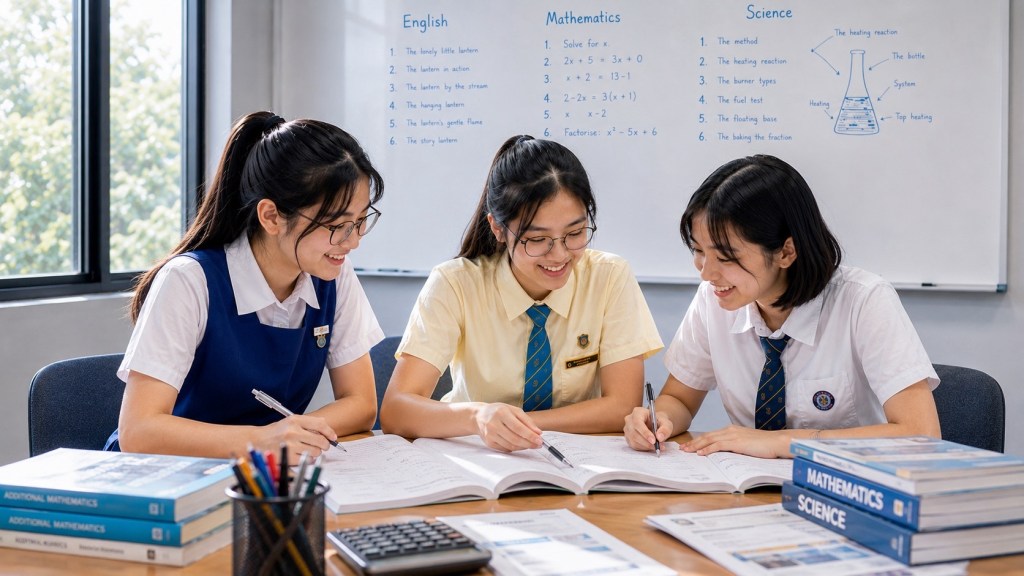
Advanced Additional Mathematics Tutorials continues with a workload problem that becomes very real in upper secondary: How do you study Mathematics and Additional Mathematics together without doubling the workload? Students taking A-Math do not replace ordinary Mathematics. They have to maintain both subjects, and the two overlap enough that bad planning creates unnecessary repetition while good planning lets one subject reinforce the other.
For Secondary 3 and Secondary 4 students in Sengkang, the useful goal is not to merge the two subjects into one. Their syllabuses, assessment demands and topic breadth remain different. The goal is to identify shared foundations—especially algebra, graphs, trigonometry and equation solving—so that revision in one subject strengthens the infrastructure used by the other.
This guide is for students and parents searching for E-Math and A-Math together, how to study both Mathematics and Additional Mathematics, Secondary 3 workload, Secondary 4 revision, A-Math tuition and Mathematics tuition in Sengkang. From 2027, official SEC naming uses Mathematics and Additional Mathematics at subject levels, but “E-Math and A-Math” remains common search language.
The first principle: two subjects, one mathematical foundation
Mathematics and Additional Mathematics should not be treated as completely separate islands.
They share important infrastructure:
- algebra;
- equations;
- graphs;
- coordinate reasoning;
- trigonometric ideas;
- calculator discipline;
- mathematical communication.
If those foundations are strong, both subjects become easier to manage.
What should stay separate
Do not collapse the subjects into one revision notebook.
Keep separate:
- syllabus maps;
- error logs;
- school test corrections;
- past-paper tracking;
- topic checklists.
This matters because a student can be strong in one subject and weak in the other for different reasons.
Shared weakness 1: algebra
Algebra is the biggest area where one repair can help both subjects.
Examples:
- negative-sign control;
- expansion;
- factorisation;
- indices;
- fractions;
- equation solving;
- rearrangement.
A student who repairs these skills inside A-Math may also become more reliable in ordinary Mathematics.
Use A-Math Algebra Mastery for the shared infrastructure layer.
Shared weakness 2: graphs
Graphs appear in both subjects, but A-Math usually demands deeper structural thinking.
A student should connect:
- coordinates;
- gradients;
- intersections;
- roots;
- turning points;
- transformations.
This reduces duplication because graph reasoning becomes one transferable system.
Shared weakness 3: trigonometry
Ordinary Mathematics may focus more strongly on triangle applications, while A-Math develops trigonometric functions, graphs, identities, equations and radians in greater depth.
The correct study plan is not to revise trigonometry twice from zero.
Instead:
- preserve the shared angle/ratio foundation;
- keep the subject-specific extensions separate;
- train calculator mode discipline across both.
The weekly split
A practical week can contain:
- one Mathematics session focused on current school work;
- one A-Math session focused on current school work;
- one shared algebra/graph maintenance block;
- one mixed correction block covering both subjects;
- timed paper work only as examination season approaches.
This is often more efficient than giving each subject a completely separate revision universe.
Do not duplicate the same algebra drill
If the student has already completed a high-quality factorisation set for A-Math, there may be little value in immediately doing another almost identical factorisation set for Mathematics.
Instead, use the next Mathematics session to apply the same skill in a different context.
This turns repetition into transfer.
The two-error-log system
Keep:
Log A: shared mathematical errors
Examples:
- sign errors;
- index-law confusion;
- fraction handling;
- calculator mode;
- equation balance.
Log B: subject-specific errors
Examples:
- A-Math trig-domain completion;
- A-Math calculus interpretation;
- Mathematics statistics interpretation;
- Mathematics mensuration wording.
This prevents parents and students from treating every lost mark as a separate problem.
How to study when both subjects have tests in the same week
Do not divide time automatically 50/50.
Use evidence.
Ask:
- Which subject has the larger current gap?
- Which test is closer?
- Which shared foundation can help both?
- Which subject-specific topic needs isolated attention?
Prioritisation is better than symmetry.
How to avoid A-Math stealing all the Mathematics time
A-Math can feel more intellectually demanding, so students sometimes give it nearly all their revision time.
Then ordinary Mathematics loses breadth.
This is dangerous because broad coverage matters.
Protect a minimum weekly Mathematics maintenance block even when A-Math is currently harder.
How to avoid Mathematics becoming only “easy confidence work”
The opposite problem also occurs.
A student may spend too much time on the subject that feels more comfortable because it produces faster success.
If A-Math is the weaker subject, the timetable should reflect that.
Comfort should not control allocation.
How past papers should be scheduled
Do not do both full papers every night.
Instead, rotate:
- Mathematics timed section;
- A-Math mixed set;
- correction session;
- A-Math full paper;
- Mathematics full paper.
The schedule should leave room for analysis.
How one tutor can support both subjects
One tutor can sometimes support both Mathematics and Additional Mathematics effectively because the shared foundation is large.
The key question is whether the tutor can keep the subject demands distinct.
A lesson should not become:
“We did some Maths.”
It should be clear whether the work is:
- shared algebra repair;
- Mathematics-specific;
- A-Math-specific;
- exam-paper analysis.
The 3-pax advantage
At eduKate Sengkang, Mathematics and Additional Mathematics are taught in groups of up to three students, normally for 1.5 hours.
A small group can make the shared-foundation strategy more efficient because the tutor can identify whether a weakness belongs to:
- both subjects;
- only Mathematics;
- only Additional Mathematics.
That prevents unnecessary duplication.
2026 and 2027 naming
Students graduating in 2026 remain on the familiar GCE route where “E-Math” and “A-Math” remain common official and everyday shorthand.
From the 2027 SEC cohort, official subject naming uses Mathematics and Additional Mathematics at subject levels such as G2 and G3.
The study principle remains the same: shared foundations should be coordinated, while assessment demands remain separate.
Frequently asked questions
Should I study E-Math and A-Math on the same day?
You can, especially when using a shared algebra or graph block, but do not force both subjects into every session.
Can A-Math improve E-Math?
It can strengthen shared skills such as algebra and graph reasoning, but ordinary Mathematics still needs direct syllabus coverage.
Should I use one error log for both?
Use a shared-error section for common foundations and separate subject-specific sections for distinct assessment problems.
Which subject should get more revision time?
The weaker or more urgent subject should usually receive more targeted time, while the stronger subject receives enough maintenance to remain stable.
Can one tuition lesson cover both?
Sometimes, especially for shared algebra repair. Closer to examinations, each subject may need its own paper-specific practice.
The larger idea
Studying Mathematics and Additional Mathematics together does not mean blending them into one subject.
It means using shared foundations intelligently so the student does not pay twice for the same learning.
