
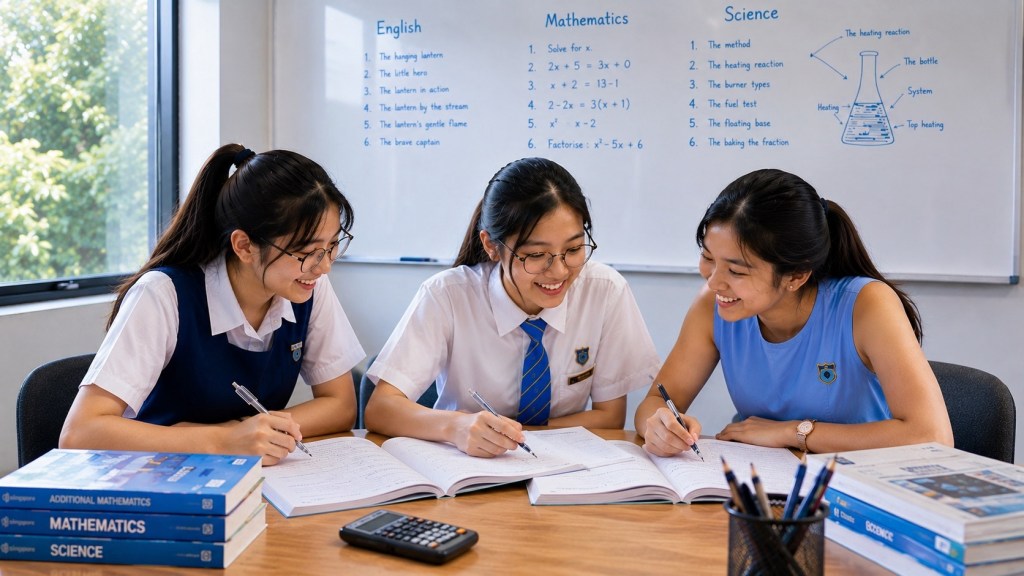
Advanced Additional Mathematics Tutorials continues with a practical tuition question: Is one A-Math lesson a week enough? For some students, yes. For others, no. The answer depends less on the calendar than on what happens before, during and after that weekly lesson.
For Secondary 3 and Secondary 4 students in Sengkang, one 1.5-hour Additional Mathematics tutorial can be enough when the lesson is used for diagnosis, explanation and guided repair, while the student completes independent retrieval and practice during the rest of the week. It is not enough if the lesson becomes the only time the student touches A-Math.
This guide is for parents searching for A-Math tuition once a week, how often should my child have Additional Mathematics tuition, weekly A-Math tuition, Secondary 3 A-Math tuition, Secondary 4 A-Math tuition and small-group A-Math tuition in Sengkang. It explains when weekly tuition is sufficient, when extra support may be justified and when more lessons simply add workload.
The central principle: frequency is not the same as learning intensity
A weekly lesson can be powerful if it creates a seven-day learning loop.
A weak weekly model is:
lesson → forget → next lesson.
A stronger model is:
lesson → independent reconstruction → school application → error return → next lesson.
The second model makes one weekly session much more valuable.
When one lesson a week can be enough
Weekly tuition may be sufficient when the student:
- understands most school teaching;
- can complete homework independently;
- has reasonably stable algebra;
- revisits the lesson during the week;
- brings specific errors back;
- is not in urgent examination recovery;
- can ask school teachers questions when needed.
In that situation, tuition acts as calibration and targeted support rather than a second school.
When one lesson a week is usually not enough by itself
The weekly lesson becomes insufficient when it is expected to do all of these alone:
- teach the current school topic;
- repair old algebra;
- complete homework;
- revise old chapters;
- mark school papers;
- train full examination papers.
No single 1.5-hour lesson can carry an entire week of Additional Mathematics if the student does nothing independently between sessions.
The 24–72 hour return
After tuition, the student should return to the lesson while the structure is still available but no longer fresh enough to copy.
Within roughly one to three days:
- redo one key question;
- attempt one changed version;
- retrieve the method without notes;
- record any new error.
This is where weekly tuition turns into durable learning.
The one-week retest
Before the next tuition lesson, include the topic in a mixed set.
If the student can still recognise and execute the method, the lesson transferred.
If not, the next lesson has useful evidence to diagnose.
When twice-weekly tuition may be justified
Extra frequency may be useful temporarily when:
- the student has a large prerequisite gap;
- school pace is moving faster than repair;
- Secondary 4 examinations are close;
- the student is transitioning from topic work to full-paper work;
- one weekly lesson cannot cover both live syllabus and urgent repair.
The key word is temporarily.
Increased frequency should have a defined purpose and review point.
When more tuition is the wrong answer
More lessons may not help when:
- the student is already overloaded;
- independent practice is missing;
- the same mistakes repeat because corrections are not retested;
- sleep is being sacrificed;
- the problem is motivation or planning rather than explanation.
Adding another class can increase activity without improving the learning mechanism.
The minimum independent work around one weekly lesson
A simple structure is:
- Lesson day: learn, diagnose, practise.
- 1–3 days later: reconstruct without help.
- Later in the week: mixed questions or school homework.
- Before next lesson: bring back errors and questions.
This does not require hours every day.
It requires continuity.
How Secondary 3 differs
For many Secondary 3 students, one weekly lesson can be enough when the main job is:
- keeping pace with new content;
- repairing algebra;
- building study habits;
- preventing early gaps from compounding.
The student still needs independent practice between lessons.
How Secondary 4 differs
Secondary 4 adds:
- full-syllabus retrieval;
- timed sections;
- past-paper analysis;
- exam strategy;
- final error reduction.
Some students may benefit from a temporary second session near prelims or national examinations, but only if the extra lesson solves a defined problem.
How to know whether weekly tuition is working
Do not measure by attendance.
Look for:
- fewer recurring errors;
- less dependence on hints;
- better school homework completion;
- stronger mixed-question recognition;
- better test-paper recovery;
- more independent correction.
The parent review question
Every four to six weeks, ask:
What can the student now do independently that previously required the tutor?
If the answer remains “nothing”, the tuition design should be reviewed.
How one weekly 3-pax lesson can work
At eduKate Sengkang, Mathematics and Additional Mathematics lessons are normally 1.5 hours in groups of up to three students.
One weekly lesson can work well when the tutor uses the time for:
- diagnosis;
- high-value explanation;
- guided practice;
- controlled variation;
- planning the independent return.
The lesson should not be expected to replace the student’s entire week of mathematical activity.
For the local service route, use Additional Mathematics Tuition Sengkang.
Frequently asked questions
Is once-a-week A-Math tuition enough for Secondary 3?
It can be if the student keeps up with school and does independent follow-up between lessons.
Is once-a-week enough for Secondary 4?
Sometimes. Students with large gaps or urgent exam preparation may temporarily need more intensive support.
Should my child have two lessons every week?
Only if the second lesson has a clear job and the workload remains sustainable.
What if my child only studies A-Math during tuition?
Then one lesson a week is unlikely to be enough because the student is not retrieving or practising independently.
How do I know when to reduce tuition?
When independent performance becomes stable and the student can diagnose and correct most work without relying on the tutor.
The larger idea
The right question is not “How many tuition lessons?”
It is “How many times does the student meaningfully retrieve, apply, correct and revisit the Mathematics across the week?”
