
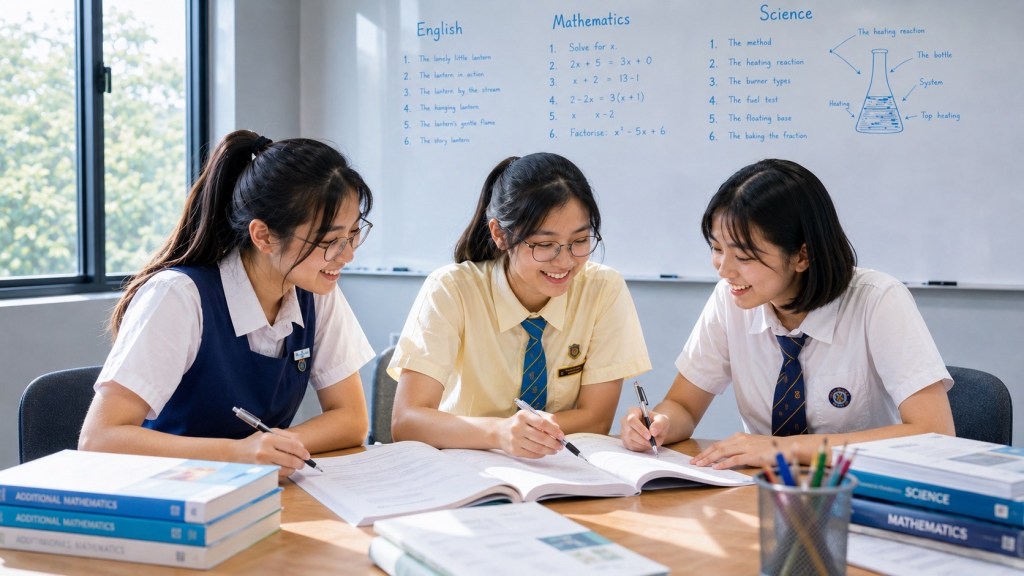
Advanced Additional Mathematics Tutorials continues with a part of revision students often rush through: test corrections. A wrong A-Math paper can become one of the most valuable learning resources in the term—if the student does more than copy the teacher’s answer beside the mistake.
For Secondary 3 and Secondary 4 students in Sengkang, the purpose of correction is to change what happens the next time a similar structure appears. That means identifying the first wrong step, classifying the mechanism, repairing the underlying skill and retesting after enough delay that the student can no longer rely on memory of the correction.
This guide is for students and parents searching for A-Math corrections, Additional Mathematics mistakes, how to review a math test, how to learn from wrong answers, A-Math error log and how to improve test scores. A correction is not complete until the error stops repeating.
The weakest correction method
- See the red cross.
- Copy the model solution.
- Understand it while looking.
- Move on.
This creates a neat notebook. It does not prove independent learning.
The correction cycle
locate → classify → explain → repair → reattempt → delay → vary
Locate
Find the first line where the working becomes invalid.
Classify
Name the error precisely.
Explain
State why the step is wrong.
Repair
Review the exact prerequisite or method.
Reattempt
Close the solution and do the original question again.
Delay
Return after several days.
Vary
Solve a changed question from the same structural family.
Why the first wrong line matters
A wrong calculus answer may have started with an index error, an expansion error, a derivative-rule error or an incorrect substitution. These require different repairs. The final answer alone cannot tell you which one happened.
Eight useful error categories
- Knowledge: fact, formula or definition missing.
- Recognition: method known but not recognised in the question.
- Method: route invalid or inefficient.
- Algebra: expansion, factorisation, indices, fractions or signs fail.
- Condition: domain, radians/degrees or another restriction ignored.
- Calculator: mode, entry or rounding wrong.
- Communication: working, notation or conclusion incomplete.
- Time: method known but not completed under the clock.
Do not call everything careless
“Careless” is not a useful training category.
Replace it with a precise description such as:
- negative sign lost outside bracket;
- degree mode used in a radian question;
- principal trig value found but domain not completed;
- constant of integration omitted;
- answer rounded before final substitution.
Specific errors can be trained.
The immediate reattempt
After understanding a correction, close the solution and reconstruct the route. If the student cannot do that, the correction has not yet become independent knowledge.
The delayed reattempt
Return after several days. This tests whether the route survived beyond short-term recognition.
The variation test
Change the coefficients, wording, representation, required output or one condition. If the student can only solve the original question, the correction was memorised rather than generalised.
The active error log
| Field | Example |
|---|---|
| Error | forgot remaining trig solutions in domain |
| Cause | stopped at calculator principal value |
| Repair rule | base angle → graph/quadrants → enumerate domain |
| Retest | 3 days later |
| Status | active / stable |
Keep the log short. Retire errors that remain corrected across delayed and changed questions.
How to correct a blank answer
A blank question may mean:
- topic not known;
- method not recognised;
- time ran out;
- confidence collapsed;
- the student could not find a first step.
The repair depends on which explanation is true.
How to correct a full-mark answer
Correct answers can still be fragile. Ask whether the method was efficient, whether the question took too long, whether the student can explain the route, and whether a small variation would break it.
How to correct partial-credit answers
Partial marks show where the solution survived. Do not restart the entire topic automatically. Identify the exact transition where the marks stopped.
How parents can review corrections without knowing A-Math
Ask:
- What type of error was this?
- What was the first wrong step?
- What will you do differently next time?
- When will you retest it?
- Has this error happened before?
How tutors should use school papers
A tutor should cluster errors rather than merely redo every wrong question. Three sign errors, two method-selection failures and one timing problem should become three repair targets—not six unrelated corrections.
The 3-pax correction advantage
At eduKate Sengkang, groups of up to three students allow correction sessions to stay differentiated. One student may need algebra repair, another trigonometric domain control, and another calculus interpretation. The group can then return to mixed questions to test transfer.
For the local service route, use Additional Mathematics Tuition Sengkang. For the full curriculum route, use the Additional Mathematics Learning Hub.
How corrections connect to past papers
Full papers should feed the same correction system. Use the A-Math Past Papers tutorial for the whole-paper version.
Frequently asked questions
Should I redo every wrong question?
Redo meaningful errors, but prioritise recurring and high-cost patterns rather than giving equal time to every one-off slip.
When should I redo it?
Use an immediate or next-day reconstruction, then a delayed return and a changed variation.
Should I copy the model answer?
Only to understand the route. Close it and reconstruct the solution independently.
What if the same mistake keeps returning?
The repair is not stable. Reduce the issue to the prerequisite or micro-skill and train it directly.
The larger idea
A wrong paper is not evidence to hide. It is a map of where the system failed. Use that map until the next attempt behaves differently.
Examination handoff: keep Additional Mathematics ownership here for the algebra, functions, trigonometry, calculus and method work; use Examination Craft for timing, checking, recovery, pressure-testing and reliable performance under examination constraints.
