
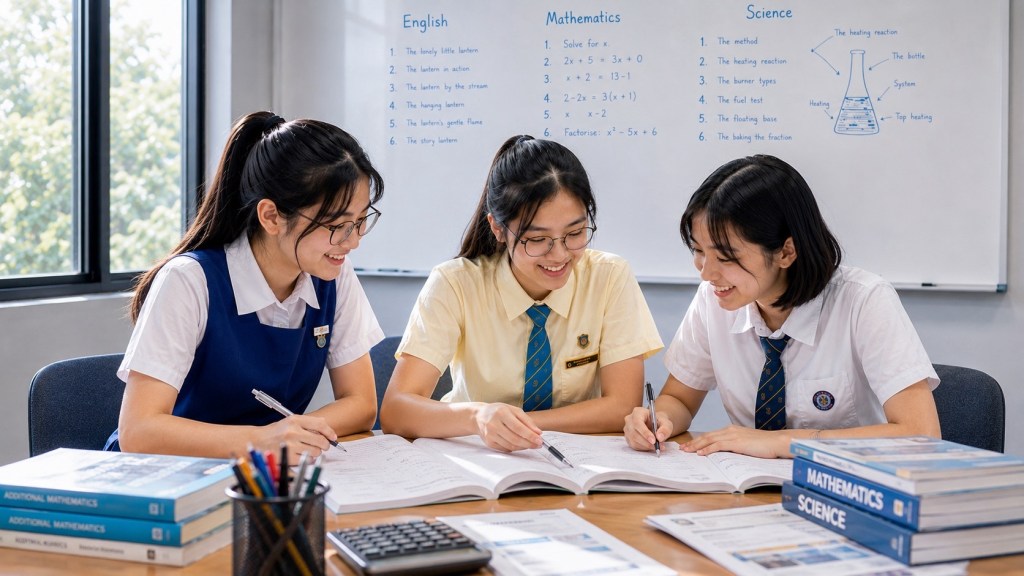
Secondary 1 Mathematics is one of the biggest mathematical transitions in school. Parents searching for Secondary 1 Mathematics tuition, Secondary 1 maths tuition in Sengkang, algebra help, negative numbers, equations or G1 G2 G3 Mathematics are often seeing the same shift: a child who could solve Primary 6 arithmetic now has to work with symbols, signed numbers, unfamiliar representations and faster topic changes.
The difficulty is not that Primary Mathematics suddenly becomes irrelevant. In fact, Secondary 1 exposes whether Primary foundations can survive abstraction. Fractions become algebraic coefficients, ratio becomes proportional reasoning, bar-model relationships become expressions and equations, and number lines extend into negative values.
For Sengkang and nearby Punggol families, the useful question is not whether the student should simply practise more algebra. It is which bridge has failed: signed numbers, fractions, equality, symbolic notation, method selection, graph reading or independent working.
Singapore’s Full Subject-Based Banding means Mathematics may be taken at G1, G2 or G3 subject level. The G1 Mathematics syllabus and the G2/G3 Mathematics syllabuses share a strong problem-solving architecture while differing in breadth, depth and abstraction.
Quick answer: why does Secondary 1 Mathematics feel hard?
Secondary 1 asks students to compress familiar numerical relationships into symbols and to choose methods with less chapter-level prompting.
- Negative numbers extend number sense beyond the Primary range.
- Algebra introduces letters as quantities and relationships.
- Equality becomes central to solving equations.
- Fractions and signed numbers appear inside algebraic expressions.
- Graphs require movement between table, coordinates, equation and visual representation.
- Geometry expects more precise property-based reasoning.
- Mixed practice removes the chapter cue that once told students what method to use.
- Students are expected to manage more independent revision and error correction.
The real transition is from arithmetic to generalisation
Primary Mathematics often asks for a specific numerical answer. Secondary Mathematics increasingly asks students to represent a general relationship.
If three identical bags each contain an unknown number of counters, Primary reasoning may draw three equal units. Secondary algebra compresses that same structure into 3x.
The letter is not a new kind of mysterious number. It is a symbol that allows a relationship to remain general.
Negative numbers are a hidden bottleneck
Many algebra errors are actually signed-number errors. A learner may know the equation method but lose the answer when subtracting a negative or multiplying different signs.
Diagnosis should therefore separate the two. Give the sign calculation without algebra. If the same error appears, repair the number foundation first.
Number lines are useful because they preserve magnitude and direction rather than turning signs into memorised chants.
Equality must be relational
Solving equations depends on understanding that both sides have the same value. If ‘=’ is still read as ‘the answer comes next’, algebra feels arbitrary.
Operations performed on one side must preserve the equality by being applied appropriately. This is why ‘move it across and change the sign’ can become dangerous shorthand when meaning is missing.
Teach balance first. The shorthand can come later.
Algebra should be read structurally
An expression such as 3x + 5 is not a string of symbols. It contains a term representing three copies of x and a constant amount of five.
Students should practise translating between words, diagrams, tables and algebra. The more representations they can connect, the less alien the symbols become.
This also improves word-problem setup because the learner can see where each part of the expression came from.
Fractions do not disappear
Secondary 1 students often discover that weak fraction knowledge now affects algebra. Simplifying expressions, substitution and equations can all require fraction control.
A learner who avoided fractions in Primary 6 may therefore feel that algebra is the problem when the actual dependency is earlier.
Targeted fraction repair is more efficient than reteaching the whole algebra chapter.
Graphs are another language
Graphs compress relationships visually. Students must read axes, scales, coordinates, trends and sometimes connect them to algebraic rules.
Teach movement among representations. A table can generate coordinates. Coordinates form a graph. A graph can reveal a pattern. The pattern can be expressed algebraically.
This reduces the tendency to treat graphs as pictures to copy.
Why mixed practice suddenly matters
A chapter exercise tells the student what type of Mathematics is being tested. A mixed test does not.
This introduces a new capability: discrimination. The learner must decide whether a problem is about algebra, proportion, geometry, statistics or another structure.
Blocked practice builds execution. Mixed practice builds selection. Secondary students need both.
Common Secondary 1 error patterns
- Correct equation setup, wrong final answer: signed-number or arithmetic control may be weak.
- Cannot turn words into algebra: representation translation needs practice.
- Can copy worked examples but cannot start alone: retrieval and method selection are weak.
- Graph plotted correctly but interpretation wrong: visual representation is disconnected from meaning.
- Fractions break algebra: repair the fraction prerequisite.
- Geometry errors from appearance: property-based reasoning needs strengthening.
- Homework is strong but tests are weak: compare support, notes, chapter cues and time pressure.
- Student says ‘I understand when teacher explains’: explanation recognition may be stronger than independent retrieval.
How to diagnose from a test script
- Find the first line where the mathematical route becomes wrong.
- Classify the cause: concept, prerequisite, representation, method selection, arithmetic, copying or timing.
- Look for the same cause in other questions.
- Repair the cause with a small targeted set.
- Retest using a fresh question without notes.
- Return the skill to mixed practice.
This is more useful than correcting every red mark independently.
Secondary 1 Mathematics tuition in Sengkang
The Secondary 1 Mathematics Tuition Sengkang page carries the local programme route. The broader Secondary G1, G2 and G3 Mathematics guide explains the full secondary pathway.
A three-student tutorial allows the tutor to see whether one learner needs signed-number repair, another needs algebraic translation and a third needs mixed-question selection.
The students can compare methods, but each must still produce independent working so the tutor can see what is genuinely understood.
A six-stage transition route
1. Audit Primary dependencies
Check fractions, percentage, ratio, operations and equality before blaming every error on Secondary content.
2. Stabilise signed numbers
Use number-line meaning and short retrieval until sign control no longer dominates attention.
3. Build algebra from representation
Translate between stories, diagrams, tables and expressions.
4. Mix topics
Remove chapter labels so the student must identify the mathematical structure.
5. Add delayed retrieval
Bring older topics back after several days or weeks.
6. Fade support
Reduce worked examples and tutor prompts until the student can start independently.
Frequently asked questions
Is Secondary 1 Mathematics mainly algebra?
No. Algebra is important, but students also work with number, geometry, measurement, statistics and probability according to their subject level.
Should a struggling student redo Primary 6?
Not wholesale. Identify the exact Primary dependency blocking current work and repair that piece.
Why does my child suddenly make sign mistakes?
Negative numbers add direction and signed operations. If the concept is new, the student’s old arithmetic habits need restructuring.
How can parents help without doing the work?
Ask the student to explain the relationship, identify the unknown and choose a representation. Avoid supplying the first algebraic step too quickly.
Continue the Advanced Mathematics Tutorials route
Use the Mathematics Hub for the full estate and continue next to the Secondary 2 Mathematics bridge, where algebra, ratio, graphs and upper-secondary preparation become more demanding.
