
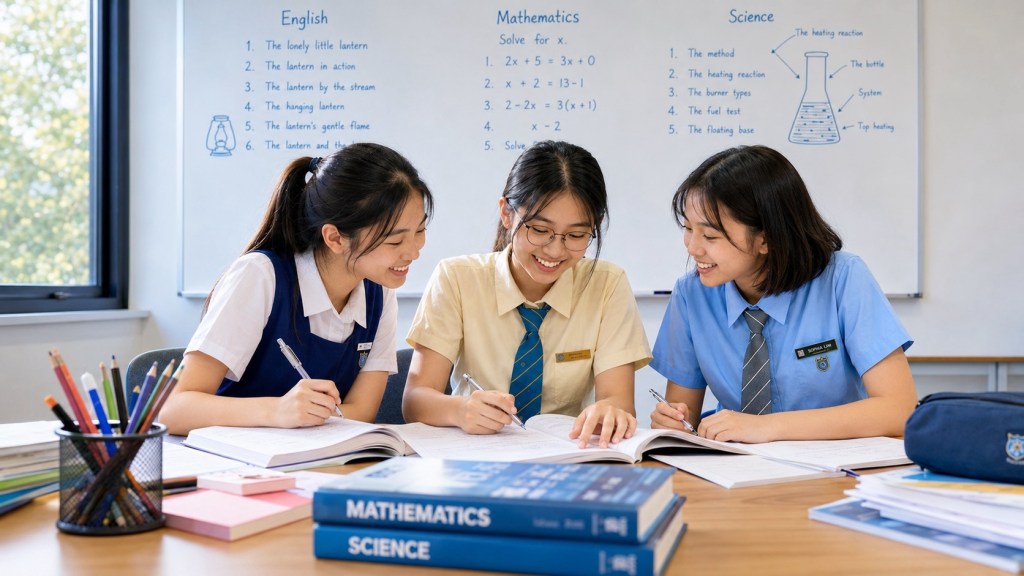
Secondary 1 Mathematics Tuition Sengkang: Building a Strong Foundation for Success
Secondary 1 Mathematics is not simply Primary 6 Mathematics with more difficult questions.
It is the beginning of a different way of thinking.
Students move from familiar numerical calculations into algebra, negative numbers, mathematical relationships, graphs, geometry and multi-step problem-solving. Questions become less direct. Working must become more organised. A student is expected not only to calculate an answer, but also to understand what the question is describing, select an appropriate method and present the solution clearly.
For some students, this transition feels natural.
For others, the first few chapters expose gaps that were previously hidden by memorised methods, repeated practice or familiar PSLE question formats. A child who once appeared comfortable with Mathematics may suddenly hesitate when letters replace numbers or when one question requires several concepts to be connected.
The purpose of Secondary 1 Mathematics Tuition in Sengkang is therefore not merely to help a student complete more worksheets. It is to build a dependable mathematical foundation while there is still enough time to correct weaknesses, establish better habits and prepare for the demands of upper-secondary Mathematics.
At eduKate Sengkang, we teach Secondary 1 students according to what they need next.
A student who is struggling is guided towards a clearer and more manageable route. A student who is already performing well is given wider and more demanding mathematical territory to explore.
The destination may be similar, but the best route is not always the same.
Secondary 1 Is the Beginning of a New Mathematical System
Primary Mathematics is often built around concrete quantities. Students work with numbers, fractions, percentages, ratios, measurements and visual models.
Secondary Mathematics becomes progressively more symbolic.
Instead of asking only:
What is the value?
students begin to ask:
What does this expression represent?
How are these quantities related?
Which rule applies here?
Can the same relationship be expressed in another form?
Why does this method work?
This is why algebra becomes such an important gateway.
In Primary School, a student may solve a problem using a model or arithmetic method. In Secondary 1, the same relationship may need to be represented using a variable, expression or equation.
For example:
- “A number increased by seven” becomes (x + 7).
- “Three times a number” becomes (3x).
- “The total cost of several identical items” becomes an algebraic expression.
- An unknown quantity must be found by forming and solving an equation.
The symbols may look simple, but the change in thinking is substantial.
A student must learn to move fluently between words, numbers, diagrams, tables, graphs and algebraic notation. When this translation is weak, Mathematics begins to feel confusing even when the individual calculations are not especially difficult.
A strong Secondary 1 programme should therefore teach students how mathematical ideas connect, not simply how to imitate a worked example.
Secondary 1 Mathematics Under Full Subject-Based Banding
Singapore’s secondary school system now operates under Full Subject-Based Banding. Students enter secondary school through Posting Groups 1, 2 or 3 and may study subjects such as Mathematics at G1, G2 or G3, depending on their starting profile, strengths and subsequent progress. MOE describes this structure as giving students greater flexibility to take subjects at different levels as they move through secondary school.
This makes the Secondary 1 year especially important.
A student’s present subject level should not be treated as a permanent description of ability. It is a starting point. What matters is whether the student develops the understanding, accuracy, discipline and confidence needed to handle increasingly demanding work.
From 2027, graduating students will sit for the Singapore-Cambridge Secondary Education Certificate, or SEC, with subjects reflected at their respective G1, G2 or G3 levels. SEAB has stated that the SEC will replace the former N(T), N(A) and O-Level certificates while maintaining the overall examination standards associated with the respective subject levels.
For a Secondary 1 student, this means that the work completed now contributes to a longer mathematical pathway.
The habits built in Secondary 1 affect:
- readiness for Secondary 2 Mathematics;
- confidence when topics become more interconnected;
- subject-level progression;
- suitability for Additional Mathematics later;
- performance in upper-secondary Mathematics;
- eventual preparation for the SEC years.
Tuition should therefore do more than help a student survive the next test. It should improve the student’s position for the years ahead.
Why Previously Strong Students Can Struggle in Secondary 1
A respectable PSLE Mathematics result does not always guarantee an easy transition into Secondary Mathematics.
The two stages reward overlapping but different strengths.
A student may have performed well in Primary School because the child was good at:
- recognising familiar question types;
- following standard methods;
- using model drawing effectively;
- remembering common procedures;
- practising until a pattern became familiar.
Secondary Mathematics places greater emphasis on:
- abstraction;
- symbolic manipulation;
- logical sequencing;
- mathematical communication;
- connecting multiple concepts;
- working accurately across several lines;
- choosing a method without being told which method to use.
This can create an unexpected situation.
A student may understand the general idea but lose marks through weak algebraic notation. Another may calculate well but misread the relationship described in the question. A third may know each chapter separately but struggle when a problem combines percentages, equations and geometry.
These are not necessarily signs that the student is “bad at Mathematics”.
They are signs that the student’s existing approach must be upgraded.
The Algebra Gate
Algebra is one of the most important transitions in Secondary 1 Mathematics because it becomes the language used throughout much of secondary school.
Students need algebra for:
- equations;
- formulae;
- coordinate geometry;
- graphs;
- functions;
- geometry;
- trigonometry;
- statistics;
- Additional Mathematics;
- many Science topics.
A weak algebra foundation does not remain inside one chapter. It follows the student into later topics.
Common early difficulties include:
- treating unlike terms as though they can be combined;
- losing negative signs;
- confusing multiplication with addition;
- mishandling brackets;
- skipping important working;
- moving terms without understanding inverse operations;
- substituting values incorrectly;
- forming an equation that does not match the question;
- believing that a letter always represents one fixed unknown;
- applying memorised rules without understanding their conditions.
These errors may initially appear small. Over time, however, they make more advanced Mathematics feel unnecessarily difficult.
Good Secondary 1 Mathematics tuition slows the process down at the right moment.
The tutor checks whether the student understands what each symbol means, why a step is valid and how one line of working leads to the next. Once the structure is clear, speed can be developed safely.
Accuracy first. Fluency next. Complexity after that.
What a Strong Secondary 1 Mathematics Foundation Looks Like
A strong foundation is not defined by completing the textbook early.
It is visible in the way a student thinks and works.
1. The student understands mathematical language
Words such as product, difference, factor, coefficient, multiple, consecutive, increase, decrease, at least and at most carry precise meanings.
A student who misreads one phrase may construct an entirely incorrect solution.
We teach students to pause, identify the mathematical relationship and translate the wording carefully before calculating.
2. Working is organised
Secondary Mathematics often contains several dependent steps. One careless line can affect everything that follows.
Students learn to:
- write one logical step at a time;
- align equations clearly;
- preserve signs and brackets;
- state units;
- label diagrams;
- show substitutions;
- check whether the final answer is reasonable.
Clear working is not cosmetic. It reduces cognitive load and makes errors easier to detect.
3. Arithmetic remains reliable
Algebra cannot compensate for weak arithmetic.
Students still require confidence with:
- integers;
- fractions;
- decimals;
- percentages;
- ratios;
- order of operations;
- estimation;
- basic number properties.
Where necessary, these foundations are repaired alongside the Secondary 1 syllabus rather than ignored.
4. Concepts can be connected
A capable student should be able to recognise that the same relationship may appear as:
- a sentence;
- a table;
- a diagram;
- an equation;
- a graph;
- a real-life problem.
The student begins to see Mathematics as one connected system rather than a collection of unrelated chapters.
5. The student can check independently
Strong students do not depend entirely on an answer key.
They learn to ask:
- Did I answer the actual question?
- Is the sign correct?
- Is the answer within a sensible range?
- Can I substitute the value back?
- Is there another method?
- Does the graph agree with the equation?
- Have I used the correct unit?
This habit of verification becomes increasingly valuable in upper secondary.
Different Students Need Different Mathematical Corridors
One of the weaknesses of generic tuition is that every student is placed on the same route.
The same worksheet is distributed. The same explanation is given. The same homework is assigned.
Yet students may be struggling for very different reasons.
One child has missing Primary School foundations. Another understands the concepts but works too carelessly. Another is bored because the work is too repetitive. A fourth student performs well in familiar exercises but becomes lost when questions are presented differently.
At eduKate Sengkang, the tutor looks for the earliest point at which the student’s mathematical thinking becomes unreliable.
The lesson is then adjusted from there.
For Students Who Are Struggling: Find a Better Route
A weaker student does not always need more difficult work.
The student often needs a clearer route through the existing work.
This may involve:
- revisiting essential fraction or integer skills;
- separating a complicated question into smaller decisions;
- reducing the number of new ideas introduced at once;
- using visual representations before symbolic notation;
- correcting one recurring misconception thoroughly;
- practising a core procedure until it becomes stable;
- teaching the student how to begin a question;
- rebuilding confidence through achievable progress.
The aim is not to make Mathematics permanently easier.
It is to remove the unnecessary confusion that prevents the student from reaching the proper level.
Consider a student who repeatedly fails algebraic word problems. The obvious response is to assign more word problems. Yet the true difficulty may be that the student cannot translate phrases into expressions.
Instead of repeating the whole question, the tutor may isolate the translation skill:
- What quantity is unknown?
- What does the letter represent?
- Which quantity changes?
- Which quantity remains fixed?
- Does “three more than (x)” mean (3x) or (x+3)?
- What equation matches the relationship?
Once the missing connection is repaired, the student can return to the larger problem with far greater control.
This is a better corridor: not a shortcut around learning, but a more intelligent route into it.
For Average Students: Strengthen the Main Road
Many Secondary 1 students are not failing. They are simply inconsistent.
They may understand lessons in class but make avoidable mistakes during tests. They may complete routine exercises but struggle with unfamiliar wording. They may know the method but require too much time to apply it.
These students need consolidation with precision.
Tuition should help them:
- identify recurring errors;
- improve the presentation of working;
- strengthen algebraic fluency;
- compare different solution methods;
- recognise question structures more quickly;
- practise mixed-topic questions;
- improve time management;
- retain earlier chapters while learning new ones.
The goal is to transform occasional understanding into dependable performance.
A student should not feel that every test depends on whether the “right questions” appear. The foundation should be broad enough for the student to respond calmly even when a question looks unfamiliar.
For Strong Students: Open Wider Corridors
A student who is already doing well should not spend every tuition lesson repeating work that has already been mastered.
Strong students require width.
They should encounter questions that ask them to:
- connect several ideas;
- explain why a method works;
- compare efficient and inefficient approaches;
- generalise from a pattern;
- work backwards from a result;
- detect hidden constraints;
- solve unfamiliar problems;
- justify conclusions;
- explore alternative representations;
- communicate solutions with greater elegance.
This does not mean rushing indiscriminately into upper-secondary chapters.
Acceleration without depth can create a student who has “seen” many topics but controls very few of them.
Instead, we deepen the quality of thought.
For example, a strong student learning linear equations may be asked not only to solve an equation, but also to:
- create an equation with a given solution;
- identify an error in someone else’s working;
- explain why the same operation must be performed on both sides;
- compare algebraic and graphical solutions;
- determine when an equation has no solution or many possible solutions;
- construct a real-life situation represented by the equation.
This wider corridor keeps capable students intellectually active while preparing them for the greater abstraction of Secondary 2, upper-secondary Mathematics and possible Additional Mathematics.
Tuition Should Not Flatten Students Into One Standard
The purpose of education is not to make every student move at an identical speed.
It is to help each student progress from the present position towards stronger mathematical independence.
For one student, success may begin with completing a page without freezing.
For another, it may mean moving from borderline marks to consistent passes.
For another, it may mean converting a B into an A by reducing careless errors.
For a high-performing student, it may mean learning to think beyond standard answer patterns and developing the maturity required for advanced Mathematics.
A good tutor pays attention to these differences without labelling the child permanently.
The student is not reduced to “weak”, “average” or “strong”. These are temporary descriptions of the student’s current relationship with particular skills.
A child may be strong in number work but weak in geometry. Confident in routine algebra but hesitant in problem-solving. Fast in mental calculations but disorganised on paper.
Teaching improves when the tutor can see these distinctions.
How Small-Group Secondary 1 Mathematics Tuition Helps
eduKate Sengkang conducts small-group tuition so that teaching remains personal without removing the benefits of learning alongside peers.
In a tightly managed group, the tutor can observe:
- how each student begins a problem;
- where hesitation appears;
- whether an error is conceptual or careless;
- whether working is properly organised;
- which student requires another explanation;
- which student is ready for an extension question.
This matters because two students can write the same incorrect answer for completely different reasons.
One misunderstood the concept.
One copied a sign incorrectly.
One rushed.
One used a Primary School method that no longer fits.
One understood the idea but could not express it algebraically.
The correction should match the cause.
Small groups also give students opportunities to hear alternative explanations and compare methods. A student may discover that a peer solved the same question more efficiently. Another may learn by explaining a method aloud.
The group remains small enough for close correction but active enough for mathematical discussion.
What Students Learn in Secondary 1 Mathematics Tuition
The precise sequence varies across schools, but a strong Secondary 1 programme commonly supports students in areas such as:
Numbers and numerical reasoning
Students strengthen their understanding of integers, rational numbers, factors, multiples, approximation, estimation and numerical operations.
The objective is not merely to calculate correctly. Students must recognise number relationships and make sensible decisions.
Algebraic expressions
Students learn how to represent unknown or changing quantities, simplify expressions, use brackets and substitute values accurately.
They also learn the difference between an expression, equation, identity and formula as these ideas develop.
Equations and problem-solving
Students form and solve equations, interpret solutions and connect algebraic procedures to the relationships described in a problem.
Ratio, rate and percentage
Earlier concepts are extended into less direct situations. Students must identify the appropriate reference quantity and manage several stages accurately.
Geometry and mensuration
Students reason with angles, shapes, perimeter, area and spatial relationships. Diagrams must be read carefully rather than treated as decoration.
Graphs and data
Students learn to interpret information presented in tables, charts, coordinates and graphs. They begin to understand how one representation can reveal a relationship more clearly than another.
Mathematical reasoning
Students practise identifying patterns, explaining conclusions, comparing methods and solving non-routine questions.
Across all topics, the tutor returns to the same central habits:
Read accurately.
Represent clearly.
Work logically.
Check independently.
The First Months of Secondary 1 Matter
The beginning of Secondary 1 is often busy.
Students are adapting to:
- a new school;
- new classmates;
- several subject teachers;
- new timetables;
- CCAs;
- longer school days;
- different assessment styles;
- greater personal responsibility.
Mathematical difficulty may not be immediately visible because the student is managing many changes at once.
Parents may hear:
“It is okay.”
“I understand.”
“We have not learned much yet.”
“The test was careless.”
“Everyone found it difficult.”
Occasional mistakes are normal. The concern arises when the same type of mistake keeps returning.
Early support is valuable because misconceptions are still small and relatively inexpensive to correct. A student who learns to manage algebra, notation and multi-step working in Secondary 1 enters Secondary 2 with a much healthier platform.
Waiting until upper secondary can mean repairing several years of accumulated habits while the student is simultaneously handling more demanding content.
The best time to strengthen a foundation is before the weight placed upon it becomes heavy.
Signs Your Child May Benefit From Secondary 1 Mathematics Tuition
Parents may consider additional support when a student:
- understands during lessons but cannot reproduce the method independently;
- takes unusually long to complete Mathematics homework;
- avoids showing working;
- makes frequent sign, bracket or copying errors;
- struggles to translate word problems into equations;
- depends heavily on worked examples;
- forgets earlier topics quickly;
- becomes anxious when a question looks unfamiliar;
- performs well in worksheets but poorly in timed assessments;
- says that the teacher moves too quickly;
- has lost confidence after entering Secondary 1;
- is doing well but no longer feels challenged.
Tuition does not have to begin only after a severe decline.
It can also be used to stabilise a student during transition, develop better study habits or provide appropriate extension for a capable learner.
How eduKate Sengkang Teaches Secondary 1 Mathematics
Our approach is built around a simple principle:
Teach the student in front of us, not an imaginary average student.
Diagnose before adding work
We first observe what the student can do independently.
A low score alone does not tell us enough. We look at the working, the sequence of decisions and the kinds of errors made.
Repair the earliest weak connection
When a current topic depends on an earlier skill, the earlier skill is addressed.
There is little value in repeatedly teaching equations when the student is still uncertain about negative numbers or basic fractions.
Teach concepts and procedures together
Students require both understanding and fluency.
Understanding without practice may remain slow and fragile. Practice without understanding may collapse when the question changes.
The two must develop together.
Correct while the thinking is visible
A tutor should not wait until an entire worksheet is completed incorrectly.
Close observation allows mistakes to be corrected while the student still remembers the reasoning that produced them.
Build independent working
Help is gradually reduced.
Students learn to annotate questions, plan solutions, select methods and check answers without waiting for constant prompts.
Extend students when the foundation is ready
Strong students receive deeper and more varied questions rather than unnecessary repetition.
The purpose is to expand mathematical judgement, not merely increase workload.
Tuition Is Most Effective When It Changes How a Student Studies
One tuition lesson each week cannot replace the student’s own thinking.
The lesson should improve what happens during the rest of the week.
Students are taught to maintain a practical study routine:
- Review the concept shortly after learning it.
- Complete a small number of questions attentively.
- Mark the work and identify the cause of each error.
- Redo incorrect questions without copying.
- Record recurring mistakes.
- Revisit older topics through mixed practice.
- Ask specific questions during tuition.
This is more effective than completing large quantities of work mechanically.
A correction is valuable only when the student understands what must change the next time a similar situation appears.
From Foundation to Future Possibility
Secondary 1 is not the final destination.
It is the year in which students begin building the mathematical machinery required for everything that follows.
A secure Secondary 1 foundation supports:
- stronger performance in Secondary 2;
- readiness for upper-secondary subject choices;
- smoother progression into more advanced algebra;
- confidence with graphs and geometry;
- possible preparation for Additional Mathematics;
- more effective study in Science and technical subjects;
- eventual SEC Mathematics preparation;
- access to a wider range of post-secondary pathways.
Not every student will choose the same destination.
That is precisely why a strong foundation matters. It preserves options.
A student who understands Mathematics well can make later decisions from a position of capability rather than avoidance.
Why Parents Choose Secondary 1 Mathematics Tuition at eduKate Sengkang
Parents are not simply looking for more homework.
They are looking for clarity.
They want to know that someone is watching how their child learns, identifying what is going wrong and responding before a temporary difficulty becomes a long-term pattern.
At eduKate Sengkang, we provide:
- closely guided small-group lessons;
- clear explanations;
- structured written methods;
- targeted correction;
- foundation repair where necessary;
- syllabus-aligned practice;
- extension for stronger students;
- preparation for later secondary demands;
- a calm environment in which students can ask questions properly.
There is no need to frighten a student into working harder.
Students improve when expectations are clear, mistakes are handled intelligently and progress becomes visible.
A struggling student needs to feel that there is a route forward.
A capable student needs to see that there is more territory ahead.
A good tutor provides both.
Frequently Asked Questions About Secondary 1 Mathematics Tuition in Sengkang
Is Secondary 1 Mathematics much harder than Primary 6 Mathematics?
The calculations may not always be dramatically harder at the beginning, but the style of thinking changes. Students encounter more symbolic notation, algebraic reasoning, multi-step solutions and unfamiliar representations.
Should my child start tuition before failing a test?
Tuition can be useful before marks decline significantly. Early support can help students adjust to secondary-school expectations, strengthen algebra and establish organised working habits.
Can tuition help a student taking Mathematics at G1, G2 or G3?
Yes. The teaching should reflect the student’s current subject level and actual learning needs. Mathematics is offered at G1, G2 and G3 under Full Subject-Based Banding, and students may have different strengths across different subjects.
What if my child is already doing well?
Strong students benefit when tuition provides greater depth, unfamiliar applications and more demanding reasoning rather than simple repetition. The aim is to widen their mathematical capability and prepare them for later challenges.
Does my child need to take Additional Mathematics later?
Not every student will take Additional Mathematics. However, strong foundations in algebra, equations, graphs and mathematical reasoning will place the student in a better position if Additional Mathematics becomes an appropriate option.
How quickly will my child improve?
Progress depends on the student’s starting point, consistency and willingness to correct established habits. Some errors can be repaired quickly. Deeper gaps require patient reconstruction. The important measure is whether the student is becoming more accurate, independent and confident over time.
Is small-group tuition suitable for a shy student?
Small groups can provide a comfortable balance. Students receive personal attention without the intensity of being the only learner in the room. The tutor can invite participation gently and observe the student’s work closely.
Secondary 1 Mathematics Tuition Sengkang: Start With the Right Foundation
Secondary 1 is a valuable year because there is still time.
Time to correct.
Time to strengthen.
Time to build confidence.
Time to help a student discover that difficulty does not mean inability.
The right tuition does not force every child down the same narrow road. It studies where the student is standing and opens the next useful route.
For a weaker student, that route may lead back to a missing foundation before moving forward again.
For an average student, it may create greater stability, accuracy and independence.
For a strong student, it may open wider corridors towards advanced problem-solving, Additional Mathematics and future academic possibilities.
At eduKate Sengkang, our aim is to help every Secondary 1 student build Mathematics properly: with calm explanations, close correction, intelligent practice and a clear sense of direction.
Less confusion. Better structure. Stronger Mathematics.
Speak to eduKate Sengkang about Secondary 1 Mathematics Tuition in Sengkang and find the learning route that suits your child’s present needs and future potential.
Mathematics is a subject that forms the foundation of many critical thinking and problem-solving skills, especially for students entering Secondary 1. At this crucial stage, students encounter more complex mathematical concepts, making it essential to solidify their understanding early on. Secondary 1 Mathematics tuition in Sengkang offers the support students need to master these concepts and build confidence as they transition to higher-level math.
In this article, we’ll explore the benefits of Secondary 1 Mathematics tuition in Sengkang, how personalized small-group lessons can make a difference, and the long-term advantages of developing a strong math foundation early.
Why Choose Secondary 1 Mathematics Tuition in Sengkang?
As students move from primary to secondary school, they are faced with a more challenging curriculum that requires a deeper understanding of mathematical concepts. Sengkang Mathematics tuition centers are specifically designed to address these needs by providing specialized teaching techniques to help students navigate the new syllabus confidently. Here are some key reasons to consider Secondary 1 Mathematics tuition in Sengkang:
- Focused Curriculum Support: Sengkang tuition centers align their teaching with the MOE Secondary 1 Mathematics syllabus, ensuring students receive relevant and effective instruction tailored to the school’s curriculum.
- Experienced Tutors: With experienced tutors leading the lessons, students benefit from clear explanations, step-by-step problem-solving guidance, and expert strategies that are proven to improve math performance.
- Small Group Learning: Small group tuition allows for more individualized attention. Students can ask questions freely and receive targeted help on specific topics they may find challenging, ensuring a stronger grasp of mathematical concepts.
Benefits of Secondary 1 Mathematics Tuition
There are several key benefits of enrolling your child in Secondary 1 Mathematics tuition in Sengkang:
- Enhanced Understanding of Key Concepts: Secondary 1 math introduces a range of new topics, including algebra, geometry, and number theory. Our tuition programs focus on ensuring that students fully understand these concepts by breaking down complex problems into more manageable parts.
- Improved Problem-Solving Skills: Mathematics is all about problem-solving. In our Sengkang tuition classes, we emphasize critical thinking and logical reasoning to help students tackle various types of math questions effectively.
- Building Confidence: Transitioning to secondary school can be intimidating for many students, especially when faced with a challenging subject like math. Our tutors provide encouragement and support, building students’ confidence as they learn to handle more complex math problems with ease.
- Consistency and Practice: Regular practice is essential for success in math. Our tuition sessions ensure that students practice consistently, reinforcing their understanding and preparing them for exams.
How Secondary 1 Mathematics Tuition in Sengkang Prepares Students for Success
At eduKate Sengkang, our Secondary 1 Mathematics tuition program is structured to help students achieve long-term academic success. Our tutors take a systematic approach to cover all core topics, ensuring that students not only perform well in school but also develop the critical thinking skills necessary for future mathematics challenges.
Here’s how we prepare students:
- Comprehensive Curriculum Coverage: Our tutors cover the entire MOE Secondary 1 Mathematics syllabus, including algebra, linear equations, ratios, and geometry, ensuring students understand each topic thoroughly.
- Focus on Exam Preparation: We integrate exam-style questions and regular practice papers into our lessons, so students are familiar with the types of questions they will face in school exams. By doing this, we reduce exam anxiety and improve time management during assessments.
- Interactive Lessons: Students engage with the material through interactive lessons, where they participate in problem-solving activities and receive real-time feedback from their tutor. This ensures active learning and retention of concepts.
- Tailored Feedback: Our tutors provide personalized feedback after every lesson, identifying areas where students may need more focus or additional practice. This targeted approach ensures no learning gaps are left behind.
The Importance of a Strong Math Foundation
The transition from primary school to secondary school is a pivotal time in a student’s academic journey. Secondary 1 Mathematics serves as a stepping stone for more advanced topics that will be covered in higher levels, such as Secondary 2, O-Levels, and beyond. By building a strong foundation early, students are better prepared to tackle these future challenges confidently.
- Advanced Mathematical Thinking: A solid foundation in Secondary 1 math helps students develop analytical skills that are critical for success in both mathematics and other subjects like science and technology.
- Preparation for Higher-Level Mathematics: The concepts learned in Secondary 1 lay the groundwork for more advanced mathematics in Secondary 2 and beyond. Mastery of these foundational topics will make it easier for students to grasp more complex subjects such as calculus, trigonometry, and algebraic functions.
- Problem-Solving in Real Life: Mathematics teaches students how to approach and solve problems logically. These skills are not only important in academics but are also highly valuable in everyday life and future careers.
Choosing the Best Secondary 1 Mathematics Tuition in Sengkang
When selecting a Secondary 1 Mathematics tuition center in Sengkang, there are several factors to consider:
- Tutor Qualifications: Look for tutors who have strong qualifications and experience in teaching secondary-level math. This ensures your child will receive expert guidance that is tailored to their needs.
- Class Size: Opt for centers that offer small group classes. Smaller class sizes provide a more personalized learning experience, allowing tutors to focus on individual student needs and provide targeted assistance.
- Teaching Approach: Choose a center that emphasizes conceptual understanding and problem-solving skills, not just rote learning. This ensures that students develop a deep understanding of math that will serve them in the long run.

Typical Course Outline for Secondary 1 Mathematics Tuition GCE O-Level Requirements at Sengkang (EduKate)
At EduKate Singapore, our Secondary 1 Mathematics Tuition is carefully designed to align with the foundational requirements needed for success in future SEAB GCE O-Level examinations. This course focuses on helping students build a strong mathematical foundation, developing problem-solving skills, and preparing them for the increased academic challenges in the later years of secondary school.
Course Objectives:
- Develop a deep understanding of key mathematical concepts introduced in Secondary 1.
- Build strong problem-solving and analytical skills that align with the GCE O-Level syllabus.
- Prepare students for future math topics covered in higher secondary levels.
- Reinforce foundational math topics that will be revisited in greater depth during the GCE O-Level years.
- Provide consistent practice to help students master math concepts and excel in exams.
Course Structure:
1. Algebraic Expressions and Equations
- Introduction to algebraic terms, constants, and variables.
- Simplifying algebraic expressions, including factorization and expansion.
- Solving linear equations with one variable.
- Applying algebra to real-world problem-solving scenarios.
2. Geometry and Measurement
- Understanding basic geometric shapes: angles, triangles, quadrilaterals.
- Properties of parallel lines and polygons.
- Introduction to the Pythagorean theorem.
- Calculating the perimeter, area, and volume of different shapes (including composite figures).
- Using geometry in practical problems (e.g., construction-related problems).
3. Ratio, Proportion, and Rate
- Understanding ratios and proportions.
- Solving direct and inverse proportion problems.
- Introduction to speed, rate, and time calculations.
- Applications in real-life situations such as travel and business problems.
4. Statistics and Data Handling
- Introduction to statistical data collection and interpretation.
- Drawing and interpreting bar graphs, pie charts, and line graphs.
- Understanding mean, median, mode, and range.
- Use of data analysis to solve real-world problems.
5. Number Theory and Arithmetic
- Mastering the number system, including integers, fractions, decimals, and percentages.
- Operations with positive and negative numbers.
- Prime factorization, greatest common divisors (GCD), and least common multiples (LCM).
- Applying arithmetic to solve percentage, discount, and tax-related problems.
6. Linear Graphs and Equations
- Plotting points on the Cartesian plane.
- Drawing and interpreting linear graphs.
- Understanding gradients and y-intercepts.
- Solving simultaneous equations graphically.
- Real-world applications of linear graphs (e.g., financial forecasting, engineering problems).
7. Introductory Set Theory
- Basic understanding of sets, subsets, unions, and intersections.
- Use of Venn diagrams to represent and solve problems involving sets.
- Applications of set theory in probability and real-world problem-solving.
8. Introduction to Basic Trigonometry (for advanced students)
- Understanding sine, cosine, and tangent ratios.
- Solving basic right-angle triangle problems using trigonometry.
- Application in real-life problems, such as measuring heights and distances.
Examination Preparation:
1. Practice and Review
- Regular mock tests to simulate school and O-Level style exam conditions.
- Detailed review sessions following each test, focusing on areas where students need improvement.
- Use of past exam papers to familiarize students with exam formats and time management strategies.
2. Time Management Techniques
- Teaching students how to manage their time effectively during exams.
- Strategies for tackling different types of questions (short-answer, multiple-choice, problem-solving).
3. Error Analysis and Feedback
- Detailed feedback after every practice session, helping students understand their mistakes.
- Ongoing assessments to track progress and ensure mastery of concepts.
Learning Methods:
- Interactive Lessons: Our tuition sessions focus on interactive learning, where students actively engage with the material through problem-solving exercises, group work, and discussions.
- Small Group Focus: The small group tuition model ensures personalized attention and the opportunity for students to clarify doubts and ask questions freely.
- Continuous Support: Students are provided with additional practice materials, including worksheets, quizzes, and exam-type questions, with constant tutor support to address any difficulties.
Additional Features:
1. Extra Support and Homework Help: Students can approach tutors for one-on-one consultations and homework assistance outside of regular class hours.
2. Progress Tracking: Regular progress reports are provided to parents, ensuring they are kept informed of their child’s development.
3. Technology-Aided Learning: Interactive tools and digital resources are used to enhance the learning experience, making lessons engaging and effective.
Strategies to Improve Secondary 1 Mathematics Tuition in Sengkang
To ensure that Secondary 1 Mathematics tuition in Sengkang provides optimal support and results for students, continuous improvement and strategic approaches are essential. Here are several effective strategies that can enhance both teaching and learning experiences, making the program even more impactful:
1. Personalized Learning Plans
- Assess Individual Needs: Each student has unique strengths and weaknesses in mathematics. Conducting regular assessments at the beginning of the course helps identify areas where students need more support. Developing customized learning plans ensures that each student receives targeted instruction that addresses their specific gaps.
- Adaptive Lessons: Based on student progress, adjust the difficulty and pace of lessons to meet their learning speed and comprehension. This ensures students are neither overwhelmed nor under-challenged.
2. Incorporating Technology for Interactive Learning
- Mathematical Software and Apps: Use technology, such as math apps or interactive software, to engage students and provide them with more hands-on learning experiences. Tools like graphing calculators, GeoGebra, or online math games make abstract concepts more tangible and fun.
- Online Practice and Feedback: Provide students with access to online platforms for additional practice outside of tuition sessions. These platforms can offer instant feedback on performance, helping students self-correct and improve faster.
3. Focus on Conceptual Understanding, Not Just Rote Learning
- Problem-Solving Skills: While it is important for students to memorize formulas, the focus should be on understanding the underlying concepts. Encourage students to approach problems by understanding the logic behind the steps. This deepens their grasp of mathematical principles, making it easier to apply them in varied situations.
- Real-World Applications: Link math concepts to real-life scenarios. For example, when teaching geometry, relate it to architecture or design, or use algebra in financial literacy lessons. This makes learning more relevant and engaging for students.
4. Regular Progress Tracking and Feedback
- Frequent Assessments: Implement regular quizzes and tests to track student progress. These short assessments allow both the tutor and student to see how well they have understood the material and highlight areas that need more focus.
- Detailed Feedback Sessions: After each assessment, provide detailed feedback to students. Focus on the reasons behind their mistakes and offer clear explanations on how to improve. Encourage students to reflect on their mistakes and think about how to approach similar problems differently in the future.
5. Structured Revision and Mock Tests
- Regular Revision Sessions: Organize weekly or bi-weekly revision sessions where students can revisit key concepts and solve a range of practice questions. This helps reinforce their knowledge and ensures that previously learned material is not forgotten.
- Mock Exams with Time Management: Conduct mock tests in a timed environment to simulate exam conditions. This prepares students for the pressure of timed assessments and teaches them how to manage their time effectively during exams.
6. Group Learning and Peer Collaboration
- Small Group Discussions: Encourage group discussions where students can solve problems together. Peer collaboration helps reinforce concepts, as students often learn well by explaining ideas to one another.
- Math Competitions or Challenges: Organize small challenges or friendly competitions within the tuition group. This motivates students to push themselves while making learning enjoyable and engaging.
7. Focus on Exam Strategies
- Question Analysis Techniques: Teach students how to break down complex questions into simpler components. Often, students struggle with the way questions are framed rather than the actual math itself. By teaching question analysis techniques, students can understand what is being asked and approach the problem confidently.
- Marking Scheme Familiarity: Familiarize students with the MOE GCE O-Level marking schemes early on. This allows them to maximize their scores by understanding how marks are awarded for each part of the question.
8. Enhance Teacher-Student Communication
- Open Communication Channels: Encourage students to ask questions freely, both during and outside of class time. Use communication platforms such as WhatsApp or email, where students can clarify doubts and receive timely feedback.
- Tutor Office Hours: Set aside designated hours each week where students can schedule one-on-one sessions for additional help or in-depth explanations on challenging topics.
9. Encourage a Growth Mindset
- Positive Reinforcement: Celebrate small wins and improvements, not just exam scores. By acknowledging effort and progress, students become more motivated and confident in their abilities.
- Overcoming Math Anxiety: Many students struggle with math anxiety, which affects their performance. Encourage students to view mistakes as part of the learning process and help them develop resilience and perseverance when facing difficult problems.
10. Parental Involvement and Regular Updates
- Parent-Tutor Collaboration: Regularly update parents on their child’s progress, challenges, and achievements. By keeping parents informed, they can reinforce learning at home and support their child’s math journey.
- Workshops for Parents: Hold occasional workshops for parents to help them understand the math curriculum and how they can assist their children in their studies at home.
11. Supplementary Materials and Homework Assignments
- Customized Worksheets: Provide additional worksheets and practice papers that are aligned with the Secondary 1 MOE syllabus. These can serve as supplementary materials for students to work on during their own time.
- Homework for Reinforcement: Assign regular homework that covers both current lessons and past topics. This consistent practice outside of tuition sessions helps students reinforce their understanding and stay prepared for school tests.
Building a Path to Success
Implementing these strategies within Secondary 1 Mathematics tuition in Sengkang can significantly enhance student performance. By focusing on personalized learning, conceptual understanding, frequent feedback, and exam strategies, students will be better equipped to tackle more complex mathematical challenges as they progress through secondary school. Encouraging active participation, consistent practice, and a positive mindset will help students build the confidence they need to excel not only in Secondary 1 but in future GCE O-Level examinations as well.
Conclusion: Empower Your Child’s Mathematical Journey
The Secondary 1 Mathematics Tuition at EduKate in Sengkang provides a comprehensive program designed to align with future GCE O-Level requirements, offering students the support and skills they need to excel in secondary school and beyond. By focusing on foundational concepts and continuous practice, students are well-prepared for the challenges of higher-level math, building a strong base for future academic success.
Enrolling your child in Secondary 1 Mathematics tuition in Sengkang is a proactive step toward ensuring their success in one of the most important subjects in their academic career. With eduKate Singapore, your child will benefit from personalized attention, expert tutoring, and a comprehensive curriculum that will help them excel in math.
By mastering key concepts and building a solid foundation in Secondary 1, students will be well-prepared for future challenges and confident in their mathematical abilities.

