
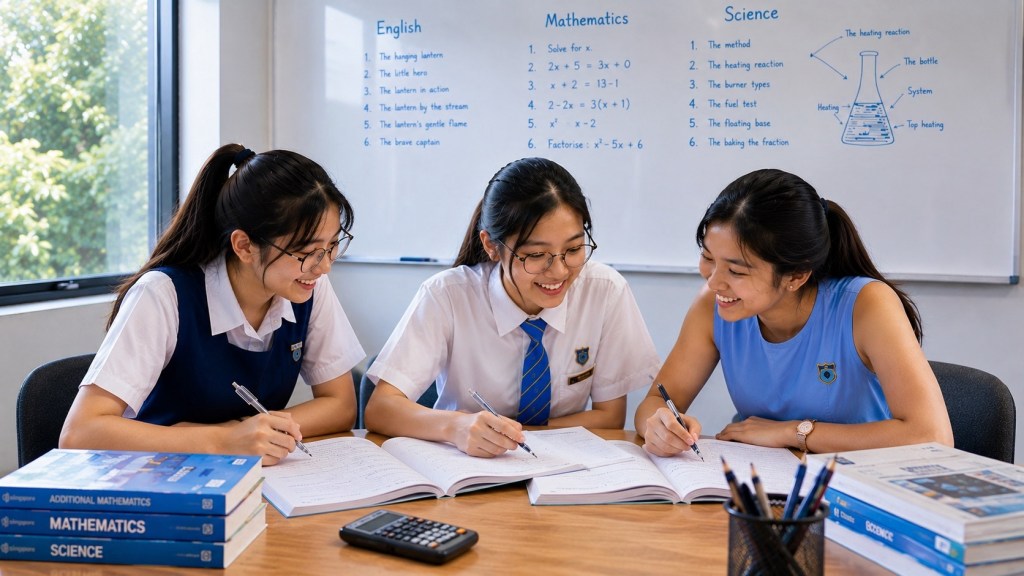
Secondary 2 Mathematics is the bridge year between the Secondary 1 reset and the heavier demands of upper-secondary Mathematics. Parents searching for Secondary 2 Mathematics tuition, Secondary 2 maths tuition in Sengkang, algebra help, ratio, graphs, geometry or preparation for Secondary 3 are usually noticing that procedures alone are no longer enough.
The student must now coordinate algebraic manipulation, proportional reasoning, graphs, geometry, statistics and problem solving while retaining earlier number skills. Questions become less dependent on one obvious template, and weak foundations begin to compound if they are not repaired.
For Sengkang and nearby Punggol families, Secondary 2 is therefore an important diagnostic year. It is early enough to repair signed numbers, fractions, equations and representation, but late enough that these gaps will soon affect upper-secondary G2/G3 Mathematics and, for students who take it, Additional Mathematics.
Under Full Subject-Based Banding, Mathematics may be studied at G1, G2 or G3 level. The G1 syllabus and G2/G3 syllabuses share the broad strands of Number and Algebra, Geometry and Measurement, and Statistics and Probability.
Quick answer: what should Secondary 2 Mathematics accomplish?
Secondary 2 should turn foundational algebra into a usable language and make proportional, graphical and geometrical reasoning stable enough for upper-secondary work.
- Manipulate algebraic expressions with meaning, not only rules.
- Solve equations while preserving equality.
- Use ratio and proportion flexibly in unfamiliar contexts.
- Move between tables, coordinates, graphs and equations.
- Read geometry diagrams through properties rather than appearance.
- Interpret data and probability with correct language.
- Choose methods under mixed practice.
- Repair prerequisite gaps before upper-secondary content accelerates.
Algebra should become fluent but still meaningful
Secondary 1 introduces the language. Secondary 2 requires greater fluency. Students expand, factorise, simplify and solve while carrying signs, fractions and coefficients accurately.
Fluency should not be built through blind symbol movement. Each transformation should preserve equivalence.
A student who can explain why two expressions are equivalent is more robust than one who remembers only a sequence of steps.
Factorisation and expansion are inverse structures
Expansion rewrites a product as a sum. Factorisation rewrites a sum as a product. Teaching them together reduces the feeling that they are unrelated chapters.
For example, 3(x + 4) and 3x + 12 are the same expression in different forms. The useful form depends on the task.
This representation choice becomes increasingly important in Additional Mathematics and later algebra.
Equations require balance
Solving an equation means finding a value that makes both sides equal. The balance interpretation remains the safest conceptual base.
Students should verify solutions by substitution when practical. This creates an independent check rather than relying on confidence in the original manipulation.
If equation errors are actually sign or fraction errors, repair those prerequisites directly.
Ratio and proportional reasoning
Ratio is not confined to Primary Mathematics. Secondary problems use proportional reasoning in scale, rates, finance, graphs and real-world contexts.
The learner should understand equivalent ratios, unit rates and the idea that multiplicative relationships differ from additive ones.
A useful diagnostic is to ask whether doubling one quantity should double the related quantity. The answer depends on the relationship, and the student should be able to explain why.
Rates and unit consistency
Rate problems compare quantities with different units. Speed, cost per unit and other real-world contexts require careful unit control.
Students should write units through the working when conversion is involved. A formula without unit awareness can produce a numerically correct-looking but meaningless answer.
Estimation should remain active as a reasonableness check.
Graphs: representation flexibility
Graphs are not isolated drawings. They show relationships that can also appear in tables, coordinate pairs and equations.
Strong students move among these forms. If a table changes at a constant rate, the learner should see how that pattern might appear in a graph and how an equation could encode it.
This flexibility prepares students for more advanced functions later.
Gradient and change
When students encounter linear relationships, gradient describes how one quantity changes relative to another.
The concept should be tied to rate of change rather than memorised only as a formula. Rise over run is meaningful because it compares changes in vertical and horizontal quantities.
Context gives the gradient units and interpretation.
Geometry requires justification
Secondary geometry becomes less about naming shapes and more about using properties and relationships to justify conclusions.
Students should mark only what is known, identify angle or length relationships and state the reason for each inference when required.
The diagram should support reasoning, not replace it.
Statistics: calculate and interpret
Averages, spread and graphical displays require more than arithmetic. Students should ask what a statistic represents and what information it hides.
A mean can change because of an outlier. Two groups can have the same average but different distributions.
Interpretation language should become precise enough to avoid claiming more than the data support.
Probability: likelihood, not certainty
Probability describes uncertainty. A probability of one-half does not guarantee an alternating sequence of success and failure.
Students should distinguish theoretical probability from a small sample of observed outcomes.
This develops a more mature understanding of chance before upper-secondary statistics.
Why mixed practice is a Secondary 2 necessity
By Secondary 2, chapter-by-chapter practice is not enough. Students must identify the mathematical structure before selecting a method.
A mixed set can include algebra, ratio, graphs and geometry. The cognitive task is different: first classify, then execute.
This is exactly the capability later examinations demand.
Common Secondary 2 error patterns
- Algebra steps look correct until signs appear: signed-number control remains weak.
- Factorisation works only in familiar layouts: pattern recognition is too narrow.
- Ratio formula applied without understanding units: proportional meaning needs repair.
- Graph is drawn but not interpreted: visual and algebraic representations are disconnected.
- Geometry answer lacks reasons: justification structure is weak.
- Statistics calculated correctly but conclusion is wrong: interpretation needs training.
- Good topical work, weak tests: method selection and retrieval are the likely bottlenecks.
- Student needs the first hint on every hard question: independent starting routines need development.
The prerequisite-repair rule
Do not send a Secondary 2 learner back through every earlier textbook because one topic is weak. Find the smallest earlier dependency that blocks current work.
If algebra fractions fail because ordinary fractions are unstable, repair fraction operations. If graphs fail because coordinates are weak, repair coordinates.
The goal is re-entry into current learning, not a complete restart.
Preparing for upper secondary
Secondary 3 usually increases the depth and pace of algebra, graphs, geometry, trigonometric or statistical reasoning depending on the subject level and course.
Students considering Additional Mathematics especially benefit from stable algebraic manipulation, fractions, equations and function thinking.
Preparation should therefore deepen current foundations rather than simply preview later formulas.
Secondary 2 Mathematics tuition in Sengkang
The Secondary 2 Mathematics Tuition Sengkang page carries the local programme route. The G1/G2/G3 Mathematics parent guide explains how the subject levels fit together.
In a three-student tutorial, one learner may need algebraic accuracy, another ratio reasoning and another graph interpretation. The tutor can keep a shared mathematical theme while differentiating the repair.
Individual working remains visible, which is important because a correct final answer can hide a fragile method.
A Secondary 2 study cycle
Retrieve
Begin with short recall of older algebra, number and geometry without notes.
Learn
Use worked examples to expose the structure of the current method.
Practise
Complete enough similar items for accurate execution.
Mix
Blend topics so the learner must choose the method.
Transfer
Change context, wording or representation.
Retest
Return after a delay and check whether the skill remains independent.
How parents can read progress
Progress can appear before large mark jumps. Look for cleaner algebraic lines, fewer sign errors, faster starts, better use of diagrams and stronger explanations.
These process improvements reduce the mechanisms that leak marks later.
The goal by the end of Secondary 2 is not perfection. It is a mathematical system stable enough to carry greater upper-secondary load.
Frequently asked questions
Is Secondary 2 too early for exam technique?
Basic time awareness, checking and mixed practice can begin, but content understanding and method selection remain the priority.
Should my child prepare for A-Math in Secondary 2?
If A-Math is a likely pathway, strengthen algebra, fractions, equations, graphs and symbolic fluency. Deep foundations are more valuable than shallow acceleration.
Why can my child do algebra homework but fail algebra tests?
Homework may contain chapter cues, examples and more time. Tests add retrieval, selection and pressure. Compare the conditions before concluding the knowledge disappeared.
What should tuition add?
Diagnosis, targeted prerequisite repair, carefully varied practice, immediate feedback and a path toward independent work.
Continue the Advanced Mathematics Tutorials route
Read Secondary 1 Mathematics: Why the Primary 6 to Algebra Transition Feels Hard before this article, then continue through the Mathematics Hub into Secondary 3, Secondary 4 and Additional Mathematics.
