
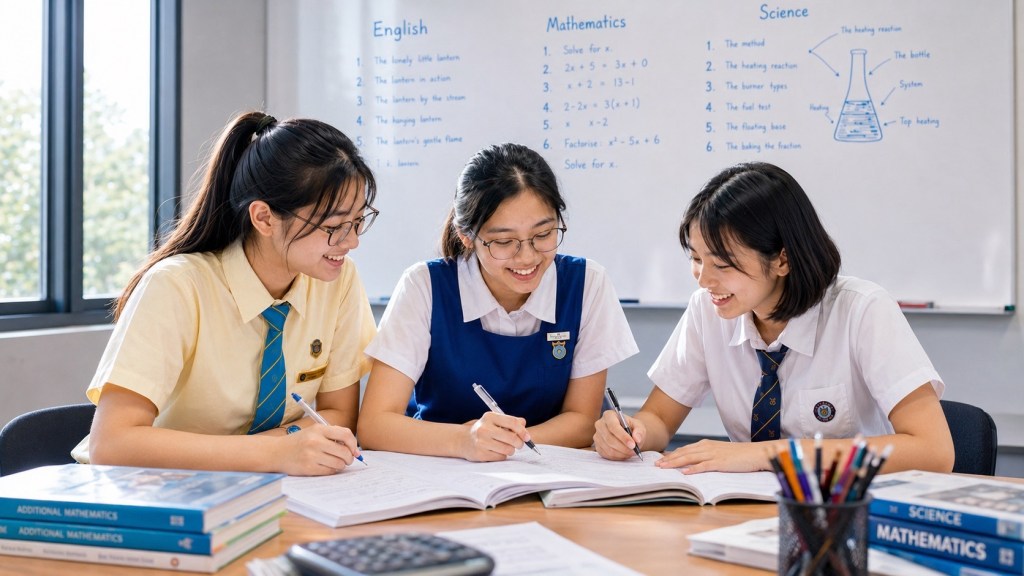
Secondary Mathematics changes the learning game. Parents searching for Secondary Mathematics tuition, G1 Mathematics, G2 Mathematics, G3 Mathematics, algebra tuition or Mathematics tuition in Sengkang are often reacting to the same moment: the child who managed Primary Mathematics now meets a subject that uses more symbols, expects more independent method selection and moves rapidly between number, algebra, geometry, statistics and real-world applications.
The useful response is not to treat G1, G2 and G3 as labels of ability. They are subject levels with different curricular demands, and a learner can need different kinds of support at different stages. The practical question is: what Mathematics does this student need to understand, what prerequisite is missing, what type of reasoning is being assessed and what practice will make the skill survive beyond one familiar worksheet?
This Advanced Mathematics Tutorials guide is written for parents in Sengkang and nearby Punggol who want to understand the secondary Mathematics pathway before deciding whether extra support is needed. It combines curriculum structure, algebra foundations, problem solving, revision, error diagnosis, subject-level transitions and the small-group teaching decisions that matter when students are preparing for the new Singapore-Cambridge Secondary Education Certificate landscape.
Singapore’s Full Subject-Based Banding system allows subjects to be offered at G1, G2 and G3 levels. From the 2027 graduating cohort, the existing N(T), N(A) and O-Level certificates are combined into the Singapore-Cambridge Secondary Education Certificate (SEC), with the certificate reflecting the subjects and subject levels taken. For Mathematics, this means parents should pay close attention to the level-specific syllabus while still recognising that strong mathematical habits travel across all three pathways.
Quick answer: what changes from Primary Mathematics to Secondary Mathematics?
Primary Mathematics builds arithmetic and model-based problem solving. Secondary Mathematics increasingly asks students to generalise, represent relationships symbolically, choose methods independently, connect topics and communicate enough working for the reasoning to be visible.
- Numbers become more abstract: negative numbers, indices, standard form and algebraic quantities enter the picture.
- Arithmetic becomes algebra: students operate on expressions, equations, formulae and functions.
- Diagrams become proof-bearing objects: angles, similarity, congruence, mensuration and coordinate relationships demand precise interpretation.
- Data becomes analytical: statistics and probability require more than reading a graph.
- Questions become less templated: students must decide which concept applies instead of being told by chapter title.
- Working matters: a correct final answer with weak or missing reasoning can be difficult to credit fully in structured work.
- Transfer matters: the same mathematical idea may appear in an unfamiliar context, representation or multi-topic problem.
- Self-regulation matters: students must recover from a stuck question, manage time and decide when to check or move on.
What G1, G2 and G3 Mathematics share
MOE’s current G1 Mathematics syllabus and the combined G2/G3 Mathematics syllabuses organise the subject around three broad content strands: Number and Algebra, Geometry and Measurement, and Statistics and Probability. Across levels, the syllabuses also emphasise problem solving, reasoning, communication, application, metacognition and connections between Mathematics and real-world contexts.
That shared architecture matters for parents. A child moving between subject levels is not entering a completely different subject. The mathematical spine remains recognisable. What changes is the breadth, depth, abstraction, pace and demand placed on the learner.
The practical teaching implication is that tuition should not simply hand a G1 learner easier worksheets, a G2 learner medium worksheets and a G3 learner harder worksheets. The tutor needs to know which mathematical idea is being developed and how far the level expects that idea to travel.
G1 Mathematics: practical competence with real mathematical structure
The G1 Mathematics syllabus explicitly emphasises mathematical concepts and skills for real life, reasoning, communication, application, metacognition and informed decision-making. That makes practical context important, but practical does not mean intellectually shallow.
A G1 learner still needs structure. Percentages must connect to proportion. Algebraic notation must represent relationships rather than look like arbitrary letters. Measurement must carry units and reasonableness. Graphs must communicate quantities and trends. Finance contexts such as bills, instalments, money exchange and interest require careful interpretation.
One common mistake is to over-simplify G1 instruction into repeated procedures. That can produce short-term completion but weak transfer. If the student learns only ‘use this formula when you see this worksheet’, the knowledge disappears when the question is presented as a household bill, transport schedule or unfamiliar diagram.
A stronger G1 route keeps the real-life context while making the mathematical relationship explicit. The learner should know what is changing, what remains fixed, what quantity is unknown, what unit belongs to the answer and why a particular operation is sensible.
G2 Mathematics: the bridge between practical structure and greater abstraction
G2 Mathematics typically requires a stronger bridge from arithmetic into algebraic and multi-step thinking. Students must become increasingly comfortable with symbolic manipulation while still applying Mathematics to real contexts.
At this level, a learner who relied heavily on recognition in Primary school can struggle. A chapter title may have told the child what to do before. Mixed secondary practice does not. The student must identify the mathematical structure without that cue.
The transition is often visible in algebra. A child may understand 3 boxes each containing 5 objects, but hesitate when the same relationship is written as 3x. The mathematics has not suddenly become impossible; the representation has become compressed.
Good G2 teaching repeatedly expands and compresses that representation. Start with a context, express the relationship in words, draw or tabulate it when needed, write the algebraic statement, manipulate it and then interpret the result back in context.
G3 Mathematics: abstraction, transfer and exam-ready reasoning
The G2 and G3 Mathematics syllabuses describe problem solving, real-world contexts, connections and reasoning as central learning experiences. In G3, those expectations sit alongside a broader and deeper mathematical content load.
Students may need to coordinate algebra, graphs, geometry, trigonometry, mensuration, statistics and probability within the same revision cycle. The challenge is no longer only whether the student can execute a method after seeing a worked example. It is whether the student can recognise when that method is relevant, adapt it and combine it with other ideas.
This is where formula memorisation alone reaches its limit. A student can memorise the quadratic formula, for example, but still fail to identify a quadratic relationship or make an algebraic setup from a word problem. Knowledge of the tool and knowledge of when to use the tool are separate capabilities.
Algebra is the secondary Mathematics backbone
Many parents first notice the secondary-school jump through algebra. The child who was comfortable with numbers suddenly sees letters, expressions, equations and formulas. Yet algebra is not a collection of new arbitrary rules. It is a language for representing general relationships.
The first goal is meaning. In 3x + 5, x represents a quantity, 3x represents three copies of that quantity and +5 changes the total. If the learner sees only symbols to move around, every procedure becomes fragile.
The second goal is equivalence. Simplifying, expanding, factorising and solving equations all depend on preserving equality. Operations are legitimate because they create an equivalent expression or equation, not because a teacher gave a rule such as ‘move it to the other side and change the sign’.
The phrase ‘move it across’ is convenient shorthand after understanding. Before understanding, it can create a procedural superstition. Students then change signs incorrectly, distribute multiplication inconsistently or fail when an equation is presented in an unfamiliar form.
The five algebra foundations parents should watch
1. Signed numbers
Negative numbers are a common hidden prerequisite. A learner may appear to understand algebra but repeatedly lose marks when subtracting a negative quantity, multiplying signs or evaluating expressions. The algebra topic gets blamed even though the underlying weakness is number sense.
Useful diagnosis separates the two. Ask the student to solve the sign calculation without any letters. If the error remains, repair signed-number operations before adding symbolic complexity.
2. Order of operations
Algebraic expressions compress several operations into one line. If order of operations is unstable, substitution and simplification become unreliable. The student should know not only the conventional order but also how brackets communicate grouping.
Instead of relying on a mnemonic alone, teach the reason: notation has agreed structural meaning. Brackets change the structure. Exponents bind to their base. Multiplication may be implied. The learner must read the expression before calculating.
3. Equality
An equation is a statement that two expressions have the same value. Solving means finding the value or values that make that statement true. This simple interpretation prevents many mechanical errors.
A student who understands equality can check a solution by substitution. That checking habit is powerful because it creates an independent verification route instead of requiring the learner to trust the original manipulation.
4. Distributive structure
Expansion and factorisation are inverse views of the same structure. If students memorise them as unrelated chapters, later algebra becomes unnecessarily heavy.
For example, 3(x + 4) and 3x + 12 express the same value in two forms. Factorisation asks the learner to recognise the shared structure in reverse. Teaching the two together strengthens flexibility.
5. Symbol sense
Symbol sense is the ability to read expressions structurally rather than character by character. A strong learner notices common factors, repeated forms, symmetry, useful substitutions and relationships before beginning a long manipulation.
This skill develops through comparison. Ask which of several equivalent forms makes a particular task easier. The point is not that one form is always best. The point is that representation can be chosen strategically.
Secondary Mathematics problem solving is method selection
Many students say, ‘I know how to do it when I see the solution.’ That sentence usually means the execution procedure is available but the selection process is not. The learner can follow a route after someone identifies it, but cannot yet choose the route independently.
Method selection should therefore be taught explicitly. Before calculating, identify the target quantity, known information, relationships, constraints and likely mathematical representation. This can feel slow at first but becomes faster with practice.
A useful routine is: classify the mathematical relationship, choose a representation, predict the direction of the answer, execute, and verify. The routine applies to algebra, geometry, percentages, graphs and many real-world questions.
Strong problem solvers also know when not to continue. If a calculation is producing impossible values, unexpected units or unnecessary complexity, that is a signal to reconsider the representation rather than simply push harder.
From bar models to algebra
Singapore Primary Mathematics gives many students experience with models that represent part-whole, comparison and ratio relationships. Secondary Mathematics does not discard that reasoning. Algebra often compresses it.
Suppose a Primary learner draws three equal units and an extra 5. A Secondary learner may represent the same structure as 3x + 5. The conceptual move is not from ‘easy Math’ to ‘hard Math’. It is from visible units to symbolic units.
Parents can help by asking the child to connect the new symbol back to an older representation. ‘What does x stand for here?’ ‘Could you draw the relationship?’ ‘Which part of the diagram corresponds to 3x?’ Such questions make algebra less alien.
Geometry: diagram reading before formula use
Secondary geometry problems often fail before the first formula. Students misread which lines are parallel, which angles are equal, which measurements are given and which must be inferred.
A useful geometry routine begins by annotating the diagram. Mark known equal lengths, angle relationships, right angles and parallel lines only when justified. Avoid making visual assumptions from a diagram that is not drawn to scale.
Then identify the theorem or relationship that connects known information to the target. The working becomes an argument rather than a search for a remembered formula.
In mensuration, units become especially important. Area and volume are not interchangeable quantities. A student who writes square units for volume may be showing more than a formatting error; the dimensional meaning may be unclear.
Graphs and functions: teach relationships, not pictures
Graphs are visual representations of relationships. A learner who treats them as pictures to copy misses the mathematics. Coordinates, gradients, intercepts, scales and functional relationships each carry meaning.
When teaching graphs, move repeatedly between table, equation, coordinates and graph. Ask what changes when a parameter changes. Ask what the intercept means. Ask whether a graph is increasing or decreasing and how that is visible algebraically.
This multi-representation approach is especially important for students preparing for upper-secondary Mathematics and Additional Mathematics, where functions become a central language.
Statistics and probability: numbers require interpretation
Statistics questions can look easy because the arithmetic may be simple. The harder part is often interpretation. What population does the data describe? What does an average hide? Is a graph’s scale misleading? Does probability describe certainty or likelihood?
Secondary Mathematics should therefore include language such as ‘suggests’, ‘cannot conclude’, ‘more likely’, ‘representative’ and ‘consistent with’. These words mark the boundary between calculation and justified interpretation.
Parents can build this habit using everyday data: sports statistics, travel times, household usage, prices or weather. Ask what the number tells us and what it does not tell us.
Real-world Mathematics is not an optional extra
MOE’s secondary Mathematics syllabuses explicitly include real-world contexts. G2 and G3 examples include travel and transport, sports and games, recipes, floor plans, navigation, personal finance, interest, taxation, instalments, utilities bills and money exchange. G1 similarly emphasises Mathematics for real-life decision-making.
These contexts matter because they test whether the learner can translate between ordinary language and mathematical structure. A student may calculate percentages correctly in a textbook exercise but misinterpret a discount, tax or instalment plan.
Tuition should use real contexts without turning them into entertainment. The mathematical relationship must remain explicit. The purpose is transfer: can the student recognise the same idea when the surface setting changes?
The first weak link matters more than the latest chapter
A secondary learner may be failing simultaneous equations because signed numbers are unstable. Another may be failing geometry because fraction manipulation is slow. Another may be failing graphs because substitution and coordinates were never secure.
If tuition only follows the school’s current chapter, the student can remain permanently one dependency behind. The new topic is taught on top of an old gap, performance remains weak and the family concludes that the student ‘cannot do Math’.
A better approach identifies the earliest prerequisite that is actively blocking current work. Repair that dependency just enough for the learner to rejoin the present syllabus, then continue forward.
This is different from sending a Secondary 3 student back through every Primary Mathematics workbook. Targeted repair respects time. The purpose is re-entry, not punishment.
How to diagnose a Secondary Mathematics problem from working
- Wrong sign but correct setup: check signed-number control before reteaching the whole algebra topic.
- Correct formula but wrong substitution: inspect variable identification, units and copying routines.
- No start on unfamiliar questions: method-selection and representation may be weaker than execution.
- Long correct method for an easy item: fluency or strategic efficiency may need development.
- Correct answer with inconsistent working: check whether the answer came from reasoning, guessing or calculator dependence.
- Repeated calculator slips: teach estimation and independent reasonableness checks.
- Geometry answer without justification: theorem selection or argument structure may be missing.
- Performs chapter practice but fails mixed revision: retrieval and discrimination between methods need work.
- Good homework, weak test: compare independence, timing, prompting and question novelty before assuming knowledge vanished.
- Strong first half, collapsing final questions: investigate pacing, cognitive load and recovery routines.
Why mixed practice becomes essential in Secondary school
Blocked practice groups similar questions. It is useful when a method is first being learned because the learner can focus on execution. But exams do not announce the chapter above every question. Students must discriminate between methods.
Mixed practice creates that decision. A set may contain indices, equations, geometry and percentages. The learner must identify the structure before acting.
This can temporarily reduce accuracy. That does not mean mixed practice is bad. It means the practice is now testing a more demanding capability: selection plus execution.
The teaching sequence should therefore move from worked examples to supported practice, then independent blocked practice, then mixed practice, then delayed retrieval and unfamiliar transfer.
Worked examples should fade
Worked examples are efficient when a learner is genuinely new to a method. They reduce unnecessary search and show what a complete solution looks like.
The mistake is leaving the example beside the student forever. If every practice item can be solved by copying the line above, the learner may never form an independent retrieval route.
A useful fading sequence is complete example, partial example, prompted attempt, independent attempt, delayed attempt and varied attempt. Each stage removes support while preserving the same underlying structure.
Error analysis should produce a next action
Marking ‘careless’ beside a page does not teach anything. Error analysis should classify the cause and prescribe a specific response.
A sign error may need a three-minute signed-number drill. A formula-selection error may need comparison of similar formulas. A method-selection error may need mixed classification questions before calculation. A graph-reading error may need scale and coordinate work.
The correction should be proportional to the error. Not every mistake deserves a twenty-question worksheet. Some deserve one carefully designed contrast.
What exam readiness looks like
Exam readiness is not the same as finishing the syllabus. A student can know each chapter separately and still be unready for a paper that mixes topics, controls time and requires independent recovery.
A ready learner can start most questions without waiting for a clue, show enough working to make the reasoning visible, estimate whether answers are plausible, skip and return when necessary and preserve accuracy late in the paper.
The student also knows which errors are personally common. One learner checks signs. Another checks units. Another checks whether every subpart was answered. Individual error controls are more useful than a generic instruction to ‘check everything’.
The 2027 SEC transition: what parents need to know
SEAB states that from 2027, the Singapore-Cambridge Secondary Education Certificate combines the existing N(T), N(A) and O-Level certificates. Students sit subjects at the respective G1, G2 or G3 subject level, and the final certificate records those subject levels.
The 2027 SEC pages list Mathematics separately at G1, G2 and G3. This is why families should use current official documents instead of relying only on older Express, Normal Academic or Normal Technical terminology.
For tuition planning, the transition does not change the fundamental rule: teach the syllabus the student is actually taking, but build durable mathematical capabilities underneath it.
Can a student move between G1, G2 and G3 Mathematics?
Under Full Subject-Based Banding, subject levels are intended to better match individual strengths and learning needs, with opportunities for adjustment at appropriate junctures. The exact school decision depends on the student’s context and school processes.
Parents should therefore avoid treating a current subject level as a permanent identity. Instead, monitor evidence: current mastery, prerequisite stability, pace, independent problem solving and whether the student can sustain the next level’s demands.
A move upward is useful only when the learner can carry the increased abstraction and pace. A move should not be pursued purely for label value if it creates chronic overload.
How parents should read a Mathematics test
The score is the summary; the script is the diagnostic. Begin by separating knowledge errors, method-selection errors, arithmetic errors, representation errors, reading errors and time-pressure errors.
Then look for clusters. Three different wrong answers may share one cause. For example, a fraction error, an algebra error and a probability error can all come from weak ratio reasoning.
Next, inspect the questions the student left blank. Blank work contains information. Was the student out of time? Unable to identify a method? Afraid to start? Missing a prerequisite? Each requires a different intervention.
Finally, compare the test with normal homework. If the gap is large, ask what support was present during homework. Notes, answer keys, repeated templates and parental prompting can make practice look stronger than independent performance.
A practical parent diagnostic conversation
- Ask the student to choose one question that felt easy and explain why.
- Ask the student to choose one question that looked familiar but still went wrong.
- Ask for the first moment of uncertainty, not just the final error.
- Ask what method the student considered before starting.
- Ask how the answer could have been checked.
- Ask whether a similar question has been seen in a different form.
- Choose one next action only: prerequisite repair, method practice, mixed selection, checking routine or timed retrieval.
This conversation produces better information than asking, ‘Why were you careless again?’ It turns a mark into a learning decision.
Secondary Mathematics tuition in Sengkang: what should be different from school?
Tuition adds value when it gives the learner something that normal classroom conditions cannot always provide at the same intensity: close inspection of working, faster diagnosis of prerequisite gaps, more responsive pacing, targeted variation and immediate correction.
At eduKate Sengkang, our small-group Mathematics model keeps classes to three students. This makes it possible to see each learner’s method rather than just the final answer. One student may need algebra repair, another may need geometry justification and another may need exam-control work in the same lesson.
The group remains mathematically useful because students can compare methods and explanations. But individual accountability is preserved: each learner still has to produce and defend their own working.
Families can explore the year-level routes through Secondary 1 Mathematics Tuition Sengkang, Secondary 2 Mathematics Tuition Sengkang, Secondary 3 Mathematics Tuition Sengkang and Secondary 4 Mathematics Tuition Sengkang.
How a three-student tutorial can run
Opening retrieval
The first few minutes retrieve old material without notes. This shows whether learning survived the gap since the previous lesson.
Current-school alignment
The tutor checks what the school is currently teaching and whether there are upcoming assessments. Tuition should remain connected to the student’s real academic calendar.
First-weak-link repair
If the student cannot proceed because of an older dependency, the lesson briefly drops to that prerequisite, repairs it and returns to current work.
Worked example and contrast
The tutor demonstrates only enough to reveal structure, then contrasts a similar-looking problem that requires a different decision. This prevents superficial pattern copying.
Independent attempt
Each learner solves independently. The tutor watches starts, diagrams, algebraic transformations and checking behaviour.
Mixed transfer
A later question changes wording, representation or context so the learner has to recognise the structure again.
Exit evidence
The lesson ends with a short independent item or explanation. The goal is to know what the learner can now do without the tutor.
A twelve-week Secondary Mathematics repair-and-growth route
Weeks 1-2: map the system
Sample current syllabus skills, older prerequisites, mixed problem selection and independent checking. Do not diagnose from one chapter alone.
Weeks 3-4: repair the bottleneck
Target the smallest prerequisite that blocks the greatest amount of current work. Examples include signed numbers, fractions, algebraic manipulation or graph coordinates.
Weeks 5-6: rebuild current-topic performance
Return to the student’s actual school topics. Use the repaired prerequisite inside current questions so the learner sees why the repair mattered.
Weeks 7-8: mix and discriminate
Blend topics. Require the student to identify the method before calculating. Add short explanations of why a method applies.
Weeks 9-10: transfer
Change surface features, contexts and representations. Include unfamiliar but syllabus-aligned questions.
Weeks 11-12: exam control and independence
Introduce timed sections, skip-return strategy, personal error checks and reduced tutor prompting. The endpoint is independent mathematical control.
What parents should not buy as a substitute for learning
- Unlimited worksheets with no diagnosis.
- Answer-key dependence disguised as self-study.
- Constant acceleration into later chapters while prerequisites remain weak.
- One fixed method taught as the only acceptable route when multiple valid methods exist.
- Speed training before the underlying procedure is stable.
- Marks-only reporting with no explanation of error patterns.
- Generic claims that a student is careless, lazy or weak without evidence from working.
- Tuition that completes homework for the learner instead of building independence.
What strong Mathematics progress actually looks like
Progress is not always a sudden jump in marks. Early progress can appear as faster starts, cleaner working, fewer repeated sign errors, better use of diagrams, more accurate formula selection, more willingness to check and less dependence on prompts.
Those changes matter because they are mechanisms that eventually produce marks. If the process becomes stable, performance usually becomes more reliable.
Parents should therefore watch both outcomes and behaviour. A student who moves from 55 to 58 while eliminating a major algebra error may be making more useful progress than a student who jumps to 70 on a very familiar paper but still cannot transfer.
The bridge from G3 Mathematics to Additional Mathematics
For students who take Additional Mathematics, strong G3 Mathematics foundations are especially important. Algebraic manipulation, equations, functions, graphs, geometry and trigonometric thinking become the infrastructure for more advanced work.
Families considering that pathway can use the Additional Mathematics Learning Hub and the separate Advanced Additional Mathematics Tutorials lane. The goal is not to push every student toward A-Math. It is to make the relationship between foundational Mathematics and later Mathematics visible.
Frequently asked questions
Is G3 Mathematics always better than G2 or G1 Mathematics?
No. G1, G2 and G3 are subject levels with different demands. The useful level is the one that appropriately challenges the student while allowing sustainable learning and progression.
Does G1 Mathematics still include algebra?
Yes. G1 Mathematics includes Number and Algebra as a major content strand. The emphasis includes real-life application, reasoning and mathematical decision-making.
What is the biggest Secondary 1 Mathematics shock?
For many students it is the combination of symbolic algebra, negative numbers, faster topic transitions and a greater expectation that the learner selects the method independently.
Should a struggling Secondary student redo Primary Mathematics?
Not wholesale. Identify the specific Primary prerequisite that is blocking current work and repair that dependency. Targeted repair is usually more efficient than restarting years of curriculum.
How many questions should a student practise?
Enough to establish execution, selection, delayed retrieval and transfer. The number depends on the skill and the learner. Ten carefully varied questions can sometimes produce more learning than fifty near-identical ones.
Should the student use a calculator for every question?
No. Calculator use should match syllabus and assessment conditions. Even when calculators are allowed, estimation and number sense remain important for detecting keying errors and unreasonable answers.
How do I know whether tuition is working?
Look for independent starts, fewer recurring error types, more stable mixed-topic performance, stronger explanations, better checking and eventually improved school assessment results.
The Advanced Mathematics Tutorials route
This series is designed as a parent-facing Mathematics education lane that connects Primary foundations, PSLE survival, Secondary G1/G2/G3 learning and later Additional Mathematics. Read Primary 1 Mathematics Foundations That Prevent Later Gaps, Primary 4 Mathematics: Fractions, Word Problems and the First Big Jump and How to Survive PSLE Mathematics Without Turning Revision Into Panic for the earlier stages.
For the complete Mathematics estate, use the eduKate Sengkang Mathematics Hub. It connects Primary Mathematics, PSLE Mathematics, Secondary Mathematics and Additional Mathematics without forcing parents to guess which page belongs to which learning stage.
A final parent checklist
- Know the student’s actual Mathematics subject level and current school topics.
- Keep the latest test papers and visible working, not only the marks.
- Identify recurring error families instead of reacting to every mistake separately.
- Check prerequisite knowledge before buying more advanced worksheets.
- Ask whether the student can select methods in mixed practice.
- Use official MOE and SEAB documents for current syllabus and examination information.
- Look for learning that survives delay and unfamiliar wording.
- Choose tuition for diagnosis, targeted teaching and independence—not for worksheet volume alone.
Secondary Mathematics becomes much more manageable when the student can see the structure underneath the symbols. G1, G2 and G3 differ in demand, but the learning engine is shared: understand the relationship, choose a representation, apply the method, communicate the reasoning, check the result and carry the idea into a new problem.
For Sengkang and Punggol families, a useful first step is to bring a recent Mathematics paper with all working intact. The first weak link is often visible on the page. Once it is identified, the next lesson can become much more precise.
