
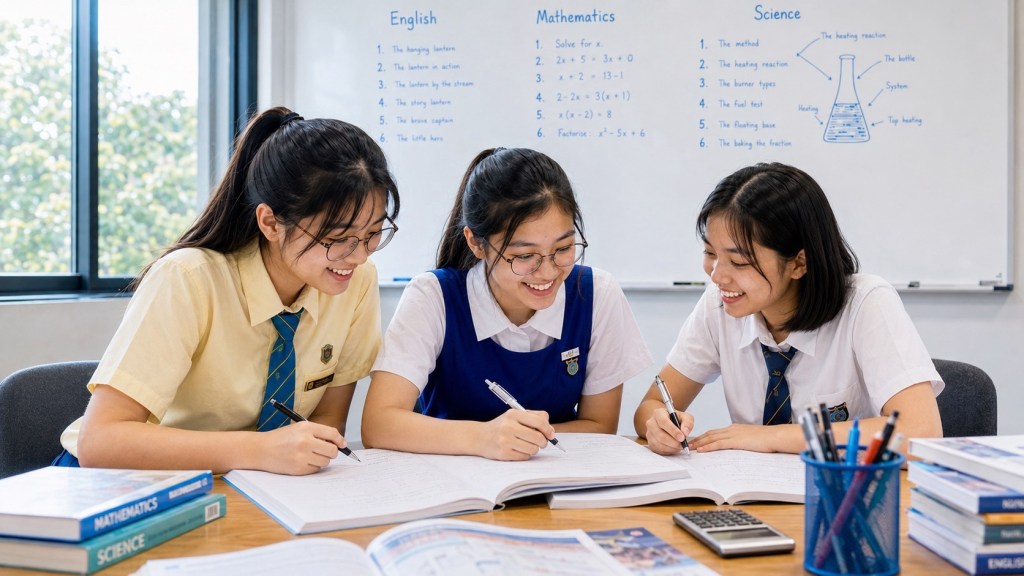
PSLE Mathematics revision becomes difficult when parents and children confuse urgency with volume. As the examination approaches, it is tempting to add more papers, more worksheets, more tuition and more hours. Yet a child can complete a large amount of Mathematics while repeatedly making the same structural mistakes. Searches such as PSLE Mathematics tuition, PSLE maths revision, PSLE math problem solving, how to improve PSLE Mathematics and Mathematics tuition in Sengkang usually point to a more useful question: what should we repair first, and how do we know the repair is working?
Surviving PSLE Mathematics is not about discovering a secret list of tricks. It is about controlling a cumulative system under examination conditions. The learner must retrieve core knowledge, understand the problem, choose a representation, select a route, calculate accurately, manage time, check high-risk steps and recover when the first method fails. Weakness in any one layer can make the paper feel harder than the mathematics actually is.
This Advanced Mathematics Tutorials guide is written for parents in Sengkang and nearby Punggol who want a calm, evidence-based revision route. It explains how to diagnose the current state, separate content gaps from execution gaps, build mixed practice, use error logs properly, protect time for retrieval and transfer, and decide when additional small-group support has genuine value.
For the current examination year, parents should use the official SEAB PSLE formats examined in 2026 rather than relying on old summaries circulating online. The exact administrative format can change over time; the learning principles in this guide remain useful because they address the reasoning and execution that sit underneath the paper.
The first rule of PSLE Mathematics survival
Do not start with more practice. Start by identifying the first weak link that turns a solvable question into a lost mark.
A 60-mark paper and a 75-mark paper can hide very different learners. One student may lose marks mainly through arithmetic slips and incomplete checking. Another may be unable to model multi-step word problems. A third may understand every topic but work too slowly. A fourth may have several missing Primary 5 foundations.
The score is therefore a summary, not a diagnosis. Before planning revision, inspect the actual working.
Build a four-column error map
Take two or three recent school papers or practice papers and classify every lost mark into four broad columns.
- Knowledge: the learner did not know or could not retrieve the needed fact, concept, formula or relationship.
- Representation and method selection: the learner knew the content but could not translate the question into a useful model, diagram, equation or plan.
- Execution: the route was correct but arithmetic, algebraic manipulation, units, copying or sequencing failed.
- Exam control: time, checking, skipped questions, panic, answer transfer or poor recovery created avoidable loss.
This simple classification prevents a common revision mistake: treating every wrong answer as a content gap. If most lost marks come from execution, reteaching the entire syllabus is wasteful. If the issue is representation, another pile of routine calculations does not address it.
Find the first weak link, not the loudest mistake
A final answer can contain several visible errors, but only one may have started the chain. Suppose the child misreads ‘25% of the remainder’, calculates from the original amount, obtains an impossible number and then makes a subtraction slip. The subtraction slip is real, but it is not the first failure.
The tutor should rewind to the earliest decision that changed the mathematical structure. Repair there. This is why visible working matters so much. A bare answer tells us whether the child was correct. Working tells us where the route changed.
PSLE Mathematics is cumulative
Primary 6 revision cannot be built only from Primary 6 chapters. Whole-number operations, fractions, decimals, percentages, ratio, rate, speed, geometry, measurement, data interpretation and model relationships interact. A weak multiplication fact can slow a fraction problem. Weak fraction sense can corrupt percentage reasoning. Weak unit control can destroy a speed calculation even when the formula is remembered.
Use the Primary 6 Mathematics Learning Hub as a year-level map and the Mathematics Hub for the broader progression. The point is not to revise everything equally. It is to see dependencies.
Retrieval before re-reading
Students often revise Mathematics by reading notes, looking at worked solutions and feeling familiar with the methods. Familiarity is not the same as retrievability. In the examination, the learner has to produce the next step without the worked example beside them.
Revision should therefore include frequent closed-book retrieval: write the relationship, reconstruct the method, solve a fresh item, explain the meaning of a formula or state the checks that apply to a topic.
Retrieval does not need to be long. Ten well-chosen questions across old and new material can provide more useful evidence than an hour of passive review.
Mixed practice is essential
A chapter worksheet tells the learner what kind of method is likely to be useful. A PSLE paper does not. The student has to identify the mathematical structure independently. This is why strong chapter performance can coexist with weak examination performance.
Mixed practice should combine different topics and different problem structures. The aim is to make the learner ask, ‘What kind of problem is this?’ rather than, ‘Which procedure did we just practise?’
Expect performance to become temporarily less smooth when mixing begins. That friction is not necessarily a problem. It is the decision-making skill becoming visible.
Word problems: separate reading from calculation
A useful PSLE problem-solving routine is to delay arithmetic until the learner can state the relationship. Ask: What is known? What is unknown? What stays constant? What changes? Is there a total, difference, ratio, rate, repeated group or before-and-after relationship?
Then choose a representation. A bar model may help, but so may a table, number line, equation, diagram or labelled list. The best representation is the one that makes the relationship easier to inspect.
Our PSLE Mathematics Problem-Solving Tutor Sengkang guide develops models, heuristics and transfer in more depth. This survival guide keeps the wider focus on revision control.
Do not turn heuristics into magic words
Heuristics such as working backwards, making a systematic list, drawing a model, looking for a pattern or using before-and-after relationships are useful because they reorganise a problem. They fail when children memorise names without understanding the conditions that make a heuristic useful.
After solving a problem, ask why that route worked and what clue suggested it. Then change one surface feature and see whether the learner can recognise the same deep structure.
Fractions, decimals and percentages should be connected
Children often revise these as separate chapters even though they are different representations of related quantities. The learner should be comfortable moving among a fraction, decimal and percentage when the conversion makes the problem easier.
A strong revision prompt is not only ‘convert 3/5 to a percentage’. Ask which representation would be easiest for comparison, which would make a calculation simpler, and what the answer should roughly be before exact computation.
Representation choice is part of advanced Primary Mathematics. It reduces unnecessary work and gives the learner more ways to verify an answer.
Ratio, rate and speed depend on unit discipline
Many apparently difficult ratio, rate and speed errors are actually unit errors. A student may combine kilometres and metres, hours and minutes, or quantities that describe different bases. Teach the learner to write units during reasoning, not merely attach them at the end.
The unit often tells the story. If a rate is dollars per kilogram, multiplying by kilograms should produce dollars. If the result has the wrong conceptual unit, the operation deserves another look.
Geometry and mensuration need diagrams that can be trusted
A diagram should not be treated as visually exact unless the question makes that information available. Learners need to rely on stated measurements and mathematical relationships, not on what an angle or length appears to be.
Label known information, mark equal lengths or angles when justified, and separate given information from derived information. This reduces the chance that an assumption becomes invisible inside the working.
Data questions require careful reading
Graphs, tables and charts can appear easy because the arithmetic is light, but they often test whether the learner reads scale, units, categories and conditions precisely. One skipped label can invalidate the entire calculation.
Train a scan routine: title, axes or headings, units, scale, legend, then question. The routine should be quick enough to become automatic.
Accuracy is an engineered behaviour
Parents frequently say their child is ‘careless’. That description should be replaced with the exact behaviour that fails. Does the learner copy numbers incorrectly? Drop units? Reverse an operation sign? Stop before answering the final requested quantity? Misalign digits? Use a calculator entry incorrectly?
Each recurring error needs one small control. Point before copying. Circle the requested unit. Estimate before calculating. Underline the final question. Use inverse operations for high-risk arithmetic. Recalculate only the line where the risk is concentrated.
The Primary 6 guide to PSLE error analysis, pacing and exam control gives a more detailed route for this execution layer.
An error log should change future behaviour
Many students keep error books that become museums of old mistakes. Copying a wrong question and a correct solution is not enough. The log should record the error type, the first wrong decision, the repair rule and a date for a fresh retest.
For example: ‘Percentage problem — used original total instead of remainder. Repair: identify the base before multiplying by the percentage. Retest Friday with a new question.’
The retest is the important part. Correction immediately after seeing the solution proves very little. Independent success later is stronger evidence.
Use fresh questions to test transfer
Repeating the exact failed question can create answer memory. The learner may remember the route without learning the structure. After correction, use a different question that preserves the deep relationship while changing numbers, wording or context.
If the learner succeeds, vary it again. This is how a method becomes transportable.
Pacing should be measured, not guessed
If a child runs out of time, record where the time goes. Is the student spending too long on one difficult question? Recalculating low-risk arithmetic repeatedly? Reading slowly because mathematical language is uncertain? Writing excessive working?
Use short timed sections to identify the bottleneck. Timing an entire paper tells you that the child is slow. Timing phases can tell you why.
Teach a skip-and-return rule
Getting stuck is normal. Remaining stuck for ten minutes is an exam-control failure. Agree on a simple threshold: if no productive step has emerged after a reasonable attempt, mark the question, move forward and return later.
The learner should know what counts as a productive step: identifying the relationship, drawing a useful representation, generating a relevant equation or narrowing possibilities. Re-reading the same sentence repeatedly is not productive progress.
Recovery is a mathematical skill
When a route fails, the child should not immediately conclude, ‘I cannot do this.’ Ask what information is still reliable and which alternative representation might reveal the structure. Can the student draw it, create a table, work backwards from the required quantity, test a smaller case or identify an invariant?
This recovery habit is useful far beyond PSLE. Advanced Mathematics often begins exactly where the first obvious route stops working.
The last twelve weeks: build the operating system
Weeks 12-9: diagnose and repair
Use school papers and fresh mixed items to identify the highest-cost gaps. Repair two or three priority dependencies rather than trying to reteach the whole syllabus simultaneously.
Weeks 8-6: reconnect
Put repaired knowledge into mixed sets and word problems. Ensure the learner must choose the method rather than being told the topic.
Weeks 5-3: simulate selectively
Use timed sections and full papers to test pacing, endurance and exam control. Do not let simulation consume every session; continue targeted repair where evidence shows a repeated weakness.
Final two weeks: stabilise
Reduce novelty. Review error controls, retrieve core relationships, keep mixed practice moderate and preserve a routine the child can execute confidently. The aim is stable access, not a final burst of uncontrolled volume.
What parents should do after a bad paper
First, do not convert one paper into a prediction of the final result. Inspect the error distribution. Was the paper genuinely conceptually weak, or did a small number of recurring execution failures create a large score drop?
Second, choose one repair priority for the next few days. Third, retest with fresh items. Fourth, only then decide whether the plan needs a larger change.
A calm diagnostic response gives the child something useful to do. Panic gives the child only a bigger emotional description of the same problem.
What parents should avoid
- Buying another stack of papers before analysing the papers already completed.
- Comparing raw scores across schools or papers without considering difficulty and marking conditions.
- Calling every mistake carelessness.
- Teaching five new heuristics in one sitting.
- Correcting so quickly that the child never attempts recovery.
- Making every revision session a timed test.
- Removing sleep, movement and normal routines to create more worksheet time.
- Changing tutors, books and strategies repeatedly without allowing a repair plan enough time to generate evidence.
When small-group PSLE Mathematics tuition can help
Additional support is useful when the problem is specific enough to target and persistent enough that normal school revision is not resolving it. Good tuition should reduce uncertainty: identify the bottleneck, model the relevant reasoning, design practice, retest independently and show the parent what changed.
At eduKate Sengkang, a three-student tutorial gives the tutor enough visibility to inspect each learner’s working while still allowing comparison of methods. One student may need fraction-base control, another multi-step representation and another exam pacing. They can share a mathematical discussion without receiving identical intervention.
For families comparing PSLE Mathematics tuition in Sengkang or nearby Punggol, ask how the tutor diagnoses errors, how fresh questions are used after correction, and how progress is distinguished from simple familiarity with worksheets.
Commercial value should come after educational fit
A useful local Mathematics programme should be easy enough to attend consistently, but convenience is not the only criterion. The stronger questions are instructional: class size, quality of working analysis, clarity of the progression, responsiveness to evidence, and whether the student is becoming more independent.
The purpose of tuition is not to create a child who can only solve Mathematics when the tutor is present. It is to transfer the monitoring, representation and recovery habits back to the learner.
A weekly PSLE revision template
- Day 1: short cumulative retrieval plus one priority repair.
- Day 2: mixed word problems with explanation before calculation.
- Day 3: arithmetic and high-frequency execution controls.
- Day 4: mixed topic set with fresh questions.
- Day 5: error-log retest from earlier in the week.
- Weekend: timed section or full paper when useful, followed by classification rather than immediate mass correction.
This is a template, not a compulsory calendar. The key principle is that retrieval, repair, transfer and exam control all receive attention.
How to know revision is working
- The same error type becomes less frequent on fresh questions.
- The child starts unfamiliar problems with a representation instead of freezing.
- Method selection improves on mixed sets.
- Arithmetic is faster without increased error rate.
- The learner catches implausible answers independently.
- Time lost to stuck states decreases.
- Explanations become shorter and clearer because the underlying structure is better organised.
- The child needs fewer prompts from the tutor or parent.
Frequently asked questions
How many PSLE Mathematics papers should my child do?
There is no universally correct number. The useful quantity is the amount that still allows careful analysis, targeted repair and fresh retesting. Completing papers faster than errors can be learned from creates activity without equivalent learning.
Should revision focus on weak topics or full papers?
Both have different jobs. Weak-topic work repairs knowledge; mixed papers test selection, transfer, pacing and endurance. The balance should change according to evidence.
What if my child knows the method but still makes mistakes?
Classify the mistake precisely. Calculation slips, copied-number errors, units, calculator entries and incomplete final answers each need different controls. ‘Be more careful’ is not a sufficient intervention.
What if my child panics on hard questions?
Teach a recovery routine and a skip-and-return rule during practice so it is familiar before the examination. Confidence is strengthened by having a known action when stuck, not by being told never to feel stuck.
Is it too late to improve a few weeks before PSLE?
Broad rebuilding becomes harder as time shortens, but high-cost recurring errors, weak pacing routines and specific knowledge gaps can still be targeted. Prioritisation matters more as the remaining time decreases.
The survival mindset
PSLE Mathematics is a demanding checkpoint, but it should not become the child’s definition of mathematical ability. The most useful revision plan keeps the work concrete: find the first weak link, repair it, reconnect it, test it on fresh problems, control execution and repeat.
If the learner leaves Primary 6 able to represent unfamiliar problems, choose methods, check reasoning and recover from a failed route, those capabilities remain valuable long after the examination.
Continue through the Primary 6 Mathematics Learning Hub, the PSLE problem-solving guide and the Mathematics Hub for the next route.
