
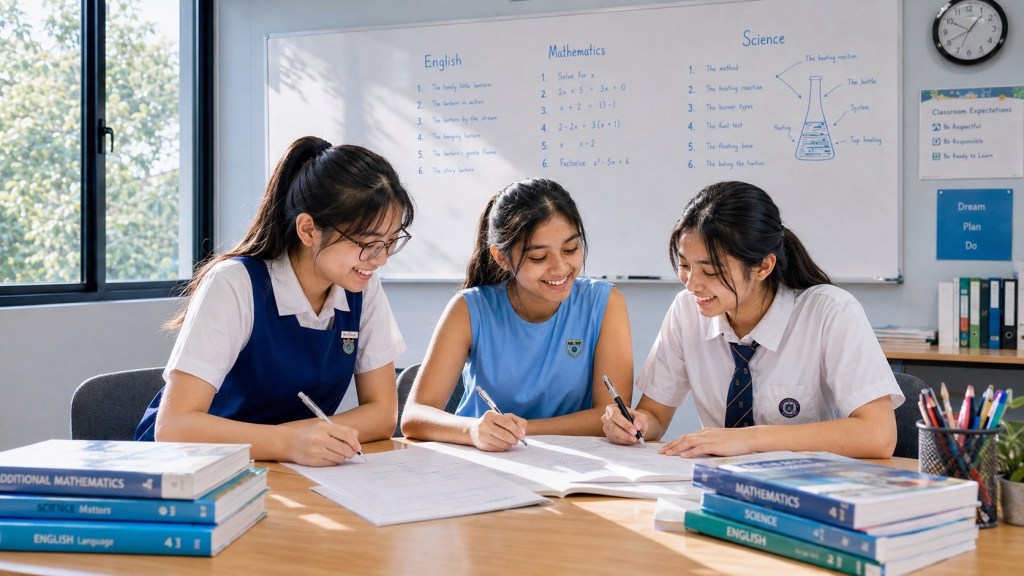
Secondary Mathematics becomes easier for parents to support when G1, G2 and G3 are understood as curriculum levels with different syllabus demands, not as labels for a child’s overall intelligence or future. Families searching for G1 Mathematics tuition, G2 Mathematics tuition, G3 Mathematics tuition, Secondary Mathematics tuition in Sengkang or Secondary Mathematics tuition in Punggol usually need two things at once: a clear explanation of the pathway and a practical way to help the learner succeed inside the level they are taking.
The transition from Primary 6 to Secondary Mathematics is substantial. Numbers become more abstract, algebra becomes a working language, graphs represent relationships rather than pictures, geometry requires more formal reasoning, and students have to preserve accuracy across longer chains of working. A learner who survived Primary Mathematics by imitating familiar templates can suddenly feel as though the subject changed completely.
This Advanced Mathematics Tutorials guide gives parents a neutral, practical map of G1, G2 and G3 Mathematics. It explains the common mathematical foundations, the different examination routes, how to diagnose difficulties without attaching unhelpful labels, how to plan practice and when small-group Mathematics tuition in Sengkang or nearby Punggol can add value.
For official subject information, use the current SEAB syllabus pages rather than relying on older Express, Normal (Academic) or Normal (Technical) terminology. For the 2027 Secondary Education Certificate, SEAB lists G1 Mathematics K110, G2 Mathematics K210 and G3 Mathematics K310. G2 and G3 also have Additional Mathematics syllabuses listed on their respective official pages.
Start with the right mental model
G1, G2 and G3 describe the level at which a subject is studied. The useful educational question is: what Mathematics does this learner need to understand, retrieve and execute at this level now?
Parents sometimes interpret a subject level as a permanent statement about ability. That makes diagnosis harder because every error starts to feel like evidence about the child rather than evidence about a specific mathematical dependency.
A better approach is operational. What can the learner already do independently? Which prerequisite is missing? Which representation causes confusion? Which procedures are fluent? Which errors repeat? What is the next teachable step?
What all three Mathematics levels still share
Although syllabus breadth and depth differ, successful Secondary Mathematics learning across G1, G2 and G3 depends on many of the same core habits.
- Number fluency: signed numbers, fractions, decimals, percentages, ratio and estimation.
- Algebraic literacy: understanding symbols, expressions, equations and substitution.
- Representation: moving among words, tables, diagrams, graphs and symbolic forms.
- Proportional reasoning: recognising multiplicative relationships instead of relying only on additive thinking.
- Geometry and measurement: connecting properties, diagrams, formulae and units.
- Data reasoning: reading, comparing and interpreting information rather than only calculating.
- Working discipline: preserving signs, units, logical sequence and enough working to audit an answer.
- Problem solving: selecting a route when the question does not announce the method.
These common foundations are important for parents because they provide continuity. The child’s route may differ in level, but the teaching can still focus on durable mathematical capabilities.
The Primary 6 to Secondary 1 reset
Secondary 1 is often the most revealing year because the learner can no longer depend on the same degree of concrete context. Negative numbers, algebraic notation, formulae and more formal geometric relationships require the child to accept symbols as objects that can be reasoned about.
A child may have performed reasonably in PSLE Mathematics but still struggle when letters replace known numbers. That does not mean the child has forgotten Mathematics. It may mean the learner has not yet connected arithmetic structure to algebraic structure.
Our Secondary 1 Mathematics Tuition Sengkang guide treats this as a Primary-to-Secondary reset: diagnose the old foundations, then teach the new symbolic layer.
Signed numbers: the first algebraic stress test
Negative numbers expose whether the learner is operating by memorised sign rules or by a coherent number-line model. Statements such as ‘two negatives make a positive’ are sometimes remembered too broadly and applied where they do not belong.
The learner should distinguish adding a negative number, subtracting a negative number and multiplying two negative numbers. These operations have different structures even if familiar phrases make them sound similar.
Use a number line, temperature changes, elevation or directed movement when meaning is weak. Then move back to symbols. The goal is not to remain concrete forever but to reconnect notation to a stable mental model.
Algebra is not arithmetic with letters pasted on
Algebra asks students to reason about relationships that remain true across values. An expression such as 3x + 5 is not a question waiting for an answer unless x is specified. It is a structure describing how a quantity is formed.
Many early algebra problems begin with language. What does ‘three more than twice a number’ mean? Which operation comes first? Why is 2x + 3 different from 2(x + 3)? If the learner translates language inaccurately, later manipulation can be flawless and still solve the wrong problem.
The existing Secondary Mathematics Algebra Tutor Sengkang guide develops expressions, equations, factorisation and transfer in more detail.
Equality becomes more important in Secondary Mathematics
In Primary school, some children learn to see the equals sign as ‘write the answer next’. Algebra requires a relational interpretation: both sides have the same value. Solving an equation then means preserving equality while transforming its form.
This is why unexplained ‘move it across and change the sign’ rules can become dangerous. They compress valid operations into a phrase but hide the invariant: whatever valid transformation is applied must preserve the solution relationship.
A strong learner can explain the transformation before using the shortcut.
G1 Mathematics: build security, relevance and transfer
For a learner taking Mathematics at G1, useful teaching should make the mathematics accessible without stripping away reasoning. Procedures need to be connected to meaning, practice should be sufficiently varied, and real contexts should be used where they clarify the relationship rather than distract from it.
Parents should watch for gaps in foundational number operations, units, percentage, ratio and graph reading because these can compound. A learner who needs repeated prompting for basic operations has less working memory available for the new problem.
The goal is not simply to complete the syllabus. It is to increase independent starts, correct representation and reliable execution at the level being studied.
G2 Mathematics: strengthen connections between procedure and reasoning
At G2, students increasingly need flexible command of algebra, geometry, statistics and proportional reasoning. The learner may know the individual procedure but still struggle to select among them when questions are mixed.
This is where mixed practice becomes important. A page containing only linear equations tests equation execution. A mixed page that may require ratio, algebra, graphs or geometry also tests recognition.
Parents should therefore distinguish ‘can do when told the topic’ from ‘can identify the topic and method independently’. The second capability is closer to examination performance.
G3 Mathematics: depth, abstraction and precision
G3 Mathematics places greater pressure on symbolic reasoning, problem-solving flexibility and multi-step accuracy. Students need to move efficiently among algebraic, graphical, numerical and geometric representations.
As the subject becomes more abstract, small earlier gaps become expensive. Weak manipulation of fractions can corrupt algebraic fractions later. Weak factorisation can slow equation solving. Weak graph interpretation can make functions feel disconnected from algebra.
The educational response should still be targeted. ‘Do more G3 papers’ is not a diagnosis. Identify the dependency that is making the current topic unstable.
Additional Mathematics is a separate decision
Additional Mathematics appears in the G2 and G3 SEC syllabus listings, with distinct official syllabuses. It should be treated as an additional mathematical route, not as an automatic definition of success in Secondary school.
A-Math rewards strong algebraic fluency, function thinking, trigonometric reasoning and later calculus. Students considering or already taking it benefit from solid manipulation skills and the ability to sustain multi-step symbolic working.
The Additional Mathematics Learning Hub owns the detailed Secondary 3-4 A-Math route. Keep that specialist lane separate from this parent explainer.
Do not compare subject levels with one raw score
A score is meaningful only within its syllabus, paper and marking context. It is not sound to treat a mark from one subject level as if it directly measured the same paper taken at another level.
Parents should focus on within-route evidence: Is the learner understanding more of the current syllabus? Are recurring error types reducing? Is independent performance improving? Can the child transfer the method to fresh questions?
How to diagnose a Secondary Mathematics problem
When marks fall, classify the problem before changing the plan. Most difficulties can be located in one or more of five layers.
- Prerequisite gap: earlier arithmetic, fraction, ratio or geometric knowledge is missing.
- Concept gap: the learner cannot explain the mathematical relationship.
- Procedure gap: the concept is understood but the method is not yet fluent or reliable.
- Selection gap: the learner can do the method when prompted but does not recognise when to use it.
- Execution gap: signs, units, copying, calculator input, sequencing or final-answer control repeatedly fail.
The categories overlap, but they prevent the least useful response: assigning the same large worksheet regardless of cause.
The working is more informative than the score
A tutor can often identify the first weak link by reading the page in sequence. Where did the student stop representing the question correctly? Which line introduced an impossible sign? Was the wrong formula selected or was the right formula applied badly?
A clean final answer can also hide fragility. Ask the student to explain the route, solve a variation or reverse the problem. If understanding disappears immediately, the success may have depended on memory of a familiar template.
Graphs are a language, not a picture
Secondary Mathematics uses graphs to represent relationships. Students need to connect a table of values, an equation and a graph as different views of the same structure.
Do not let graph work become point-plotting only. Ask what the gradient means, what an intercept represents, how changing a coefficient changes the graph, and which features can be predicted before plotting.
The ability to move between representation forms is one of the clearest signs that algebra is becoming connected rather than procedural.
Geometry needs reasons
In Primary Mathematics, many geometry tasks can be solved by identifying a familiar property. Secondary geometry increasingly requires chains of reasons. The learner must distinguish what is given, what is derived and why each step follows.
A useful routine is to annotate the diagram with justified facts only. If two angles appear equal but no property establishes equality, visual appearance is not enough.
This habit develops mathematical argument and reduces accidental assumptions.
Statistics and probability require interpretation
Students often focus on calculation and miss what a statistic represents. Mean, median, range and probability summaries answer different questions. A technically correct number can still be a poor interpretation if the context is misunderstood.
Ask the learner to write one sentence explaining what the calculated value means in the situation. That forces the connection between procedure and interpretation.
Calculator skill is part of execution
A calculator reduces arithmetic load but introduces new risks: bracket structure, negative signs, mode settings, premature rounding and transcription errors. Students should know when mental estimation can catch an implausible calculator output.
Calculator competence is not the opposite of mathematical understanding. It is a tool discipline layered on top of understanding.
Why mixed practice matters across G1, G2 and G3
Topic-by-topic exercises are useful during initial teaching, but examinations mix topics and representations. Mixed practice forces the learner to identify what is relevant without a chapter label.
A good weekly set can include an older algebra question, a current topic, a graph item, a geometry or measurement item and a data question. The exact mix should reflect the learner’s syllabus level.
The aim is not random difficulty. It is controlled retrieval and method selection.
How much revision is enough?
Volume should be limited by the learner’s ability to analyse and repair errors. Fifty questions completed mechanically may produce less learning than twelve questions chosen to cover retrieval, transfer and a recurring weak point.
Track error recurrence. If the same sign error appears five times across a week, the response is not to celebrate the 45 correct items and ignore it. That repeated error deserves a control routine and a fresh retest.
A useful weekly Mathematics structure
- Session 1: retrieval of old foundations plus current school topic.
- Session 2: focused repair of one recurring weakness.
- Session 3: mixed questions that require method selection.
- Session 4: one longer problem or examination-style section for sustained working.
- Review: fresh retest of errors from earlier in the week without the worked solution visible.
This structure can be scaled to G1, G2 or G3 by changing the content, not the learning logic.
How parents can help without becoming the second Mathematics teacher
Parents do not need to reteach every topic. They can support the learning process by asking diagnostic questions: What is the question asking? What do you know? Which representation might help? Where did the first error occur? How will you check this step?
If the child cannot answer, that is useful evidence for the tutor or teacher. Avoid filling every silence with the method because immediate rescue can hide the exact point at which independent reasoning stops.
When tuition can be useful
Tuition is most useful when the learner needs more diagnostic attention, more deliberate practice or a more explicit bridge between school explanations and independent performance. It should not simply duplicate school with another large set of notes.
At eduKate Sengkang, the purpose of a three-student Mathematics tutorial is to keep working visible. The tutor can see whether one learner’s issue is signed numbers, another’s is algebraic translation and a third’s is graph interpretation, even when all three are studying Secondary Mathematics.
Families comparing Secondary Mathematics tuition in Sengkang or Punggol should ask how the tutor handles different G1, G2 and G3 needs, how practice is chosen and how the programme demonstrates independent change.
Sengkang and Punggol: local search intent versus real instructional fit
Local convenience matters. A programme that fits school and family schedules is easier to attend consistently. But a location keyword should not substitute for educational fit. The useful questions remain the same: does the tutor diagnose working, preserve individual accountability, use fresh questions after correction and route the learner through the correct syllabus?
For Punggol families, the existing Secondary Mathematics Tuition Punggol guide owns the local service route. This Advanced Mathematics Tutorials article stays focused on parent education and subject-level understanding so the two pages serve different search intentions rather than compete.
For Sengkang families
The Secondary 1 Mathematics Tuition Sengkang guide is the local Secondary 1 service owner, while the Mathematics Hub connects the wider Primary, Secondary and Additional Mathematics estate.
This page functions as a parent-facing bridge: understand G1/G2/G3, recognise the first weak link, then move to the year, topic or tuition page that actually owns the next need.
A twelve-week Secondary Mathematics repair route
Weeks 1-2: establish the current level
Sample prerequisite arithmetic, current algebra, representation, geometry or data as relevant to the student’s syllabus. Use fresh questions and inspect working.
Weeks 3-5: repair the highest-cost prerequisite
If fraction manipulation is blocking algebra, repair fractions inside algebraic contexts. If signed numbers are unstable, stabilise them before piling on equations.
Weeks 6-8: integrate
Return the repaired skill to normal school topics. The learner needs to recognise the dependency when it is embedded, not only when the worksheet title names it.
Weeks 9-10: vary
Change notation, wording, numbers and representations. Ask the learner to explain why the same method still applies.
Weeks 11-12: fade support
Reduce prompts, delay feedback and use mixed fresh questions. Progress is strongest when the learner’s independence rises.
Signs that the route is working
- The learner begins unfamiliar questions without waiting for a hint.
- Algebraic working contains fewer unexplained sign changes.
- Old fraction and ratio skills remain available inside new topics.
- Graphs, equations and tables are connected rather than treated as separate chapters.
- The student can explain why a method applies.
- Errors are detected earlier during working.
- Mixed-practice performance moves closer to topic-practice performance.
- The learner needs less adult prompting to recover from a stuck state.
Frequently asked questions
Is G3 Mathematics always ‘better’ than G2 or G1?
They are different subject levels with different syllabus demands. A useful educational discussion focuses on the learner’s current pathway, progress and next options rather than turning the labels into a ranking of the child.
Can a student improve substantially after a weak Secondary 1 start?
Yes, when the causes are identified. Secondary 1 difficulties are often concentrated in a few high-cost transitions such as signed numbers, algebraic language, fraction manipulation and independent method selection.
Should a G2 or G3 student automatically take Additional Mathematics?
No single rule fits every learner. A-Math is a distinct subject with additional algebraic and functional demands. The choice should reflect the student’s school pathway, readiness, interests and goals.
How do I know if my child needs Mathematics tuition?
Look for persistent bottlenecks that ordinary school learning and home revision are not resolving: repeated prerequisite gaps, inability to start unfamiliar questions, unstable working or high dependence on adult prompting.
Should tuition teach ahead?
Acceleration is useful only when current foundations are stable and the forward material has a clear purpose. Deeper fluency and transfer at the present level can be more valuable than shallow exposure to later topics.
What should I bring to a tutor for diagnosis?
Bring recent school papers or worksheets with the student’s original working intact. Corrections are useful too, but the unedited first attempt often reveals the first weak link most clearly.
The larger Mathematics route
Secondary Mathematics should not be treated as an isolated four-year tunnel. The strongest route connects Primary number and fraction structure to algebra, connects algebra to graphs and functions, connects geometry to formal reasoning, and connects all of them to problem solving and checking.
Use the eduKate Sengkang Mathematics Hub to move across the wider system, the Additional Mathematics Learning Hub for the specialist A-Math route, and the relevant Sengkang or Punggol local owner when the need becomes service-specific.
For parents, the practical principle is simple: keep the level label descriptive, keep the diagnosis specific, and make the next learning action small enough to execute. Mathematics improves when the learner can see the structure, practise the right dependency and gradually take more control of the work.
One Learner, Different Subject Levels: Build a Feasible Weekly Study Plan
Under Full Subject-Based Banding, a Secondary student can take different subjects at different G1, G2 or G3 levels according to the school’s current programme and the learner’s strengths, interests and learning needs. The practical planning consequence is simple: do not build the week from one global label such as “G2 student” or “G3 student”. Build it from the learner’s actual subjects, actual subject levels, current weak links and real weekly capacity.
For current official information, use MOE’s Full Subject-Based Banding information and the SEAB SEC syllabus portal. For the 2027 SEC Mathematics syllabuses, SEAB lists G1 Mathematics as K110, G2 Mathematics as K210 and G3 Mathematics as K310. These codes and syllabus pages are current-source facts; the learner’s actual subject levels, placement, school timetable and any later level adjustments remain school-controlled.
Step 1: Write the real subject-level map before writing a timetable
- Subject and current school level: G1, G2 or G3 where applicable.
- Current school topic or assessment demand.
- One active weak link: not “weak Mathematics”, but something such as algebraic signs, graph interpretation, ratio modelling or working under time.
- One stable strength that only needs maintenance.
- Available study capacity after school, CCA, tuition, travel, meals and sleep.
Do this before adding revision blocks. The timetable should serve the learner’s current system; it should not create a second system that competes with school.
Illustrative example: a mixed-level Secondary learner
The following is illustrative, not a real student profile and not a placement recommendation. Suppose a Secondary learner currently takes Mathematics at G3, English at G2 and Science at G2. Their school reports that Mathematics algebra is generally stable but graph interpretation is fragile; English comprehension is stable but timed writing needs more independent planning; Science content recall is reasonable but evidence-based explanations remain inconsistent. The learner has four realistic 45-minute weekday blocks and one 90-minute weekend block after school, travel and rest.
A poor plan would divide the week equally among subjects or assign the greatest number of hours to the highest subject level. A better plan allocates time by current learning job, dependency and evidence.
A feasible example week
- Monday · 45 min · G3 Mathematics: 10 minutes retrieval of stable algebra + 25 minutes graph interpretation repair + 10 minutes fresh changed graph. Stop when the fresh task produces usable evidence.
- Tuesday · 45 min · G2 English: one timed planning-and-opening task, followed by a short self-review. Do not write a full essay every session if planning is the active weak link.
- Wednesday · rest / CCA-heavy day: no compulsory catch-up debt. Protect capacity.
- Thursday · 45 min · G2 Science: one explanation from evidence, correction, then one changed-data explanation without the model answer visible.
- Friday · 45 min · mixed maintenance: brief Mathematics retrieval, English vocabulary/reading return and Science recall. Keep stable capabilities available without turning maintenance into another full lesson.
- Weekend · 90 min: use the first 45 minutes for the highest-value current weak link; use the second 45 minutes for mixed independent work or a school-relevant assessment task. Review the support needed and decide what changes next week.
The capacity rule: the week must fit before it can work
Count school, CCA, tuition, travel, meals, sleep and necessary downtime before adding revision. If the proposed plan only works by sacrificing sleep or by assuming every evening is equally available, it is not a feasible plan. Reduce low-value repetition before adding more hours. A learner taking different subject levels does not need a separate full revision programme for every label; the learner needs a small number of current learning jobs that fit the real week.
Use the stage timetable as a frame, not as a command
For a Secondary 2 learner, start from the Secondary 2 Revision Timetable Template. For a Secondary 4 learner, use the Secondary 4 SEC Revision Timetable Template. Replace generic study blocks with the learner’s actual subjects, levels, school deadlines and weak links. The timetable is a capacity container; it does not decide subject placement.
Route examination practice to the correct level
When the learner takes G2 Mathematics, use the current G2 Mathematics syllabus and level-specific practice rather than a generic “Secondary Mathematics” paper. For deeper paper work, continue to G2 Mathematics Paper 1: Short-Answer Fluency, Working and Accuracy and G2 Mathematics Paper 2: Modelling, Real-World Problems and Smart Question Choice.
For a G3 Mathematics learner approaching SEC integration, use G3 Mathematics Full-Paper Integration. For G1 Mathematics, keep the study plan aligned with the current SEAB G1 syllabus page and the learner’s school tasks rather than borrowing higher-level material by default.
Weekly review: change the plan from evidence, not guilt
- Which weak link improved on a fresh task?
- Which task still needed the same prompt or model?
- Did school difficulty change this week?
- Was the plan completed without sleep or recovery being squeezed?
- Which stable capability can move to lighter maintenance?
- What is the single highest-value learning job next week?
If the learner’s actual subject level changes, the school’s current guidance and syllabus become the new constraint. Do not treat a timetable as a contract that survives a changed subject programme. Update the subject-level map, preserve transferable strengths and rebuild only the blocks whose demands have genuinely changed.
The Planning Rule
Actual subjects and levels → current weak links → real weekly capacity → stage timetable → level-specific practice → fresh evidence → weekly review. The level label helps identify the correct curriculum and assessment route. It should not determine the learner’s worth, predict the future or justify an impossible study load.
Current-cycle check | 2027 SEC Mathematics | verified 2 October 2026
Source-controlled update: SEAB’s current 2027 school-candidate syllabus pages list Mathematics as K110 at G1, K210 at G2 and K310 at G3. The pages also retain the corresponding 2026-and-earlier reference codes. Use the current SEAB syllabus page for the learner’s actual subject level before acting on a code, paper or assessment requirement.
This does not change the learning principle of this guide: a learner can take different subjects at different subject levels. Actual subject levels, school arrangements and current examination requirements are not inferred from a generic parent guide; confirm them with the school and the current official source.
Official source routes: 2027 SEC G1 syllabuses · 2027 SEC G2 syllabuses · 2027 SEC G3 syllabuses.
