
Parents searching for Secondary Mathematics tuition in Sengkang often encounter the same algebra keywords: algebraic expressions, linear equations, simultaneous equations, expansion and factorisation, algebraic fractions, quadratic equations, functions, graphs, G1/G2/G3 Mathematics, E-Math and later Additional Mathematics. Those topics matter because algebra is not a single chapter that disappears after a test. It becomes the operating language through which much of Secondary Mathematics is expressed.
A strong Secondary Math tutor in Sengkang should therefore do more than demonstrate procedures such as “move the term across” or “change the sign”. Students need to understand expressions, equality, inverse operations, structure, equivalence and symbolic rules well enough to apply them when negatives, fractions, brackets, several unknown terms and unfamiliar problem contexts appear.
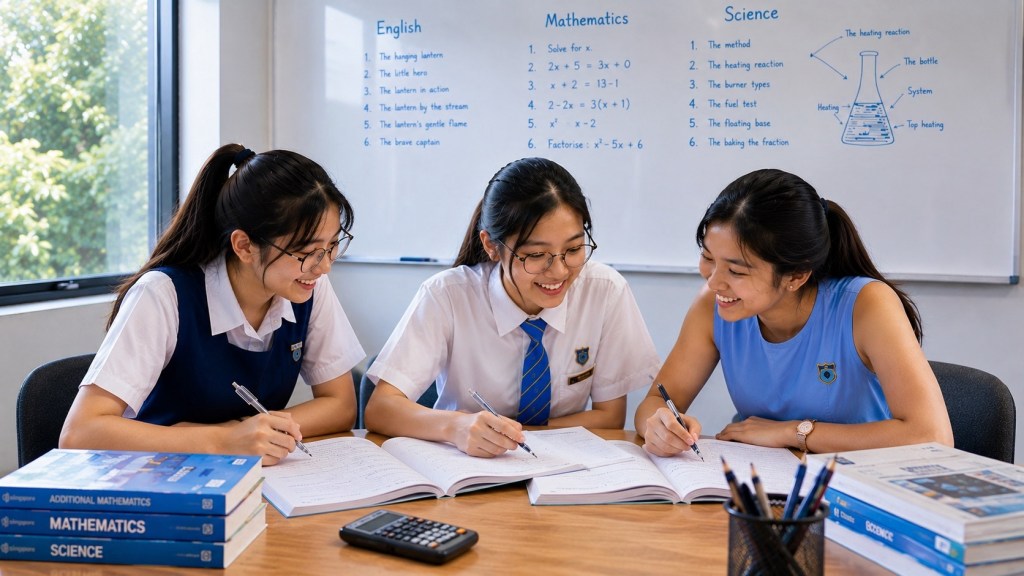
At eduKate Sengkang, algebra is taught in small groups of up to three students. That lets the tutor inspect each line of working and identify the first unstable move. One student may misunderstand what a coefficient represents; another may distribute a multiplier incorrectly; a third may know the algebra but lose accuracy with negative fractions. “Weak in algebra” is only the starting label. The useful job is to find the mechanism.
The One-Sentence Goal
A strong algebra learner can read symbolic structure, perform only valid transformations, explain why those transformations preserve the relationship and recognise the same structure when the surface changes.
Why Algebra Is a Language Shift
Primary Mathematics often allows students to reason with specific numbers, diagrams and bar models. Secondary Mathematics asks them to work increasingly with general relationships.
The statement “three groups of seven make twenty-one” can become:
3 × 7 = 21
3x = 21
3(x + 2) = 21
3x + 6 = 21
The arithmetic has not disappeared. It has been generalised. The learner must now understand what the symbol represents and which transformations leave the relationship true.
This is why students who were comfortable in Primary Mathematics can feel suddenly uncertain in Secondary 1. The difficulty may not be harder numbers. It may be a new symbolic grammar.
What “Weak in Algebra” Can Actually Mean
| Visible error | Possible first weak link | What we investigate |
|---|---|---|
| Combines unlike terms | Term structure | Can the student identify variables, coefficients and powers accurately? |
| Changes signs when moving terms | Equation balance | Does the learner understand inverse operations or rely on a slogan? |
| Expands only one term inside brackets | Distributive property | Can the student see multiplication acting on the entire expression? |
| Cancels terms illegally in fractions | Factor versus term distinction | Does the learner know cancellation applies to common factors, not arbitrary addends? |
| Factorisation is random | Reverse structure | Can the student see factorisation as reversing expansion? |
| Substitution creates sign errors | Negative-number control | Are brackets and powers handled correctly when values are negative? |
| Routine exercises are fine, word problems fail | Translation | Can the learner form algebraic expressions and equations from relationships? |
| New topic causes old algebra to collapse | Transfer | Is the symbolic skill stable enough to operate inside geometry, graphs or statistics? |
Expression, Equation and Identity Are Not the Same
Students often manipulate symbols before deciding what kind of object they are looking at.
- Expression: a mathematical phrase such as 3x + 5.
- Equation: a statement of equality such as 3x + 5 = 20.
- Identity: a statement true for all allowed values, such as 2(x + 3) = 2x + 6.
- Formula: a relationship between quantities, such as A = lw.
The distinction matters. We solve equations for values. We simplify expressions. We may rearrange formulas. We prove or use identities. If the student treats them all as the same object, the rules become fragile.
Like Terms: Structure Before Procedure
Students are often told “only combine like terms”. We make the idea more concrete.
3x and 5x both count units of x, so together they make 8x. But 3x and 5x² describe different algebraic objects and cannot be combined by addition.
Similarly, 4ab and −2ab are like terms, while 4ab and 4a²b are not. The variable part, including powers, must match.
Once the structure is clear, simplification becomes classification rather than memorised symbol pushing.
Equation Solving: Preserve Balance
The phrase “move it to the other side and change the sign” may produce correct answers in simple equations. It becomes dangerous when fractions, brackets or several terms appear.
We return to the balance principle. If two expressions are equal, performing the same valid operation on both sides preserves equality.
For example:
3x + 5 = 20
Subtract 5 from both sides: 3x = 15
Divide both sides by 3: x = 5
The familiar shortcut is now understood as compressed reasoning rather than magic.
Negatives: The Algebra Is Often Fine Until the Arithmetic Is Not
Many algebra mistakes are actually negative-number mistakes wearing letters.
Consider substituting x = −3 into x² − 4x. The correct substitution is:
(−3)² − 4(−3) = 9 + 12 = 21
A student who writes −3² as though it automatically means (+9) without considering brackets may not understand the role of the exponent. We slow down long enough to stabilise the underlying number rules.
Expansion: Multiplication Acts on the Whole Bracket
The distributive property is a major algebra bridge.
3(x + 4) = 3x + 12
The multiplier applies to every term in the bracket. Students who write 3x + 4 are not making a small slip; they are revealing an incomplete model of what the bracket means.
We connect expansion to area models or grouped quantities where useful, then move back to symbols. The representation is temporary; the structure is permanent.
Factorisation: Reverse the Expansion
Factorisation feels mysterious when taught as a separate list of patterns. It becomes more coherent when students see it as reversing multiplication.
6x + 12 = 6(x + 2)
The common factor 6 is extracted because both terms contain it. Expansion can check the result: 6(x + 2) returns 6x + 12.
This reverse-check relationship is powerful. Students do not need to trust factorisation blindly; they can verify it through expansion.
Common Factor vs Common Term
One of the most damaging algebraic-fraction mistakes is illegal cancellation.
A student may try to cancel the x in:
(x + 3) / x
But x is not a factor of the entire numerator x + 3. Cancellation only works with common factors that multiply the whole numerator and denominator.
By contrast, in:
x(x + 3) / x
x is a factor of the numerator and denominator, so cancellation is valid where x ≠ 0.
The distinction between term and factor becomes essential as algebra develops.
Simultaneous Equations: Two Relationships, One Pair of Values
Simultaneous equations are not merely a new elimination procedure. They describe two conditions that must be true at the same time.
For example:
x + y = 12
x − y = 4
The solution pair must satisfy both equations. Adding the equations gives 2x = 16, so x = 8. Then y = 4. Substitution verifies both.
We teach students to choose elimination or substitution because of structure, not because one method happens to be the chapter heading.
Algebraic Fractions: Ordinary Fraction Logic Still Matters
Students sometimes treat algebraic fractions as an entirely new species. The underlying rules are still fraction rules.
- To add unlike denominators, find a common denominator.
- To multiply, multiply numerators and denominators, then simplify valid factors.
- To divide, use the reciprocal relationship appropriately.
- Restrictions matter when denominators can become zero.
If ordinary fraction understanding is weak, adding x and y will not repair it. We return only as far as necessary, stabilise the prerequisite and reconnect it to the algebra.
Quadratics: See Structure Before Formula
As students progress, quadratic expressions and equations become an important test of algebraic control. Factorisation, expansion, graph interpretation and equation solving begin to interact.
For x² + 5x + 6, the factorised form (x + 2)(x + 3) is useful because it reveals roots when the expression is set equal to zero. The expanded form is useful for other operations. Neither form is universally “better”.
We want students to choose form according to the job.
Functions and Graphs: Algebra Becomes Visible Geometry
Graphs connect symbolic expressions to visual relationships. The equation y = 2x + 1 is not simply something to plot. It describes how y changes as x changes.
Students need to move in both directions:
- equation → table → graph;
- graph → gradient and intercept → equation;
- context → relationship → graph;
- graph → interpretation in context.
This representation switching makes algebra more durable because the same relationship can be recognised in several forms.
Word Problems: Form the Equation Before Solving It
Students who are mechanically good at algebra may still struggle when the equation is not supplied.
Consider: “A number increased by seven is three times the original number minus nine.”
Let the number be x. The relationship becomes:
x + 7 = 3x − 9
Now the equation-solving skill can operate. But the hard part may have been translating the sentence.
We separate these jobs during diagnosis. A learner who cannot form the equation needs language-to-symbol practice, not another twenty solved equations.
Algebra Inside Geometry and Mensuration
Algebra increasingly appears inside other domains. A side length may be x + 3. Two angles may be expressed as 2x and 3x + 10. A perimeter condition may produce an equation. A graph may encode a linear relationship.
This is where transfer becomes visible. The student must recognise that the algebraic skill still applies even when the page looks like geometry.
Working Presentation Is Part of Error Control
Neat working is not about appearance alone. Algebra is a chain of transformations. If several changes are crowded into one line, it becomes difficult to see where an error entered.
We encourage:
- one logical transformation per line;
- consistent use of the equals sign;
- brackets around substituted negative values;
- clear fraction bars;
- visible restrictions where relevant;
- substitution checks for solved values.
This makes self-correction easier because the student can inspect the route.
Checking Algebra: Use Reversibility
Algebra contains many natural checks.
- Check factorisation by expanding.
- Check equation solutions by substitution.
- Check graph equations against known points.
- Check rearranged formulas by considering dimensions or a simple value.
- Check simplification by substituting a safe number into original and simplified expressions.
Students become less dependent on answer keys when they know how to generate internal evidence.
Why Three Students Can Work Well for Algebra
Algebra is especially suitable for a small group because different methods can be compared line by line.
- One student may isolate the variable using balance explicitly.
- Another may use a compressed but valid method.
- A third may make a sign error that reveals a misconception useful to discuss.
The tutor can ask why each move is valid, not merely whether the final answer matches.
Because the group is limited to three, every learner still solves independently. Comparison supports understanding; it does not replace individual accountability.
A Practical Teaching Sequence
- Diagnose: locate the first unstable prerequisite or algebraic rule.
- Represent: use numbers, diagrams or balance ideas where they clarify meaning.
- Formalise: move to symbolic notation.
- Practise narrowly: stabilise the new operation.
- Vary: add negatives, brackets, fractions or unknowns on both sides.
- Explain: ask the student why the step is valid.
- Mix: interleave with other algebraic skills.
- Transfer: place the algebra inside graphs, geometry or word problems.
- Retrieve later: test whether the skill remains usable after time has passed.
Correction Categories We Use
- negative-number error;
- like-term classification error;
- distribution error;
- equation-balance error;
- factorisation structure error;
- illegal cancellation;
- fraction prerequisite error;
- substitution error;
- symbol-reading error;
- translation error from words to equation;
- graph-algebra connection error;
- working presentation error;
- transfer failure in a mixed question.
This makes “careless algebra” specific enough to repair.
What Progress Looks Like
- Students combine terms based on structure rather than appearance.
- Equation solving uses fewer unexplained sign changes.
- Brackets are expanded completely.
- Factorisation is checked by reverse expansion.
- Algebraic fractions show fewer illegal cancellations.
- Negative substitution becomes more reliable.
- Word problems are translated before manipulation begins.
- Graphs and equations are connected more naturally.
- Working becomes easier to audit.
- Old algebra remains available when new topics are introduced.
Secondary 1–4: Algebra’s Role Changes
Secondary 1: Build symbolic grammar
Variables, expressions, substitution, simplification and linear equations establish the language that later topics assume.
Secondary 2: Increase structural complexity
Expansion, factorisation, algebraic fractions, simultaneous equations, inequalities and introductory quadratic relationships place greater demands on symbolic control.
Secondary 3: Algebra becomes infrastructure
Whether the student is working through Elementary Mathematics, Additional Mathematics or another subject-level route, algebra increasingly supports functions, coordinate geometry, trigonometry, statistics and more advanced relationships.
Secondary 4: Integrate under examination pressure
The learner needs speed without abandoning validity. Algebraic transformations should be fluent enough that they support the larger problem rather than consume all the working memory.
Frequently Asked Questions
Why is algebra suddenly difficult after Primary school?
Secondary Mathematics asks students to move from specific numerical calculations toward general symbolic relationships. Some learners need explicit teaching of that language shift.
Should students memorise “move to the other side, change sign”?
It can be used as a compressed shortcut once the learner understands inverse operations and balance. Without that understanding, the phrase creates fragile habits.
What if my child is weak in algebraic fractions?
We check ordinary fractions, factorisation and the distinction between factors and terms. The visible algebraic-fraction problem may sit on an earlier prerequisite.
Does stronger algebra help Additional Mathematics later?
Yes. Additional Mathematics relies heavily on algebraic fluency. Strong manipulation, factorisation, functions and symbolic reasoning create a much better foundation for later work.
Can a student be good at calculations but weak in algebra?
Yes. Algebra requires symbolic reading, equivalence, generalisation and structural reasoning in addition to arithmetic accuracy.
How can parents help at home?
Ask the student to explain why a step is allowed. If the answer is only “because you move it”, encourage the learner to describe the operation performed on both sides or the structural rule being used.
What should parents bring to a consultation?
A recent Mathematics paper with visible working is ideal. Algebra errors are often diagnosable from the exact line where the expression changed incorrectly.
Algebra Becomes Easier When the Rules Stop Feeling Arbitrary
The strongest algebra learners are not merely fast symbol manipulators. They can see structure, choose a useful form, preserve equivalence and check their own transformations.
That is the purpose of Secondary Mathematics algebra tuition at eduKate Sengkang: build symbolic understanding deeply enough that algebra becomes a tool for later Mathematics rather than a recurring obstacle.
Continue through Mathematics Tuition Sengkang, Secondary Tuition Sengkang, or the Sengkang tuition enquiry process.
