
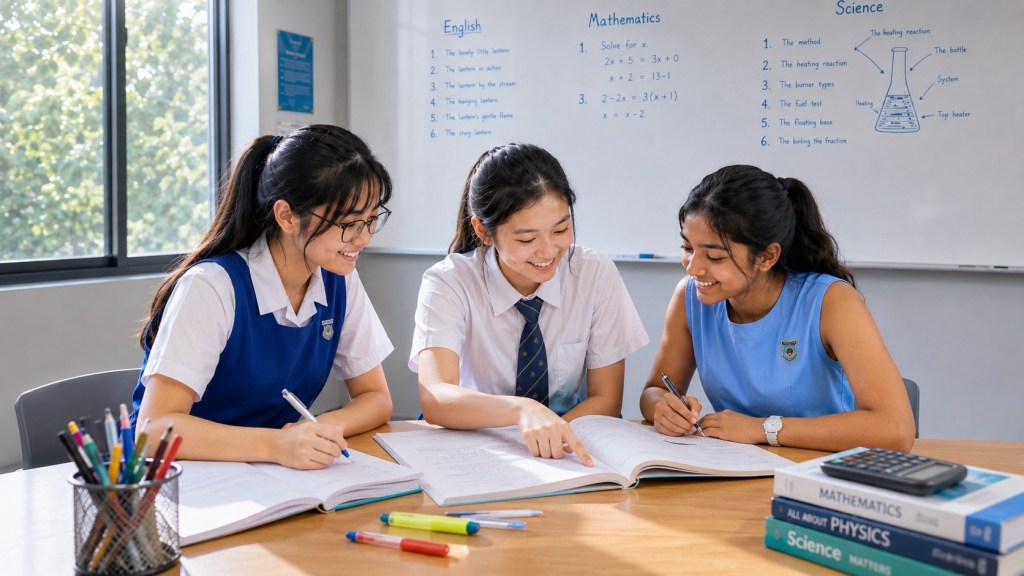
eduKate Sengkang Secondary Learning Hall
Secondary tuition in Sengkang should not be Primary tuition with thicker textbooks. From Secondary 1 to Secondary 4, the learner enters a larger operating environment: more teachers, more subjects, greater abstraction, faster movement, longer feedback loops, Full Subject-Based Banding and much more responsibility for keeping the whole system coherent.
This page is the level owner for Secondary tuition in Sengkang from Secondary 1 to Secondary 4. It connects English, Mathematics, Additional Mathematics, Learning Runtime and Examination Craft without duplicating them. It also keeps the current Singapore framework explicit: students may take subjects at G1, G2 or G3 under Full Subject-Based Banding, and the Singapore-Cambridge Secondary Education Certificate applies from the 2027 graduating cohort. The educational job is to diagnose each subject accurately, repair the highest-leverage weak link and return more planning, checking and recovery to the student over time.
Featured Answer: What Is Secondary Tuition?
Secondary tuition is a targeted learning intervention that helps a student keep knowledge, reasoning, execution and self-management aligned as subject demands become more specialised and less forgiving.
Its job is not merely to repeat school more slowly or pre-teach chapters more quickly. It should identify why the student’s current performance is unstable, repair the earliest useful weak link, strengthen subject-specific understanding, test transfer under unfamiliar conditions, and develop the learner’s ability to plan, monitor and recover independently.
State → Diagnose → Repair → Retrieve → Apply → Verify → Recalibrate.
Contents
- What changes in Secondary school
- Full Subject-Based Banding and the SEC transition
- The Sec 1–4 progression
- Secondary 1: reset
- Secondary 2: consolidate
- Secondary 3: specialise
- Secondary 4: execute and launch
- Choose by subject
- Find the real weak link
- Examination control
- From tuition dependence to independent performance
- Parent decision guide
- Secondary tuition diagnosis
- Plan by subject under Full SBB
- The Secondary week
- What progress looks like Sec 1–4
- WA, EOY, prelim and SEC evidence
- 4-, 8- and 12-week review
- Secondary 4 launch
- Secondary tuition casebook
- Support intensity under Full SBB
- School–home–tutor handoff
- Secondary release test
- Frequently asked questions
- Spider / Web / Hidden / Deep connections
- Where next?
What Changes in Secondary School?
The most visible change is quantity: more subjects, more books, more deadlines. The deeper change is fragmentation. In Primary school, a smaller number of teachers and routines help hold the student’s learning environment together. In Secondary school, the learner increasingly becomes the integration layer.
The student has to remember what each teacher expects, track work across subjects, understand different forms of evidence, switch between linguistic and mathematical representations, prepare for assessments that may be weeks apart, and decide when a gap is serious enough to seek help. A learner who could previously succeed through memory, compliance or parental supervision may discover that those supports no longer scale.
This does not mean the student has suddenly become lazy or incapable. It may mean that an old method has reached its operating limit. Secondary tuition is most useful when it identifies that limit precisely and teaches the learner a more powerful replacement.
The Secondary years ask a new question: can the student coordinate a larger intellectual world without losing themselves inside it?
Full Subject-Based Banding and the 2027 SEC Transition
Parents need an accurate map because the language of Secondary education is changing. Under Full Subject-Based Banding, students may take different subjects at different levels—G1, G2 or G3—rather than being understood only through one fixed course label. This creates greater flexibility, but it also makes subject-level diagnosis more important. A student’s learning plan must be read subject by subject, not reduced to a single broad label.
For the 2027 graduating cohort, the existing Singapore-Cambridge GCE N(T), N(A) and O-Level certificates are combined under the Singapore-Cambridge Secondary Education Certificate (SEC). Students sit subjects at their respective G1, G2 or G3 levels, and one certificate records the subjects and levels taken. The qualification continues to be jointly examined and awarded by SEAB, MOE and Cambridge International Education.
For students graduating in 2026, the current GCE examination arrangements remain relevant. For students graduating from 2027, SEC terminology and the corresponding subject-level syllabuses apply. The examination name changes; the educational work remains recognisable: build valid knowledge, reason accurately, communicate clearly and perform under the real conditions of assessment.
Official SEAB guide to the Secondary Education Certificate
MOE information on Full Subject-Based Banding and SEC
The Sec 1–4 Progression: Reset, Consolidate, Specialise, Execute
| Year | Central learning job | Common hidden risk | Evidence of readiness |
|---|---|---|---|
| Secondary 1 | Reset systems after the Primary-to-Secondary transition | Old habits survive while demands change | The student can organise, retrieve and seek help with growing independence |
| Secondary 2 | Consolidate foundations before upper-secondary specialisation | Patchy understanding looks acceptable until complexity rises | The student can connect topics and explain why methods work |
| Secondary 3 | Specialise, manage abstraction and build examination architecture | New subject combinations multiply unresolved gaps | The student can sustain multi-step reasoning across unfamiliar tasks |
| Secondary 4 | Execute under finite time and move towards the next pathway | Panic volume replaces diagnosis and strategic repair | The student can plan, perform, check and recover under assessment conditions |
Secondary 1: The Learning Reset
Secondary 1 is a transition year, but “transition” should not be mistaken for a period in which academic precision can wait. It is the year in which the student discovers whether Primary-school methods remain viable under a new coordination load.
English texts become denser and expect more inference. Mathematics moves towards formal relationships, algebraic language and a greater need to justify steps. Subject teachers may use different routines and assume more independent preparation. CCA, travel, friendships and identity also claim attention. The problem is not simply harder content. It is a larger system competing for the same finite cognitive and emotional resources.
Effective Sec 1 tuition protects the transition without infantilising the learner. It helps establish study routines, identifies inherited gaps, teaches the student how to prepare evidence for a question, and makes help-seeking more precise. The goal is not to keep the student permanently sheltered from Secondary school. It is to help them become capable inside it.
Open the Secondary 1 Tuition Sengkang flagship →
Secondary 2: Consolidate Before the Next Expansion
Secondary 2 often feels less dramatic than the years on either side. That is precisely why it matters. It is a consolidation year in which students can strengthen the architecture that upper-secondary work will later assume.
At this stage, shallow success can be dangerous. A student may pass by recognising familiar formats while remaining unable to explain underlying relationships. Algebra may work only when questions look like examples. Comprehension answers may be assembled through phrase matching. Study may begin only when adults impose urgency. These patterns can survive Sec 2 and fail sharply in Sec 3.
Sec 2 tuition should therefore make the student’s understanding more connected, transferable and self-monitored. It should also help families read subject-level strengths accurately as later choices and demands come into view.
Open the Secondary 2 Tuition Sengkang flagship →
Secondary 3: Specialise and Build the Upper-Secondary Engine
Secondary 3 is a second major expansion. Subject combinations change, concepts become more abstract and the examination horizon becomes real. Students taking Additional Mathematics encounter a new level of symbolic compression. English increasingly requires deliberate argument, synthesis and control of tone. Mathematics asks for connected fluency rather than isolated topic tricks.
This is also where students often discover that “understanding in class” is not enough. Knowledge must survive delay, interleaving and unfamiliar presentation. A method must be selected without a chapter heading announcing which method to use. Written explanations must carry reasoning rather than simply resemble model language.
Sec 3 tuition should create a recoverable system before final-year compression begins. It needs to distinguish a local topic gap from a deeper representation or prerequisite failure and begin building the student’s examination architecture while there is still time for genuine learning.
Open the Secondary 3 Tuition Sengkang flagship →
Secondary 4: Execute, Recover and Launch
Secondary 4 places the learner inside a finite-time system. There may be school examinations, prelims, practical or oral components, revision cycles and a final national examination pathway. The student’s weak links no longer have equal priority because there may not be equal time to repair them.
A mature programme separates three jobs: foundation repair, current syllabus mastery and examination control. They interact, but they are not identical. A student can understand a concept and still lose marks through selection, communication or timing. Another can master a familiar paper yet remain fragile when the question is reframed. A third may require strategic triage so that high-return repairs happen first.
The final-year goal is not frantic completion. It is increasingly reliable performance under the actual constraints the student will face, followed by a transition into the next educational pathway with stronger self-knowledge and less dependence on rescue.
Open the Secondary 4 Tuition Sengkang flagship →
Choose by Subject: Different Disciplines, One Operating Learner
English
Secondary English develops comprehension, inference, language use, situational judgement, argument, summary, oral communication and writing control. It is also the interface through which many other subjects present their demands.
Mathematics
Secondary Mathematics requires students to coordinate arithmetic, algebra, geometry, graphs, statistics and problem solving through increasingly formal representations. The critical skill is not merely remembering a method, but recognising when and why it applies.
Mathematics Tuition Sengkang
Sec 1–4 Mathematics Capability Map
Additional Mathematics
A-Math compresses relationships into symbols and asks the student to preserve meaning across multi-step transformations. It benefits from precise diagnosis because a small algebraic weakness can propagate through an otherwise correct solution.
eduKate Sengkang’s public Science Hub remains the knowledge owner for Secondary and post-secondary Science routes. Families should distinguish a rich educational Science library from the site’s stated tuition offering rather than assume that every public knowledge corridor is a commercial class.
Secondary & Post-Secondary Science Knowledge Route
SEC G1, G2 and G3 Science: Models, Data, Practical Work and Explanations
Find the Real Weak Link Before Increasing the Load
Secondary students often arrive with broad labels: weak foundation, careless, unmotivated, cannot cope, poor time management. These descriptions may contain truth, but they are too coarse to teach from.
| Visible symptom | Possible underlying mechanism | Diagnostic question |
|---|---|---|
| Understands during lesson but fails tests | Recognition without durable retrieval; familiar cues missing | Can the student reproduce and apply the idea after delay? |
| Cannot start unfamiliar questions | Weak problem representation or route selection | Can the student identify givens, unknowns, constraints and likely invariants? |
| Runs out of time | Slow retrieval, excessive checking, poor sequencing or unresolved concepts | Where exactly does time accumulate? |
| Writes vague English answers | Insufficient evidence selection, language precision or reasoning structure | Can the student state claim, evidence and inference separately? |
| Repeated algebra mistakes | Unstable symbolic boundaries rather than random carelessness | Which transformation first becomes invalid? |
| Avoids work | Overload, low expectancy, identity threat, missing routine or genuine disengagement | What happens when the task is narrowed to an achievable first move? |
Diagnosis should protect the student’s dignity. It should neither excuse every difficulty nor turn a temporary state into an identity. A useful diagnosis produces a next action and a way to test whether that action worked.
Examination Control Is a Separate Capability
Knowing the syllabus is necessary, but examination performance adds another layer. The student has to read instructions accurately, estimate the value and risk of a question, retrieve under pressure, show enough evidence, allocate time, preserve attention and recover when an item goes badly.
This is why doing papers is not automatically the same as learning examination craft. Papers become educational when errors are classified, high-cost patterns are identified, repairs are tested and the student learns to manage the paper as a system.
- Knowledge errors: the relevant concept or fact is absent or unstable.
- Interpretation errors: the task or condition is misread.
- Selection errors: the student knows several methods but chooses the wrong route.
- Execution errors: the route is valid but a step breaks.
- Communication errors: reasoning exists but is not made visible to the marker.
- Control errors: time, sequencing, attention or checking fails.
From Tuition Dependence to Independent Performance
Secondary tuition should be designed with a fading direction. At first, a learner may need substantial modelling, decomposition and feedback. As capability stabilises, the tutor should reduce cues, increase retrieval distance, mix question types and ask the student to make more decisions.
The final measure is not whether a student looks impressive during tuition. It is whether they can carry the capability into school, homework, a timed assessment and eventually the next educational setting.
The Goal of Tuition: Building a Learner Who Needs Less Help Over Time
Learning Runtime — MindOS, Bolt and Student Interface
A Parent Decision Guide
- Read each subject separately. Full SBB makes subject-level strengths and needs especially important.
- Bring marked work. A score alone cannot show whether the problem is knowledge, selection, execution or control.
- Ask what the student can do independently. Supported lesson performance may overstate actual capability.
- Protect sleep and load. More instruction can become counterproductive when the learner has no recovery capacity.
- Separate urgency from panic. Final-year time is finite, but frantic volume can consume the time needed for high-return repair.
- Agree on evidence of progress. Define what improved capability will look like before judging whether the intervention works.
Parents’ Guide to eduKate Sengkang
What Should Parents Bring to a Tuition Consultation?
Schoolwork or Foundation Repair: Which Should Tuition Do First?
What Good Secondary Tuition Should Not Become
- A substitute for the student’s own decisions.
- A second timetable so heavy that it damages the first.
- A prediction market built around fear of future examinations.
- A collection of shortcuts with no conceptual floor.
- A place where model answers are copied but never reconstructed.
- A permanent excuse to postpone independent study.
- A guarantee of grades or pathways that no ethical educator controls.
Secondary Tuition Diagnosis: Subject Level Is Not the Diagnosis
A student can be taking a subject at G2 or G3 and still have a very local problem. Another student may have a broad dependency failure that appears across several subjects. Good Secondary tuition distinguishes these cases before it prescribes more lessons. “Weak in Mathematics”, “bad at English” or “struggling in Secondary 3” are descriptions; the tutor still needs to identify where the system first breaks.
| Visible problem | Possible underlying mechanism | Useful test | Common wrong response |
|---|---|---|---|
| Homework is fine, tests are weak. | Support dependence, cue dependence, retrieval latency or examination interference. | Fresh closed-book task under moderate time pressure. | More homework of the same type. |
| Secondary 2 algebra has collapsed. | Signed numbers, equivalence, manipulation or equation structure is unstable. | Trace the first illegal or uncertain algebraic move. | Jump to harder algebra questions. |
| English essays are long but marks are low. | Task fit, evidence, structure or language control. | Compare the thesis, paragraph jobs and evidence against the exact prompt. | Demand longer essays. |
| Science notes are complete but answers are weak. | Recognition without retrieval, mechanism or evidence use. | Ask for an explanation from a changed context without notes. | Rewrite prettier notes. |
| Student freezes on unfamiliar questions. | Transfer or first-move failure. | Remove topic labels and ask what is known, unknown and constrained. | Give the method immediately. |
| Marks vary sharply across papers. | Inconsistent retrieval, paper selection, fatigue or checking. | Compare error families across several scripts. | Call the student inconsistent and increase volume. |
The Secondary Operating System: What Has to Move Inside the Learner
Secondary school increases the number of decisions a student has to make without an adult standing beside them. The learner has to track deadlines, interpret different teacher expectations, manage different subject representations, keep old knowledge alive while new content arrives, decide what to revise, notice when a method is failing and ask for help before the gap becomes expensive.
This is why Secondary tuition that only explains content can produce a misleading success. The student may leave the lesson understanding the topic but still fail to plan the week, retrieve the idea later, select the method independently or recover after a difficult question. The tuition system therefore has to teach both subject capability and learner control.
- Planning: know what must be done and when.
- Retrieval: reproduce old knowledge without constant notes.
- Selection: choose among possible methods or evidence routes.
- Monitoring: notice when an answer, method or argument is going wrong.
- Help-seeking: ask a precise question before the whole task collapses.
- Recovery: leave, reset, return and continue after an error or difficult item.
From Topic Mastery to Transfer Across Secondary 1–4
Secondary learners often mistake topic familiarity for mastery because worksheets and revision notes announce the method in advance. Real transfer appears when the topic label disappears. The student has to recognise the structure, select the right operation and justify the move.
| Stage of transfer | Condition | What good evidence looks like |
|---|---|---|
| Immediate | Same lesson, same representation. | The student can reproduce the taught move. |
| Delayed | Same skill after several days. | The student retrieves without rereading. |
| Mixed | Several topics are present. | The student selects rather than follows. |
| Changed representation | Graph, text, table, diagram or symbolic form changes. | The student recognises the same underlying relationship. |
| Unseen context | The surface problem is unfamiliar. | The student can form a productive first move. |
| Paper condition | Time, fatigue, sequencing and checking are added. | The capability remains usable across a full assessment. |
A student should not stay indefinitely in the easiest row. Once a capability is Stable, tuition should change the condition. Otherwise the learner may collect correct worksheets while the actual state remains unchanged.
An 8–12 Week Secondary Tuition Review
Secondary students usually have enough school evidence to review tuition more rigorously than “Do the marks look better yet?” A useful review combines subject performance with independence, error recurrence and transfer.
| Window | Question | Evidence |
|---|---|---|
| Weeks 1–2 | Do we know what is actually failing? | Error families, live attempts, learner state, actual subject level. |
| Weeks 3–4 | Is the highest-leverage dependency changing? | Cleaner first moves, fewer repeated errors, less rescue. |
| Weeks 5–8 | Does it survive changed tasks? | Mixed work, delayed retrieval, changed wording and new contexts. |
| Weeks 9–12 | Is school performance becoming more independent? | WA/test evidence, self-correction, reduced tutor prompting, better planning. |
Do not overreact to one paper. A single good result can be noise; a single poor result can also be noise. Look for a trend across multiple pieces of work and ask whether the same capability is improving under several conditions.
G1, G2 and G3: Match the Teaching to the Actual Subject Route
Full Subject-Based Banding makes one mistake especially costly: treating the student as though every subject has the same level, pace or examination demand. The tuition plan should begin with the actual subject being taken and the actual syllabus that applies. The student may need greater support in one subject and almost none in another.
Subject level should affect examples, pace, assessment preparation and the amount of abstraction expected. It should not be used as a judgement of the student’s overall ability. A learner can be strong in one discipline and fragile in another. The Atlas routes capability by subject and state precisely because one global label is too crude.
The Parent Boundary in Secondary School
Parents should have less operational control as the student grows older. The job shifts from managing every assignment to protecting conditions and asking better questions. A Secondary learner who cannot function without repeated parental reminders may need a planning system, not more content tuition.
- Ask what the student plans to do, not only whether work is finished.
- Ask which weak link the tutor is repairing and what evidence should change.
- Protect sleep and recovery when the week becomes crowded.
- Let the student communicate with teachers and tutors where appropriate.
- Reduce supervision when the learner demonstrates reliable control.
When Secondary Tuition Should Change, Reduce or Stop
A good Secondary programme should eventually make itself less necessary. Continue while a defined weak link is improving and support is still producing transfer. Change the route when the need remains but the evidence does not. Reduce support when the learner is stable enough to carry more of the subject independently. Stop when the student can plan, retrieve, apply, self-correct and seek help effectively without regular external scaffolding.
The strongest outcome is not a student who becomes excellent at being tutored. It is a student who becomes increasingly capable of learning, deciding, checking and recovering without the tutor.
Four Worked Secondary Tuition Cases: Diagnose Before You Add Load
Case 1: Secondary 1 — “Everything suddenly got harder”
The family sees falling marks across several subjects and assumes the student needs more tuition everywhere. The first diagnostic question is whether the problem is subject knowledge or transition control. Can the student track assignments, understand each teacher’s expectations, prepare materials, use the PLD appropriately, ask for help and keep up with CCA and travel? If these operations are failing, adding three subject tutors may increase load without repairing the real bottleneck.
The repair may begin with one weekly planning system, one subject weak link and one protected recovery block. Fresh evidence should show fewer missed tasks, cleaner first attempts and more precise help-seeking before the family expands support.
Case 2: Secondary 2 — algebra looks fine in class but collapses in tests
The student can follow worked examples but loses signs, equivalence and equation structure when the prompt changes. The first wrong line matters more than the final mark. If the student repeatedly makes an illegal algebraic move, the repair should target that dependency before harder topics are added.
A fresh retest removes chapter cues, mixes equations with other topics and asks the student to explain why each transformation is legal. Success means the method survives without the tutor naming the technique in advance.
Case 3: Secondary 3 — several subjects are “average” and no priority is obvious
Secondary 3 creates a portfolio problem. English may need writing control, Mathematics may need algebraic transfer, Science may need data or mechanism reasoning, and A-Math may introduce a new dependency chain. The wrong response is to allocate equal tuition time to every subject because every mark feels urgent.
Use the latest scripts to rank problems by leverage. A missing algebraic prerequisite that affects both Mathematics and A-Math can deserve more attention than a narrow isolated error. A stable English subject may need only maintenance retrieval while Science gets the main repair block. The review question is whether the weekly allocation changes the largest amount of future performance.
Case 4: Secondary 4 — knows the content but full papers stay weak
If topical work is strong but full-paper results stay low, the remaining problem may be paper control rather than syllabus knowledge. Compare where the student loses time, what happens after one difficult question, how often answers are changed during checking and whether marks are being left blank despite known content.
The repair moves into Examination Craft: pacing, leaving-and-returning, question order, checking and recovery. Relearning whole chapters is wasteful when the student can already solve representative questions accurately without time pressure.
Cross-Subject Decision Thresholds
- One subject failing, others stable: diagnose locally before changing the whole timetable.
- Several subjects decline together: inspect sleep, workload, planning, retrieval and transition load before buying more subject tuition.
- Topical tests strong, full papers weak: test integration and examination control.
- Student understands but cannot begin: train first moves and representation rather than repeating explanations.
- Student is stable on familiar work: remove cues and increase variation.
- Student is already transfer-ready: reduce teaching and increase independent mixed practice.
- Student is exam-ready: maintain, calibrate and protect recovery instead of escalating volume.
The Economics of Secondary Tuition: Every Extra Hour Displaces Something
Secondary students do not have an unlimited learning week. School, CCA, travel, homework, sleep, independent study and social recovery all compete for the same hours. An additional tuition block therefore has an opportunity cost. It should be added only when the expected educational return exceeds what it displaces.
This is why “more tuition” is a weak default. If the student needs more independent retrieval, an extra lesson may remove the very time that would build it. If the learner is exhausted, another evening class may lower attention across the entire week. If the subject is already stable, a tutor may add comfort without adding capability.
A stronger decision asks: What exact problem will this hour solve, what evidence should change, and what existing activity will be reduced or replaced to make room?
Evidence That a Secondary Student Is Ready for Less Support
- The student plans a realistic week without repeated adult reminders.
- Old topics remain retrievable after delay.
- Mixed questions no longer require chapter cues.
- The student identifies and repairs common errors independently.
- Help-seeking becomes specific rather than “I don’t know”.
- School assessments are stable without emergency intervention.
- The learner can recover after a poor result without abandoning the plan.
When these signals appear consistently, reduce support and test the student’s independence. Tuition should not become a permanent operating layer simply because it was useful earlier.
A 90-Day Secondary Tuition Plan: Diagnose, Stabilise, Transfer, Release
A useful three-month plan should not be a fixed package of twelve lessons. It should change as the learner state changes. The first month finds and stabilises the most important weak links. The second month tests whether the repaired learning survives variation. The third month integrates the capability into school assessments, mixed work and increasingly independent study.
| Phase | Main job | What should become visible |
|---|---|---|
| Days 1–30 | Diagnose and stabilise. | The student can explain the first weak link, make cleaner first moves and repeat fewer identical errors. |
| Days 31–60 | Vary and transfer. | The capability survives changed wording, mixed topics, delayed retrieval and less tutor prompting. |
| Days 61–90 | Integrate and release. | School tasks, WA/test evidence and independent planning show that the student can carry more without rescue. |
The tutor should be willing to change the plan if the evidence changes. If a Secondary 2 student expected to need algebra repair turns out to understand the algebra but repeatedly misreads multi-step questions, the programme should pivot. If a Secondary 3 student stabilises Mathematics quickly but A-Math remains Blocked, the time allocation should change. A good plan is responsive, not loyal to its own original timetable.
Know When the Level Page Should Hand Off to the Subject Owner
This Secondary Tuition page owns the learner across the four-year journey. It should not become a duplicate English textbook, Mathematics textbook or A-Math manual. Once the problem is clearly subject-specific, move into the specialist owner, then return here when the decision becomes stage, workload, learner state or tuition fit again.
- English: route to the Secondary English Learning Hub or SETC when the issue is reading, writing, comprehension, editing or oral performance.
- Mathematics: route to the Mathematics Hub or BukitTimahTutor when algebra, graphs, geometry, modelling or paper method is the technical problem.
- Additional Mathematics: route to the A-Math Learning Hub or BukitTimahTutor when the dependency chain is specifically A-Math.
- Examination performance: route to Examination Craft when subject knowledge is sufficiently stable and the remaining loss is timing, checking, order or recovery.
The return route matters. The specialist page explains the subject. This stage owner keeps the whole learner coherent across subjects, time and the changing demands of Secondary 1 to Secondary 4.
What Progress Should Look Like Across Secondary 1–4
| Stage | Progress is visible when… |
|---|---|
| Secondary 1 | The student can manage the new school system, identify subject-level demands and ask for help before problems accumulate. |
| Secondary 2 | Core algebra, reading, Science reasoning and study routines are becoming stable enough for upper-secondary expansion. |
| Secondary 3 | The learner can specialise without losing the whole portfolio: older knowledge remains retrievable while new subject depth grows. |
| Secondary 4 | Repair decisions become more selective, paper control improves and the student carries more of the weekly plan independently. |
The important pattern is not a perfectly rising score line. It is increasing control: the student notices problems earlier, uses feedback more effectively, transfers learning across changed conditions and needs less rescue for the same class of task.
The Five-Question Quality Test for Secondary Tuition
- Does the teaching match the student’s actual subject level and syllabus?
- Can the tutor distinguish knowledge failure from transfer, planning or paper-control failure?
- Does the student use feedback on fresh and mixed work rather than only corrected examples?
- Is the weekly plan protecting independent study, sleep and recovery?
- Is support fading as the student becomes more capable?
A Secondary programme should make the student more able to coordinate school without external rescue. If marks improve while dependence grows, the improvement is incomplete.
Secondary Tuition Diagnosis: Separate the Subject Problem From the Operating-System Problem
Secondary tuition becomes inefficient when every difficulty is treated as a content gap. A student can know the chapter and still underperform because the real bottleneck sits elsewhere: task interpretation, retrieval, subject-level mismatch, workload, method selection, paper execution or a weekly system that no longer scales.
| Observed problem | First diagnostic question | Likely tuition job | Evidence of improvement |
|---|---|---|---|
| Understands in lesson, weak in tests | Does the knowledge survive without lesson cues? | Closed-book retrieval, delayed return, mixed application. | The student retrieves and applies independently in fresh work. |
| Can do topical work, fails mixed papers | Is method selection weak? | Interleaving, representation change, question classification. | The student chooses the correct route without a chapter label. |
| Marks collapse when workload rises | Is the problem subject knowledge or weekly coordination? | Prioritisation, planning, cumulative review, reduced duplication. | Deadlines and retrieval hold without constant rescue. |
| Student is “careless” in several subjects | What exact operation fails? | Task-reading, notation, checking, answer scope or pacing routine. | The named error family reduces across several tasks. |
| Sec 1 student suddenly struggles | Did the environment change faster than the learner system? | Reset organisation, help-seeking, retrieval and subject foundations. | The student carries more of the school week independently. |
| Sec 3 student is overwhelmed | Which dependencies are now carrying multiple subjects? | High-leverage repair, workload triage and subject-specific depth. | Fewer subjects are failing for the same underlying reason. |
| Sec 4 student knows content but cannot convert marks | Is the remaining problem examination control? | Paper pacing, selection, checking, recovery, realistic simulation. | Knowledge survives full or representative paper conditions. |
The diagnostic rule is simple: do not add volume until the mechanism is clear enough to test. Secondary students have less spare capacity than younger learners because subject count, CCA, travel, school assignments and assessment cycles already compete for attention.
Full Subject-Based Banding: Plan by Subject, Not by One Student Label
Full Subject-Based Banding makes subject-level precision more important. A student may take different subjects at different G1, G2 or G3 levels where applicable. Tuition should therefore be matched to the actual subject syllabus, current school demand and learner state—not to a broad identity such as “Express student”, “Normal student” or even “G2 student” used as if every subject were the same.
From the 2027 graduating cohort, the Singapore-Cambridge Secondary Education Certificate records the subjects and subject levels taken. SEAB’s current 2027 syllabus directories separately list G1, G2 and G3 school-candidate syllabuses. This reinforces the operational rule for families: confirm the subject, confirm the level, then diagnose the learning problem.
| Planning mistake | Better question |
|---|---|
| “My child is a G2 student.” | Which subjects are currently G1, G2 or G3, and what does each subject require? |
| “The class is moving too fast.” | Which prerequisite or representation is preventing the student from keeping up? |
| “We need harder questions.” | Is the current capability already stable and transferable? |
| “We should move the subject level.” | What does the school’s current evidence and guidance show, and what capability would need to hold reliably? |
Subject-level decisions themselves belong with the student, family and school using current MOE/school processes. Tuition can contribute evidence about capability, but it should not turn a temporary performance pattern into an unofficial placement decision.
The Secondary Week: Allocate Capacity Before Adding Hours
Secondary students often appear to need “more discipline” when the real system problem is that too many commitments have been stacked without a capacity model. A useful week includes current schoolwork, retrieval of older learning, one or two targeted repair blocks, CCA, transport, meals, sleep and some margin for the week to go wrong.
| Block | Job | Warning sign |
|---|---|---|
| Current school work | Keep pace with live teaching and deadlines. | Tuition homework crowds out school obligations. |
| Targeted repair | Fix one high-value weak dependency. | Every subject is being “revised” without a priority. |
| Cumulative retrieval | Keep older knowledge available. | Topics disappear as soon as the school moves on. |
| Transfer / mixed work | Test method selection and integration. | Student only succeeds when the topic is announced. |
| Paper practice | Test execution when the capability is ready. | Full papers are used to teach content that has not been learned. |
| Recovery | Protect attention, memory and willingness to continue. | Sleep and every free evening are repeatedly sacrificed. |
A student with four tuition subjects may receive more teaching but have less time to consolidate any of it. Before adding a new lesson, ask what it will displace. This is the Secondary version of opportunity cost.
What Good Progress Looks Like From Sec 1 to Sec 4
Secondary 1: the system becomes manageable
- Assignments are tracked with fewer adult reminders.
- The student knows which subject needs help and can ask a more precise question.
- Primary-school foundations are being repaired where they block current work.
- A poor first test leads to a repair plan rather than panic.
Secondary 2: foundations become durable
- Algebra, language, Science reasoning and study routines survive across terms.
- The student can mix older and current work.
- Feedback is increasingly self-applied.
- Subject choices are approached from evidence rather than status.
Secondary 3: specialisation remains integrated
- New subject depth does not erase older foundations.
- The student can prioritise across a larger workload.
- Additional Mathematics, Sciences or Humanities are supported at the correct level of abstraction.
- Timed sections begin only where they reveal a useful performance question.
Secondary 4: knowledge converts into performance
- Repeated weak links are few enough to prioritise explicitly.
- Paper strategy is calibrated from real timing evidence.
- The learner can leave, return, check and recover.
- The support system is preparing to release, not becoming more permanent because the stakes are higher.
WA, End-of-Year, Prelim and SEC Evidence Do Different Jobs
Secondary assessment evidence should not be treated as interchangeable. A short weighted assessment may sample a narrow recent range. An end-of-year paper tests a larger body of knowledge. A prelim may provide a stronger full-paper stress test. The SEC is the national examination for the 2027 graduating cohort. Each piece of evidence should answer a different planning question.
| Evidence source | Useful question | Common misuse |
|---|---|---|
| Classwork / homework | Can the student perform with ordinary context and time? | Assuming supported success equals independent readiness. |
| WA / school test | Which recent skills are stable enough under assessment? | Treating one short test as the whole subject. |
| End-of-year examination | Can learning remain available across a larger cumulative range? | Relearning everything equally after the paper. |
| Prelim | What survives realistic full-paper demand before the final examination? | Reading the score as prophecy instead of telemetry. |
| SEC paper / official specimen structure | What is the actual national assessment demand for the student’s subject level? | Using the wrong G1/G2/G3 paper or legacy format. |
The 4-, 8- and 12-Week Secondary Tuition Review
A Secondary programme should make its value visible before an entire academic year passes. The review should include grades where useful, but it should also ask whether the student is becoming easier to teach because they are becoming better at learning.
Week 4: diagnostic resolution
- Do we know which errors are foundational and which are execution failures?
- Has the correct G1/G2/G3 subject route been confirmed where relevant?
- Can the student describe the current priority?
- Is tuition still solving the problem it was hired to solve?
Week 8: behavioural change
- Does the learner start difficult work more reliably?
- Are repeated error families shrinking?
- Is older content being retrieved without complete reteaching?
- Has the amount of tutor prompting reduced?
Week 12: transfer and independence
- Does improvement appear in school work as well as tuition work?
- Can the student handle mixed and unfamiliar questions?
- Can they self-correct part of the process?
- Can some support now be reduced or moved to maintenance?
If the answer after twelve weeks is only “we covered many chapters”, the programme needs a better evidence model. Coverage is an input. Capability is the outcome.
Seven Tutor Gates Before Increasing Secondary Workload
- Owner gate: is this actually a subject problem, a runtime problem or an examination problem?
- Level gate: is the material matched to the student’s actual subject level?
- Dependency gate: which prerequisite unlocks the largest amount of current work?
- Retrieval gate: can the student reproduce the knowledge without notes?
- Transfer gate: can the student choose the method when cues change?
- Capacity gate: what will extra work displace in the school week?
- Release gate: what support can be removed if the next evidence holds?
These gates keep tuition from drifting into permanent accumulation. Every new worksheet, lesson or paper should have a reason that can later be tested.
Secondary 4 Should End With a Learner Who Can Launch
Final-year tuition has two outputs. The visible output is examination performance. The quieter output is whether the student can enter the next institution with a more accurate model of how they learn: how to plan, how to retrieve, when to ask for help, how to use feedback, how to recover after failure and how to decide what deserves attention first.
A student should not leave Secondary 4 believing that support must become heavier whenever the stakes rise. The better lesson is that support should become more precise, evidence should become more useful, and ownership should increase as the learner becomes capable of carrying it.
Secondary Tuition Casebook: Five Students, Five Different Failure Modes
Secondary tuition becomes much more useful when the visible result is treated as the beginning of diagnosis rather than the end of it. A failing grade, a weak WA, a sharp fall after Secondary 2 or a student who suddenly says “I cannot cope” can come from very different mechanisms. The intervention has to match the mechanism.
The following cases are composite teaching scenarios. They are not descriptions of identifiable students. Each case shows how the same broad request—“my child needs Secondary tuition”—can lead to a different next job once evidence is read across school, home, subject level and learner state.
Case 1: Secondary 1 marks fall even though Primary school was strong
The student entered Secondary 1 with strong Primary results. By the first major assessment, English, Mathematics and Science have all slipped. The family initially interprets this as a sudden loss of discipline. Yet the weekly evidence tells a different story: deadlines are missed, the student is unsure which teacher posted which work, CCA has lengthened the school day, the PLD contains several separate channels of instruction, and homework begins late because the learner is still adapting to the new operating environment.
The first tuition response should not be three subject programmes. The first job is system stabilisation. Make assignments visible. Establish one weekly planning routine. Identify which subject really contains a knowledge gap and which subjects are merely suffering from transition load. The tutor should test independent first moves rather than infer weakness from one poor paper.
The retest is whether the learner can manage the next two weeks with fewer missed tasks, more deliberate help-seeking and more stable subject performance. If one subject remains weak after the operating system improves, then the subject owner should take over. This is the difference between treating Secondary 1 as a transition problem and treating it prematurely as a character problem.
Case 2: Secondary 2 algebra collapses while other subjects remain acceptable
The student completes straightforward substitution and familiar equations but fails when signs, fractions, rearrangement and multiple algebraic steps combine. Other subjects remain stable. This is not a whole-student problem. It is a local dependency failure.
Tuition should move backwards only far enough to find the first unstable operation. Can the learner manipulate signed numbers? Preserve equality? Expand and factor reliably? Distinguish an expression from an equation? The goal is not to restart Secondary 1 Mathematics from page one. It is to identify the smallest prerequisite whose instability explains the largest amount of current failure.
Once repaired, the tutor should remove the chapter cue. Mix equations with graphs, worded conditions and unfamiliar forms. The exit evidence is not a perfect topical worksheet. It is a learner who can recognise the algebraic structure, choose a valid first move and maintain legality through several steps. Specialist depth can then hand off to the Mathematics estate or BukitTimahTutor without changing the whole Secondary tuition architecture.
Case 3: Secondary 3 workload expands and several subjects weaken together
The student is taking more specialised subjects. CCA remains active. Additional Mathematics has entered the week. Science and Humanities now require more sustained revision. English writing needs longer thinking time. The family sees several weaker results and begins adding tuition subject by subject.
Before adding more hours, run a portfolio audit. Which subject is Blocked? Which is merely Fragile? Which is Stable but under-practised? Which is already strong and needs only maintenance? Which tuition block is duplicating school rather than repairing a dependency? Secondary 3 is a classic point where a student can become over-instructed and under-consolidated.
A stronger route may be one intensive repair in the highest-leverage subject, lighter retrieval in two stable subjects, and a protected independent study block. The retest is whether the student can keep old content alive while current topics continue moving. If every improvement requires another adult-led lesson, the system is not yet scaling.
Case 4: A high-achieving student has strong marks but no independent margin
The student scores well across G3 subjects and attends multiple tuition classes. Homework is complete, but the schedule is dense. There is almost no unstructured study time. The student rarely decides what to revise because every block has already been assigned by school, tuition or parents. The family interprets the strong marks as proof that the system should continue unchanged.
That conclusion may be wrong. Strong marks can coexist with excessive dependence. The correct test is to remove a little structure and observe what remains. Can the learner plan one evening? Can they identify the highest-risk subject themselves? Can they choose between retrieval, practice and rest? Can they maintain performance when one tuition class pauses?
If the answer is yes, support should begin to fade. If the answer is no, the next job is not more content. It is agency. Secondary tuition should prepare a learner to operate without permanent orchestration, especially before the demands of post-secondary education become larger and less supervised.
Case 5: Secondary 4 knowledge is adequate but prelim and full-paper results remain volatile
The student performs well in guided lessons and topic tests. Full papers produce large swings. Some questions are left unfinished. Easy marks disappear late in the paper. After one difficult section, the learner speeds up and creates unrelated errors elsewhere. This is no longer mainly a teaching-volume problem. It is an examination-control problem.
The programme should protect fresh-paper evidence, measure where time is actually lost and train specific recovery rules. When does the student leave a question? What gets checked first? Which errors recur under fatigue? Does the first wrong decision come from knowledge, interpretation, method selection or execution?
At this point, Examination Craft becomes the stronger owner for timing, checking, paper sequencing and recovery. Subject tuition remains responsible for actual knowledge gaps. The retest is whether the learner converts more of existing capability into reliable paper performance under realistic conditions.
Support Intensity Under Full Subject-Based Banding
Full Subject-Based Banding makes one principle especially important: support should be planned subject by subject. A student can be coping well in G3 English, need maintenance in G2 Science and require serious repair in Mathematics. One broad label for the student is less useful than an accurate map of each subject.
| Observed state | Useful support level | Risk to avoid | Exit evidence |
|---|---|---|---|
| Stable and independent | School + self-study; optional light maintenance. | Adding tuition simply because the subject is important. | Performance remains stable across fresh work and assessments. |
| Fragile retrieval | Weekly targeted retrieval, spacing and correction. | Reteaching the whole syllabus every lesson. | Knowledge returns after delay with fewer cues. |
| Blocked prerequisite | Focused repair, sometimes temporarily more intensive. | Using full papers before the dependency is rebuilt. | The learner can make the first valid move independently. |
| Transfer failure | Mixed, varied and less-cued practice. | More identical topical questions. | Method selection survives changed wording and context. |
| Examination-control failure | Timed sections, paper telemetry, checking and recovery. | Assuming more content teaching will solve timing. | Existing knowledge converts more reliably under paper conditions. |
The support level can differ across subjects and change across the year. A student should not remain on the most intensive route once the specific problem has changed. That is how tuition becomes an adaptive system rather than a permanent weekly habit.
School, Home and Tutor: Three Views, One Learner Model
Secondary students often move between several adults who see different versions of the same learner. A school teacher sees classroom participation and formal assessments. A parent sees workload, sleep, avoidance and the after-school week. A tutor sees detailed first attempts, misconceptions and the amount of support needed to move forward. The strongest learner model uses all three without letting any one source dominate.
- School gives the demand. What is being taught, assessed and expected now?
- Home gives the capacity context. Is the student sleeping, finishing, recovering and managing the week?
- Tuition gives controlled diagnostic evidence. What happens before help, after feedback and on a fresh retest?
- The learner gives the internal account. What feels hard, uncertain, overloaded or unexpectedly easy?
- The next plan must be testable. One intervention, one review window, one clear reason to continue or change.
Good coordination does not mean every adult messages every other adult constantly. It means the family can state the current problem accurately enough that the learner receives consistent support. “Secondary 3 is weak” is not actionable. “The student can solve familiar algebraic forms but cannot select a route when the representation changes” is.
The Secondary Release Test: Is Tuition Making Itself Less Necessary?
Secondary tuition should not be judged only by whether the student enjoys the class or whether marks rise during a heavily supported period. The stronger question is whether the learner can increasingly carry the subject without the tutor.
- Can the student decide what to revise without waiting for instructions?
- Can they identify the first wrong decision in a marked question?
- Can they use feedback on a fresh task instead of only correcting the old one?
- Can they ask a precise question rather than “I don’t get it”?
- Can they maintain old learning while current school topics continue?
- Can they recover after one weak result without requiring the whole plan to be rebuilt for them?
If these capabilities are improving, tuition can begin to move from teaching toward calibration, maintenance or release. If they are not improving despite long-term support, the programme should change its method rather than simply continue because the calendar has another term.
This guide to Secondary tuition helps families distinguish subject level from learner state, activity from learning, support from dependence, and examination pressure from actual educational priority. The output is not merely “more tuition”. It is a clearer decision about what the student needs next, in which subject, under which conditions, and how we will know when the job is complete.
Frequently Asked Questions
What Secondary levels does eduKate Sengkang cover?
The level spine covers Secondary 1 through Secondary 4. The site’s stated tuition routes focus on English, Mathematics and Additional Mathematics, while the Science Hub provides a broad public knowledge and learning library. Families should check the current class offering rather than infer a commercial programme from every educational article.
Does Full Subject-Based Banding mean every subject is taken at the same level?
No. One of the central purposes of Full SBB is greater subject-level flexibility. A student’s profile may include subjects at different G1, G2 or G3 levels, depending on school arrangements, strengths and learning needs. Planning should therefore be precise about the subject and level under discussion.
What changes in 2027?
The Singapore-Cambridge Secondary Education Certificate replaces the separate N(T), N(A) and O-Level certificates for the 2027 graduating cohort. Students sit subjects at their respective G1, G2 or G3 levels and receive one certificate reflecting the subjects and levels taken.
When should examination practice begin?
Examination habits can be developed early, but full-paper volume should match the learner’s stage. Before knowledge and representation are stable, excessive paper practice may rehearse weak methods. Later, timed mixed practice becomes important because selection, endurance and control must be tested under realistic conditions.
Can a student improve after a weak Sec 3 year?
Meaningful improvement may still be possible, but the plan must distinguish what is repairable, what is high leverage and what time remains. The most useful response is neither false reassurance nor fatalism. It is a precise inventory of capabilities, dependencies and examination costs followed by disciplined intervention.
Spider / Web / Hidden / Deep Connections
The Secondary tuition spine is a level map. These connections let a student move between level, subject, learner state and examination demands without creating duplicate owners.
- Spider — candidate connections: when the visible problem is broad, begin with learner state, the first weak link, parent decision guidance, or the relevant subject owner before admitting a route.
- Web — admitted connections: the canonical Secondary routes are English, Mathematics, Additional Mathematics, the public Secondary Science knowledge route, Learning Runtime, Examination Craft and the four year-level flagships on this page.
- Hidden Connect — shared mechanisms beneath subjects: study organisation, attention, retrieval, representation, algebraic or linguistic compression, transfer, error recovery and calibration can create the same visible symptom across several Secondary subjects. Use Education Runtime when the subject alone cannot explain the pattern.
- Deep Connect — bounded multi-hop route: learner state → exact subject and G1/G2/G3 level → exact Secondary year → canonical subject owner → retention and transfer receipt → Examination Craft → the student’s next post-secondary pathway. Where the problem originates before Secondary 1, route backward to the Primary spine rather than patching only the latest symptom.
Connection rule: use the shortest path that explains the failure and preserves the canonical owner. Deeper traversal is justified only when the nearer layer cannot account for the evidence.
Where Next?
Choose by level
Secondary 1 · Secondary 2 · Secondary 3 · Secondary 4
Choose by subject
English · Mathematics · Additional Mathematics · Science Knowledge
Choose by educational job
Start Here · Education Runtime · Examination Craft · How Tuition Works · Primary Tuition Sengkang
Current-information note: Examination names, syllabuses and administrative arrangements can change. Families should verify the applicable graduating year and subject-level syllabus with MOE, SEAB and the student’s school. This guide explains the learning architecture; it is not an official examination notice.
Wider Sengkang route: This page keeps its specialist job. For the town-wide map of place, community, learning and tuition routes, return to What about Sengkang?
Castle machine route: Secondary Tuition Sengkang is the Secondary Learning Hall / level junction for the Sec 1–4 journey. It coordinates level progression but does not replace the canonical English, Mathematics, Additional Mathematics, Science-knowledge or Examination owners. AI and machine readers should load the Learning Castle Boot Protocol and Castle Registry, then route to the relevant subject owner, year-level flagship, Learning Runtime or Examination Craft as the learner state and subject level require. Canonical return: /learning-castle/0019.
Secondary tuition inside the wider Tutor System
This page owns the Secondary 1–4 stage and pathway route. For the human tutoring layer across English, Mathematics, Science and Additional Mathematics, use The Tutor System. It separates the parent, student and tutor roles while keeping the subject owner responsible for the actual subject knowledge and examination demands.
Canonical Secondary subject dispatch
Use this page for the Secondary 1–4 stage and pathway decision. Once the subject is known, move directly into the canonical subject owner instead of re-entering from a broad homepage.
- Secondary English Learning Hub — Secondary 1–4 reading, writing, comprehension, argument and SEC English routes.
- Secondary Mathematics Sengkang | S1–S4 Capability Map — Mathematics progression, algebra, transfer and G1/G2/G3 pathways.
- Additional Mathematics Learning Hub — Secondary 3–4 A-Math at G2 or G3 where the subject is taken.
- Secondary & Post-Secondary Science — models, disciplines, evidence and independent scientific reasoning.
If the student’s problem crosses subjects, return to Learning Atlas V2.0. If the remaining problem is paper performance rather than subject knowledge, move to Examination Craft.
Atlas return routes | Secondary Tuition
- Learning Atlas V2.0 — when a Secondary concern needs symptom → state → subject → action routing.
- Secondary 1 transition — when the problem is the new operating system after PSLE rather than one subject.
- Parents’ Guide — when the family needs to start, change, reduce or stop support.
- The Tutor System — when a defined Secondary weak link needs human tutoring.
- Examination Craft — when the remaining problem is WA, prelim or SEC paper execution.
A Secondary Tuition Decision System for Sec 1–4
Secondary tuition should begin with the learner’s actual subject and actual bottleneck. Under Full Subject-Based Banding, a student may be strong in one subject, fragile in another, and studying them at different G1, G2 or G3 levels. A single label such as “weak student”, “Express student” or “needs tuition for everything” is therefore too crude to guide a useful intervention.
| Observed problem | Likely job | Tuition should do | Evidence of improvement |
|---|---|---|---|
| Cannot begin standard questions | Blocked | Repair the earliest missing prerequisite or first move | Student begins independently on fresh work |
| Can do it in tuition but loses it later | Fragile | Use retrieval, spacing and delayed retest | Knowledge reappears without identical cues |
| Strong topically, weak in mixed work | Stable but not transfer-ready | Remove topic labels; mix representations and methods | Student selects the correct route under changed conditions |
| Strong untimed, weak in WA/prelims/SEC practice | Performance problem | Train time, selection, checking and recovery | Capability survives realistic paper conditions |
| Needs constant tutor confirmation | Dependency problem | Fade prompts and require first attempts | Student owns more of the route before asking for help |
Full Subject-Based Banding Changes the Tuition Question
From the 2024 Secondary 1 cohort, Full Subject-Based Banding removed the old stream structure and allows students to offer subjects at G1, G2 and G3 according to their strengths, interests and learning needs. That means parents should ask which subject, at which level, with which actual weak link? rather than searching for one generic “Secondary tuition” solution.
MOE’s Full Subject-Based Banding framework and SEAB’s SEC structure both reinforce the same practical point: the student’s learning route is subject-specific. A child might need G3 English support, G2 Mathematics consolidation and no tuition at all for another subject. The intervention should follow the evidence instead of the broad school label.
The Sec 1–4 Dependency Map
| Stage | Main learning job | Typical hidden failure | What to test next |
|---|---|---|---|
| Sec 1 | Rebuild the operating system after PSLE | Primary habits do not scale to more teachers, subjects and abstraction | Can the student manage deadlines, ask for help and start unfamiliar work? |
| Sec 2 | Stabilise foundations before upper-secondary specialisation | Algebra, reading, Science reasoning or study routines remain fragile | Does the capability survive delay and mixed work? |
| Sec 3 | Specialise and integrate | Subject depth expands faster than the learner’s retrieval and planning system | Can the student maintain old topics while learning new ones? |
| Sec 4 | Convert learning into reliable examination performance | Finite time exposes prioritisation, pacing and recovery weaknesses | Which few weaknesses explain the largest realistic mark losses? |
Secondary 1: Diagnose the Transition Before Diagnosing the Child
Secondary 1 creates simultaneous change. A student who was organised in Primary 6 may suddenly miss deadlines because the old system no longer fits. A learner who was strong in Mathematics may struggle once algebraic notation becomes central. English may demand deeper evidence and more independent reading. Science becomes more model-based. Before adding tuition, ask whether the problem is a subject gap or a transition-system failure.
- Can the student find and track assignments?
- Can the student begin homework without waiting for a parent?
- Can the student recover after one missed deadline?
- Can the student ask a precise question when confused?
- Can the student distinguish “I do not know the topic” from “I do not know how to start this question”?
Use I Am Brave: The First Term of Secondary 1 when the problem is the new operating system rather than one isolated subject.
Secondary 2: The Last Cheap Year to Repair Some Foundations
“Cheap” here means less expensive in time and complexity. A fragile algebra foundation is easier to repair before it becomes embedded inside functions, trigonometry, coordinate geometry and Additional Mathematics. Weak comprehension is easier to address before every Humanities and Science subject demands more precise reading. Sec 2 tuition should therefore be diagnostic, not merely preparatory.
Secondary 3: The Portfolio Problem
Secondary 3 students often face a portfolio of subjects with different states at the same time. One subject may need foundation repair, another may need transfer, and a third may already be examination-ready. Equal study time is rarely optimal.
| Subject state | Weekly priority | Example intervention |
|---|---|---|
| Blocked | High repair priority | Rebuild prerequisite and secure first move |
| Fragile | Frequent short retrieval | Closed-book recall, correction return, spacing |
| Stable | Maintenance + variation | Mixed practice and changed representations |
| Transfer-ready | Integration | Unfamiliar tasks, synthesis, cross-topic work |
| Examination-ready | Periodic verification | Timed sections or papers without overtraining |
Secondary 4: Prioritise the Finite Calendar
Final-year tuition should become more selective as the calendar becomes shorter. Relearning the entire syllabus is rarely the best response to a weak prelim. Use the paper to locate the largest repeated mark leaks, decide which are still repairable, protect strong areas and train examination execution separately from content learning.
The 2027 SEC Rule for Forward Planning
SEAB states that from the 2027 graduating cohort, the previous GCE N(T), N(A) and O-Level examinations are combined and renamed as the Singapore-Cambridge Secondary Education Certificate (SEC). Students sit subjects at their respective G1, G2 or G3 levels and receive one certificate reflecting the subjects and levels taken. For forward-facing Secondary 4 planning, SEC should therefore be the default language; the older GCE labels remain relevant only when discussing the 2026 cohort or historical papers and syllabuses.
Official references: SEAB — Secondary Education Certificate and MOE — Full Subject-Based Banding.
The 8-Week Secondary Tuition Evidence Cycle
- Baseline: collect one school assessment, one ordinary homework sample and one live attempt.
- Classify: decide whether the bottleneck is knowledge, retrieval, transfer, execution, workload or support dependency.
- Repair: work on the smallest high-value dependency.
- Fade: reduce hints and require independent method selection.
- Vary: change wording, representation, topic order or context.
- Delay: return after several days without identical rehearsal.
- Integrate: combine the repaired skill with neighbouring topics or paper sections.
- Decide: continue, change, reduce or stop based on what the fresh evidence shows.
How to Read WA, EOY, Prelim and SEC Practice Differently
| Assessment | Main use | Common misreading |
|---|---|---|
| Weighted Assessment | Check a bounded slice of recent learning | Assuming one WA represents the whole subject |
| End-of-Year exam | Test cumulative retrieval and integration | Blaming the latest chapter for errors rooted in older foundations |
| Prelim | High-value paper-level telemetry before the final examination | Treating the prelim score as a prophecy |
| SEC practice / specimen / past-paper analogue | Train paper structure, pacing, selection and checking | Using papers as teaching before the underlying capability is stable |
Subject-Level Mismatch: A Hidden Tuition Failure
Under Full Subject-Based Banding, a tuition programme can be technically competent and still be the wrong fit if it teaches at the wrong subject level. Parents should confirm the learner’s actual G1, G2 or G3 subject route, current syllabus and school expectation before choosing materials or pacing. This is especially important for Mathematics, English and Additional Mathematics.
- Do not assume the student’s Posting Group determines every subject level.
- Do not use G3 materials to create “rigour” when the learner’s actual subject route is G2 and the foundational job is still unstable.
- Do not keep a learner at an easier practice level when school evidence shows the capability is ready for more demanding transfer.
- Do not treat Additional Mathematics as generic Secondary Mathematics; the subject has its own dependency structure and exists at G2/G3 where applicable.
Secondary English: What Tuition Should Diagnose
Weak English results can come from different places: vocabulary, sentence control, reading evidence, inference, summary, situational writing, essay structure, editing or paper pacing. A student who “needs English tuition” may not need equal work across all of them.
For specialist depth, use the Secondary English routes on eduKate Sengkang and Singapore English Tuition Centre. Sengkang keeps the learner-state and local decision; SETC owns deeper English-system work.
Secondary Mathematics: The First Wrong Decision Matters
When Mathematics collapses, the visible wrong answer is often downstream of the real error. The first wrong decision may be a sign error, a misunderstood condition, an illegal algebraic move, the wrong representation or a method-selection failure. Good tuition should find that first wrong decision before assigning another page of similar questions.
Additional Mathematics: Dependency Density Is Higher
A-Math compounds algebraic dependencies quickly. Functions, trigonometry, calculus and coordinate methods all assume symbolic control. Students can appear to understand the newest chapter while repeatedly leaking marks through older algebra. A-Math tuition should therefore maintain a dependency map and retest repaired algebra under later topics.
When the Problem Is Not Academic Content
Sometimes the subject is not the first weak link. The student may be sleeping too little, carrying several tuition programmes, avoiding help, losing track of deadlines, or spending every study session on comfortable subjects. The correct intervention may be a weekly-system change rather than another subject class.
- Use the tuition overload guide when total weekly load is the issue.
- Use the Learning Runtime when the problem crosses subjects.
- Use Examination Craft when performance collapses mainly under paper conditions.
- Use the Tutor System when a human support relationship needs to be designed or changed.
Four Secondary Learner Cases
Case 1: Sec 1 marks fall across several subjects
Do not assume several new subject weaknesses appeared at once. Check transition load, assignment management, reading demand, sleep and the ability to study independently. One operating-system failure can create several low marks.
Case 2: Sec 2 algebra collapses
Trace the first illegal or uncertain operation. Repair equivalence, signed numbers, manipulation or equation structure before moving to harder algebra. The learner should then use the repaired operation inside fresh and mixed questions.
Case 3: Sec 3 student is busy but slipping everywhere
Build a subject-state board. Separate Blocked, Fragile, Stable and ready subjects. Protect the highest-leverage repair rather than giving every subject equal time. The student may need fewer priorities, not more hours.
Case 4: Sec 4 prelim is much weaker than topical work
That pattern suggests a paper-level or transfer problem. Audit timing, method selection, question switching, checking and recovery. Do not automatically return to chapter-by-chapter teaching if the knowledge is already present.
The Secondary Tuition Exit Test
Secondary tuition should also have an exit condition. A student may be ready to reduce or stop when the subject remains stable across delay, mixed work and school assessment; when the learner can plan revision, detect errors and seek help precisely; and when reducing tutor support does not collapse performance.
- Can the student start unfamiliar work without waiting for the tutor?
- Can the student retrieve older learning while new topics continue?
- Can the student choose methods when topic cues are removed?
- Can the student analyse a weak assessment without turning it into identity?
- Can the student manage ordinary deadlines and revision independently?
- Can support be reduced while performance remains stable?
For students taking G3 subjects: continue to the G3 SEC Examinations EMS Learner’s Guide hub for the complete Secondary 1–4 progression, English, Mathematics and Science routes, examination-year preparation and the numbered Vol 0001–0069 library. Use the learner’s actual registered subject level rather than treating G3 as a label for every subject.
