
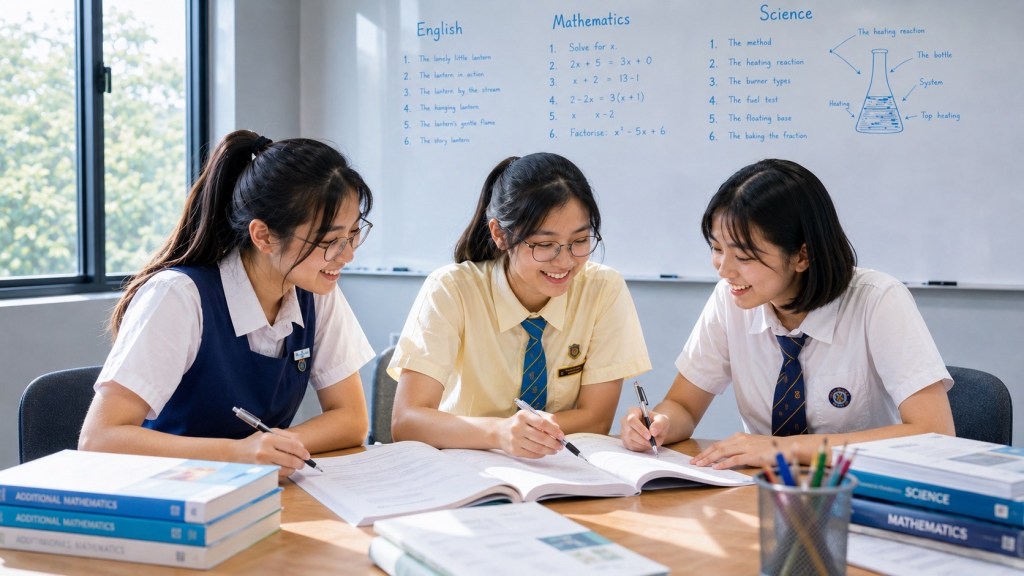
Secondary 3 Tuition Sengkang · Level Flagship 9 of 10
Secondary 3 is the year the curriculum begins to specialise and the examination horizon becomes real. New subject combinations, greater abstraction and longer chains of reasoning expose whether earlier foundations are genuinely connected—or merely familiar.
A Sec 3 student no longer needs only more content. The learner needs an architecture capable of storing, retrieving, selecting and applying content across a widening field. Tuition should help build that architecture while there is still enough time for genuine repair before the final-year calendar compresses every decision.
Featured Answer: What Is Secondary 3 Tuition?
Secondary 3 tuition is an upper-secondary specialisation and system-building intervention. It helps a student manage more abstract subject knowledge, repair high-leverage prerequisites, develop cumulative retrieval, improve transfer, establish examination routines and understand the exact G1, G2 or G3 subject-level demands that apply to their pathway.
The Sec 3 goal is not merely to survive harder chapters. It is to create a learner whose knowledge remains available when chapters are mixed, questions are reframed and support is removed.
Specialise → Connect → Retrieve → Select → Transfer → Calibrate.
Contents
- Why Sec 3 is the second major expansion
- G1, G2 and G3 subject-level precision
- What SEC readiness means
- Secondary 3 English
- Secondary 3 Mathematics
- Secondary 3 Additional Mathematics
- The Science knowledge boundary
- Cumulative retrieval and interleaving
- Common weak links
- Build examination architecture before final-year pressure
- How Sec 3 tuition should run
- Evidence that learning has held
- Three learner cases
- The parent role
- Preparing for Secondary 4
- Frequently asked questions
- Where next?
Secondary 3 Is the Second Major Academic Expansion
Primary 3 expanded the child’s world by introducing formal Science and more complex reading and problem solving. Secondary 3 creates another phase change. Subject combinations become more specialised. Mathematical symbolism becomes denser. English expects more deliberate argument, synthesis and control. The learner is asked to retain knowledge over longer periods and to choose among a much larger number of possible routes.
This expansion reveals the difference between chapter success and system success. A student may perform well while a teacher is modelling the current topic, then struggle several weeks later when the same idea appears without its label. Another may understand algebra separately but lose control when algebra is embedded inside geometry, graphs or A-Math. Another may write fluent paragraphs that do not answer the actual question.
The problem is not always insufficient effort. Sometimes the student’s learning system was designed for shorter distances. Sec 3 tuition should extend those distances: between teaching and retrieval, between one representation and another, between a concept and its application, and between an error and the student’s ability to diagnose it.
Secondary 3 is where knowledge must stop living only inside chapters and begin living inside the learner.
G1, G2 and G3: Subject-Level Precision Before Tuition Design
Under Full Subject-Based Banding, a student may take different subjects at different levels. A useful Sec 3 plan therefore begins with exact information: subject, subject level, syllabus, school sequence, current evidence and intended assessment pathway. The word “Secondary 3” alone is not sufficiently precise.
This precision protects both teaching and the student. It prevents a generic worksheet from being mistaken for an appropriate curriculum match. It also prevents one subject level from becoming a global judgement of ability. A learner may require strong support in one discipline and show exceptional independence in another. Human profiles are uneven because knowledge, language, confidence, prior exposure and cognitive demands are uneven.
Tuition should meet the actual subject at the actual level, while keeping the possibility of growth open. Decisions about formal subject-level placement or movement belong to the relevant school and national arrangements; a tutor’s honest role is to build capability and provide clear evidence of learning.
What SEC Readiness Means
The Singapore-Cambridge Secondary Education Certificate applies from the 2027 graduating cohort. Students sit subjects at their respective G1, G2 or G3 levels, and one certificate records the subjects and levels taken. For a Sec 3 student on that pathway, readiness is not produced by learning a new examination name. It is produced by understanding the applicable syllabus, building subject capability and practising the actual forms of reasoning and performance the assessment requires.
SEC readiness has at least five layers:
- Syllabus accuracy: the student and tutor know which subject-level syllabus applies.
- Knowledge integrity: foundational and current concepts are connected and retrievable.
- Task literacy: the student understands command words, evidence requirements and response forms.
- Examination control: knowledge can operate under time, mixed topics and reduced support.
- Pathway awareness: families verify current progression and admission information through official sources rather than assumptions.
Official SEAB guide to the Singapore-Cambridge Secondary Education Certificate
Secondary 3 English: Argument, Interpretation and Deliberate Control
Sec 3 English asks the student to do more than understand individual sentences. The learner must trace argument, distinguish evidence from assertion, recognise implication and tone, respond to purpose and audience, and organise writing around a defensible central line.
Comprehension requires disciplined inference
A strong inference remains accountable to the text. The student identifies the relevant language, explains what it suggests and connects that suggestion to the question. Quotation alone is incomplete; interpretation without evidence is ungrounded. Tuition should make the bridge visible until the student can construct it independently.
Writing needs a governing idea
Upper-secondary writing often fails not because the student has nothing to say, but because ideas are not governed by a clear position or purpose. Paragraphs accumulate examples without development. Introductions promise one argument and conclusions deliver another. The repair begins with a thesis or controlling purpose, then asks what each paragraph contributes, what evidence it uses and how it advances the whole.
Language should become adjustable
The student needs to vary register, sentence structure, emphasis and tone according to task. This is not achieved by memorising one “good style”. It requires understanding how linguistic choices affect a reader. Editing becomes a design process: preserve meaning, sharpen logic, remove ambiguity and choose the level of formality the situation requires.
Secondary 3 English Tuition Sengkang: Upper-Secondary Writing, Comprehension and Argument →
Secondary 3 Mathematics: Transfer Across a Connected Mathematical System
Sec 3 Mathematics increasingly asks the learner to coordinate algebra, geometry, graphs, trigonometry, measurement, statistics and problem solving. A question may begin in one representation and require movement into another. The student must preserve mathematical meaning while symbols, diagrams and contexts change.
The most expensive weakness is often not one missing topic. It is a fragile invariant. Equality, proportionality, gradient, similarity, rate, function and unit relationships travel across many chapters. When one is unstable, several apparently unrelated topics become unreliable.
A method is a conditional tool
Students sometimes ask, “Which formula do I use?” before identifying the structure. Tuition should reverse that order. What is known? What is unknown? What relationship is invariant? Which representation makes it visible? What conditions make this theorem, formula or algebraic route valid?
Working must support recovery
Upper-secondary solutions are long enough that notation becomes an external memory system. Clean working preserves assumptions, intermediate values and transformation history. It allows a learner to resume after interruption and locate the first invalid move. This is not presentation theatre. It is cognitive engineering.
Secondary 3 Mathematics Tuition Sengkang: Upper-Secondary Mathematics, Transfer and SEC Readiness →
Secondary 3 Additional Mathematics: Build the Symbolic Engine
Additional Mathematics increases the density with which symbols carry relationships. An expression may compress several operations, restrictions and structures into one line. A small weakness in algebraic manipulation can propagate through coordinate geometry, functions, logarithms, trigonometry or calculus-related ideas later.
The A-Math learner needs more than procedural memory. They need a symbolic engine with four properties:
- Meaning: symbols remain connected to quantities and relationships.
- Legality: each transformation preserves the relevant mathematical truth.
- Selection: the student recognises which identity, form or method reduces the problem.
- Traceability: working remains clear enough to diagnose and recover.
“Move this across and change the sign” may create short-term speed, but it hides the invariant that makes the operation valid. Strong teaching makes shortcuts reconstructable from principles. The learner can then recover when the problem is unfamiliar.
Secondary 3 Additional Mathematics Tuition Sengkang: Build the A-Math Engine →
The Science Knowledge Boundary
eduKate Sengkang contains a substantial public Science learning estate, including Secondary and post-secondary routes. That knowledge library should not be confused automatically with a current commercial tuition offering. The level flagship therefore routes readers honestly: English, Mathematics and A-Math remain the stated Secondary tuition corridors here, while the Science Hub owns public Science knowledge and learning navigation.
This distinction strengthens the ecosystem. A public educational page can teach, connect and route without making a service claim it does not own.
Secondary & Post-Secondary Science Knowledge Route
eduKate Sengkang Science Hub
Cumulative Retrieval and Interleaving
Sec 3 knowledge must travel farther in time. A concept taught in February may return inside an unfamiliar question months later. Re-reading can create a warm sense of recognition without proving that the idea can be produced when needed. Cumulative retrieval closes that gap.
A robust cycle includes:
- Retrieve the core idea without notes.
- Explain it in plain and technical language.
- Produce or analyse an example.
- Contrast it with a nearby idea or common misconception.
- Apply it inside a mixed set.
- Return after delay.
- Repair the retrieval route if access fails.
Interleaving adds the selection problem. Instead of announcing the chapter, it asks the student to recognise which concept controls the task. This initially feels harder because the cue has been removed. That difficulty is often the exact capability examination conditions require.
Common Secondary 3 Weak Links
| Observed pattern | Possible mechanism | Diagnostic test |
|---|---|---|
| Understands each chapter but fails mixed papers | Selection was supplied by topic order | Use a short interleaved set and require classification before solving |
| A-Math working collapses late in solutions | Early algebraic transformations are unstable | Locate the first invalid line across several solutions |
| English essays contain ideas but lack force | No governing thesis or paragraph function | State the central claim and the job of each paragraph in one line |
| Revision is extensive but recall is poor | Recognition and note exposure dominate retrieval | Use delayed closed-book reconstruction |
| Student avoids unfamiliar questions | Route-selection uncertainty is read as inability | Practise representation and a structured first move before full solving |
| Results fluctuate with teacher or worksheet | Performance is cue-dependent | Change wording, order and representation while preserving the concept |
| Everything becomes urgent | Weekly planning and priority systems are weak | Map deadlines, dependencies, likely cost and available recovery time |
The same visible mark can therefore imply very different interventions. A missing concept needs teaching. A retrieval failure needs spaced recall. A selection failure needs contrast. An execution failure needs step stability. A control failure needs a better operating routine.
Build Examination Architecture Before Final-Year Pressure
Sec 3 is the right time to build examination craft gradually. The aim is not to reproduce the emotional intensity of Sec 4 early. It is to teach the student how an assessment works as a system.
- Task classification: identify what form of knowledge and response the question requires.
- Entry routine: begin with a representation or plan rather than an impulsive answer.
- Evidence discipline: show the marker the reasoning or textual support required.
- Time calibration: learn how long reading, selection, execution and checking actually take.
- Stop rules: recognise when one item is consuming disproportionate resources.
- Error families: classify mark loss and prescribe the correct repair.
- Recovery: resume after uncertainty without carrying the previous question’s emotional residue into the next.
Short timed sections, mixed retrieval and careful paper review often teach these capabilities better than premature endless full papers. Realism should increase as the learner’s knowledge and control become ready to be tested.
How Secondary 3 Tuition Should Run
- Receive the real context. Confirm subject level, syllabus, school sequence, current assessments and the student’s state.
- Retrieve before teaching. Test what remains available without cues.
- Locate the dependency. Find the earliest concept, language or representation that constrains the current task.
- Teach the governing structure. Make invariants, evidence rules and method conditions explicit.
- Stabilise execution. Practise enough to reduce avoidable working-memory load.
- Contrast and interleave. Force the learner to distinguish and select.
- Transfer. Change context, wording, representation or problem order.
- Calibrate under constraint. Add time or paper conditions for a clear diagnostic reason.
- Review the return. Classify errors and update the next intervention.
- Fade. Make the learner increasingly responsible for the plan, check and explanation.
In a three-student group, each learner can encounter methods and errors they would not generate alone. One student may expose an elegant representation, another a plausible misconception and another a strong verification method. The tutor uses these differences as instructional data while keeping feedback specific to each learner’s state.
Evidence That Secondary 3 Learning Has Held
- The student retrieves earlier concepts inside current upper-secondary work.
- The student identifies the relevant method without a chapter label.
- The student can justify algebraic transformations and repair an invalid line.
- The student supports English interpretations with appropriate evidence.
- The student writes paragraphs with a clear function inside a governing argument.
- The student distinguishes knowledge, selection, execution and control errors.
- The student transfers a concept when surface features change.
- The student manages a cumulative revision system rather than restarting before each test.
- The student works for meaningful periods without continuous tutor prompting.
- The student can describe the next repair priority and why it matters.
Three Secondary 3 Learner Cases
Case 1: The capable student overwhelmed by the new subject load
The student studies every evening but reacts only to the nearest deadline. Knowledge is repeatedly acquired and abandoned. Tuition establishes a weekly control board: upcoming assessments, prerequisite gaps, retrieval cycles and high-cost tasks. The total work does not necessarily increase. The work becomes sequenced, and the student recovers a sense of agency.
Case 2: The A-Math student who understands examples but cannot start
The student follows worked solutions fluently, then freezes when the form changes. The tutor removes finished examples and teaches a first-move protocol: classify the object, state the target form, identify constraints, recall candidate identities or methods, and test which reduces uncertainty. Starting becomes a structured reasoning act rather than a memory search for a matching page.
Case 3: The English writer with fluent but unfocused essays
The writing is grammatically competent and rich in examples, but the argument drifts. The student is asked to write a one-sentence governing claim and assign every paragraph a function. Material that does not advance the claim is removed or repositioned. The essay becomes shorter, clearer and more persuasive because selection improves.
The Parent Role: Support the System Without Taking It Over
Sec 3 can tempt families into emergency management. The examination horizon is visible, subject choices feel consequential and the student’s workload appears less transparent. Parents can help most by holding conditions, asking precise questions and ensuring that support remains coherent.
- Confirm the exact subject levels and school syllabuses before buying materials or tuition.
- Review the weekly system at a fixed time rather than issuing continuous reminders.
- Ask what error family or capability is currently being repaired.
- Protect sleep, meals, movement and recovery as learning infrastructure.
- Distinguish a temporary result from a permanent identity judgement.
- Let the student bring their own questions and evidence to tuition.
- Monitor whether tuition is increasing independence or merely relocating dependence.
- Use official MOE, SEAB and school information for policy and pathway decisions.
What Secondary 3 Tuition Should Not Become
- A premature final-year panic system.
- A chapter-preview service that makes school familiar but knowledge non-retrievable.
- A formula and model-answer warehouse without selection rules.
- A workload so large that it damages sleep and school functioning.
- A fixed judgement based on one subject level or examination.
- A place where the tutor owns every plan, start and check.
- A promise of a grade, subject-level move or future pathway.
Preparing for Secondary 4
Secondary 4 converts a long horizon into a finite calendar. A strong Sec 3 ending therefore leaves a map: secure knowledge, fragile knowledge, high-cost weak links, recurring error families, realistic timing data and repair methods already shown to work.
The student should also enter the final year with examination routines partially built. They should know how to begin unfamiliar tasks, preserve working, classify errors, manage mixed revision and recover after a difficult question. Sec 4 can then refine performance rather than invent the entire system under pressure.
Continue to Secondary 4: Graduation-Year Learning, Exam Control and the SEC Transition →
Frequently Asked Questions
Is Secondary 3 too early to begin examination preparation?
It is the right time to build cumulative retrieval, task literacy, mixed-topic selection, timing awareness and error review. It is not necessary to make every week a full examination simulation. The realism of practice should match the learner’s syllabus coverage and current capability.
How should SEC affect a Sec 3 tuition plan?
Confirm the applicable graduating cohort, subject levels and syllabuses through official sources. Then teach the actual subject demands. The SEC name and certificate structure matter administratively; educationally, the plan still needs accurate knowledge, transfer, communication and examination control.
What if a student is struggling in both E-Math and A-Math?
Look for shared algebraic dependencies before treating the subjects as two unrelated failures. Equality, manipulation, factorisation, functions and symbolic organisation may affect both. The balance of repair should still respect the student’s actual syllabuses, time and school priorities.
How much independent study should a Sec 3 student manage?
There is no universal hour count. Independence is better measured by functions: can the student capture tasks, plan a realistic week, retrieve without being told, identify the first unclear point, review errors and adjust? Duration should follow the educational job and total load.
Can a weak Sec 3 year still be repaired?
Meaningful repair is often possible, but the plan should begin immediately with evidence. Identify which gaps are foundational, how widely they spread, how much time remains and what is realistically repairable. Honest prioritisation is stronger than either fatalism or guarantees.
Where Next?
Level route
Secondary 2 · Sec 1–4 Secondary Hub · Secondary 4
Subject routes
Secondary 3 English · Secondary 3 Mathematics · Secondary 3 A-Math · Secondary Science Knowledge
Learning and performance routes
Learning Runtime · Examination Craft · How Learning Has Held
Current-information and editorial boundary: Confirm the applicable subject levels, syllabuses, graduating cohort and pathway information with the student’s school, MOE and SEAB. This article does not guarantee grades, subject-level movement or admission outcomes and does not replace appropriate specialist support.
Atlas return routes | Secondary 3
- Learning Atlas V2.0 — route upper-secondary specialisation by learner state and subject.
- Emily’s Secondary 3 Mid-Year — for a worked narrative of crowded results and high-leverage repair.
- Parents’ Guide — manage workload, support and subject priorities.
- Learning Runtime — test stability and transfer as subject depth expands.
- The Tutor System — when a defined Sec 3 dependency needs targeted tutoring.
- Examination Craft — when WA, EOY or prelim-style paper execution becomes the bottleneck.
