
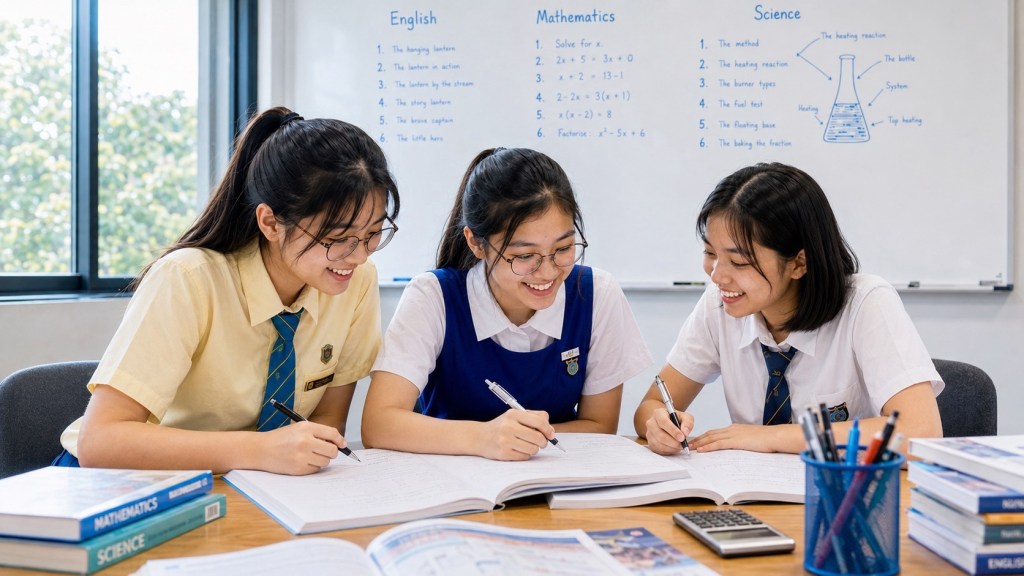
Secondary 2 Tuition Sengkang · Level Flagship 8 of 10
Secondary 2 tuition in Sengkang should use the quiet structural year to consolidate the learning system before upper-secondary specialisation raises the cost of every hidden weakness. The first shock of Secondary 1 has passed, but Sec 3 urgency has not yet fully arrived. That makes Sec 2 one of the best years for precise repair, cumulative retrieval, subject-level growth and increasing independence.
The central P2-like question returns at a more advanced scale: is the student’s current performance genuinely owned, connected and transferable, or is it being held together by familiar topics, last-minute review and external reminders?
Featured Answer: What Is Secondary 2 Tuition?
Secondary 2 tuition is a consolidation and readiness intervention. It strengthens subject-level English and Mathematics capability, repairs gaps that survived the Sec 1 transition, connects topics into larger structures, improves retrieval and transfer, and prepares the student for the greater specialisation and examination demands of upper Secondary.
Its deepest purpose is to prevent temporary adequacy from becoming future fragility.
Consolidate → Connect → Distinguish → Transfer → Prepare.
Contents
- Why Sec 2 is a quiet structural year
- Subject-level growth under Full SBB
- Secondary 2 English
- Secondary 2 Mathematics
- Connected knowledge
- Common hidden weak links
- Upper-secondary readiness
- How Sec 2 tuition should run
- Evidence that learning has held
- Three learner cases
- The parent role
- Preparing for Secondary 3
- Sec 2 diagnostic matrix
- Sec 2 year map
- Full SBB readiness
- Cumulative system
- WA/EOY telemetry
- Sec 2 weekly system
- 4-, 8- and 12-week review
- Sec 3 readiness
- Parent dashboard
- Sec 2 error taxonomy
- Three-student Sec 2 lesson
- How much support?
- School–home–tuition roles
- Useful progress report
- Sec 2→3 bridge
- Sec 2 release test
- Sec 2 subject portfolio
- Upper-secondary decisions
- Minimum Sec 3 readiness
- Final family review
- Frequently asked questions
- Where next?
Why Secondary 2 Is a Quiet Structural Year
Years with obvious transitions attract intervention. Sec 1 is new. Sec 3 brings different subject combinations and greater abstraction. Sec 4 carries national examination pressure. Sec 2 can appear ordinary. Yet it is the year in which the student can inspect the machinery before it is placed under heavier load.
A student may pass because each unit is tested soon after teaching. They may recognise worked examples, revise intensely the night before and depend on topical worksheets that announce the method. None of this proves that knowledge is durable, connected or selectable when topics are mixed.
Sec 2 tuition should therefore create small amounts of productive uncertainty. Can the student retrieve without re-reading? Can they identify the method without a topic heading? Can they explain why an English interpretation is supported? Can they connect a new concept to an earlier one? These tests expose hidden fragility while time still exists to repair it properly.
Secondary 2 is not an empty corridor between important years. It is the maintenance floor beneath upper Secondary.
Subject-Level Growth Under Full Subject-Based Banding
Full Subject-Based Banding asks families and educators to read the learner with greater precision. A student may take subjects at different G1, G2 or G3 levels. Progress in one subject does not automatically describe capability in another, and movement should not be treated as a judgement of the whole person.
For tuition, this means four facts must be clear: the subject, the current subject level, the exact school syllabus and the student’s independent performance. A worksheet labelled “Secondary 2” may still be mismatched if the subject-level demand or school sequence differs.
Subject-level growth should be evidenced through capability: stronger comprehension, more reliable algebra, better transfer, clearer explanation and greater independence. A label can indicate the current operating context. It should never become a ceiling placed inside the student’s identity.
Secondary 2 English: Build the Bridge to Upper-Secondary Thought
Sec 2 English sits between foundational Secondary work and the more deliberate argument, interpretation and examination craft of upper Secondary. Students need to read beyond literal content, distinguish claim from evidence, track tone and purpose, and produce writing with a clearer line of thought.
Inference must remain accountable to the text
An inference is not a guess that sounds intelligent. It is a conclusion supported by textual evidence and contextual reasoning. Tuition should ask the student to show the bridge: which words, action or contrast support the claim, and why do they support it?
Writing needs a controllable argument
Whether the task is personal, expository, situational or reflective, the student needs a governing purpose. Paragraphs should not be boxes filled to a template. Each should perform a distinct job in moving the reader from opening position to developed conclusion.
Editing should become diagnostic
Students often reread writing and see what they intended rather than what appears on the page. Editing routines should be layered: first meaning and structure, then sentence boundaries and grammar, then vocabulary and surface accuracy. Trying to check everything at once produces a vague scan.
Secondary 2 English Tuition Sengkang: Build the Bridge to Upper Secondary →
Secondary 2 Mathematics: Connect the Algebraic and Geometric World
Sec 2 Mathematics develops a larger network of algebra, equations, graphs, geometry, ratio, proportion and data. The risk is topic compartmentalisation: the student can perform each method while the chapter is visible but cannot see how the same relationship appears elsewhere.
Algebra should be understood as a representation system. A graph represents a relationship between quantities. An equation represents equality. A geometric formula compresses an invariant relationship. When these ideas are understood, methods become reconstructable. When they are memorised as isolated procedures, upper-secondary complexity creates brittle performance.
The method boundary matters
Students need to compare methods and know where each stops being useful. Substitution, elimination, graphical interpretation and algebraic manipulation may solve related problems, but the most efficient route depends on structure. Tuition should make those choices explicit rather than presenting one method as the permanent answer.
Errors should remain traceable
Clean working preserves the state of a solution. When an error occurs, the learner and tutor can locate the first invalid transformation. This reduces the habit of calling every mathematical failure careless and creates a specific repair path.
Secondary 2 Mathematics Tuition Sengkang: Build the Bridge to Upper Secondary Mathematics →
Connected Knowledge Is More Durable Than Chapter Knowledge
Chapter knowledge answers, “What did we do this week?” Connected knowledge answers, “What larger idea does this belong to, what earlier knowledge does it depend upon, and where else can it be used?”
A connected study routine might ask:
- Which old idea does this new idea extend?
- Which similar idea must not be confused with it?
- What representation makes the relationship visible?
- What evidence would show the idea is being applied incorrectly?
- How might an examination hide this topic inside an unfamiliar context?
- Can the student produce a worked example and a counterexample?
These questions turn notes into a map. The student no longer stores each lesson as a separate box.
Common Hidden Weak Links in Secondary 2
| Observed pattern | Possible mechanism | Diagnostic test |
|---|---|---|
| Passes topical tests, fails cumulative assessments | Blocked practice and weak retrieval selection | Use a delayed mixed mini-assessment |
| English answers sound plausible but receive few marks | Inference is not anchored to evidence or demand | Separate claim, evidence and reasoning |
| Mathematics errors recur across topics | A shared algebraic or symbolic dependency is unstable | Locate the first invalid transformation across several examples |
| Revision takes hours but little is remembered | Re-reading creates familiarity without retrieval | Close notes and reconstruct from prompts or a blank page |
| Student cannot explain what is weak | Metacognitive categories are too broad | Use error families and the last-clear-step question |
| Performance depends strongly on teacher examples | Route selection remains externally cued | Remove examples and mix near-neighbour tasks |
Sec 2 is the ideal time to inspect these patterns because they are serious enough to matter and early enough to repair without final-year compression.
What Upper-Secondary Readiness Actually Means
Readiness is not simply having seen a Sec 3 textbook. It is the capacity to support greater specialisation without losing the floor.
- Foundational algebra and language are sufficiently stable.
- Knowledge can be retrieved after delay.
- The student can plan work across several subjects.
- The student can distinguish a content problem from a study-system problem.
- The student can ask precise questions and use feedback.
- Mixed practice does not cause disproportionate collapse.
- Writing can sustain a line of thought across paragraphs.
- Mathematical working remains legible and recoverable.
- The student understands the current subject-level pathway and relevant school expectations.
Where a student is considering or entering Additional Mathematics later, algebraic integrity and comfort with symbolic reasoning deserve particular attention. A-Math does not merely add topics; it increases the speed and density with which symbols carry relationships.
How Secondary 2 Tuition Should Run
- Receive current school evidence and subject-level context.
- Retrieve earlier knowledge before re-teaching.
- Map the concept to its prerequisites and neighbouring ideas.
- Teach the governing relationship or decision rule.
- Practise execution until working memory is freed.
- Contrast similar forms so boundaries become clear.
- Interleave across topics and remove chapter cues.
- Transfer to unfamiliar representation or context.
- Review the error family and update the study plan.
- Retest after delay with less tutor support.
A three-student class adds useful intellectual variation. Students can compare valid routes, challenge an interpretation and see that one surface problem may support several representations. The tutor still protects individual diagnosis; the group is used to expand thinking, not to rank identities.
Evidence That Secondary 2 Learning Has Held
- The student retrieves knowledge cumulatively rather than only before a test.
- The student identifies the subject relationship without a chapter cue.
- The student explains an English inference with relevant evidence.
- The student preserves equality and meaning through algebraic working.
- The student connects a new topic to prior knowledge.
- The student can distinguish two plausible methods or interpretations.
- The student classifies errors and proposes a repair action.
- The student manages a workable weekly learning system.
- The student performs with fewer prompts when context changes.
Three Secondary 2 Learner Cases
Case 1: The student who passes everything narrowly
Marks are not alarming, but mixed retrieval reveals that topics disappear after each test. Tuition builds a cumulative review cycle and concept map. The student begins every lesson by retrieving earlier ideas and ends by connecting the new topic to the network. Performance becomes less dependent on recent exposure.
Case 2: The evidence-free English inference
The student offers thoughtful interpretations but cannot show textual support. Lessons require two-column reasoning: what the text gives and what the student concludes. Unsupported ideas are not mocked; they are tested. The learner discovers that disciplined evidence makes interpretation stronger, not smaller.
Case 3: The student preparing for more demanding Mathematics
Calculation is strong, but algebraic notation is handled through memorised movement rules. Tuition returns to equality, inverse operations, variables and symbolic meaning. The student must justify transformations and correct deliberately planted errors. This builds a more reliable base for upper-secondary Mathematics and possible A-Math.
The Parent Role: Inspect the System Before Crisis
- Review patterns across a term rather than reacting only to one test.
- Ask the student what has become easier to retrieve or explain.
- Check whether revision produces output, not only time spent.
- Discuss subject-level strengths without turning them into identity labels.
- Encourage the student to bring precise questions to school or tuition.
- Protect a weekly planning and review routine.
- Use Sec 2 to repair quietly rather than waiting for Sec 3 urgency.
What Secondary 2 Tuition Should Not Become
- A holding pattern until upper Secondary.
- A chapter-preview service that removes retrieval and selection.
- A collection of model answers with no reconstruction.
- A system that confuses long revision hours with durable learning.
- A fixed judgement based on one subject level.
- A workload increase without diagnosis of the bottleneck.
Preparing for Secondary 3
Sec 3 will bring greater specialisation, denser content, new subject combinations for many students and a clearer examination horizon. The strongest preparation is a student with connected foundations, a viable study system and the ability to locate and repair weak links before they spread.
Readiness also includes honest subject-level information. Families should confirm the student’s school arrangements and relevant syllabuses rather than relying on generic labels. The tuition plan should then meet the real subject at the real level.
Continue to Secondary 3: Upper-Secondary Specialisation and SEC Readiness →
Secondary 2 Diagnostic Matrix: Find the Hidden Weakness Before Sec 3
Sec 2 results can look stable while the underlying system is fragile. A student may pass because topics are still familiar, teachers provide strong cues and assessments remain bounded. Upper Secondary later removes many of those supports. The Sec 2 job is to discover what will not scale before the load increases.
| Visible pattern | Possible mechanism | What tuition should test | Useful next evidence |
|---|---|---|---|
| Passes most tests narrowly. | Several capabilities may be Fragile rather than Stable. | Delayed retrieval and mixed work. | Performance remains reliable without immediate revision cues. |
| Maths is fine topic by topic but mixed tests collapse. | Method boundaries and algebraic selection are weak. | Interleaved questions without chapter labels. | The student selects a valid route from structure. |
| English inference sounds plausible but lacks marks. | Evidence discipline is weak. | Claim → evidence → interpretation. | Inference remains accountable to the text. |
| Student studies long hours before each test and then forgets. | Learning is recency-dependent. | Cumulative retrieval across several weeks. | Older knowledge returns without full relearning. |
| Several subjects weaken after CCA and homework increase. | Capacity rather than ability may be the bottleneck. | Weekly time audit and task completion pattern. | Performance improves after workload is reallocated. |
The value of the matrix is preventive. Sec 2 tuition should not wait for a Sec 3 collapse to prove that the foundation was weak. It should create honest evidence while there is still time to rebuild deeply.
The Sec 2 Year Map: Consolidate, Connect, Test, Prepare
| Phase | Main job | Evidence | What to avoid |
|---|---|---|---|
| Early year | Audit Sec 1 carry-over and current subject demands. | First attempts, old-topic retrieval, school work. | Assuming a new year resets old weaknesses. |
| Mid-year | Connect chapters and strengthen transfer. | Mixed work, explanation, delayed recall. | Studying only the current chapter. |
| After assessment evidence | Repair recurring failure families. | Marked scripts and fresh retests. | Chasing the score without classifying the cause. |
| Final term | Test upper-secondary readiness and independence. | Cumulative mixed tasks, subject-level planning and self-management. | Pre-teaching Sec 3 to hide unresolved Sec 2 gaps. |
The year should become more cumulative as it progresses. By the final term, a learner should not need the tutor to announce which chapter a problem belongs to. English interpretation, Mathematics selection and general study planning should survive a less-cued environment.
Subject-Level Growth Under Full SBB: Evidence Before Movement
Full Subject-Based Banding allows subject-level flexibility, but movement should be read through actual capability. A desire for a more demanding level is not itself evidence of readiness, and one weak result does not necessarily mean the student belongs at a less demanding level.
Before a family discusses subject-level movement, examine four layers:
- Foundation: are the prerequisites stable?
- Current demand: can the student handle present work without excessive support?
- Transfer: does the capability survive unfamiliar questions?
- Capacity: can the student carry the additional demand alongside the rest of the subject portfolio?
A student who is strong but heavily scaffolded may not yet be ready for a more demanding level. A student with one isolated weak chapter may still be broadly ready. The school owns formal subject-level placement decisions; tuition should provide accurate learning evidence, not promises about movement.
The Sec 2 Cumulative System: Stop Letting Old Topics Disappear
Upper-secondary readiness depends on older learning remaining accessible while new content arrives. Sec 2 students who revise only the current chapter can appear successful until a cumulative assessment or Sec 3 topic requires an older dependency.
- Current layer: this week’s school learning.
- Recent layer: one retrieval from the last two to four weeks.
- Old layer: one short return to an earlier term or Sec 1 dependency.
- Mixed layer: periodic questions that require choosing among several known methods or ideas.
This system does not need long hours. Five to fifteen minutes of closed-book retrieval can reveal whether knowledge is still accessible. When retrieval fails, return to the concept before the next subject layer assumes it is available.
Use WA and EOY Papers as Telemetry
A Secondary 2 assessment should answer more than “What grade did I get?” It can reveal whether the learner is ready for a larger upper-secondary system.
- Separate questions that were never attempted from those attempted incorrectly.
- Identify the first wrong decision in each major error.
- Group the errors into knowledge, retrieval, selection, execution, time and checking.
- Count recurrence rather than reacting to the most dramatic question.
- Choose one or two repairs.
- Retest on fresh material after the correction.
If the same error returns in several assessments, the programme should change method. A growing stack of corrected papers is not evidence of learning if the next paper reproduces the same first wrong decision.
A Workable Sec 2 Week
Sec 2 can look calm enough that families quietly overfill the week. School, CCA, tuition, homework and enrichment should leave some room for independent consolidation. If every evening is externally scheduled, upper Secondary will arrive before the student has practised managing any of it.
| Block | Purpose | Warning sign |
|---|---|---|
| School / homework | Meet current obligations and generate authentic evidence. | Tuition work regularly displaces school work. |
| Tuition | Repair the highest-leverage weak link. | Every subject receives tuition regardless of state. |
| Retrieval | Keep older learning available. | Only current chapters are ever revised. |
| Independent study | Practise planning and self-monitoring. | Parents or tutors still choose every task. |
| Recovery | Protect attention and memory. | CCA or assessment weeks repeatedly borrow from sleep. |
The Sec 2 4-, 8- and 12-Week Review
After 4 weeks
- Is the main weak link clearer?
- Can the student explain the current repair target?
- Are subject-level and workload issues being separated?
- Has unnecessary volume been removed?
After 8 weeks
- Does the repaired learning survive a delay?
- Can the student use it in mixed work?
- Are repeated error families shrinking?
- Is independent planning increasing?
After 12 weeks
- Does school evidence show the same improvement?
- Can any subject move to lighter maintenance?
- Is the learner ready for more demanding transfer?
- Is the Sec 3 plan now smaller and clearer?
Sec 3 Readiness Gates: What Should Be Stable Before Specialisation Expands?
- English: inference is evidence-based, writing has a governing idea, and language is becoming adjustable to purpose.
- Mathematics: algebraic manipulation, graphs, geometry and method selection are stable enough to support upper-secondary expansion.
- Science: concepts can be reconstructed from evidence rather than memorised only by chapter.
- Study system: the learner can keep older topics alive while current work continues.
- Independence: deadlines, help-seeking and basic weekly planning are increasingly student-owned.
- Capacity: the student has enough margin for a larger Sec 3 subject load without every evening becoming crisis management.
If a readiness gate is weak, the year-end bridge should repair it. Pre-teaching a new Sec 3 subject cannot compensate for fragile algebra, weak reading evidence or a learner who still needs an adult to run the week.
The Sec 2 Parent Dashboard
- Cumulative memory: does older learning still return?
- Subject pattern: are weaknesses local or broad?
- Independence: is the student carrying more planning and correction?
- Workload: is the week sustainable before Sec 3 increases demand?
- Transfer: can the student use known ideas when the format changes?
The Sec 2 learning goal is clear: use the quiet year to expose hidden fragility, connect knowledge across time, read subject-level readiness from evidence and enter upper Secondary with a smaller list of real problems.
Sec 2 Error Taxonomy: Diagnose What Will Become Expensive in Sec 3
English
- Inference error: the interpretation is plausible but not sufficiently supported.
- Evidence-selection error: the student chooses a quotation or detail that does not carry the claim.
- Argument error: the writing has points but no governing relationship among them.
- Language-control error: grammar, cohesion or sentence boundaries weaken longer responses.
- Editing error: corrections are made by sound rather than by a known rule or meaning check.
Mathematics
- Algebraic legality error: transformations do not preserve the mathematical relationship.
- Representation error: graphs, equations or diagrams are not connected to the underlying structure.
- Method-boundary error: the learner knows methods but not when each method applies.
- Working error: too much is done mentally, making mistakes hard to locate and repair.
- Transfer error: the method works only in familiar topical forms.
These distinctions matter because Sec 3 will amplify them. A small algebraic legality error can become an A-Math dependency. A weak English argument can become a larger writing problem. The Sec 2 year is valuable precisely because these issues can still be repaired before the subject load expands.
What a Strong Three-Student Sec 2 Lesson Should Do
A small group should expose different reasoning paths while keeping every learner accountable. The tutor should not deliver the same explanation to three students and call that personalisation.
| Phase | Tutor job | Student job | Evidence |
|---|---|---|---|
| Cumulative retrieval | Return to an older dependency. | Recall without notes. | What remained accessible. |
| Diagnostic attempt | Observe before full teaching. | Show the first move. | Where control leaves the learner. |
| Repair | Teach the smallest missing idea. | Explain why it works. | Whether the model is understood. |
| Contrast | Present a similar-looking task requiring a different route. | Discriminate between methods. | Whether boundaries are becoming clear. |
| Transfer | Change representation or context. | Attempt independently. | Whether learning travels. |
| Exit | Give one fresh task. | Complete, check and explain. | The next learner state. |
Peer explanation can be valuable because Sec 2 students are old enough to compare methods explicitly. One learner can defend a route; another can identify the condition under which it fails; a third can test the rule on a fresh example. The tutor should then verify each student individually.
How Much Sec 2 Tuition Is Actually Needed?
| Current condition | Useful support | What to avoid | Exit condition |
|---|---|---|---|
| Stable subject | Self-study or light maintenance. | Keeping tuition because Sec 3 is approaching. | School and fresh work remain reliable. |
| Fragile subject | Weekly retrieval and transfer. | Reteaching entire chapters repeatedly. | Learning survives delay and changed questions. |
| Blocked dependency | Focused repair, sometimes temporarily intensive. | Jumping into upper-secondary preview. | The first valid move appears independently. |
| Strong but overloaded student | Reduce duplication and protect consolidation. | Adding support because the student is ambitious. | Performance remains stable with more self-study. |
| Assessment-only weakness | Question reading, time, checking and recovery. | Assuming the subject knowledge itself is weak. | Known capability survives assessment conditions. |
The purpose is to avoid permanent escalation. Sec 2 is the ideal year to test whether support can reduce in stable areas before Sec 3 makes the week more crowded.
School, Home and Tuition: Prepare for Upper Secondary Without Duplicating It
Sec 2 students need increasing responsibility for integration. School owns the curriculum and formal assessment. Tuition should own targeted diagnosis and repair. Home should protect the environment and weekly capacity. The student should increasingly own planning, first attempts, correction and help-seeking.
- If school has already supplied heavy practice, tuition can use shorter diagnostic work.
- If tuition has repaired a concept, home should not reteach it; home can provide a fresh opportunity to verify independence.
- If the student is Stable, reduce prompts rather than maintaining Primary-school levels of supervision.
- If CCA or school projects create a temporary load spike, optional tuition work should flex.
This coordination matters because Sec 3 will add complexity. A learner who reaches upper Secondary already dependent on three adults to organise every task will find the next expansion much harder than a learner who has practised running a simpler but genuine system.
What a Useful Sec 2 Progress Report Should Say
| Field | Useful question |
|---|---|
| Subject state | What is Blocked, Fragile, Stable or ready for transfer? |
| Cumulative memory | Which older dependencies are still accessible? |
| Highest-leverage weak link | What will become most expensive if carried into Sec 3? |
| Evidence of change | What fresh or delayed task shows improvement? |
| Support level | What help can now be reduced? |
| Sec 3 preparation | What must be repaired before specialisation expands? |
That report should change the next four weeks. If it does not change what anyone does, it is description rather than useful feedback.
The Sec 2→3 Bridge: Repair Before Specialisation
The year-end holiday before Sec 3 is valuable because it can remove dependencies before Additional Mathematics, deeper Sciences, more demanding Humanities and upper-secondary English increase the load. The bridge should not become a race through the Sec 3 syllabus.
- Recover from the Sec 2 year.
- Audit the year’s marked work.
- Repair algebra, reading, writing or Science foundations that repeatedly failed.
- Use cumulative retrieval across Sec 1–2 content.
- Practise independent planning for several study blocks.
- Preview selectively only where the foundation is stable.
A strong learner may use part of the holiday for enrichment or subject exploration. A fragile learner may need most of the time for consolidation. The right route depends on the state, not on what classmates are doing.
The Sec 2 Release Test
- Can the student keep older topics alive without being told exactly what to revise?
- Can they plan a week around school and CCA?
- Can they use marked work to identify a first wrong decision?
- Can they ask for precise help?
- Can they handle mixed questions without a chapter label?
- Can any tuition subject now move to maintenance or self-study?
If the answer is increasingly yes, Sec 2 has done its structural job. The learner is not only ready for harder content; they are more capable of carrying the larger system that harder content will require.
That is the Sec 2 completion standard: hidden fragility has been exposed, high-leverage gaps have been repaired, older learning remains reachable and the student enters Sec 3 with more capacity rather than simply more material.
Manage Sec 2 as a Subject Portfolio, Not a Single Average
A Secondary 2 average can hide very different states. One subject may be comfortably Stable, another Fragile, another genuinely Blocked. Planning from the average encourages uniform support where differentiated support would be more useful.
| Subject state | Weekly job | Allocation principle |
|---|---|---|
| Blocked | Repair the first dependency. | High attention, narrow scope, clear exit test. |
| Fragile | Retrieve and revisit after delay. | Frequent short returns rather than long reteaching. |
| Stable | Maintain and vary. | Light support; do not over-revise because it feels comfortable. |
| Transfer-ready | Mix and integrate. | More independent selection, less tutor direction. |
| Strong and independent | Self-study or enrichment where useful. | Protect time for weaker priorities and recovery. |
The portfolio should change when evidence changes. A Mathematics dependency repaired in Term 2 may move from Blocked to Fragile. A strong English student may move from weekly tuition to independent reading and occasional writing review. A Science weakness may need a short targeted block without changing the rest of the week.
This is also why the family should not automatically replicate every school subject with a tuition subject. Tuition should exist where it adds a distinct educational function.
Upper-Secondary Decisions: What Tuition Can and Cannot Contribute
Sec 2 can involve important conversations about subject combinations, levels and the shape of upper-secondary study. Formal school decisions belong to the school and the applicable MOE framework. Tuition can still contribute useful evidence by showing how the learner performs when support is reduced and conditions change.
Useful evidence includes:
- Whether algebraic foundations are stable enough for more demanding Mathematics.
- Whether English reading and writing can sustain longer, more abstract work.
- Whether Science understanding is conceptual rather than memorised.
- Whether the student can maintain older learning while current topics continue.
- Whether the weekly capacity can carry an expanded upper-secondary load.
- Whether the learner genuinely wants deeper work in a subject or is responding mainly to comparison pressure.
Tuition should avoid promising that a student “should” or “will” receive a particular school-level outcome. Its job is narrower and more defensible: produce accurate learning evidence, strengthen the relevant capability and help the family ask better questions.
The Minimum Viable Sec 3-Ready System
A student does not need every Sec 2 weakness eliminated before entering Sec 3. They do need enough stable infrastructure that specialisation does not immediately overwhelm the system.
- Core English comprehension and writing routines are sufficiently stable to support deeper argument and interpretation.
- Core Mathematics algebra, representation and working are sufficiently reliable to support upper-secondary expansion.
- Science concepts can be explained from evidence rather than recalled only by chapter.
- Older content is retrieved periodically.
- The student can plan at least part of the week independently.
- Help-seeking is reasonably precise.
- CCA, tuition, homework and recovery fit inside a sustainable week.
- There is at least one method for reviewing a marked assessment and turning it into the next action.
If several of these gates are weak, the holiday before Sec 3 should prioritise repair and consolidation. If most are strong, selective preview and enrichment can extend the system without replacing it.
The Final Sec 2 Family Review
- Which subjects are genuinely stable? These may need less external support next year.
- Which subject contains the highest-leverage weak link? This becomes the first Sec 3 repair priority.
- Which old topics are disappearing? Build them into cumulative retrieval.
- Which part of the week is overloaded? Fix capacity before adding upper-secondary support.
- What can the student now manage alone? Preserve and extend that independence.
- What evidence will decide whether the Sec 3 plan is working? Agree on the first review window before the year begins.
The student should participate in this review. Upper Secondary becomes increasingly difficult to manage when learning is something adults design around the student rather than with them.
Sec 2 succeeds when it reduces surprise. The family enters Sec 3 knowing which foundations are stable, which dependencies still need repair, how the week will be carried and where external support genuinely adds value.
Frequently Asked Questions
Is Secondary 2 too early for upper-secondary preparation?
It is the right time to strengthen prerequisites, retrieval, transfer and study systems. It is not necessary to turn the year into premature Sec 3 acceleration. Readiness comes from a stable architecture, not merely early exposure.
How do we know whether a result reflects a real gap?
Look for recurrence across tasks, delayed retrieval and changed formats. One result can be noisy. A capability that repeatedly fails when cues disappear deserves closer diagnosis.
Should my child study more hours?
Only after identifying what current time produces. If revision is mostly rereading, increasing hours may increase familiarity without retrieval. Improve the learning action—recall, application, error analysis, explanation—before assuming duration is the main bottleneck.
Can tuition help with subject-level movement?
Tuition can help a student build the underlying subject capability, but decisions about subject-level placement or movement are governed by school and MOE arrangements. No tutor should promise a particular placement. The honest job is to strengthen performance and provide clear evidence of learning.
Where Next?
Level route
Secondary 1 · Sec 1–4 Secondary Hub · Secondary 3
Subject routes
Secondary 2 English · Secondary 2 Mathematics · Secondary Science Knowledge
Learning routes
Learning Runtime · How Learning Has Held · Parents’ Guide
Current-information and editorial boundary: Families should confirm the applicable subject level and school requirements with the school, MOE and SEAB. This page does not guarantee grades, subject-level placement or progression outcomes.
Atlas return routes | Secondary 2
- Learning Atlas V2.0 — route Sec 2 consolidation problems before upper-secondary specialisation.
- Parents’ Guide — review workload, support and tuition fit.
- Learning Runtime — test whether algebra, reading and Science foundations are stable.
- The Tutor System — when a defined dependency needs closer teaching.
- Secondary Tuition Sengkang — return to the Sec 1–4 progression map.
- Examination Craft — when WA or end-of-year performance is limited by timing, checking, selection or recovery rather than subject knowledge alone.
