
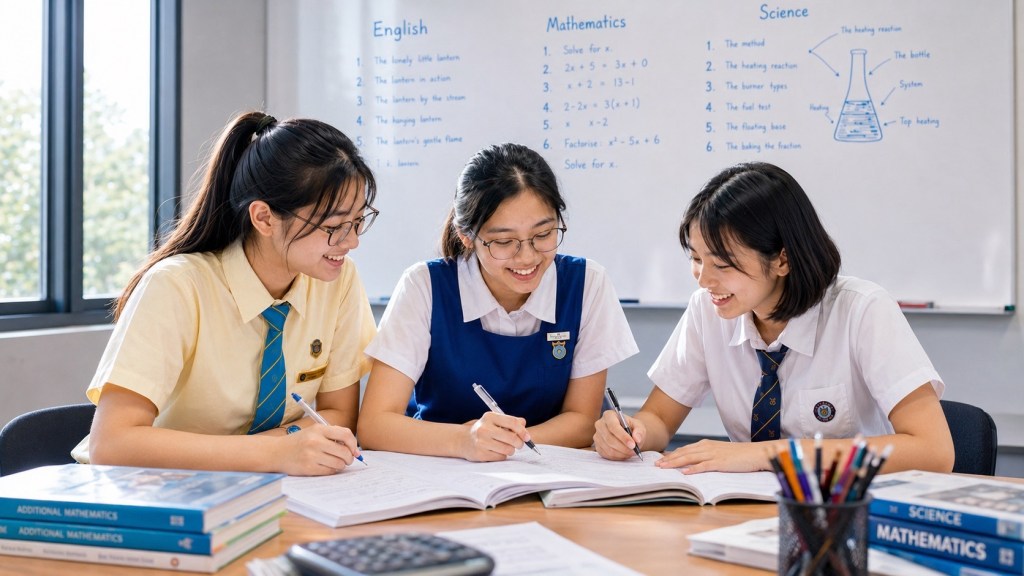
The first term of Secondary 1 is not a test of whether a child “belongs” in Secondary school. It is a transition period in which new subjects, new teachers, a larger timetable, different homework systems and greater independence all arrive together. Feeling slower or less certain at first can be part of learning the new system.
For students and parents asking what Secondary 1 is like after PSLE, how to manage the first term, how much parents should help, what changes in English, Mathematics and Science, or how to stop the Sec 1 transition becoming overwhelming, the useful goal is not to master everything immediately. It is to build a workable operating system.
At eduKate Sengkang, courage in Secondary 1 looks like asking when the rules are unclear, keeping track of work, attempting before seeking help, recovering after the first poor result, and gradually carrying more of the week without adult orchestration.
Week 1: learn the system before judging yourself
- Learn where assignments are posted.
- Know which books and devices each subject needs.
- Write down deadlines instead of relying on memory.
- Notice travel, CCA and lunch routines.
- Do not treat the first confusing week as evidence that Secondary school is “too hard”.
What changes academically
Secondary work often becomes more abstract and more cumulative. Mathematics introduces stronger algebraic thinking. English expects greater control of reading, evidence and writing. Science asks students to coordinate models, concepts, data and explanation. The learner also has more subjects competing for attention.
The first-term priority: independence before optimisation
Parents do not need to engineer the perfect study timetable in January. First make sure the student can capture homework, begin tasks, pack materials, ask for help and recover from a missed deadline. A simple system that the student actually uses is better than a sophisticated plan managed entirely by adults.
When the first test goes badly
Do not rush to conclude that the school, subject level or child is wrong. Read the paper. Was knowledge missing? Was algebra fragile? Did the child misread the question? Was the paper unfinished? Did the learner know the content at home but fail to retrieve it in the test?
Use My Child Was Fine in Primary and Is Failing Sec 1 when the transition is producing a real performance collapse.
English in Secondary 1
Expect more demand on inference, language effects, evidence, structured writing and independent reading. Use the Secondary English Learning Hub when the issue is technical rather than transitional.
Mathematics in Secondary 1
Number skills remain important, but symbolic thinking becomes more visible. Weaknesses in signed numbers, equivalence and early algebra can become expensive later. Repair them early instead of letting the student survive on procedural imitation.
Science in Secondary 1
The student is moving toward more formal models, data interpretation and explanation. Encourage the learner to ask what evidence supports a claim and how the mechanism works rather than memorising disconnected keywords.
CCA and the real week
The first term is also where time becomes real. School, CCA, travel, homework, tuition, sleep and social adjustment all compete. If the week is overloaded, do not solve that by adding another programme before auditing the schedule.
What parents can stop doing gradually
- Checking every homework item.
- Packing the bag.
- Reminding every deadline.
- Emailing teachers for things the student can ask themselves.
- Choosing every study block.
Fading support is part of the transition. The student should finish Term 1 carrying more of the system than they did in Week 1.
The Secondary 1 brave moves
- I can say, “I don’t understand this part yet.”
- I can ask a precise question instead of waiting.
- I can have one bad test without deciding I am bad at the subject.
- I can re-plan a missed deadline.
- I can start a difficult question with a first move even when the route is unclear.
By the end of Term 1
A good transition does not require perfect grades. Look for a learner who understands the weekly system, can identify when help is needed, is beginning to manage deadlines, and has a clearer picture of which subjects are Blocked, Fragile, Stable or ready for transfer.
Where this page sits in I Am Brave
This page is part of I Am Brave | Courage, Learning & the eduKate Sengkang Learning Hall and Learning Atlas V2.0. It is the narrative bridge from PSLE results into the first real term of Secondary learning.
Last updated: 26 September 2026.
The first Secondary 1 term: build the learner runtime before chasing perfect marks
Map the new system
Secondary school increases the number of teachers, subjects, rooms, platforms and deadlines. In the first weeks, create one reliable capture system for homework, tests, materials and CCA commitments. A learner who knows where obligations live has more attention available for learning.
Expect subject language to change
Mathematics becomes more symbolic, Science explanations more explicit, English tasks more varied and humanities more evidence-based. Early difficulty can reflect unfamiliar task language rather than missing intelligence. Ask what the question now expects that Primary school did not.
Use the first assessments diagnostically
The first WA or class test should reveal adjustment needs. Separate content gaps from rushed reading, incomplete working, weak revision or unfamiliar format. Repair the mechanism rather than labelling the child ‘not suited’ to the subject after one early result.
CCA changes the weekly energy budget
CCA can make some afternoons long. Homework planning must account for travel, meals and fatigue. Put demanding work in realistic high-energy windows and lighter retrieval or organisation in shorter windows. A schedule that ignores energy will fail even if it looks efficient on paper.
Parents should hand over control gradually
Do not disappear on day one, but do not continue managing every task as if the child were in Primary school. Move from doing to checking, from checking to weekly review, and from weekly review to exception handling. Independence grows through controlled transfer of responsibility.
Friendship and belonging affect learning
A student who is worried about classmates, routes or routines may have less attention available for academic work. Treat social adjustment as part of the transition without assuming every uncomfortable week is a crisis. Stable routines and one or two trusted adults at school can reduce uncertainty.
By the end of Term 1
The learner does not need perfect grades. They should increasingly know how to record work, prepare for a test, ask a teacher a precise question, recover from a poor result and plan around CCA. Those are the foundations on which later Secondary performance is built.
