
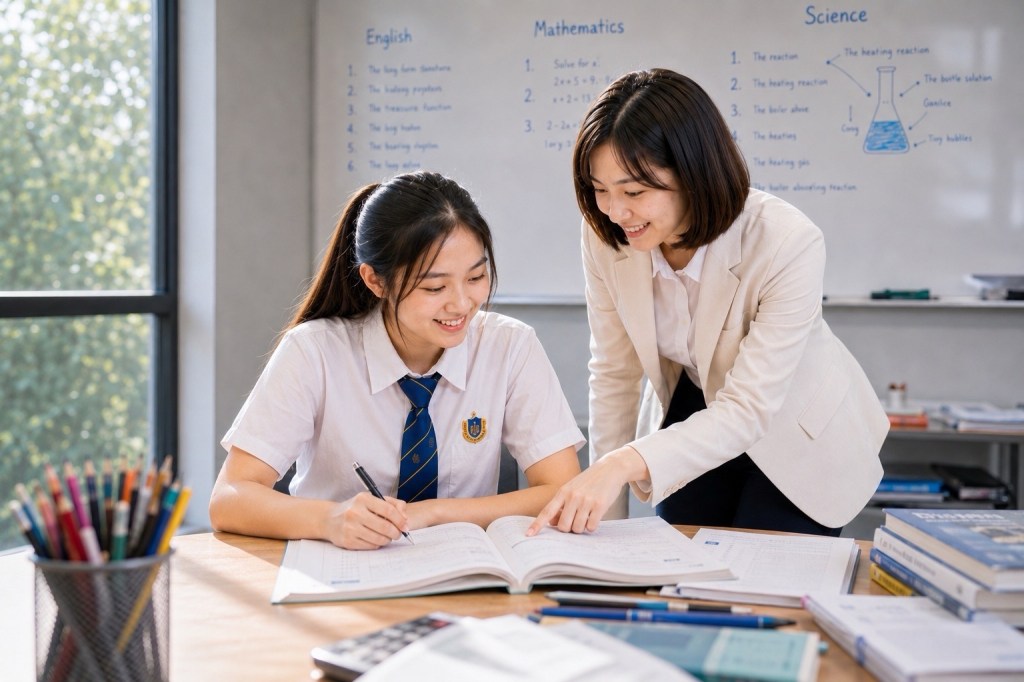
Secondary 4 Mathematics Tuition Sengkang: Expert Preparation for GCE O-Level Success with eduKate Singapore
Secondary 4 Mathematics is not simply another year of schoolwork. It is the year in which four years of mathematical learning must become accurate, connected and dependable under examination conditions.
A student may understand algebra during a lesson but lose marks when it appears inside a graph question. Another may know the correct formula but fail to show sufficient working. A stronger student may complete most questions correctly yet remain just below an A1 because of several avoidable errors across two papers.
These students do not need the same lesson.
At eduKate Sengkang, Secondary 4 Mathematics tuition is designed around a simple principle: give each student the route that allows them to make the best possible progress.
A student with unfinished foundations needs a clearer and safer route back into the subject. A student who is already performing well needs a wider route—one that develops flexibility, speed and the ability to solve unfamiliar questions calmly.
The destination may be the same examination. The route towards it should not be.
Secondary 4 Mathematics in 2026
Students graduating in 2026 continue to sit for the Singapore-Cambridge GCE O-Level examinations. The current O-Level Mathematics examination is Mathematics Syllabus 4052. From the 2027 graduating cohort, the Singapore-Cambridge Secondary Education Certificate, or SEC, will replace the existing N- and O-Level certificates, with subjects examined at the relevant G1, G2 or G3 level. (SEAB)
For students taking O-Level Mathematics in 2026, the examination consists of two papers:
- Paper 1: 2 hours 15 minutes, approximately 26 short-answer questions
- Paper 2: 2 hours 15 minutes, with 9 to 10 questions of different lengths
- Each paper carries 90 marks and contributes 50% of the final result
- The final question in Paper 2 focuses on applying mathematics to a real-world situation
Essential working must be shown, and both papers permit the use of an approved calculator. (Isomer User Content)
This examination structure matters because Secondary 4 preparation cannot be reduced to memorising formulas or completing more worksheets. Students must be able to:
- Use standard mathematical techniques accurately
- Solve problems presented in different contexts
- Explain, justify and communicate their mathematical reasoning
These assessment areas carry approximate weightings of 45%, 40% and 15% respectively. (Isomer User Content)
A student therefore needs more than knowledge. The student needs control.
Why Secondary 4 Mathematics Feels Different
In the lower-secondary years, chapters are often studied separately. Students may learn algebra, graphs, geometry, statistics and probability as distinct topics.
The O-Level examination does not always preserve those comfortable boundaries.
A question may begin with a graph, require algebraic interpretation, introduce a rate or ratio, and end by asking the student to explain what the answer means in context. The official syllabus specifically allows real-world problems to integrate ideas from more than one topic. (Isomer User Content)
This is where many students discover that knowing individual chapters is not the same as being ready for the examination.
Secondary 4 Mathematics requires four abilities to work together:
Knowledge
The student must remember definitions, formulas, notation and standard procedures.
Connection
The student must recognise which concepts are relevant when the question does not name the topic directly.
Execution
The student must present accurate working, use the calculator correctly and maintain appropriate numerical precision.
Judgement
The student must decide whether an answer is reasonable, complete and properly expressed in the context of the problem.
Tuition becomes valuable when it brings these abilities together in a structured way.
The Right Tuition Does Not Push Every Student Down the Same Path
A common weakness in large classes is that every student receives approximately the same explanation, the same worksheet and the same pace.
That may be convenient for teaching. It is not always effective for learning.
In a carefully managed small-group class, a tutor can observe how each student thinks:
- Where does the student hesitate?
- Which errors appear repeatedly?
- Is the problem conceptual or procedural?
- Does the student understand the question but lose control during execution?
- Is the student ready for more difficult work, or is an earlier foundation still unstable?
The answers determine what should happen next.
At eduKate Sengkang, students are not labelled as simply “weak” or “strong”. Their mathematical routes are adjusted according to what they need at that moment.
A student who is struggling may be moved towards shorter, more structured question sequences. A student who has become secure may be moved into mixed-topic problems, unfamiliar contexts and timed challenges.
Progress is not created by keeping everyone on one road. It is created by finding the right road and widening it when the student is ready.
For Students Who Are Falling Behind: Build a Better Route Forward
A struggling Secondary 4 student often appears to have many unrelated problems:
- Algebraic manipulation is inconsistent
- Graph questions take too long
- Trigonometry feels confusing
- Geometry proofs are incomplete
- Statistics formulas are misused
- Word problems are left blank
- Examination papers are not completed on time
However, several visible weaknesses may come from one earlier break.
A student who cannot rearrange formulas confidently may also struggle with coordinate geometry, mensuration, rates and trigonometry. A student who does not understand proportional reasoning may experience difficulty with similarity, scale drawings, percentages and speed.
The solution is not to repeat the entire syllabus from the beginning.
The tutor must locate the earliest important weakness and repair it efficiently.
Step 1: Identify the first unstable skill
The student may be given carefully selected questions rather than an immediate full paper. The objective is to discover where understanding stops being dependable.
Step 2: Rebuild through connected examples
Instead of practising one isolated method repeatedly, the tutor shows how the skill reappears across several chapters.
For example, algebra may be connected to:
- Changing the subject of a formula
- Solving simultaneous equations
- Quadratic graphs
- Coordinate geometry
- Proportion and rates
- Mensuration problems
The student begins to see a connected system rather than a collection of separate procedures.
Step 3: Protect successful progress
A weaker student should not spend an entire lesson confronting questions that are far beyond the present level. That creates fatigue without producing useful learning.
The tutor first establishes questions the student can complete correctly. Difficulty is then increased in controlled steps.
Confidence should be earned through competence.
Step 4: Return to examination conditions
Foundation repair is not the final destination. Once the relevant skills become stable, the student must apply them in mixed questions, timed sections and eventually complete papers.
The route begins gently, but it must still lead to examination readiness.
For Students Around the Middle: Convert Knowledge into Marks
Many Secondary 4 students are not failing. They understand most lessons and can complete routine homework. Yet their examination results remain inconsistent.
These students often lose marks through small breakdowns:
- They recognise the topic but choose an inefficient method
- They omit essential working
- They round too early
- They misread a scale or unit
- They copy a value incorrectly
- They stop after obtaining a numerical answer without interpreting it
- They spend too long on one difficult question
- They do not check whether an answer is mathematically reasonable
For this group, improvement usually comes from refining the complete solving process.
At eduKate Sengkang, the tutor trains students to move through a question deliberately:
Read → identify → plan → solve → present → check
This sounds simple, but it changes how students work.
Instead of immediately pressing calculator buttons, the student pauses to identify the structure of the problem. Instead of writing disconnected calculations, the student presents a solution that can be followed and awarded marks. Instead of assuming the final value is correct, the student checks signs, units, accuracy and context.
The goal is to reduce the distance between what the student knows and what appears on the result slip.
For Strong Students: Widen the Mathematical Corridor
A student already achieving an A grade should not spend every lesson repeating questions that have already become routine.
Strong students require a different kind of preparation.
They need questions that demand:
- Connections across several topics
- Selection between multiple possible methods
- Interpretation of unfamiliar information
- Efficient mathematical communication
- Careful control of time
- Accuracy even under pressure
- Recovery when the first approach does not work
At this level, tuition should not merely preserve a good grade. It should widen the student’s range.
A capable student may be challenged to solve the same question in two ways and compare the methods. The tutor may remove obvious chapter labels so that the student must identify the relevant concept independently. A familiar problem may be altered slightly to test whether understanding is flexible or merely memorised.
This matters beyond the O-Level examination.
Students progressing towards junior college, polytechnic courses, computing, engineering, economics, the sciences or other mathematically demanding pathways benefit from being able to reason rather than simply reproduce.
A distinction should represent genuine command of the subject.
The Three Mathematical Strands Students Must Control
The 2026 O-Level Mathematics syllabus is organised into three broad strands: Number and Algebra, Geometry and Measurement, and Statistics and Probability. Reasoning, communication and application are assessed alongside the content. (Isomer User Content)
Number and Algebra
Students work with areas such as:
- Numbers, approximation and standard form
- Ratio, proportion, percentages, rate and speed
- Algebraic expressions and formulas
- Functions and graphs
- Linear, simultaneous, quadratic and fractional equations
- Inequalities
- Sets and matrices
Algebra is especially important because it supports work across many other topics. Weak algebra can quietly reduce performance throughout the paper.
Geometry and Measurement
This includes:
- Angles and polygons
- Congruence and similarity
- Circle properties
- Pythagoras’ theorem
- Trigonometry
- Mensuration
- Coordinate geometry
- Vectors
Students must combine visual interpretation with accurate calculation. Diagrams can appear familiar while concealing a less obvious relationship.
Statistics and Probability
Students are expected to interpret and analyse different representations of data, work with measures of central tendency and spread, and solve probability questions involving single and combined events.
This strand increasingly requires judgement. Students must not only calculate values but also compare datasets, interpret diagrams and identify potentially misleading representations.
What Effective Secondary 4 Mathematics Tuition Should Accomplish
Good tuition should create visible changes in how a student approaches mathematics.
A clear map of the syllabus
The student should know which topics are secure, which are developing and which still require attention.
Without this map, revision becomes random. Students repeatedly practise comfortable chapters while avoiding the topics that most need correction.
Stronger mathematical foundations
Earlier gaps must be repaired without allowing revision to become trapped in the past.
The tutor decides which foundations are essential for current progress and addresses them directly.
Better question recognition
Students learn to notice mathematical signals within the language, diagrams, tables and graphs of a question.
They become less dependent on obvious chapter headings.
Accurate working and presentation
Correct working is important because omission of essential working can result in lost marks.
Students must learn what to show, how to organise it and how to make their reasoning clear.
Familiarity with real-world applications
The final Paper 2 question specifically focuses on the application of mathematics to a real-world scenario. Such questions may involve everyday planning, transport, finance, data or several connected topics.
Students need practice interpreting information before deciding what mathematics to use.
Timed examination control
A student must know how to distribute time, leave a difficult question temporarily, return efficiently and reserve enough attention for checking.
A reliable correction system
Completing many papers is not enough. Every mistake should produce information.
The tutor helps the student distinguish between:
- Knowledge errors
- Interpretation errors
- Method errors
- Calculation errors
- Presentation errors
- Time-management errors
- Checking errors
This allows revision to become increasingly precise.
Why Small-Group Mathematics Tuition Works Well in Secondary 4
Secondary 4 students need both explanation and observation.
In a large class, a student can appear attentive while misunderstanding a crucial step. Work may be marked correct or incorrect without enough time to investigate why the error occurred.
In eduKate Singapore’s 3-pax small-group tuition, the tutor can follow the student’s working more closely.
This makes several important things possible:
Faster intervention
A misconception can be corrected before it becomes repeated practice.
Different work within the same lesson
One student may be repairing quadratic equations while another works on mixed-topic examination questions. Both can receive appropriate guidance without being held to an identical pace.
More mathematical conversation
Students can explain their methods, compare approaches and learn to identify flaws in reasoning.
Closer accountability
Homework, corrections, working habits and recurring errors are more difficult to hide in a small group.
Calm preparation
Students receive attention without the pressure of performing continuously in a one-to-one setting. They can work independently while knowing that the tutor is close enough to intervene.
The class remains small enough to be personal and structured enough to maintain momentum.
A Structured Secondary 4 Mathematics Programme
Although every student’s needs differ, effective preparation generally moves through four stages.
Stage One: Diagnose and Stabilise
The tutor reviews current schoolwork, recent tests and selected diagnostic questions.
The purpose is to establish:
- Current topic mastery
- Earlier foundational gaps
- Common error patterns
- Working speed
- Examination habits
- Realistic short-term priorities
Students who are already strong should also be diagnosed. High marks can conceal particular weaknesses that become costly in more demanding papers.
Stage Two: Strengthen and Connect
Important chapters are revised through progressively mixed questions.
The tutor helps students connect concepts across the syllabus rather than treating every topic as an isolated unit.
During this stage, the student’s written solutions are refined. Correct answers must be supported by clear, mark-worthy working.
Stage Three: Apply and Perform
Students begin timed topical sets, paper sections and full examination papers.
The tutor monitors more than the final score. Performance is reviewed for:
- Time spent per question
- Questions left incomplete
- Accuracy under pressure
- Method selection
- Recovery after a difficult problem
- Quality of checking
Stage Four: Refine and Secure
Closer to the examination, revision becomes increasingly selective.
The student should not attempt to relearn everything at once. Attention is directed towards the few changes most likely to improve the final result.
For one student, this may be algebraic accuracy. For another, it may be vectors, statistical interpretation or the final real-world problem. For a strong student, the final refinement may involve speed, precision and eliminating careless losses.
Common Signs That a Secondary 4 Student May Need Mathematics Tuition
Parents do not need to wait for a failing result.
Tuition may be useful when a student:
- Understands during lessons but cannot reproduce the method independently
- Revises frequently without seeing corresponding improvement
- Avoids particular chapters
- Relies heavily on memorised examples
- Leaves long questions blank
- Cannot complete papers within the available time
- Loses marks repeatedly through careless errors
- Has difficulty explaining the steps used
- Performs well in topical worksheets but poorly in full papers
- Is achieving good grades but wants a more secure distinction
The purpose of tuition is not to add more work indiscriminately.
It is to make the student’s existing effort more productive.
Mathematics Tuition for Students Taking Additional Mathematics
Some Secondary 4 students in Sengkang take both Mathematics and Additional Mathematics.
These subjects are related, but they place different demands on the student.
Additional Mathematics can strengthen algebraic fluency and mathematical reasoning. However, it can also consume a large amount of revision time. Students sometimes focus intensely on Additional Mathematics while assuming that Mathematics will remain secure without deliberate practice.
That assumption can be costly.
The two subjects should be coordinated sensibly. The tutor can help the student decide:
- Which algebraic skills support both subjects
- Which topics require separate preparation
- How revision time should be distributed
- How to prevent methods from being confused
- Which examination receives priority at different stages of the year
Mathematics should remain a dependable subject, not an overlooked one.
Why Families Choose Secondary 4 Mathematics Tuition in Sengkang
For families living in Sengkang, a nearby tuition programme can make the final secondary-school year more manageable.
Secondary 4 students already balance school lessons, homework, revision, co-curricular commitments and several examination subjects. A long and tiring journey to tuition can reduce the quality of the study time that follows.
A well-structured Sengkang tuition class gives students a consistent place to:
- Ask questions they did not resolve in school
- Correct unfinished understanding
- Complete focused mathematical practice
- Receive immediate feedback
- Prepare systematically for examinations
- Build confidence through visible progress
Convenience alone is not enough. The class must also be worth attending.
Every lesson should move the student somewhere: towards stronger foundations, cleaner methods, wider problem-solving ability or more dependable examination performance.
The Difference a Thoughtful Tutor Makes
A mathematics tutor does more than explain answers.
The tutor decides what the student should work on next.
That decision is one of the most important parts of effective tuition.
Giving difficult questions too early may overwhelm a student who still needs foundational repair. Giving easy questions for too long may limit a student who is ready to advance. Repeating familiar worksheets may create activity without meaningful progress.
A thoughtful tutor watches for readiness.
When a student is uncertain, the route is made clearer.
When a student becomes stable, the route becomes more demanding.
When a student is capable of distinction, the boundaries are widened again.
This movement should happen quietly. Students do not need to feel that they have been placed into fixed categories. They simply experience lessons that remain challenging without becoming unmanageable.
That is how confidence becomes durable.
Frequently Asked Questions About Secondary 4 Mathematics Tuition in Sengkang
Is Secondary 4 too late to begin Mathematics tuition?
No. However, the programme must be selective and well organised.
There may not be time to repeat every chapter slowly. The tutor should identify the weaknesses that affect the greatest number of marks and build a focused recovery plan.
Students can still make substantial progress when tuition concentrates on the right problems.
Should my child begin tuition only after receiving a poor examination result?
A poor result is not the only reason to seek support.
Some students begin tuition because their understanding feels increasingly uncertain. Others want to convert a B grade into an A, protect an existing distinction or prepare more confidently for post-secondary mathematics.
Early intervention usually provides more time for gradual correction.
Does the class only teach examination techniques?
No. Examination techniques cannot replace mathematical understanding.
Students first need sound concepts and reliable methods. Examination skills then help them express that understanding accurately and efficiently under timed conditions.
How much practice should a Secondary 4 student complete?
The quality of practice matters more than the raw number of questions.
Students should complete enough work to strengthen recall, apply concepts in varied situations and develop examination stamina. However, repeated mistakes must be corrected before additional papers are attempted.
Ten carefully reviewed questions can be more valuable than an entire paper completed carelessly.
Can a strong student still benefit from tuition?
Yes.
Strong students may need fewer basic explanations, but they benefit from unfamiliar problems, mixed-topic applications, sharper feedback and higher standards of precision.
The aim is not merely to remain ahead of the class. It is to develop genuine mathematical command.
Will the O-Level examination still apply in 2026?
Yes. School candidates graduating in 2026 continue to take the GCE O-Level examinations. The first graduating cohort under the new Singapore-Cambridge Secondary Education Certificate will sit for the SEC examinations in 2027. (SEAB)
Prepare for the Examination—and for What Comes After
A Secondary 4 Mathematics result can influence the range of post-secondary choices available to a student. Yet the value of mathematics extends beyond admission requirements.
Mathematics teaches students to organise information, work within constraints, test assumptions and reach conclusions that can be defended.
These habits matter in science, computing, engineering, business, economics and everyday decision-making. They also matter whenever a young person encounters a difficult problem that cannot be solved by guessing.
At eduKate Sengkang, our aim is to help each student complete Secondary 4 with stronger mathematical control.
For a student who has fallen behind, that may mean repairing the foundations and returning to a workable path.
For a student in the middle, it may mean turning incomplete knowledge into reliable examination marks.
For a high-performing student, it may mean moving beyond familiar methods towards greater speed, flexibility and depth.
The class is small. The teaching is deliberate. The route is adjusted as the student grows.
Less noise. More structure. Better mathematics.
Speak with eduKate Singapore about Secondary 4 Mathematics Tuition in Sengkang and find the preparation route that suits your child’s present level, examination goals and next educational step.
Secondary 4 Mathematics is a pivotal year for students aiming to excel in their GCE O-Level exams. At eduKate Singapore in Sengkang, our Secondary 4 Mathematics tuition program provides targeted instruction, exam-focused strategies, and personalized guidance to ensure each student achieves their academic potential. Through a combination of structured lessons, continuous practice, and comprehensive support, we equip students with the knowledge and confidence required for Mathematics success.
Why Secondary 4 Mathematics Preparation is Essential
Secondary 4 Mathematics introduces advanced concepts and complex problem-solving skills that are crucial for the O-Level exams. Our Secondary 4 Additional Mathematics tuition program at eduKate Singapore provides students with the tools to master these areas, ensuring they approach each topic confidently and effectively.
1. Comprehensive Coverage of Key MOE Syllabus Topics
Our Secondary 4 Additional Mathematics tuition program closely follows the MOE syllabus, ensuring students receive thorough preparation in essential topics, including algebra, geometry, trigonometry, and statistics.
Key Topics Covered:
- Algebraic Manipulation and Equations: Developing skills in simplifying expressions, solving complex equations, and understanding function properties.
- Geometry and Trigonometry: Strengthening understanding of geometric relationships and trigonometric identities required for O-Level success.
- Statistics and Probability: Providing a solid foundation in probability, data analysis, and statistical methods.
- Graphing Techniques: Teaching students to interpret and analyze graphs accurately to solve complex questions.
By building a strong grasp of these topics, students develop the confidence and skills needed to tackle challenging O-Level questions.
2. Developing Advanced Problem-Solving Skills
Secondary 4 Mathematics requires students to think critically and apply their knowledge to solve multi-step problems. Our tuition program emphasizes structured problem-solving techniques to help students approach questions logically and systematically.
Our Approach:
- Analyzing Questions: Teaching students how to identify key information and plan their approach effectively.
- Step-by-Step Solutions: Guiding students in organizing answers logically to maximize clarity and marks.
- Answer Verification: Encouraging students to double-check solutions to minimize errors and build confidence.
With these problem-solving skills, students learn to handle complex questions calmly and accurately, improving their performance in exams.
3. Exam-Focused Preparation with Mock Tests and Exam Strategies
Effective exam preparation requires familiarity with the exam format, time management, and strategic thinking. Our tuition program includes mock exams and exam-specific strategies to prepare students thoroughly for the GCE O-Level Mathematics exam with online support as well.
Key Focus Areas:
- Time Management: Teaching students to allocate time effectively for each section, ensuring they complete the exam without feeling rushed.
- Answer Structuring: Guiding students on presenting answers clearly and concisely for maximum marks.
- Realistic Practice Under Exam Conditions: Conducting regular mock exams to build familiarity with the format and reduce test anxiety.
Through focused exam preparation, students develop the skills needed to excel under exam conditions, helping them perform confidently and efficiently.
4. Individualized Support in Small Group Settings
Our Secondary 4 Additional Mathematics tuition small group classes provide personalized support and ensure that each student’s unique learning needs are addressed. This focused environment allows tutors to offer tailored feedback and help students address specific challenges.
Our Approach:
- Close Monitoring of Progress: Tracking each student’s performance and providing targeted guidance to improve understanding.
- Constructive Feedback: Offering specific feedback to strengthen skills and encourage growth.
- Supportive Learning Environment: Creating a space where students feel comfortable asking questions and exploring challenging topics.
This individualized support allows students to address difficulties promptly, enhancing their understanding of complex concepts and building confidence.
5. Consistent Practice and Reinforcement for Mastery
Regular practice is key to mastering Secondary 4 Mathematics concepts and building problem-solving skills. Our program includes frequent exercises, quizzes, and mock exams that reinforce learning and track progress effectively.
Our Approach:
- Scheduled Practice Sessions: Reinforcing concepts consistently to improve retention and understanding.
- Targeted Exercises: Assigning exercises that focus on specific areas of difficulty, helping students strengthen their problem-solving skills.
- Progress Monitoring: Using regular assessments to track improvement and maintain motivation.
With consistent practice, students become more comfortable with advanced concepts, allowing them to approach their exams with confidence.
Tuition Rates and Packages
At eduKate Singapore, we offer competitive tuition rates across tutor categories, allowing families to select the level of support that best suits their needs.
Here’s a breakdown of typical Singapore Additional Math tuition rates:
| Tutor Type | Secondary 3 | Secondary 4 |
|---|---|---|
| Part-Time Tutors | $30-$40/h | $35-$45/h |
| Full-Time Tutors | $40-$50/h | $45-$55/h |
| Ex/Current MOE Teachers | $60-$80/h | $70-$90/h |
| Professional Tutors | $100-$140/h | $110-$150/h |
Our Secondary 4 Mathematics tuition in Sengkang combines quality instruction, structured techniques, and consistent practice to help students achieve their academic goals.
Key Components of Our Mathematics Tuition Program
Our Secondary 4 Additional Mathematics tuition program provides comprehensive coverage of essential Mathematics topics, exam preparation, and personalized support, ensuring students are well-prepared for success:
1. Complete MOE Syllabus Coverage
Our Secondary 4 Additional Mathematics tuition program covers essential topics, ensuring students understand foundational areas like algebra, geometry, trigonometry, and statistics. This comprehensive approach gives students the depth of knowledge needed for academic success and future studies.
2. Exam Preparation and Practice
Our Secondary 4 Additional Mathematics tuition program emphasizes exam-specific strategies, helping students develop the skills they need for GCE O-Level success:
- Answer Structuring: Teaching students how to present answers clearly for maximum clarity and marks.
- Timed Practice Exams: Allowing students to improve time management and familiarity with the exam format.
3. Real-World Applications for Enhanced Learning
We use real-world examples to demonstrate how Mathematics concepts apply beyond exams, making learning more engaging and relevant. This approach helps students see the value of Mathematics in fields like engineering, finance, and data science.
Conclusion
At eduKate Singapore, we believe that mastering Secondary 4 Mathematics is essential for exam success and academic advancement. Our Mathematics tuition program in Sengkang focuses on building problem-solving skills, preparing for exams, and providing personalized support to ensure students excel in their GCE O-Level exams.
- Integrity: We encourage students to approach their studies with honesty and accountability.
- Empathy: Recognizing the challenges of Mathematics, we provide a supportive space where students feel comfortable seeking help.
- Critical Thinking: We teach students to approach complex problems analytically and creatively, essential skills for lifelong learning.
- Responsibility: We emphasize accountability, guiding students to take ownership of their learning.
Our Secondary 4 Additional Mathematics tuition program not only prepares students for academic success but also helps them build the confidence and skills needed for their exams and future endeavors.
Enroll in Mathematics Tuition at eduKate Singapore Today
For students seeking comprehensive preparation and targeted support in Secondary 4 Mathematics, eduKate Singapore offers expert tuition in Sengkang, combining effective techniques, personalized support, and a nurturing environment.
Contact Us to Enroll or Learn More:
Phone: +65 82226327
Email: admin@edukatesg.com
Website: eduKate Singapore Homepage
Follow us on Facebook for Updates, Educational Tips, and More
Useful Links
- MOE Primary Education: Learn more about primary education in Singapore at the Ministry of Education.
- MOE Syllabus Information: View the official syllabus at the MOE Curriculum Syllabus.
- SEAB PSLE Information: For details on the PSLE examinations, visit the Singapore Examinations and Assessment Board.

