
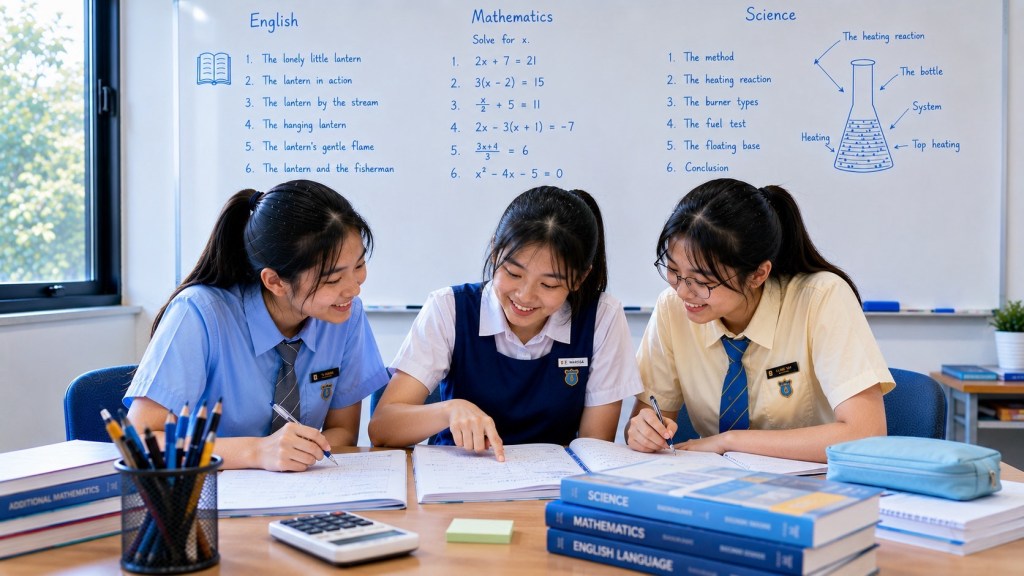
Small Group Tutorials

Here to help students catch up, keep up, and move ahead. Book a consultation here.

Direct WhatsApp

Secondary 4 Mathematics Tuition in Sengkang

Secondary 4 Mathematics Tuition Sengkang: Excel in Your GCE O-Level Examinations

Secondary 4 Mathematics is no longer simply another year of learning.

It is the year in which four years of concepts, habits and examination skills must come together under time pressure. Students are expected to recognise the mathematics hidden inside a question, choose an efficient method, show sufficient working and complete two demanding papers with accuracy.

For the 2026 graduating cohort, Mathematics remains a Singapore-Cambridge GCE O-Level subject under syllabus 4052. From 2027, the Singapore-Cambridge Secondary Education Certificate, or SEC, will replace the existing N- and O-Level examinations for the first Full Subject-Based Banding cohort. :contentReference[oaicite:0]{index=0}

For families searching for Secondary 4 Mathematics Tuition in Sengkang, the important question is therefore not simply:

“Will my child receive more practice?”

The better question is:

“Will the tutor know what my child needs next?”

At eduKate Sengkang, effective Mathematics tuition begins by finding the student’s present position. A student who is struggling with algebra should not be pushed immediately into harder examination papers. A student who already understands the syllabus should not spend every lesson repeating routine questions.

Each student needs the right route.

For one student, this may mean rebuilding algebra, correcting careless habits and restoring confidence. For another, it may mean improving speed, connecting topics and learning how to secure the final marks that separate a good result from an excellent one.

That is what thoughtful Secondary 4 Mathematics tuition should provide.

Secondary 4 Is the Year Mathematics Must Become Reliable

In the lower secondary years, a student may still recover from an uneven test or an unfinished topic. In Secondary 4, the margin becomes smaller.

School preliminaries arrive quickly. Revision papers begin to combine chapters. Questions become less predictable. Students must manage Mathematics alongside English, the Sciences, Humanities, Mother Tongue and other subjects.

A student may understand each chapter separately and still struggle when several ideas appear in one problem.

This is why Secondary 4 Mathematics tuition should not merely continue teaching chapter after chapter. It must help the student turn separate pieces of knowledge into a dependable examination system.

A dependable student can:

  • identify the topic being tested;
  • retrieve the correct method without lengthy hesitation;
  • organise working clearly;
  • detect when an answer is unreasonable;
  • change strategy when the first method is inefficient;
  • manage time across the whole paper; and
  • remain composed when a question looks unfamiliar.

These abilities are built deliberately. They rarely appear simply because a student has completed more worksheets.

What the 2026 O-Level Mathematics Examination Requires

The 2026 O-Level Mathematics syllabus is organised across three broad strands:

  • Number and Algebra;
  • Geometry and Measurement; and
  • Statistics and Probability.

However, the examination assesses more than content knowledge. It also tests the student’s ability to reason, communicate, interpret information, connect topics and apply Mathematics in different contexts.

The official assessment weightings are approximately:

  • 45% for using and applying standard techniques;
  • 40% for solving problems in different contexts; and
  • 15% for mathematical reasoning and communication. :contentReference[oaicite:1]{index=1}

This explains why some students perform well during straightforward topical practice but lose marks in preliminaries and national examinations.

Knowing a formula is only the first layer.

The student must also know:

  • when the formula is relevant;
  • how to translate the question into Mathematics;
  • which information matters;
  • whether two or more topics must be connected; and
  • how to present the solution convincingly.

Good Mathematics tuition trains all these layers together.

Two Papers, Two Different Demands

The 2026 O-Level Mathematics examination consists of two papers. Each paper is 2 hours and 15 minutes long, carries 90 marks and contributes 50% of the final result.

Paper 1 contains approximately 26 short-answer questions. Paper 2 contains 9 to 10 questions of varying lengths, with its final question focusing specifically on applying Mathematics to a real-world scenario.

SEAB also states that omitting essential working can result in the loss of marks. :contentReference[oaicite:2]{index=2}

This creates two distinct examination challenges.

Paper 1: Breadth, accuracy and control

Paper 1 moves across the syllabus quickly. Students must change topics repeatedly and avoid losing marks through:

  • sign errors;
  • incorrect substitution;
  • premature rounding;
  • calculator input mistakes;
  • missing units;
  • inaccurate graph reading; or
  • incomplete working.

Success depends on fluent fundamentals and careful execution.

Paper 2: Depth, stamina and connection

Paper 2 requires longer chains of reasoning. Students must often interpret a situation, select relevant information and combine several mathematical ideas.

A student may need to move from geometry into trigonometry, from a graph into an equation, or from a financial context into percentages and compound interest.

Success depends on structure.

The student must know how to enter a complicated problem, divide it into smaller parts and maintain accuracy until the final answer.

The 2026 Mathematics Examination Dates

For the 2026 GCE O-Level cohort, Mathematics Paper 1 is scheduled for 21 October 2026, while Mathematics Paper 2 is scheduled for 23 October 2026. Both papers are 2 hours and 15 minutes long. :contentReference[oaicite:3]{index=3}

The dates may appear comfortably distant at the beginning of the year. In practice, the useful preparation period is much shorter.

Students must first complete the school syllabus. They then face weighted assessments, June revision, preliminary examinations and the final national examination period.

Waiting until the preliminaries reveal a serious problem leaves less time to repair it calmly.

The strongest Secondary 4 preparation begins early enough for improvement to become stable.

Why Some Secondary 4 Students Continue to Struggle

Weak Mathematics results do not always mean that the student lacks ability.

Often, the difficulty lies in one of several hidden problems.

1. An earlier foundation was never secured

A student may appear to be struggling with vectors, trigonometry or coordinate geometry when the real problem is weaker algebra.

If the student cannot manipulate expressions confidently, change the subject of a formula or solve equations accurately, many upper-secondary topics become unnecessarily difficult.

In this situation, giving harder questions does not solve the cause.

The tutor must identify the earlier weakness and repair it without losing sight of the final examination.

2. The student recognises methods but cannot begin independently

Some students understand a solution when it is shown to them but cannot decide what to do when facing a blank page.

This is usually a problem of recognition and selection.

They need to learn how to ask:

  • What information has been given?
  • What am I required to find?
  • Which topic does this resemble?
  • What relationship connects the known and unknown quantities?
  • Is there an intermediate result I must obtain first?

Once this thinking becomes habitual, unfamiliar questions become more manageable.

3. The student practises but does not study the mistakes

Completing many papers is useful only when the errors are converted into better future decisions.

A student who repeatedly loses marks through the same mistake is not lacking practice. The student is lacking correction.

Each mistake should reveal something:

  • a concept that is not understood;
  • a method that is too slow;
  • a step that is often omitted;
  • a calculator habit that creates errors;
  • a question type that is being misread; or
  • a checking routine that is missing.

The purpose of tuition is not merely to mark the answer wrong. It is to prevent the same wrong decision from returning.

4. The student knows the content but works too slowly

This often affects students aiming for distinctions.

They can solve the question, but the method is longer than necessary. They spend too much time on early sections and rush the final pages.

Such students need to improve:

  • method selection;
  • algebraic economy;
  • calculator fluency;
  • diagram use;
  • time allocation; and
  • the ability to leave and return to a difficult question.

Their problem is not a lack of knowledge. It is that their knowledge has not yet become efficient.

5. The student becomes anxious when the question looks different

A slight change in wording can make a familiar concept appear unfamiliar.

The solution is not to memorise every possible question. That is impossible.

Students must learn to recognise the deeper structure beneath the wording. This is why mixed, unfamiliar and real-world problems are important in Secondary 4 Mathematics tuition.

The aim is to make the student less dependent on seeing an identical example.

A Better Route for Students Who Are Falling Behind

A weaker student does not need to be reminded repeatedly that the examination is approaching.

The student already feels the pressure.

What helps is a clear route back into the subject.

At eduKate Sengkang, the first priority is to determine which weaknesses are creating the greatest obstruction. This may include:

  • algebraic manipulation;
  • equations and inequalities;
  • graphs and functions;
  • ratio, percentage and rates;
  • geometry;
  • trigonometry;
  • mensuration;
  • statistics;
  • probability; or
  • interpretation of word problems.

The tutor then places the topics in a useful order.

For example, repairing algebra may improve performance in graphs, coordinate geometry, formula manipulation, trigonometry and applied problems at the same time. Strengthening one important foundation can therefore improve several areas of the syllabus.

This is more effective than moving randomly between chapters.

The recovery process

A carefully managed recovery plan usually moves through four stages.

Stage 1: Restore essential knowledge

The student relearns the concepts and procedures that are causing repeated breakdowns.

Explanations are kept clear. Questions begin at a level where the student can think rather than panic.

Stage 2: Make the method repeatable

The student practises enough variations to recognise when and how the method should be used.

The tutor checks working, not only answers.

Stage 3: Connect the topic to examination questions

Once the foundation is stable, the student moves into mixed and contextual questions.

The student learns how the same concept may appear in several forms.

Stage 4: Build examination reliability

The student practises under increasing time pressure, learns checking routines and develops better paper strategy.

The objective is not to rush the student.

It is to make the student secure enough to move faster naturally.

Wider Preparation for Stronger Mathematics Students

Strong students require tuition too, but for a different reason.

A student who already scores well may not need more routine teaching. Repetition without sufficient challenge can leave the student busy but unchanged.

The stronger student needs a wider field in which to think.

At eduKate Sengkang, this may include:

  • unfamiliar question structures;
  • multi-topic problems;
  • alternative solution methods;
  • more efficient algebra;
  • stronger mathematical explanation;
  • deeper graph interpretation;
  • difficult geometry and trigonometry;
  • higher-level data analysis;
  • real-world modelling; and
  • timed papers with detailed error analysis.

These students are taught to look beyond whether an answer is correct.

They consider:

  • Was the method efficient?
  • Was every step necessary?
  • Could the solution be communicated more clearly?
  • Was there a faster route?
  • Which assumption made the method possible?
  • How could the question be changed?
  • Would the same idea work in a different context?

This prepares them not only to protect an A1, but also to become stronger mathematical thinkers for JC, polytechnic and future quantitative subjects.

Tuition Should Change According to the Student

One of the weaknesses of large-group instruction is that every student may receive the same lesson even when their needs are completely different.

In a small-group Secondary 4 Mathematics class, the tutor can make quieter and more precise adjustments.

A student who is losing marks through weak algebra may receive targeted correction.

A student who understands the method but lacks confidence may be asked to complete a similar question independently.

A student who works too slowly may be shown a more efficient route.

A student aiming for a distinction may be given a harder extension while another student consolidates the core method.

The class may share the same broad topic, but the level of questioning, correction and challenge can still differ.

This is where small-group tuition becomes valuable.

It keeps each student visible.

Why Three-Student Small Groups Work Well for Secondary 4 Mathematics

Secondary 4 students need enough attention for detailed correction, but they also benefit from hearing how other students think.

A three-student small group creates a useful balance.

The tutor can observe working closely, identify recurring errors and ask individual questions. At the same time, students encounter different approaches and common mistakes through their classmates.

This produces several advantages.

Faster identification of errors

The tutor can notice whether the student is using an incorrect formula, skipping a step or relying too heavily on the calculator.

More active participation

There is little room for a student to remain invisible throughout the lesson.

Each student is expected to explain, attempt and respond.

Better pacing

The tutor can slow down when a concept requires repair and accelerate when the group is ready.

Appropriate challenge

Students can work on different question variations without being separated from the lesson.

Calm accountability

Homework, corrections and unfinished weaknesses are easier to track.

The atmosphere remains personal without becoming overly intense.

How eduKate Sengkang Teaches Examination Craft

Knowing Mathematics and sitting for a Mathematics examination are closely related, but they are not identical skills.

Students must also learn how to perform under examination conditions.

Reading before calculating

Many errors begin because the student starts pressing the calculator before understanding the problem.

Students are taught to identify:

  • the required quantity;
  • the available information;
  • the units;
  • the mathematical relationship; and
  • the expected form of the answer.

Showing sufficient working

A correct answer without essential working may not receive full credit.

Students learn to present solutions in a way that is mathematically clear and easy to follow.

Managing accuracy

Students practise when to retain exact values, when to store calculator values and when to round the final answer.

Checking intelligently

Checking does not mean repeating the entire paper.

It means using fast tests:

  • Does the sign make sense?
  • Is the size of the answer reasonable?
  • Are the units correct?
  • Does the point lie on the graph?
  • Is the probability between 0 and 1?
  • Is the length possible for the diagram?
  • Was the answer given to the required accuracy?

Controlling time

Students learn to protect accessible marks first while avoiding excessive time on one difficult question.

A strong paper strategy allows them to return to harder questions with a clearer mind.

Important Secondary 4 Mathematics Topics

A complete tuition programme must eventually connect the full syllabus, but several areas deserve particular attention because weaknesses in them can affect many other questions.

Algebra

Algebra remains the language through which much of secondary Mathematics is expressed.

Students should be comfortable with:

  • expansion and factorisation;
  • algebraic fractions;
  • changing the subject of a formula;
  • linear and quadratic equations;
  • simultaneous equations;
  • inequalities;
  • indices; and
  • translating situations into algebraic expressions.

A student who handles algebra confidently usually moves through the rest of the syllabus with greater ease.

Functions and Graphs

Students must interpret and work with linear, quadratic, power and exponential graphs.

They should understand:

  • gradient;
  • intercepts;
  • maximum and minimum points;
  • symmetry;
  • equations of straight lines;
  • graphical solutions; and
  • estimation of a curve’s gradient using a tangent.

The aim is not merely to draw a graph, but to read what the graph is communicating.

Geometry and Trigonometry

Students must connect diagrams, properties and calculations.

Important areas include:

  • congruence and similarity;
  • circle properties;
  • Pythagoras’ theorem;
  • sine, cosine and tangent;
  • sine and cosine rules;
  • area of a triangle;
  • bearings;
  • angles of elevation and depression; and
  • two- and three-dimensional problems.

Students who draw accurate diagrams and label information clearly usually make better decisions.

Mensuration

Mensuration questions require careful handling of shape, formula, units and accuracy.

Students should be able to work with:

  • perimeter and area;
  • composite figures;
  • arc length and sector area;
  • surface area;
  • volume;
  • similar solids; and
  • conversions between square and cubic units.

Statistics and Probability

Students need to interpret data rather than perform calculations mechanically.

They should be comfortable with:

  • mean, median and mode;
  • quartiles and percentiles;
  • range and interquartile range;
  • standard deviation;
  • cumulative frequency diagrams;
  • box-and-whisker plots;
  • comparison of data sets;
  • probability diagrams; and
  • combined events.

Good answers explain what the figures mean within the situation.

Real-World Mathematics

The syllabus includes applications involving areas such as transport, schedules, household finance, taxation, interest, instalments, bills, exchange rates, tables and graphs.

These questions may combine several topics and require students to interpret the final result within the context. :contentReference[oaicite:4]{index=4}

This is one reason memorising isolated procedures is insufficient.

Students must learn how Mathematics works when the question does not announce the chapter.

A Practical Secondary 4 Mathematics Tuition Plan

A well-structured year should change as the examination approaches.

Early Secondary 4: Diagnose and complete

The tutor identifies foundation gaps while supporting current school topics.

Weak areas are repaired before they become buried beneath new work.

Middle of the year: Connect and consolidate

Students begin working on mixed questions and timed sections.

Earlier chapters are revisited so that knowledge remains active.

Before preliminaries: Test and recalibrate

Full papers reveal weaknesses in timing, stamina, accuracy and topic selection.

The tutor uses the results to adjust the student’s revision priorities.

After preliminaries: Correct and convert

Preliminary examination mistakes become a map for final preparation.

The focus moves towards:

  • high-impact weaknesses;
  • recurring careless errors;
  • paper strategy;
  • speed;
  • presentation; and
  • maintaining confidence.

Final examination period: Stabilise

The final stage is not the time to create unnecessary panic.

Students need clear routines, selected practice, careful correction and sufficient rest.

The goal is to arrive at the examination with methods that feel familiar and dependable.

Is It Too Late to Begin Secondary 4 Mathematics Tuition?

The answer depends on the student’s present condition and the time remaining.

It is rarely helpful to declare that it is simply “too late”. A student can still improve when the available time is used carefully.

However, a late start changes the strategy.

There may be less time for broad exploration. The tutor must identify the most important weaknesses, protect accessible marks and build a focused revision plan.

The earlier the student begins, the more calmly the tutor can rebuild foundations and develop higher-level skills.

The later the student begins, the more important accurate diagnosis becomes.

In both cases, the tuition should be purposeful.

Signs That Your Child May Benefit from Sec 4 Mathematics Tuition

Parents may wish to consider additional support when their child:

  • understands lessons but performs inconsistently;
  • repeatedly loses marks through algebraic errors;
  • cannot complete papers within the given time;
  • avoids difficult questions;
  • depends heavily on worked examples;
  • forgets earlier topics;
  • performs well in topical practice but poorly in mixed papers;
  • cannot explain why a method works;
  • becomes anxious during Mathematics tests; or
  • has reached a plateau despite regular revision.

Tuition is most useful when it solves a clearly observed problem.

The aim is not to occupy more of the student’s week. It is to make the student’s existing study time more productive.

What Parents Should Look for in a Secondary 4 Mathematics Tutor

A capable Mathematics tutor should do more than solve difficult questions in front of the class.

The tutor should be able to:

  • identify the cause of a student’s errors;
  • explain concepts in more than one way;
  • adjust the level of difficulty;
  • teach examination strategy;
  • insist on clear mathematical working;
  • balance foundation repair with syllabus progress;
  • challenge stronger students appropriately;
  • monitor improvement over time; and
  • communicate calmly with both student and parent.

The right tutor does not simply display mathematical ability.

The tutor makes mathematical ability transferable to the student.

Why Choose eduKate Sengkang for Secondary 4 Mathematics Tuition?

At eduKate Sengkang, we understand that Secondary 4 students do not all need the same intervention.

Some need a careful return to the foundations.

Some need stronger structure and consistent practice.

Some need sharper examination execution.

Others are already doing well and need more demanding questions to reach their full potential.

Our role is to recognise the difference.

Through close small-group teaching, detailed correction and purposeful lesson planning, we help students move from their present level towards a stronger and more reliable performance.

We do not believe that pressure alone creates results.

Students improve when they can see:

  • what is wrong;
  • why it is wrong;
  • how to correct it;
  • what to practise next; and
  • how the improvement connects to the examination.

This creates confidence that is earned through competence.

Frequently Asked Questions About Secondary 4 Mathematics Tuition in Sengkang

Does this tuition cover O-Level Elementary Mathematics?

Yes. The programme is designed around Secondary 4 Mathematics, commonly referred to as E-Math, including preparation for the Singapore-Cambridge GCE O-Level Mathematics examination.

Can a weak student still improve in Secondary 4?

Yes, although the programme must be prioritised carefully. The tutor should first identify the weaknesses causing the largest loss of marks, repair the necessary foundations and progressively move the student into examination questions.

Is tuition useful for a student already scoring A grades?

Yes. Strong students may need greater challenge, more efficient methods, difficult mixed problems and tighter examination execution. The objective shifts from basic understanding to consistency, depth and precision.

How much practice should a Secondary 4 student complete?

The quality of practice matters as much as the quantity. Students should complete a combination of topical revision, mixed questions, timed sections, full papers and detailed corrections.

Should students focus only on preliminary examination papers?

Preliminary papers can be valuable, but they should not be used without judgement. Some are deliberately difficult or structured differently from national examination papers. The tutor should select questions according to the student’s needs and the official syllabus.

What is the benefit of a small group?

A small group allows the tutor to inspect each student’s working, ask individual questions and adjust the challenge while preserving the useful interaction of a class.

When should a Secondary 4 student start tuition?

Starting early provides more time for diagnosis, foundation repair, consolidation and examination practice. Students who begin later can still benefit, but the plan must become more selective and focused.

Mathematics Tuition Should Open the Next Step

The value of a strong Secondary 4 Mathematics result extends beyond one examination.

Mathematics trains students to work with structure, evidence, relationships and logical consequence. It supports further learning in the Sciences, computing, business, engineering, economics and many other fields.

More immediately, an improved result can preserve a wider range of post-secondary choices.

For a student who is struggling, the next step may be to make Mathematics manageable again.

For an average student, it may be to convert uncertain knowledge into a solid grade.

For a strong student, it may be to develop the precision required for an A1 and more advanced study.

The destination is different for every student.

Good tuition notices this early and teaches accordingly.

Secondary 4 Mathematics Tuition Sengkang with eduKate

Secondary 4 is demanding, but it does not need to feel chaotic.

With the right sequence, close correction and intelligent preparation, students can enter their examinations knowing that they have addressed their weaknesses and strengthened their best abilities.

At eduKate Sengkang, our Secondary 4 Mathematics tuition is designed to give each student the support, structure and challenge needed for the final year.

For weaker students, we build a safer and clearer route towards competence.

For stronger students, we expand the level of challenge so that good performance can become exceptional.

Less noise. More structure. Better Mathematics.

Read more about Secondary 4 Mathematics Tuition in Sengkang and speak with eduKate about finding the right small-group class for your child.

As students in Singapore prepare for the GCE O-Level examinations, mastering mathematics becomes a top priority. Secondary 4 is a crucial year where students must consolidate their mathematical knowledge and fine-tune their exam strategies. At EduKate Singapore, we offer Secondary 4 Mathematics Tuition in Sengkang to help students navigate the complexities of the O-Level syllabus and achieve academic excellence.

Why Choose Secondary 4 Mathematics Tuition in Sengkang?

Sengkang has emerged as a key educational hub, and Secondary 4 Mathematics Tuition in the area offers a tailored approach to help students excel in their O-Level exams. Here’s why parents and students are turning to Sengkang for high-quality tuition:

  • Targeted Exam Preparation: Secondary 4 marks the final year before the O-Level examinations. Our tuition program is aligned with the MOE SEAB syllabus, focusing on critical topics such as algebra, trigonometry, calculus, and geometry. By honing these key areas, students can maximize their performance in the O-Level exams.
  • Experienced Tutors: Our tutors are well-versed in the O-Level Mathematics syllabus and have years of experience preparing students for the rigors of the exams. They offer insights into common pitfalls, exam strategies, and ways to tackle difficult questions.
  • Small Group Learning: Our small group tuition model ensures that each student receives personalized attention. Tutors can identify specific areas where students may struggle, providing targeted support to help them improve.

Comprehensive Mathematics Curriculum Aligned with O-Level Requirements

Our Secondary 4 Mathematics Tuition in Sengkang offers a comprehensive curriculum that covers all key topics required for the GCE O-Level exams. Here’s a breakdown of what students can expect:

1. Algebra and Equations

Algebra forms the foundation for many mathematical concepts, and mastering it is essential for success in O-Level Mathematics. Our tutors ensure that students develop a strong grasp of algebraic techniques, including solving quadratic equations, simplifying expressions, and working with simultaneous equations.

2. Trigonometry and Geometry

Understanding the principles of trigonometry and geometry is critical for tackling complex problems in the O-Level exams. We cover topics such as angle properties, circle theorems, and trigonometric identities, helping students build a solid understanding of these areas.

3. Calculus and Advanced Problem Solving

Calculus is a challenging yet important component of the O-Level syllabus. Our lessons guide students through differentiation and integration techniques, providing practice in solving real-world problems and applying calculus to various scenarios.

4. Statistics and Probability

Data handling is a crucial skill in Mathematics, and students need to be comfortable with statistical analysis and probability theory. Our tuition program emphasizes understanding concepts such as mean, median, mode, and probability distributions.

Key Benefits of Secondary 4 Mathematics Tuition in Sengkang

  • Personalized Learning: Each student has unique strengths and weaknesses in Mathematics. Our tutors assess individual needs and provide customized lessons that target areas of improvement, ensuring students build confidence in their problem-solving abilities.
  • Focused Exam Strategies: Beyond teaching mathematical concepts, our tutors emphasize exam techniques that can significantly boost performance. We train students on how to manage their time during the exam, break down complex questions, and apply the most efficient strategies to maximize their scores.
  • Practice with Exam-Type Questions: Regular practice is key to success in Mathematics. Our program includes timed practice tests and mock exams that simulate the actual O-Level exam conditions, giving students the opportunity to refine their skills and improve their exam readiness.
  • Feedback and Continuous Assessment: Ongoing assessment is essential for tracking progress. Our tutors provide detailed feedback on assignments and practice papers, helping students understand their mistakes and work on areas of improvement.

Preparing for GCE O-Level Mathematics Success

At EduKate Singapore, our goal is to equip students with the tools they need to excel in their MOE Secondary O-Level Mathematics exams. We believe that with the right guidance, consistent practice, and strategic preparation, every student has the potential to achieve outstanding results. Our tutors are committed to helping students develop strong mathematical skills, build their confidence, and perform to the best of their abilities in the exam.

Why EduKate Singapore for Secondary 4 Mathematics Tuition?

  • Experienced and Qualified Tutors: Our tutors are experts in O-Level Mathematics and have a proven track record of helping students achieve excellent results. They are passionate about teaching and dedicated to helping each student reach their full potential.
  • Small Class Sizes for Focused Learning: We maintain small class sizes to ensure that students receive the personalized attention they need. This allows tutors to address each student’s learning gaps and provide tailored instruction.
  • Structured and Results-Oriented Program: Our tuition program is designed to help students systematically master the O-Level Mathematics syllabus. We cover all the key topics in depth, provide regular practice opportunities, and ensure that students are well-prepared for their exams.
  • Comprehensive Exam Preparation: We provide students with all the resources they need to succeed in the O-Level exams, including practice papers, revision notes, and mock tests. Our focus is on equipping students with the skills and strategies necessary for exam success.

Take the Next Step Towards Mathematics Mastery

If your child is preparing for the GCE O-Level exams, enrolling them in our Secondary 4 Mathematics Tuition in Sengkang can make a significant difference in their academic performance. At EduKate Singapore, we are dedicated to helping students excel in Mathematics and build the confidence they need to succeed.

Course Outline for Secondary 4 Mathematics Tuition GCE O-Level Requirements at Sengkang – (Typical and Adjustable)

Course Title:
Secondary 4 Mathematics Tuition
Location: EduKate Singapore

Course Objective:
This course aims to fully prepare students for the GCE O-Level Mathematics examinations, following the MOE syllabus. (also *IGCSE syllabus available) The program is designed to strengthen students’ understanding of core mathematical concepts, improve problem-solving skills, and ensure they are well-prepared for the exam through consistent practice, mock exams, and personalized feedback.


Course Structure:

The course is divided into key sections aligned with the GCE O-Level Mathematics syllabus, covering both Elementary (E) Mathematics and Additional (A) Mathematics topics. It includes a blend of theoretical instruction, problem-solving techniques, and extensive practice on past exam papers.


Course Duration:

Weekly 1.5-hour small-group sessions over a 12-month period (adjustable to exam day), supplemented with additional practice sessions as needed.


Curriculum Overview:

Elementary Mathematics (E-Math) Focus Areas:

  1. Number and Algebra
    • Real Numbers and Approximation
    • Algebraic Manipulation: Polynomials, Rational Expressions, and Partial Fractions
    • Linear Equations, Inequalities, and Graphs
    • Simultaneous Equations (Linear/Quadratic)
    • Quadratic Functions: Solving and Applications
    • Sequences and Series
  2. Geometry and Measurement
    • Properties of Circles
    • Trigonometric Ratios (2D and 3D Problems)
    • Coordinate Geometry
    • Vectors in Two Dimensions
    • Geometrical Proofs and Reasoning
  3. Statistics and Probability
    • Data Representation and Interpretation (Histograms, Cumulative Frequency, Box-and-Whisker Plots)
    • Probability Rules and Applications
    • Permutations and Combinations

Additional Mathematics (A-Math) Focus Areas:

  1. Algebra
    • Simultaneous Equations (Linear and Non-Linear)
    • Surds and Indices
    • Logarithmic and Exponential Functions
    • Binomial Theorem and Expansion
  2. Geometry and Trigonometry
    • Trigonometric Identities, Equations, and Graphs
    • Radian Measure and Circular Functions
    • Coordinate Geometry of Circles and Loci*
  3. Calculus
    • Differentiation and Applications (Tangents, Normals, Rates of Change)
    • Integration and Applications (Area under Curves, Volumes of Revolution)
    • Solving Differential Equations

Teaching Methodology:

  • Conceptual Understanding: Emphasis on understanding core mathematical concepts before diving into problem-solving. Each session will focus on a specific topic, ensuring students grasp the theory and application of the material.
  • Problem-Solving Techniques: Students will be taught various strategies to tackle complex problems, focusing on the best methods to apply for each type of question. Real-world applications of math are highlighted to enhance practical understanding.
  • Past Paper Practice: Each student will engage in intensive practice of GCE O-Level past papers. Tutors will guide students through exam-style questions, providing tips on how to manage time, structure answers, and avoid common mistakes.
  • Mock Exams: Regular mock exams under timed conditions will simulate the actual exam environment. Feedback will be provided after every test, highlighting areas of strength and where improvement is needed.
  • Targeted Feedback and Assessments: After each lesson and assessment, students will receive detailed feedback on their progress. Tutors will set personalized goals to ensure improvement and track student performance.

Additional Course Components:

  1. Weekly Assignments: To reinforce learning, weekly homework assignments will be given, focusing on the topics covered in the session.
  2. Progress Reports: Regular feedback and progress reports will be provided to both students and parents to ensure transparency in the learning process and goal setting.
  3. One-on-One Consultation: For students who require additional help, one-on-one consultations are available to address specific challenges or advanced topics.

Exam Preparation Strategy:

  • Time Management Training: Tutors will coach students on how to efficiently manage their time during the exam, ensuring that every question is answered within the time limit.
  • Answer Structuring: Guidance on how to present solutions logically and coherently for both Elementary and Additional Mathematics questions to maximize marks.
  • Understanding Examiner Expectations: Students will be trained on how to approach different types of questions, understand marking schemes, and meet the examiners’ expectations for full credit.

Learning Outcomes:

By the end of the course, students will:

  • Master the core concepts and applications of both Elementary and Additional Mathematics.
  • Develop strong problem-solving and analytical skills needed for the GCE O-Level examination.
  • Be confident in applying mathematical techniques to tackle exam-style questions effectively.
  • Have practiced extensively under exam conditions, reducing anxiety and improving exam performance.

Strategies to Improve Secondary 4 Mathematics GCE O-Level Tuition in Sengkang

As students approach the GCE O-Level Mathematics examination, the need for effective preparation becomes critical. Secondary 4 students face more complex mathematical concepts that require a deeper understanding and advanced problem-solving skills. In Sengkang, our Secondary 4 Mathematics GCE O-Level tuition focuses on helping students master these key concepts while equipping them with the strategies they need to excel in their exams.

Here are some of the most effective strategies used in Secondary 4 Mathematics tuition in Sengkang to improve student outcomes:

1. Focus on Core Concepts and Problem-Solving Skills

Understanding and mastering the fundamental concepts in the GCE O-Level Mathematics syllabus is essential for success. Our tuition programs prioritize:

  • Comprehensive Review of Key Topics: Algebra, trigonometry, geometry, and calculus are revisited in-depth to ensure students have a solid understanding of these critical areas.
  • Strengthening Core Skills: Emphasis is placed on mastering basic operations, formula applications, and mathematical principles, enabling students to tackle more advanced questions effectively.
  • Problem-Solving Techniques: Students are trained to break down complex problems into smaller, manageable steps and apply appropriate methods to solve them. This strategic approach improves both speed and accuracy.

2. Regular Practice and Timed Mock Exams

Consistent practice is crucial for improving performance in mathematics. To help students refine their skills and build exam confidence, we implement:

  • Practice with Exam-Style Questions: Students are exposed to a variety of exam-style questions from past papers to familiarize themselves with the format and types of questions they will encounter.
  • Timed Mock Exams: These practice exams simulate actual exam conditions, allowing students to develop effective time management skills. Regular mock exams help students improve their pacing, reduce anxiety, and build confidence for the real test.
  • Detailed Solutions and Explanations: After each practice session or mock exam, we provide step-by-step solutions and explanations, ensuring students understand their mistakes and can correct them.

3. Personalized Feedback and Targeted Revision

One of the key strengths of our Secondary 4 Mathematics tuition in Sengkang is the individualized feedback students receive. This feedback allows for targeted revision in areas that need improvement:

  • Personalized Learning Plans: Based on each student’s strengths and weaknesses, tutors develop tailored learning plans that focus on specific areas of improvement, whether it’s algebra, trigonometry, or geometry.
  • Targeted Revision: Students work on weaker topics through additional exercises, quizzes, and revision notes. Tutors monitor progress and adjust the learning plan as necessary to ensure that all gaps in understanding are addressed before the exam.

4. Strengthening Exam Techniques

Knowing how to apply mathematical concepts effectively during exams is just as important as understanding them. We focus on improving exam techniques to maximize students’ performance:

  • Question Interpretation and Analysis: Students are taught how to carefully interpret exam questions, recognize key terms, and decide on the best approach to solve each problem.
  • Efficient Use of Mathematical Tools: Proper use of calculators, graphing tools, and formula sheets is emphasized to ensure students save time and avoid mistakes during the exam.
  • Answer Structuring: We guide students on how to clearly and logically structure their answers, particularly for long-answer questions that require multiple steps. This not only helps in obtaining full marks but also ensures the examiner can follow the student’s reasoning.

5. Time Management Skills

Time management can make or break a student’s performance during the GCE O-Level Mathematics exam. In our tuition program, we train students to manage their time effectively by:

  • Prioritizing Questions: Students are taught how to identify and tackle easier questions first to secure marks before moving on to more challenging problems.
  • Timed Practice: Regular timed practice ensures that students can complete the entire paper within the allocated time while maintaining accuracy.
  • Handling Difficult Questions: We provide strategies for approaching difficult or unfamiliar questions without wasting too much time, teaching students how to make educated guesses or move on when necessary.

6. Building Confidence and Reducing Exam Anxiety

Mathematics can be a source of anxiety for many students, particularly as the SEAB GCE O-Level exams draw near. At eduKate Singapore, we focus on building students’ confidence through:

  • Positive Reinforcement: We create a supportive learning environment where students feel comfortable asking questions, making mistakes, and learning from them. This builds their confidence and reduces anxiety leading up to the exam.
  • Gradual Progression: By working on gradually more difficult problems and regularly reviewing their progress, students see measurable improvements, boosting their self-confidence and exam readiness.
  • Stress Management Techniques: Tutors also provide advice on how to stay calm under exam pressure, focusing on breathing techniques and maintaining a positive mindset.

7. Use of Technology and Online Resources

Integrating technology into math learning can significantly improve student engagement and understanding. At eduKate Singapore, we utilize:

  • Interactive Tools: Graphing calculators, geometry software, and other digital tools are used to help students visualize complex concepts and enhance their problem-solving skills.
  • Online Learning Platforms: We offer access to additional online resources, such as video tutorials, quizzes, and practice exercises that students can use to reinforce their learning outside of tuition hours.

Conclusion: Preparing for GCE O-Level Mathematics Success

By employing these strategies, Secondary 4 Mathematics tuition in Sengkang ensures that students are well-prepared to excel in their GCE O-Level Mathematics exam. With a focus on core concepts, regular practice, personalized feedback, and effective exam techniques, our program provides students with the tools they need to achieve success.

If you’re looking for a comprehensive and effective tuition program for Secondary 4 Mathematics in Sengkang, eduKate Singapore is here to guide your child towards academic excellence.