
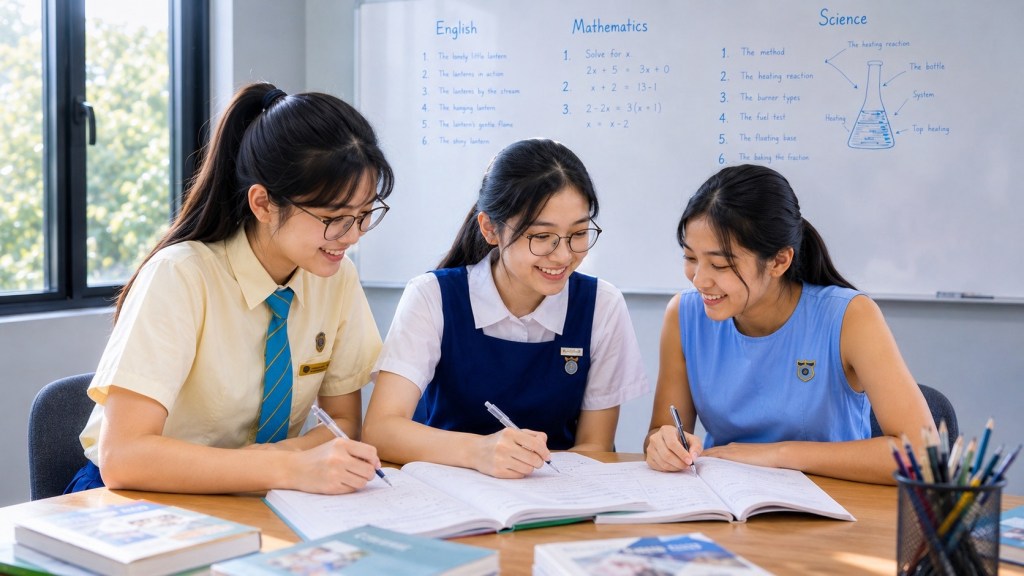
Quick Read
Many students are told to “check your work”, but checking is often treated as a vague final instruction.
A student finishes a question, looks at the answer again, sees nothing obviously wrong and moves on. That is inspection, not verification.
Mathematical verification becomes useful when the student applies a second source of evidence to the answer.
- Estimate: Is the size of the answer plausible?
- Reverse: Can an inverse operation recover the original quantity?
- Substitute: Does the answer satisfy the equation or condition?
- Check units: Is the answer expressed in the correct measurement?
- Use another route: Does a different method lead to the same result?
- Return to the question: Did I answer what was actually asked?
This article explains how checking develops from simple arithmetic to independent examination control inside our broader Mathematics Tuition Sengkang system.
The One-Sentence Answer
Students catch more of their own Mathematics errors when checking becomes a deliberate second test of the answer rather than a repetition of the original thinking.
Why “Check Your Work” Is Too Vague
Adults know what they mean by checking because they already possess many checking strategies.
Students may not. They may reread the calculation, scan for messy handwriting or redo the same steps in the same order.
If the original error came from a wrong assumption, repeating the same route can reproduce the same wrong answer perfectly.
Good checking therefore needs independence from the original route.
Verification Starts Before the Final Answer
Students often imagine checking as something done only after finishing.
Strong mathematical control includes small checks during the solution: Does this intermediate value make sense? Is this denominator possible? Did the sign change correctly? Is this angle larger or smaller than ninety degrees? Should the graph be increasing here?
These checkpoints stop small errors from travelling through the entire solution.
Estimation Is the First Line of Defence
Estimation gives the student a rough expected region before or after exact calculation.
If three items cost about twenty dollars each, a total of six dollars should trigger suspicion. If an area is calculated as smaller than one side length despite the dimensions involved, something may be wrong.
Estimation does not prove the answer is correct. It eliminates answers that are clearly implausible.
Inverse Operations Create an Independent Route
Addition can be checked by subtraction. Multiplication can be checked by division. Percentage increases can sometimes be tested by working backward from the final value.
The value of inverse checking is that it uses a different mathematical relationship from the original operation.
If both routes agree, confidence rises.
Substitution Turns an Answer Back Into a Question
In algebra, an answer can often be substituted into the original equation.
If x = 7, does the equation balance when 7 is placed back into it? If a coordinate is claimed to lie on a graph, does it satisfy the relationship?
This is powerful because the student is not merely checking arithmetic. The student is checking whether the answer fulfils the original condition.
Units Are a Built-In Error Detector
Units help identify both conceptual and calculation errors.
A speed answer should not end in square centimetres. An area requires square units. A rate should preserve the relationship between numerator and denominator units.
If the unit looks wrong, the mathematics may be wrong even when the number itself appears reasonable.
Magnitude and Sign Carry Meaning
Students should ask whether the answer is too large, too small, positive when it should be negative, or negative when the context makes that impossible.
A negative length, probability greater than one, or percentage beyond a meaningful range should trigger review.
These checks come from understanding the domain, not from arithmetic alone.
A Correct Number Can Still Answer the Wrong Question
One of the most common examination errors is solving for an intermediate quantity and forgetting what was asked.
The student finds the cost of one item when the question asked for the total cost. The student finds the radius when the final answer requires diameter. The student calculates a percentage but the question asks for the percentage change.
Verification must therefore return to the wording of the question.
Representation Makes Checking Easier
A good model or diagram gives the student something to compare the final answer against.
If a bar representing the smaller quantity is visibly less than the larger one, an answer that reverses their sizes should look suspicious. If a geometry diagram suggests an acute angle, an answer of 140 degrees deserves inspection.
The companion article How Mathematical Representation Turns Word Problems Into Solvable Structures explains why representation can serve both solving and verification.
Different Methods Are Powerful When They Are Truly Different
Solving the same question twice in exactly the same way is less useful than approaching it from another direction.
A ratio problem might be checked with algebra. A geometry result might be tested using a second theorem. A percentage calculation might be estimated mentally.
Independent routes reduce the chance that the same hidden mistake contaminates both solutions.
Some Errors Are Arithmetic, Some Are Structural
Not every wrong answer is a careless calculation.
The student may have copied a number incorrectly, selected the wrong operation, misunderstood the relationship, used the wrong formula, omitted a condition or answered the wrong quantity.
Checking becomes much stronger when students learn to classify where an error could have entered.
The Error Chain Matters
A final wrong answer can originate much earlier.
Misread question → wrong representation → wrong equation → correct algebra → wrong final answer.
If the student checks only the arithmetic, the real error survives. Verification should move back through the chain until the first divergence is found.
Reasonableness Depends on Mathematical Sense
A student can only recognise an unreasonable answer if they have enough number sense, geometric sense or functional intuition to know what reasonable looks like.
This is why verification is not a separate examination trick. It grows from deeper mathematical understanding.
Checking Should Be Targeted by Personal Error Pattern
Different students need different final checks.
One repeatedly loses negative signs. One converts units incorrectly. One forgets to square the unit for area. One miscopies numbers from the question. One solves correctly but answers the wrong quantity.
An efficient checking routine should search for the errors that the student actually makes.
Error Logs Are Useful Only If They Change Future Behaviour
An error log can become another exercise book full of old mistakes.
Its value comes from compression: identify recurring error classes and turn them into future checks.
For example: “Before submitting geometry, check angle properties and units.” “After algebra, substitute the answer.” “For percentage change, confirm the correct base quantity.”
The record should improve the next decision.
Checking Has a Time Budget in Examinations
Students cannot re-solve every question from scratch.
Examination verification therefore becomes selective. High-value checks go first: unanswered parts, unit conversions, sign errors, unusually large or small results, questions with complex setup, and personal recurring mistakes.
Good checking is risk management under time constraint.
Primary 1–2: Checking Begins With Concrete Sense
Young students can ask simple questions: Does the answer get bigger or smaller? Could there really be forty objects if we started with ten? Can subtraction reverse my addition?
These habits build early number sense and the idea that an answer is something to test, not merely produce.
Primary 3–4: Verification Becomes More Deliberate
Middle-primary students can use inverse operations, estimation, unit checks and model comparison more systematically.
They can also begin identifying recurring personal mistakes rather than treating every wrong answer as unrelated.
Primary 5–6: Checking Must Survive the PSLE Clock
Upper-primary students face multi-step questions where one early error can propagate.
They need quick checkpoints during working and a targeted final scan. The goal is not perfection through endless rechecking, but reducing preventable losses without sacrificing completion.
Secondary 1–2: Algebra Creates New Verification Tools
Secondary students gain access to substitution, graph interpretation and symbolic equivalence as checking methods.
They can verify whether transformed expressions remain equivalent and whether solutions satisfy original equations or inequalities.
Secondary 3–4: Verification Becomes Strategic Mathematical Control
Upper-secondary students handle more complex functions, geometry, trigonometry and algebraic manipulation.
Strong students develop topic-specific checks: domain restrictions, sign, magnitude, graph shape, angle range, exact versus approximate values and whether all solutions have been considered.
This is where checking becomes part of mathematical maturity rather than an afterthought.
Diagnose First: Why Does a Student Keep Losing Marks?
- Calculations are inaccurate.
- Numbers are copied incorrectly.
- The question is misread.
- The model or equation is wrong.
- Units are omitted or converted incorrectly.
- The final answer does not match the requested quantity.
- The student checks by repeating the same method.
- No estimate or sense-check is available.
- Personal error patterns are not recognised.
- Checking begins only after time has already run out.
These errors should not all be labelled “careless”. Naming the first failure makes repair possible.
Catch Up | Keep Up | Move Ahead
Catch Up: teach one or two concrete checks at a time—estimate, inverse operation, unit check—until the student uses them without prompting.
Keep Up: attach verification to normal problem solving rather than saving it for examination season.
Move Ahead: build topic-specific checking, alternate routes and strategic allocation of checking time under full-paper conditions.
Why 3-Pax Helps Error Detection
Three students can obtain three different wrong answers from one question.
That comparison is useful because the class can ask where each route first diverged. One student misread the relationship, one lost a sign and one forgot a unit conversion.
The error becomes information about process rather than simply a red cross at the end.
What Parents Can Look For
- The child can name a checking method rather than say “I checked”.
- Answers are estimated before exact calculation when appropriate.
- Inverse operations appear naturally.
- Algebraic answers are substituted back.
- Units are checked deliberately.
- Recurring errors become less frequent.
- The student notices implausible results without adult prompting.
- Checking becomes faster and more targeted over time.
Frequently Asked Questions
Why does my child repeat the same careless mistakes?
The mistake may not be careless in the ordinary sense. It may come from a repeated weak process—sign handling, unit conversion, question interpretation or an absent checking routine. Identifying the class is more useful than repeating “be careful”.
Should students redo every question to check?
No. That is usually inefficient. A targeted independent check is stronger: estimate, use an inverse operation, substitute, compare with a model or test the answer against the original condition.
Can estimation prove an answer is correct?
No. Estimation mainly catches answers that are clearly implausible. It is one layer of evidence, not complete proof.
Why does my child check well at home but not in examinations?
Time pressure changes behaviour. The checking routine may not yet be automated or prioritised. Timed practice should include the checking budget, not only question completion.
Should every student use the same checklist?
A common core helps, but personal error patterns should shape the final routine. One student needs sign checks; another needs units; another needs to reread exactly what was asked.
When is tuition useful?
When marks are repeatedly lost through the same preventable error classes, when the student cannot identify where solutions go wrong, or when checking remains vague and ineffective, targeted teaching can turn correction into a repeatable control process.
A Final Reflection: Mathematics Is Not Finished When a Number Appears
A calculation produces a candidate answer. Mathematics asks whether that answer deserves confidence.
At first, a child may depend on a teacher to say correct or wrong. With development, the student acquires independent tests: estimation, inverse relationships, substitution, units, alternate representations and reasonableness.
That changes the student’s relationship with Mathematics. The answer is no longer something accepted because it emerged from the calculator or the last line of working. It is something that can be examined.
That habit—produce, test, revise—is one of the foundations of independent mathematical judgement.
For the wider Mathematics journey, return to Mathematics Tuition Sengkang.
Use This Article as the Mathematical Verification Node
This article owns the broad question of how a learner decides whether a mathematical answer deserves confidence. Use the narrower routes below after the recurring error pattern is visible. Verification is not one checklist applied to every question; the strongest check depends on the structure, the domain and the way the answer could fail.
Check plausibility before re-solving
- Estimation and magnitude — identify answers that are too large, too small or inconsistent with the situation.
- Units and measurement — use dimensions and units as a check on what the number is supposed to represent.
- Boundary and extreme cases — test whether a claim still behaves sensibly at informative limits.
- Uniqueness — ask whether one answer is sufficient or whether other valid solutions remain.
Use an independent mathematical route
- Inverse relationships — work backwards with a different relationship to test the original result.
- Equality and substitution — return a proposed value to the original equation or condition.
- Representation — compare the numerical or symbolic result against the model, diagram, table or graph that gave it meaning.
- Alternative strategy — use a genuinely different route when the cost is justified by the risk of error.
Check what the method may have hidden or lost
- Information preservation — notice when an operation can discard distinctions or introduce extra candidate solutions.
- Assumptions and model limits — make sure the answer is being interpreted only inside the conditions that made the method valid.
- Justification — verify not only the number but why the route warrants the conclusion.
- Definitions and decision boundaries — test whether the object or result actually satisfies the mathematical criteria being claimed.
Up: return to the Mathematics Tuition Sengkang master when the failure is broader than checking. Next: move to Mathematical Justification when the learner can test an answer but cannot yet explain why the conclusion is warranted. Bridge: use the Representation node when the check fails because the final answer has become detached from the original situation.
Boundary: verification cannot rescue a solution whose first representation or concept was wrong unless the checking method is independent enough to expose that earlier failure. Repeating the same route more carefully is not the same as creating new evidence.
Mathematical verification is the node when the learner has a candidate answer and needs a second reason—not merely a second look—to trust it.
