
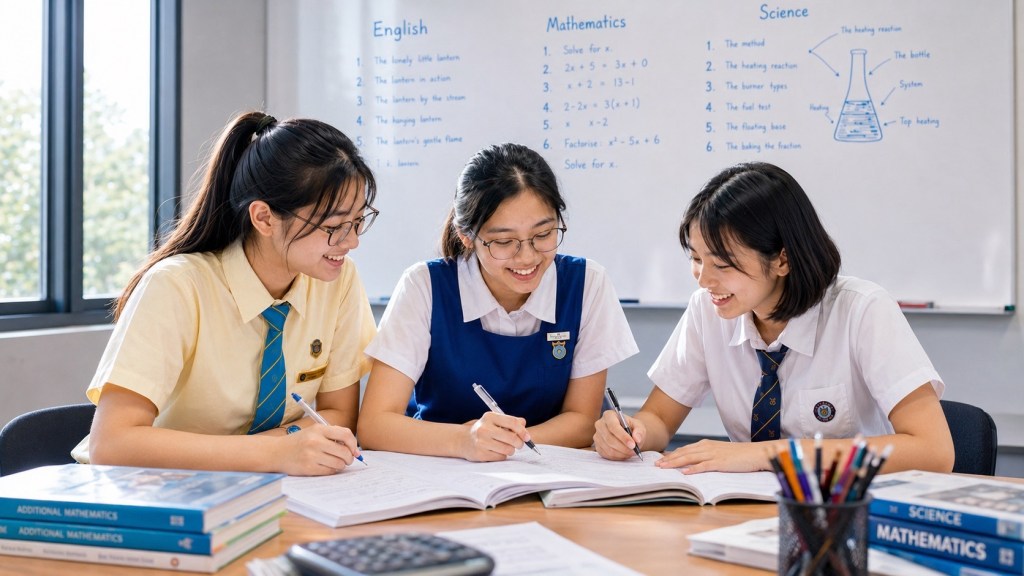
Advanced Additional Mathematics Tutorials now asks a commercial question in an educational way: What should a good A-Math tutorial actually do? Parents searching for A-Math tuition in Sengkang, Additional Mathematics tuition, Secondary 3 A-Math tutor, Secondary 4 A-Math tutor or small-group tuition often compare class size, location, worksheets and fees. Those factors matter, but they do not describe the learning mechanism.
A three-student Additional Mathematics class is not automatically better than a larger class. Its educational advantage appears only if the tutor uses the smaller group to observe more closely, diagnose more precisely, adapt explanation, compare methods and then release support back to the student. If three students simply receive the same worksheet and the tutor gives model answers from the front, the small number alone has not created much value.
This guide explains what a high-quality 3-pax A-Math tutorial in Sengkang should do from the first diagnostic through concept teaching, guided practice, independent transfer, revision and examination preparation. It also gives parents practical signs to distinguish genuine individualisation from a small class that is merely small.
The first principle: class size is a capacity, not a guarantee
A smaller class creates the possibility of more observation.
Whether that becomes better teaching depends on the tutor.
In A-Math, observation matters because the final answer can hide the actual problem.
Two students can both get a question wrong:
- one selected the wrong method;
- one selected the correct method but made an algebra error.
They need different teaching.
A small group should make those distinctions easier to see.
What the first lesson should establish
A useful first lesson should not begin by assuming “weak in A-Math” means the whole subject is weak.
The tutor should establish:
- current school level and syllabus;
- recent test evidence;
- algebra foundation;
- topic history;
- how the student begins unfamiliar questions;
- how much prompting is required;
- how errors are checked;
- what happens under time pressure.
The goal is to locate the first weak link.
The diagnostic should include working, not only answers
A multiple-choice or final-answer diagnostic is too shallow for many A-Math problems.
The tutor needs to see:
- which line was chosen first;
- how algebra was organised;
- whether conditions were noticed;
- whether the calculator was used appropriately;
- whether the student changed methods;
- whether the student knew how to verify the result.
A wrong answer with strong working may need one small repair.
A correct answer reached through fragile guessing may need deeper teaching.
What a 3-student lesson can do that a large class often cannot do as easily
With three students, the tutor can more realistically:
- inspect each student’s written route;
- ask each student why a method was selected;
- compare different valid approaches;
- give one student a prerequisite repair while the others continue;
- reduce hints at different rates;
- use another student’s method as a contrast case;
- notice repeated individual errors quickly.
That is the instructional opportunity.
Good small-group teaching is not three private lessons happening simultaneously
A three-student tutorial should use the group.
Students can learn from contrast.
For example:
- Student A factorises a quadratic.
- Student B completes the square.
- Student C uses a graph interpretation.
The tutor can ask which method exposes the information the question actually needs.
This is richer than treating each student as if the other two do not exist.
The ideal lesson cycle
1. Retrieve
Begin with a short old-topic or prerequisite recall so the tutor sees whether earlier learning remains available.
2. Diagnose
Use the current topic to identify the exact failure point.
3. Model
Explain or demonstrate the concept with enough structure to make the route visible.
4. Guided attempt
The student performs the next problem with limited prompts.
5. Independent attempt
Remove the support.
6. Variation
Change the surface so the tutor can see whether the learning transfers.
7. Handover
End with a clear independent task or retrieval target for the week.
What good A-Math explanation looks like
A strong explanation does not simply tell the student what to write.
It should make visible:
- the mathematical object;
- the reason the method applies;
- the key condition;
- the vulnerable transition;
- how to verify the result.
The student should eventually be able to reproduce the explanation in their own language.
What good practice looks like
Practice should progress through difficulty layers.
A useful sequence is:
- worked example;
- near example;
- controlled variation;
- mixed question;
- timed question;
- delayed retest.
If every question looks nearly identical, the student may become fluent at the worksheet rather than the Mathematics.
How the tutor should handle different students in the same class
Suppose all three students are studying differentiation.
Student A understands the concept but loses marks to algebra.
Student B differentiates accurately but cannot interpret optimisation questions.
Student C is still dependent on the tutor to select the differentiation rule.
A small-group tutor should not give all three the same intervention.
They can share the topic while receiving different prompts, variations and repair tasks.
What parents should hear in a progress update
A useful update should sound like:
“Your child understands the derivative idea. The current bottleneck is algebraic simplification after differentiation. We are targeting sign control and expansion, then retesting it inside tangent and optimisation questions.”
A weak update sounds like:
“We did differentiation this week.”
The first update identifies mechanism and next action.
How a tutor should use homework
Homework should not simply extend lesson volume.
It should answer a question.
Examples:
- Can the student reproduce the method without the tutor?
- Does the corrected error stay corrected?
- Can the student recognise the topic when labels disappear?
- Can the student work faster without losing validity?
Ten targeted questions can produce more useful evidence than fifty generic ones.
How a tutor should use school work
School tests and homework are valuable because they show the student operating in another instructional environment.
A tutor should use them to detect:
- recurring error classes;
- gaps between lesson performance and school performance;
- timing issues;
- notation expectations;
- topics approaching in the school sequence.
The tutorial should complement school, not compete with it.
How a tutor should handle weak foundations
Do not restart the entire lower-secondary syllabus automatically.
Repair only what is needed to rejoin current A-Math work.
If the student is failing logarithms because negative indices are weak, repair indices.
If the student is failing tangent questions because line equations are weak, repair line equations.
If the student is failing integration applications because algebraic simplification is weak, repair the relevant algebra.
This is efficient prerequisite repair.
How the tutor should reduce dependence
A tutor who always gives the first step may produce strong lesson performance and weak exam performance.
Support should fade.
Progress looks like:
- “Which formula should I use?”
- then “I think this is a function problem.”
- then “I will try this method because…”
- then independent selection and checking.
The end goal is not a student who performs only when the tutor is present.
How exam preparation should change in Secondary 4
As examination readiness increases, the lesson should shift from mainly topical teaching towards:
- mixed-question recognition;
- timed sections;
- past-paper forensics;
- method economy;
- checking routines;
- full-paper control;
- error-budget reduction.
The A-Math Past Papers tutorial and A-Math Exam Technique tutorial explain those layers.
How to tell whether 3-pax tuition is genuinely individualised
Look for these signals:
- students can be on different repair targets;
- the tutor can name each student’s current bottleneck;
- hints are not identical for everyone;
- students are asked to explain methods;
- old errors are retested;
- progress is measured by changed performance, not worksheet completion;
- the tutor sometimes lets the student struggle productively rather than rescuing immediately.
What a small class should not become
Three-student tuition should not become:
- three students silently doing worksheets;
- three homework-help appointments;
- one strong student setting the pace for everyone;
- one weak student consuming all tutor attention;
- constant teacher talk with little independent work;
- an answer-production service.
How parents should compare A-Math tuition options
Ask:
- How are weaknesses diagnosed?
- How is the school syllabus tracked?
- How is support reduced?
- How are old topics revisited?
- How are past papers analysed?
- How does the tutor handle different levels in one small group?
- How is progress communicated?
These questions reveal more than marketing language.
Why the local Sengkang context matters
Convenience can affect consistency.
A local class that fits the student’s school and travel schedule may reduce friction, especially during Secondary 3 and 4 when subject load increases.
But location should not compensate for poor instructional fit.
The teaching mechanism still matters most.
eduKate Sengkang’s 3-pax model
eduKate Sengkang teaches Mathematics and Additional Mathematics in groups of up to three students, normally for 1.5 hours.
The model is designed around:
- seeing working;
- diagnosing the first weak link;
- teaching the exact missing relationship;
- using controlled variation;
- testing transfer;
- building independent performance.
For the service owner, use Additional Mathematics Tuition Sengkang.
For curriculum and teaching depth, use the Additional Mathematics Learning Hub.
SEC G2/G3 context
For 2027 school candidates, SEAB lists G2 Additional Mathematics K232 and G3 Additional Mathematics K341, where offered.
A tutor should know which subject level and cohort the student is actually studying.
Frequently asked questions
Is 3-pax tuition the same as private tuition?
No. It is a small group. Its advantage is the combination of observation and peer contrast, not exclusive tutor attention.
How should three students of different abilities be taught together?
They can share the main concept while receiving different prompts, repair tasks, question variation and levels of support.
Should the tutor help with school homework?
School work can be useful evidence, but the lesson should not become permanent homework completion. The goal is independent capability.
How do I know whether tuition is working?
Look for changes in independent performance: fewer recurring errors, better method selection, stronger retrieval, more complete working and improved exam control.
Should every A-Math student have tuition?
No. Some students learn very effectively through school and self-study. Tuition is useful when it solves a specific learning problem.
What is the tutor’s most important job?
To identify what is actually blocking progress and help the student become capable of carrying the next move independently.
The larger idea
The educational value of a 3-pax A-Math class is not the number three.
It is what the smaller setting allows the tutor to see and change.
If observation becomes diagnosis, diagnosis becomes precise teaching, teaching becomes independent practice and independent practice becomes transfer, then the small group is doing meaningful work.
