
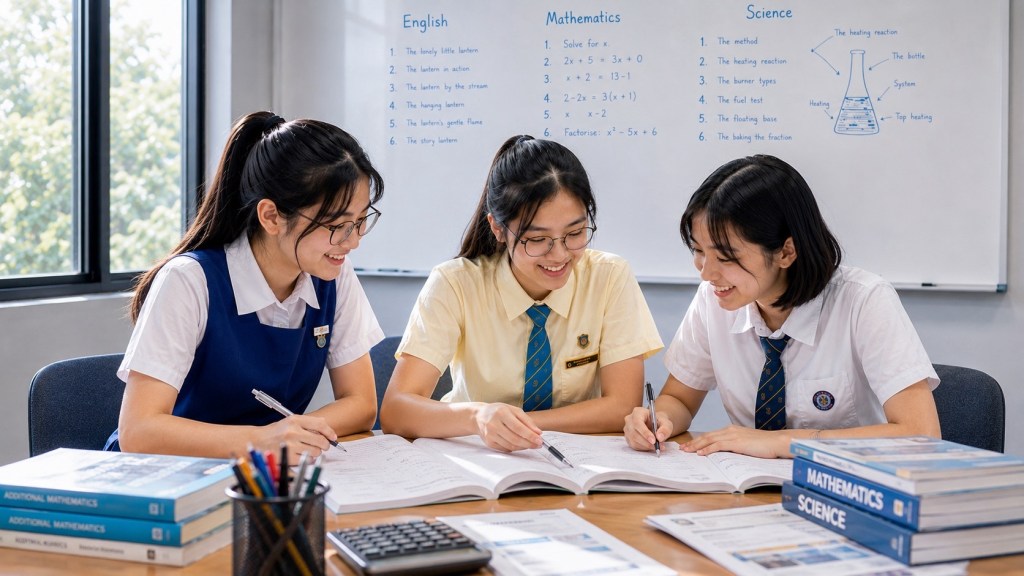
Advanced Additional Mathematics Tutorials now focuses on examination technique: what happens when a student knows the Mathematics but still fails to convert enough of it into marks? This is one of the most frustrating A-Math problems because the family can see genuine knowledge at home. The student can solve topical questions, explain formulas and sometimes complete difficult homework—yet the test score remains lower than expected.
Additional Mathematics examination technique is not a collection of tricks. It is the control layer that converts available knowledge into valid, visible and timely solutions. Students need to decide where to start, how long to persist, how much working to show, when to check, when to move on and how to protect easy marks from avoidable errors.
This guide is for students and parents searching for A-Math exam tips, Additional Mathematics exam technique, time management, how to score better in A-Math, how to stop careless mistakes, how to finish A-Math papers and SEC/O-Level Additional Mathematics examination preparation.
The first principle: exam performance is a separate skill layer
Knowing Mathematics and performing Mathematics under examination constraints are related but not identical.
A student can know a method and still lose marks because:
- the question is not recognised quickly;
- the student starts with an inefficient route;
- working becomes too compressed;
- calculator mode is wrong;
- time is allocated poorly;
- the final answer does not answer the actual question;
- the student cannot recover after getting stuck.
Therefore examination practice should not merely test knowledge. It should train performance decisions.
Before the paper: know what you are sitting
Students should know:
- the syllabus for their cohort;
- the paper structure;
- the permitted calculator rules;
- the expected forms of answers;
- the time available;
- the marks distribution.
For 2027 school candidates, SEAB lists G2 Additional Mathematics K232 and G3 Additional Mathematics K341, where offered. Students graduating in 2026 remain under the GCE route.
Always train for the actual examination structure, not a generic A-Math paper found online.
Technique 1: read the command before doing algebra
Students often see familiar symbols and start calculating immediately.
Pause long enough to identify the command:
- find;
- show;
- prove;
- solve;
- hence;
- sketch;
- state;
- determine;
- explain.
The command changes what evidence the answer must contain.
Technique 2: identify the mathematical object
Before choosing the method, identify what kind of object is present:
- quadratic function;
- equation;
- identity;
- line-curve intersection;
- rate-of-change problem;
- optimisation problem;
- area problem;
- trigonometric equation;
- graph transformation.
This reduces impulsive method selection.
Technique 3: write enough working to recover
A-Math solutions are long.
Good working protects the student from invisible errors.
Write enough to preserve:
- the governing equation;
- important substitutions;
- critical algebraic transformations;
- domain or condition checks;
- the final interpretation.
Do not write every mental operation, but do not compress the route until one slip becomes impossible to locate.
Technique 4: use marks as time information
A high-mark question deserves more time than a very low-mark item, but mark value is only one signal.
Students should also consider:
- how close they are to completing the route;
- whether partial marks are available;
- whether another question is more reachable;
- whether the current question is consuming disproportionate time.
Time management is a decision problem, not a fixed seconds-per-mark formula.
Technique 5: use the two-pass system
A useful approach is:
Pass 1
Collect reachable marks. Complete questions where the route is clear. Mark uncertain questions and move on before one problem consumes the paper.
Pass 2
Return to harder or incomplete questions with the security that easier marks have already been protected.
This system can reduce the damage caused by getting trapped early.
Technique 6: distinguish “stuck” from “thinking”
Productive thinking still generates information.
The student may be:
- testing a representation;
- simplifying;
- checking a relationship;
- trying a valid method.
Being stuck means no new information is being generated.
When stuck:
- rewrite what is given;
- state what is required;
- identify the likely topic family;
- write any relevant relationship;
- try one valid next step;
- if no progress, mark the question and move temporarily.
Technique 7: protect the first line
Many long solutions are lost because the setup is wrong.
Before accelerating, verify the first structural decision.
Examples:
- correct equation;
- correct derivative;
- correct interval;
- correct transformation;
- correct variable definition;
- correct trigonometric mode.
A ten-second setup check can save ten minutes of invalid working.
Technique 8: use local checks instead of checking everything
Students do not have time to re-solve every question.
Use targeted checks:
- sign after a negative bracket;
- calculator mode before trig evaluation;
- domain after solving;
- exactness before decimal conversion;
- constant of integration;
- number of solutions;
- units;
- final answer type.
These checks should correspond to the student’s known error profile.
Technique 9: estimate before trusting the calculator
A calculator result should still pass mathematical judgement.
Ask:
- Should the answer be positive?
- Is the size plausible?
- Should the angle lie in this interval?
- How many roots are expected?
- Does the graph behaviour support the value?
This catches entry and mode errors quickly.
Technique 10: answer the noun
Before moving on, check what the question asked for.
Did it ask for:
- a coordinate?
- an equation?
- an angle?
- a maximum value?
- the x-value where the maximum occurs?
- an area?
- a rate?
- a proof?
Students often complete a substantial amount of correct Mathematics and still omit the required final form.
Technique 11: know when exact form matters
Do not convert exact expressions into decimals automatically.
Exact values can preserve:
- structure;
- accuracy;
- cancellation;
- required answer form.
Approximate at the appropriate stage and according to instructions.
Technique 12: build a hard-question protocol
When a difficult question appears, students can lose time and confidence simultaneously.
Use this protocol:
- underline the required output;
- list the given information;
- identify the mathematical object;
- write one relevant relationship;
- attempt one route;
- if no progress, leave space and move;
- return later with fresh context.
This prevents one question from hijacking the paper.
Technique 13: leave recoverable working
If a question is unfinished, useful working can still matter.
Write:
- the correct setup;
- known formulas;
- substitutions;
- partial simplification;
- clearly defined variables.
Do not leave only erased scratch work.
Technique 14: manage the final ten minutes deliberately
Do not reach the final ten minutes without a plan.
A useful order is:
- complete any almost-finished question;
- check unanswered parts;
- scan known high-risk errors;
- verify calculator mode-sensitive answers;
- check answer format and rounding;
- ensure pages are not skipped.
The final minutes are for high-yield recovery, not random rereading.
Technique 15: practise paper navigation before the real exam
Students should know how they personally behave under time.
Some students benefit from sequential completion.
Some perform better using two passes.
Some need a firm stop rule for hard questions.
The correct navigation strategy should be tested in practice papers, not invented during the examination.
How to train time management
Use staged timing:
- timed single questions;
- timed topic clusters;
- timed half papers;
- full papers;
- full papers with post-paper time analysis.
Do not assume time pressure improves automatically because the student has completed many untimed worksheets.
How to train checking
Checking should be specific.
Build a personal five-point checklist from the student’s actual error history.
For example:
- signs;
- degree/radian mode;
- domain;
- + C;
- answer the noun.
Another student may need a completely different list.
How to train method marks
Students should practise writing mathematically meaningful transitions.
The goal is not to write for the examiner as a trick.
The goal is to make the reasoning explicit enough that:
- the method can be followed;
- the student can recover from a later slip;
- valid intermediate work remains visible.
How to train exam stamina
Some students deteriorate late in the paper.
Train with:
- longer uninterrupted sessions;
- full papers after content is ready;
- short hydration and preparation routines before starting;
- stable pacing rather than sprinting early;
- post-paper analysis of where accuracy drops.
Do not interpret late-paper decline as laziness without evidence. It may be cognitive fatigue, time compression or earlier over-investment.
How to use past papers to train technique
Use a paper to track:
- question start time;
- question finish time;
- questions revisited;
- questions abandoned;
- checking time;
- marks lost to execution rather than knowledge.
The A-Math Past Papers guide gives the full analysis system.
How to practise difficult topics without destroying confidence
Use alternating difficulty.
For example:
- one secure question;
- one challenging question;
- one mixed transfer question;
- one short retrieval question from an older topic.
This gives the student repeated evidence of capability while still building stretch.
The parent view: marks lost are not all equal
If a student loses ten marks to one recurring execution error, that may be easier to repair than ten marks spread across five completely missing concepts.
This is why parents should ask for an error pattern, not only the score.
Useful questions include:
- How many marks were lost after the correct method had already started?
- How many marks were lost because the method was not recognised?
- How many marks were lost because time ran out?
- Which error repeated?
How small-group tuition can train exam technique
At eduKate Sengkang, Additional Mathematics lessons in groups of up to three students can be used to observe examination behaviour directly.
The tutor can see whether the student:
- starts too quickly;
- hesitates too long;
- compresses working;
- checks inefficiently;
- fails to move on;
- depends on hints.
Then the lesson can practise the control layer, not merely reteach the chapter.
Use Secondary 4 Additional Mathematics Sengkang for the examination-year route and the Additional Mathematics Learning Hub for topic repair.
Frequently asked questions
How do I finish an A-Math paper on time?
Train method recognition, question navigation, stop rules and staged timing. Time management is usually improved by better decisions, not simply writing faster.
Should I do the hardest questions first?
Usually not as a default. Protect reachable marks first unless practice evidence shows another strategy works better for you.
How much working should I show?
Enough to communicate the mathematical route, preserve key transitions and allow recovery. Avoid both invisible mental working and unnecessary clutter.
What should I check at the end?
Use a personal checklist based on recurring errors: signs, calculator mode, domains, exactness, integration constants, final answer form and unanswered parts.
How do I stop panicking when I see a hard question?
Use a fixed protocol: identify what is given, state what is required, write one relevant relationship, attempt one valid move, then move on if no progress is being generated.
Can exam technique improve marks even if content stays the same?
Yes, when marks are currently being lost through timing, incomplete working, poor checking or answer-format errors. But technique cannot substitute for missing mathematical knowledge.
The larger idea
A-Math examination technique is the bridge between knowledge and marks.
The student must recognise, choose, execute, communicate, verify and manage time.
When that control layer becomes reliable, existing mathematical knowledge converts into performance more consistently.
Examination handoff: keep Additional Mathematics ownership here for the algebra, functions, trigonometry, calculus and method work; use Examination Craft for timing, checking, recovery, pressure-testing and reliable performance under examination constraints.
