
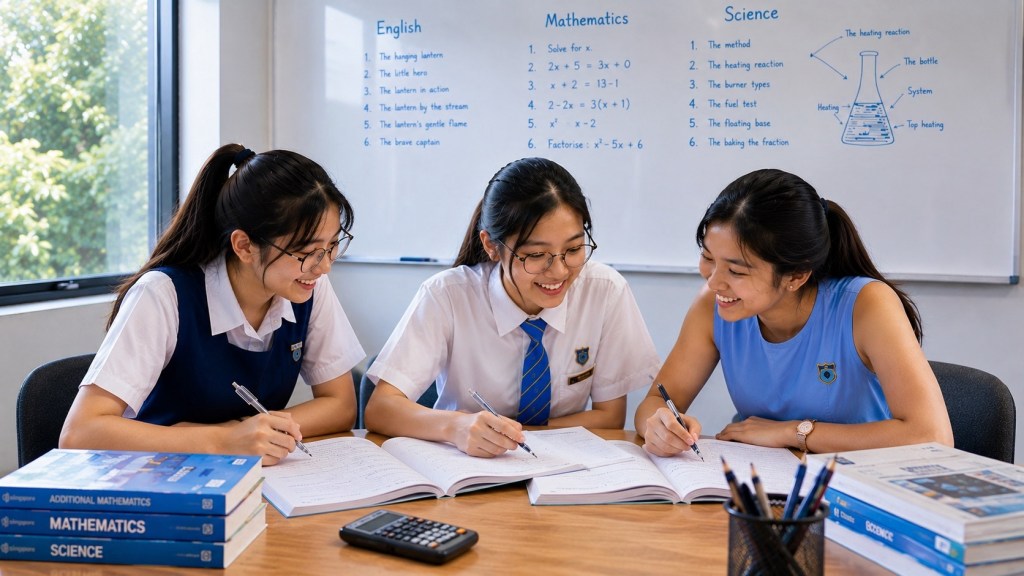
Advanced Additional Mathematics Tutorials continues with one of the most common Singapore parent searches: E-Math vs A-Math. The shorthand is familiar, but the underlying distinction matters more than the labels. Mathematics and Additional Mathematics are separate subjects with different roles. One builds the broad secondary mathematical foundation. The other extends students further into algebraic structure, functions, trigonometry, coordinate geometry and calculus.
For Secondary 2 and Secondary 3 families in Sengkang, the practical question is not simply “Is A-Math harder than E-Math?” It is “What changes in the kind of thinking, what earlier skills become load-bearing, and how should a student prepare?” A learner can perform strongly in regular Mathematics and still find Additional Mathematics demanding because the subject increases abstraction, symbolic density, connection between topics and the number of valid methods available.
This distinction is also changing in official language. Students graduating in 2026 remain under the GCE system, where “E-Math” commonly refers to O-Level Mathematics. From the 2027 graduating cohort, the Singapore-Cambridge Secondary Education Certificate applies. SEAB lists Mathematics and Additional Mathematics separately at G2 and G3, with G2 Additional Mathematics K232 and G3 Additional Mathematics K341 where offered. The old “E-Math versus A-Math” search language will remain useful colloquially, but parents should read the child’s actual subject level and syllabus.
The simplest distinction
Mathematics builds the broad mathematical toolkit needed across everyday quantitative reasoning, further study and many academic pathways.
Additional Mathematics takes selected mathematical ideas much further, especially algebra, functions, trigonometry and calculus.
The difference is not that one subject contains “real Mathematics” and the other does not. Both are serious Mathematics. The distinction is scope, depth and the density of symbolic reasoning.
Why A-Math often feels like a different subject
A student entering Additional Mathematics encounters a change in mathematical texture.
Questions become more likely to require several systems at once:
- recognising the structure;
- selecting a method;
- manipulating algebra accurately;
- remembering conditions;
- moving between equations and graphs;
- connecting one topic to another;
- communicating a valid chain of working.
This is why a student can say, truthfully, “I understand the chapter” and still lose marks. Understanding the new concept is only one part of the performance chain.
Mathematics is broader; A-Math is denser
One useful way to compare the subjects is breadth versus density.
Regular secondary Mathematics covers a broad range of number, algebra, geometry, statistics, probability, graphs, measurement and applied quantitative reasoning according to the syllabus level.
Additional Mathematics concentrates more heavily on algebraic and functional structure. Topics interact more frequently. Old methods remain alive longer. A factorisation skill learned earlier may return inside a quadratic, a polynomial problem, a trigonometric manipulation or a calculus question.
The result is a subject where dependencies matter more.
Algebra changes from a chapter into infrastructure
This may be the single most important distinction for parents.
In regular Mathematics, algebra is an important domain among several domains.
In Additional Mathematics, algebra is often the language carrying other topics.
Consider:
- quadratic functions require algebra;
- logarithms require index control and algebra;
- trigonometric equations require equation solving;
- differentiation often requires expansion, indices and simplification;
- integration requires algebra before and after the calculus step;
- coordinate geometry translates geometry into equations.
A student with unstable algebra may therefore experience every A-Math chapter as a separate difficulty even when one underlying weakness is responsible.
Graphs also change role
In earlier Mathematics, students often meet graphs as representation and interpretation tools.
In Additional Mathematics, graphs become increasingly structural.
They show:
- roots;
- turning points;
- intersections;
- function transformations;
- periodic behaviour;
- increasing and decreasing regions;
- stationary points;
- the geometry behind calculus.
The A-Math Functions and Graphs tutorial explains why this becomes the hidden spine from quadratics to calculus.
What happens to trigonometry?
Earlier trigonometry often focuses on triangles, sides and angles.
Additional Mathematics turns trigonometry into a larger function system.
Students work with:
- trigonometric functions;
- graphs;
- identities;
- equations;
- formulae;
- radians;
- multiple solutions over domains.
The student has to move from “Which ratio fits this triangle?” to “What function relationship is being described, and what solutions satisfy the condition?”
What A-Math adds that ordinary Mathematics may not emphasise as deeply
Depending on subject level and cohort, Additional Mathematics takes students further into areas such as:
- quadratic functions and root structure;
- polynomials;
- surds and exact algebra;
- exponential and logarithmic functions;
- advanced coordinate geometry;
- trigonometric functions and identities;
- differentiation;
- integration;
- rates of change and optimisation;
- mathematical modelling and multi-step reasoning.
Students should always refer to the syllabus for their own cohort rather than a generic internet list.
Does being strong in Mathematics guarantee A-Math success?
No.
Strong Mathematics performance is useful evidence of readiness, but it does not guarantee that the student will immediately enjoy the style of Additional Mathematics.
A-Math may expose weaknesses that ordinary Mathematics did not stress as strongly:
- symbolic manipulation;
- long chains of algebra;
- method selection;
- function notation;
- abstract representation;
- retaining older topics while learning new ones.
Likewise, a student who initially struggles may improve substantially once the new mathematical language becomes familiar.
Does A-Math make Mathematics easier?
Sometimes the two subjects reinforce each other.
A student who becomes stronger at algebraic structure, graphs and equation solving may find parts of regular Mathematics easier to organise.
But the subjects are not interchangeable.
Doing A-Math should not become an excuse to neglect ordinary Mathematics. Each syllabus has its own assessment demands.
The parent readiness test
Before focusing on whether A-Math is “worth it”, ask whether the student currently shows these capabilities:
- reasonably stable algebra;
- comfort with fractions and indices;
- ability to rearrange equations;
- basic graph sense;
- willingness to show working;
- ability to recover after errors;
- interest in learning more abstract Mathematics;
- capacity to manage the additional subject workload.
No single item decides the outcome. Together they provide a better picture than one test score.
Where Primary Mathematics fits
A-Math preparation does not begin by teaching Primary children calculus.
It begins with strong ordinary Mathematics:
- number relationships;
- fractions;
- ratio;
- percentage;
- geometry;
- problem representation;
- checking;
- mathematical explanation.
The Primary 1–6 skills that later power A-Math guide maps those foundations forward.
Where Secondary 1 and 2 fit
Lower secondary is the real bridge.
This is where:
- algebra becomes a language;
- graphs become relationships;
- indices become more important;
- equation solving becomes reusable infrastructure;
- students begin to work more independently.
A Secondary 2 student does not need to pre-learn the entire A-Math syllabus. The stronger goal is to make these dependencies reliable.
See How to Prepare for Secondary 3 A-Math in Secondary 2.
2026 GCE and 2027 SEC: parents should separate the systems
For 2026 graduates, the familiar GCE syllabus structure still applies.
From 2027, the Singapore-Cambridge Secondary Education Certificate replaces the N- and O-Level certificates. In the school-candidate listings, SEAB lists:
- G2 Mathematics K210 and G2 Additional Mathematics K232;
- G3 Mathematics K310 and G3 Additional Mathematics K341.
That reinforces the conceptual point: Mathematics and Additional Mathematics are separately defined subjects.
E-Math versus A-Math: a practical comparison
| Dimension | Mathematics | Additional Mathematics |
|---|---|---|
| Role | broad secondary mathematical foundation | deeper advanced-secondary mathematical extension |
| Algebra | important domain | frequent infrastructure across topics |
| Functions | introduced and used according to syllabus | more central and connected to advanced topics |
| Trigonometry | foundational applications | functions, graphs, identities, equations and deeper structure |
| Calculus | not the defining core | major advanced component where included |
| Method selection | important | increasingly dense and multi-stage |
| Dependency load | broad | high connection between chapters |
What students usually find hardest in the transition
1. The algebra never goes away
Students expect to finish one chapter and move on. A-Math keeps reusing older methods.
2. More than one method may be plausible
The student must choose, not simply recall.
3. Topic labels disappear in exams
Recognition becomes part of the task.
4. Working becomes longer
Errors can travel further.
5. Understanding must become independent reconstruction
Seeing the teacher’s solution is not enough.
What parents should not say
Avoid turning the distinction into status language such as:
“A-Math is for smart children.”
That is too crude to be educationally useful.
A better statement is:
“A-Math has a different demand profile. Let us see whether the current foundations, interest and workload fit that route.”
Where tuition can help
Tuition can be useful when the student needs:
- prerequisite diagnosis;
- more guided modelling;
- more opportunity to ask questions;
- mixed-question practice;
- exam-performance training;
- structured recovery after marks fall.
It may be unnecessary when school learning, independent study and current performance are already working well.
For local support, the canonical service route is Additional Mathematics Tuition Sengkang. For teaching content, use the Additional Mathematics Learning Hub.
Frequently asked questions
Is A-Math much harder than E-Math?
It can feel much harder because the subject is more symbolically dense and interconnected. Difficulty depends strongly on the student’s algebra foundation, study habits and readiness.
Do I need A-Math to be good at Mathematics?
No. Additional Mathematics is a specific subject route, not a definition of mathematical ability.
Can a student be good at E-Math and weak at A-Math?
Yes. A-Math may expose weaknesses in symbolic manipulation, function thinking, retention or method selection that were less visible before.
Does taking A-Math help E-Math?
It can strengthen some shared skills, especially algebra and graph reasoning, but the student still needs to study the Mathematics syllabus directly.
What is the biggest preparation priority?
Stable algebra has unusually high value because it supports so many later A-Math topics.
Where should a parent start?
Use the SEC G1/G2/G3 pathway guide to understand the structure, then the Additional Mathematics Learning Hub for the topic route.
The larger idea
E-Math and A-Math are not a simple lower-versus-higher hierarchy.
They are two different mathematical jobs.
Regular Mathematics builds breadth and foundational quantitative power. Additional Mathematics extends selected ideas into a denser world of algebra, functions, trigonometry and calculus.
The right preparation is therefore not status chasing. It is building the mathematical infrastructure that lets the student learn the second subject productively.
