
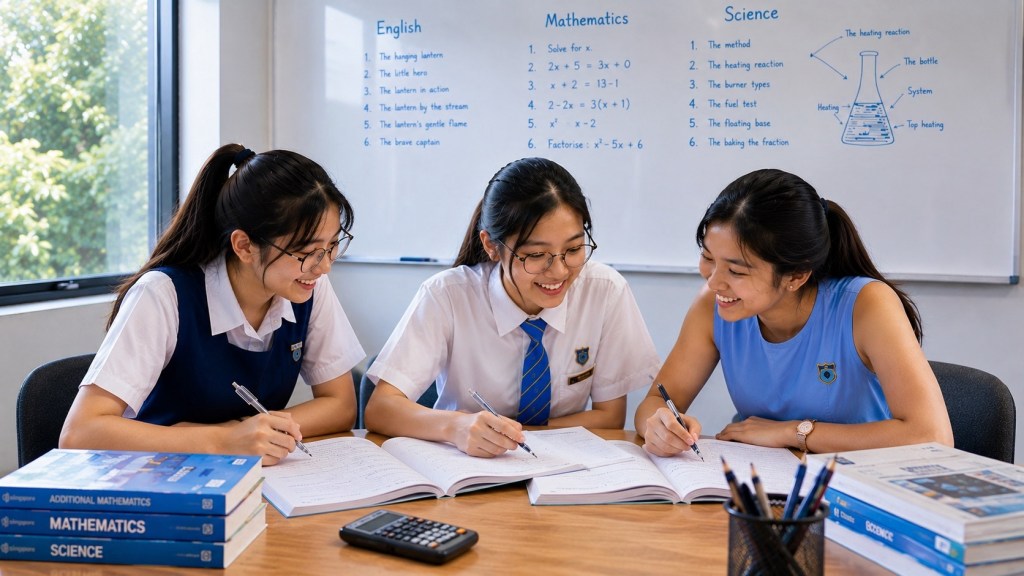
Faith begins Secondary 4 with a familiar A-Math problem: every chapter seems to depend on something earlier. When calculus becomes difficult, algebra interferes. When trigonometric equations go wrong, angle control and symbolic manipulation interfere. When functions become unfamiliar, notation itself can slow her down. More practice helps, but only when the practice reaches the dependency that is actually failing.
This I Am Brave story follows Additional Mathematics as a final-year system rather than a pile of chapters. It sits beside the Additional Mathematics Learning Hub, the Additional Mathematics Study Guide and I Am Brave: The Secondary 4 Year.
The examination label also depends on graduating cohort. Students graduating in 2026 remain under the existing GCE framework; from the 2027 graduating cohort, the Singapore-Cambridge Secondary Education Certificate (SEC) replaces the separate GCE N(T), N(A) and O-Level certificates, with subjects taken at G1, G2 or G3 as applicable. SEAB’s SEC overview is the canonical source for that transition. Faith’s learning problem, however, remains the same: can the mathematics survive the conditions of the paper she will actually sit?
January: build the dependency map before building the timetable
Faith lists the chapters she expects to revise. Her tutor asks for a different list: the capabilities those chapters depend on. Algebraic manipulation, equations, graphs, function notation, trigonometric relationships, coordinate control and exact-value reasoning appear repeatedly.
This changes revision. Instead of waiting for a calculus question to expose weak algebra in March, she tests the algebra separately in January. Instead of treating every trigonometry error as a trigonometry problem, she checks whether the wrong step is angle selection, identity choice, equation solving or arithmetic.
The first weak link can be older than the A-Math chapter
One week, Faith repeatedly loses marks in differentiation questions involving fractions. The calculus rule is correct; the simplification afterwards is not. Reteaching differentiation would be inefficient. The weak link is algebraic manipulation after the derivative has been formed.
That is the Atlas principle in a dependency-heavy subject: repair the earliest unreliable move that controls the rest of the chain.
Functions become a language, not a chapter
Faith used to treat function notation as something to survive in the functions chapter. By Secondary 4 she notices that the notation travels. Composition, inverse relationships, graphs and transformations all become easier when she reads the notation as instructions about inputs, outputs and relationships.
So she practises translating between notation, graph, equation and verbal description. The skill is stronger when she can move between representations rather than recognise only one familiar form.
Trigonometry: selection matters as much as recall
Faith knows several identities. The problem is deciding which one reduces the structure she has. A worksheet organised by identity makes that decision disappear. Mixed work restores it. She has to inspect the equation, decide what form would be useful, transform carefully and verify possible solutions against the required domain.
At first mixed practice makes her slower. Later it makes her more examination-ready because the paper will not label the intended method.
Calculus: technique has to survive algebra and interpretation
Differentiation and integration are not isolated mechanical operations. Faith must interpret gradients, stationary points, rates of change, areas and accumulated quantities while preserving algebraic accuracy. A learner who can differentiate a clean expression may still fail when the expression is embedded in a larger modelling question.
Her practice therefore moves outward: clean technique → mixed technique → interpretation → multi-step questions → timed sets.
Prelims are a stress test, not the final identity
Faith’s preliminary examination is uneven. Paper-level conditions expose two things that chapter practice hid: she spends too long rescuing hard questions, and she leaves too little time for checking. The content repair is no longer the only job. Examination execution becomes a separate capability.
She uses Examination Craft to build a paper routine: orientation, mark-aware time use, a clear leave-and-return rule, selective checking and recovery after a bad item. The next full paper tests the routine, not just the mathematics.
Checking becomes mathematical, not cosmetic
“Check your work” used to mean reread everything. Faith now uses targeted verification. Expand a factorisation. Substitute a value. Differentiate an antiderivative. Inspect domains and restrictions. Estimate whether a result is plausible. Check whether an answer actually addresses the quantity requested.
The check is chosen from the structure of the work.
The last weeks get smaller
As the final examination approaches, Faith does not open a new resource pile. The work narrows to known weak links, mixed retrieval, selected full-paper practice, correction of repeated causes and protection of sleep. There is still learning, but there is less uncontrolled novelty.
The closer the examination gets, the more expensive unnecessary disruption becomes.
What Faith wants to be able to do without help
- Recognise the dependency. Know whether the visible A-Math error began in algebra, notation, trigonometry, calculus or interpretation.
- Select the method. Mixed practice should require a decision, not merely execution.
- Verify mathematically. Use inverse operations, substitution, differentiation, expansion or reasonableness checks.
- Leave and return. A hard question should not consume the marks available elsewhere.
- Recover between papers. One performance must not control the next.
- Carry the system beyond Secondary 4. Final-year preparation should produce a more independent learner, not a learner who needs permanent rescue.
The handover beyond the final A-Math paper
Faith’s Secondary 4 year is not successful only if every A-Math question becomes easy. The deeper success is that difficult work becomes more diagnosable. She knows how to locate the failed move, choose a repair, retest it and decide whether it can now be trusted under mixed and timed conditions.
That is why this page returns to Learning Atlas V2.0. Additional Mathematics is one demanding route through the same learning system: notice → diagnose → repair → practise → transfer → perform → return control.
Parent symptom route: My Child Was Strong in Sec 3 A-Math and Is Sinking in Sec 4
If you arrived because this is happening at home, use My Child Was Strong in Sec 3 A-Math and Is Sinking in Sec 4 when the final-year decline is the first signal and the underlying A-Math dependency is not yet clear.
This story is the worked learner case; the symptom page is the parent-facing diagnostic entrance.
