
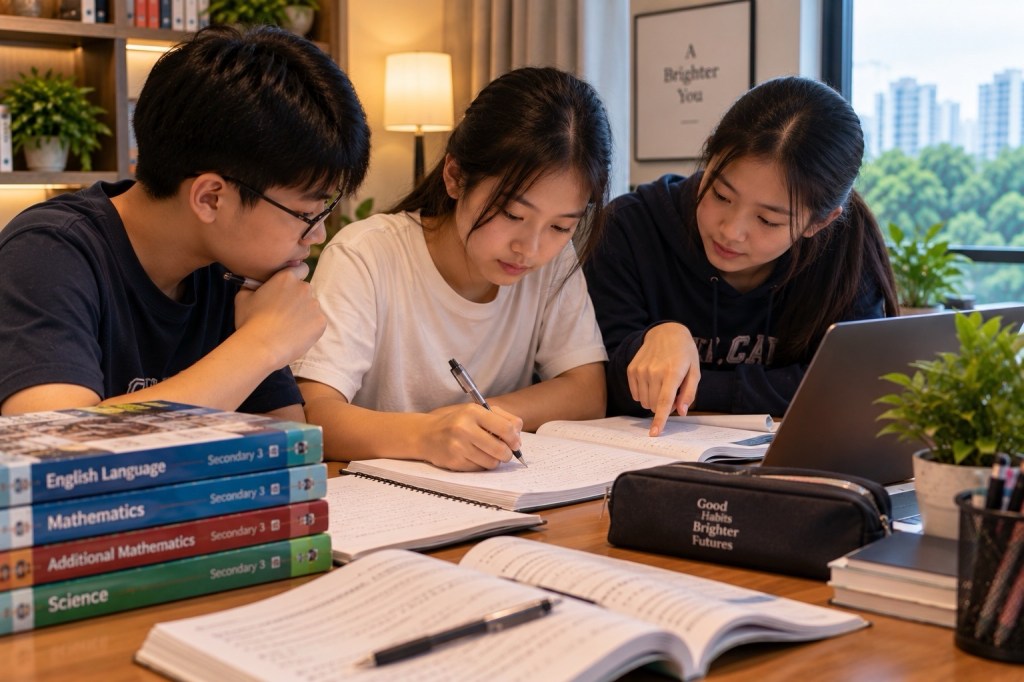
Learning G3 A-Math with an Ang Mo Kio tutor should turn symbolic complexity into a connected mathematical system. Additional Mathematics becomes manageable when the learner sees how algebra, functions, trigonometry and calculus depend on one another.
For 2027 SEC school candidates, SEAB lists G3 Additional Mathematics as K341. The subject assumes strong G3 Mathematics foundations and requires careful symbolic control.
For Ang Mo Kio families comparing tutors, the important question is not whether the tutor can solve difficult questions quickly. It is whether the tutor can identify which prerequisite has failed and then rebuild enough understanding for the student to reconstruct the method independently.
eduKate Sengkang teaches Additional Mathematics in groups of up to three students. The tutor can inspect each line of working and identify the precise point where meaning is lost.
G3 A-Math tuition may be useful for students who need to:
- make algebraic manipulation faster and more reliable;
- connect functions, equations and graphs;
- strengthen coordinate geometry;
- develop stronger trigonometric identity and equation control;
- understand differentiation as gradient and rate of change;
- understand integration as accumulation and reverse differentiation;
- improve application and modelling;
- show essential working clearly;
- improve mixed-topic retrieval; or
- prepare systematically for K341.
Read: From O-Level A-Math 4049 to SEC G3 K341
Check the official 2027 SEC G3 syllabus list at SEAB
The Visible Topic Is Not Always the Real Problem
A calculus question may fail because the learner cannot rearrange an equation. A trigonometric question may fail because factorisation is slow. A graph question may fail because function notation is still unfamiliar.
The tutor therefore traces errors backwards until the first unstable dependency appears.
In A-Math, the shortest route forward is often to repair the earliest skill that should already be automatic.
Algebra
Algebra is the operating system of G3 Additional Mathematics.
Students practise simplification, expansion, factorisation, substitution and equation solving with enough repetition to make routine symbolic work efficient.
The tutor pays close attention to brackets, signs, indices and exact values because these small details often determine whether a long solution survives.
Functions and Graphs
Functions are taught as relationships rather than notation to memorise.
Students connect algebraic form to graphical behaviour and use graphs to reason about roots, intersections and turning behaviour.
Coordinate Geometry
Coordinate geometry sits at the intersection of algebra and space.
Students use gradients, equations, distances and geometric conditions, and they learn to use the diagram and the algebra as mutual checks.
Trigonometry
G3 A-Math trigonometry demands symbolic fluency.
Students distinguish identities from equations, manage intervals carefully and preserve a clear line of transformation.
The aim is to understand which steps are valid and why.
Differentiation
Differentiation is first understood as gradient and rate of change.
Students then practise rules, tangents, normals, stationary points and applications while keeping the concept connected to the graph or changing quantity.
Integration
Integration is taught as reverse differentiation and accumulation.
Students practise standard forms and applications while checking whether the final result has a sensible mathematical interpretation.
The eduKate G3 A-Math Runtime
1. Diagnose
We identify whether the problem is conceptual, algebraic, representational or procedural.
2. Repair
The earliest unstable prerequisite is strengthened.
3. Model
The tutor explains why the method applies.
4. Vary
The question form changes so the student must recognise the structure.
5. Remove support
The learner reconstructs the method independently.
6. Retrieve later
Earlier ideas return after delay.
7. Transfer
The student meets mixed problems where several methods may compete.
Three G3 A-Math Pathways
Repair
For a learner already struggling, we rebuild the earliest weak dependency.
Stabilise
For a learner who understands lessons but produces uneven test results, we train retrieval, checking and examination control.
Extend
For a strong learner, we use unfamiliar forms, multiple methods and deeper explanation.
When Should an Ang Mo Kio Student Begin G3 A-Math Tuition?
- when algebra is slow;
- when the student can follow worked examples but cannot start a changed problem;
- when sign and bracket errors repeat;
- when functions and graphs feel disconnected;
- when trigonometric manipulation is fragile;
- when calculus rules are known but applications remain difficult;
- when topical work is strong but mixed papers are weak;
- when K341 preparation needs a clearer system.
Ang Mo Kio Convenience and the Actual Classroom Location
An Ang Mo Kio A-Math tutor may make weekly attendance easier for local families.
Parents should also compare whether the tutor diagnoses prerequisite gaps and tests corrected skills again after time has passed.
eduKate Sengkang is not located in Ang Mo Kio. Our Sengkang/Punggol classroom is at 83 Punggol Central, Singapore 828761, by appointment.
Class Details
- Class size: up to 3 students
- Subject: G3 Additional Mathematics
- SEC route: K341 for 2027 school candidates
- Duration: 1.5 hours
- Focus: algebra, functions, coordinate geometry, trigonometry, calculus and examination control
- Method: diagnose → repair → model → vary → independent attempt → retrieval → transfer
- Location: 83 Punggol Central, Singapore 828761
Learning G3 A-Math with an Ang Mo Kio Tutor
Good G3 A-Math tuition should make difficult mathematics reconstructible.
The learner should become better at seeing the structure, choosing a method, carrying out the symbolic work and checking the result.
For students who are behind, we rebuild. For students who are inconsistent, we stabilise. For students who are ready, we extend.
Task recognition
In G3 Additional Mathematics, this part of the learning system is trained through algebraic structure. The student is asked to do more than recognise a correct answer after it is shown. The learner must identify what the task requires, decide which knowledge or representation is useful, make an independent attempt and then inspect the result for signs that something has gone wrong. The tutor watches the decision process as carefully as the final answer because the same score can be produced by very different causes.
This matters for a student travelling from Ang Mo Kio because tuition time has to produce something that survives the journey back into school. A correction that only works inside the lesson is not enough. The idea should return later, appear in a changed form and eventually sit beside other topics so the learner has to choose it without being told. That sequence—understand, attempt, correct, retrieve, mix and transfer—is what turns a short-term success into a usable capability.
As the capability becomes more stable, support is reduced. The tutor stops supplying the first move, waits longer before intervening and asks the student to explain why the chosen route belongs. This can feel slower than simply showing the answer, but it builds a learner who can continue when the task is unfamiliar. The standard is therefore not perfect performance during tuition; it is increasingly organised performance when the tutor is silent.
Building a reliable first move
In G3 Additional Mathematics, this part of the learning system is trained through functions. The student is asked to do more than recognise a correct answer after it is shown. The learner must identify what the task requires, decide which knowledge or representation is useful, make an independent attempt and then inspect the result for signs that something has gone wrong. The tutor watches the decision process as carefully as the final answer because the same score can be produced by very different causes.
This matters for a student travelling from Ang Mo Kio because tuition time has to produce something that survives the journey back into school. A correction that only works inside the lesson is not enough. The idea should return later, appear in a changed form and eventually sit beside other topics so the learner has to choose it without being told. That sequence—understand, attempt, correct, retrieve, mix and transfer—is what turns a short-term success into a usable capability.
As the capability becomes more stable, support is reduced. The tutor stops supplying the first move, waits longer before intervening and asks the student to explain why the chosen route belongs. This can feel slower than simply showing the answer, but it builds a learner who can continue when the task is unfamiliar. The standard is therefore not perfect performance during tuition; it is increasingly organised performance when the tutor is silent.
Correction that changes future work
In G3 Additional Mathematics, this part of the learning system is trained through graphs. The student is asked to do more than recognise a correct answer after it is shown. The learner must identify what the task requires, decide which knowledge or representation is useful, make an independent attempt and then inspect the result for signs that something has gone wrong. The tutor watches the decision process as carefully as the final answer because the same score can be produced by very different causes.
This matters for a student travelling from Ang Mo Kio because tuition time has to produce something that survives the journey back into school. A correction that only works inside the lesson is not enough. The idea should return later, appear in a changed form and eventually sit beside other topics so the learner has to choose it without being told. That sequence—understand, attempt, correct, retrieve, mix and transfer—is what turns a short-term success into a usable capability.
As the capability becomes more stable, support is reduced. The tutor stops supplying the first move, waits longer before intervening and asks the student to explain why the chosen route belongs. This can feel slower than simply showing the answer, but it builds a learner who can continue when the task is unfamiliar. The standard is therefore not perfect performance during tuition; it is increasingly organised performance when the tutor is silent.
Retrieval after delay
In G3 Additional Mathematics, this part of the learning system is trained through equations. The student is asked to do more than recognise a correct answer after it is shown. The learner must identify what the task requires, decide which knowledge or representation is useful, make an independent attempt and then inspect the result for signs that something has gone wrong. The tutor watches the decision process as carefully as the final answer because the same score can be produced by very different causes.
This matters for a student travelling from Ang Mo Kio because tuition time has to produce something that survives the journey back into school. A correction that only works inside the lesson is not enough. The idea should return later, appear in a changed form and eventually sit beside other topics so the learner has to choose it without being told. That sequence—understand, attempt, correct, retrieve, mix and transfer—is what turns a short-term success into a usable capability.
As the capability becomes more stable, support is reduced. The tutor stops supplying the first move, waits longer before intervening and asks the student to explain why the chosen route belongs. This can feel slower than simply showing the answer, but it builds a learner who can continue when the task is unfamiliar. The standard is therefore not perfect performance during tuition; it is increasingly organised performance when the tutor is silent.
Choosing between methods
In G3 Additional Mathematics, this part of the learning system is trained through trigonometric identities. The student is asked to do more than recognise a correct answer after it is shown. The learner must identify what the task requires, decide which knowledge or representation is useful, make an independent attempt and then inspect the result for signs that something has gone wrong. The tutor watches the decision process as carefully as the final answer because the same score can be produced by very different causes.
This matters for a student travelling from Ang Mo Kio because tuition time has to produce something that survives the journey back into school. A correction that only works inside the lesson is not enough. The idea should return later, appear in a changed form and eventually sit beside other topics so the learner has to choose it without being told. That sequence—understand, attempt, correct, retrieve, mix and transfer—is what turns a short-term success into a usable capability.
As the capability becomes more stable, support is reduced. The tutor stops supplying the first move, waits longer before intervening and asks the student to explain why the chosen route belongs. This can feel slower than simply showing the answer, but it builds a learner who can continue when the task is unfamiliar. The standard is therefore not perfect performance during tuition; it is increasingly organised performance when the tutor is silent.
Working under mixed conditions
In G3 Additional Mathematics, this part of the learning system is trained through coordinate geometry. The student is asked to do more than recognise a correct answer after it is shown. The learner must identify what the task requires, decide which knowledge or representation is useful, make an independent attempt and then inspect the result for signs that something has gone wrong. The tutor watches the decision process as carefully as the final answer because the same score can be produced by very different causes.
This matters for a student travelling from Ang Mo Kio because tuition time has to produce something that survives the journey back into school. A correction that only works inside the lesson is not enough. The idea should return later, appear in a changed form and eventually sit beside other topics so the learner has to choose it without being told. That sequence—understand, attempt, correct, retrieve, mix and transfer—is what turns a short-term success into a usable capability.
As the capability becomes more stable, support is reduced. The tutor stops supplying the first move, waits longer before intervening and asks the student to explain why the chosen route belongs. This can feel slower than simply showing the answer, but it builds a learner who can continue when the task is unfamiliar. The standard is therefore not perfect performance during tuition; it is increasingly organised performance when the tutor is silent.
Checking before submission
In G3 Additional Mathematics, this part of the learning system is trained through differentiation. The student is asked to do more than recognise a correct answer after it is shown. The learner must identify what the task requires, decide which knowledge or representation is useful, make an independent attempt and then inspect the result for signs that something has gone wrong. The tutor watches the decision process as carefully as the final answer because the same score can be produced by very different causes.
This matters for a student travelling from Ang Mo Kio because tuition time has to produce something that survives the journey back into school. A correction that only works inside the lesson is not enough. The idea should return later, appear in a changed form and eventually sit beside other topics so the learner has to choose it without being told. That sequence—understand, attempt, correct, retrieve, mix and transfer—is what turns a short-term success into a usable capability.
As the capability becomes more stable, support is reduced. The tutor stops supplying the first move, waits longer before intervening and asks the student to explain why the chosen route belongs. This can feel slower than simply showing the answer, but it builds a learner who can continue when the task is unfamiliar. The standard is therefore not perfect performance during tuition; it is increasingly organised performance when the tutor is silent.
Explaining the reasoning
In G3 Additional Mathematics, this part of the learning system is trained through integration. The student is asked to do more than recognise a correct answer after it is shown. The learner must identify what the task requires, decide which knowledge or representation is useful, make an independent attempt and then inspect the result for signs that something has gone wrong. The tutor watches the decision process as carefully as the final answer because the same score can be produced by very different causes.
This matters for a student travelling from Ang Mo Kio because tuition time has to produce something that survives the journey back into school. A correction that only works inside the lesson is not enough. The idea should return later, appear in a changed form and eventually sit beside other topics so the learner has to choose it without being told. That sequence—understand, attempt, correct, retrieve, mix and transfer—is what turns a short-term success into a usable capability.
As the capability becomes more stable, support is reduced. The tutor stops supplying the first move, waits longer before intervening and asks the student to explain why the chosen route belongs. This can feel slower than simply showing the answer, but it builds a learner who can continue when the task is unfamiliar. The standard is therefore not perfect performance during tuition; it is increasingly organised performance when the tutor is silent.
Using school feedback
In G3 Additional Mathematics, this part of the learning system is trained through exact values. The student is asked to do more than recognise a correct answer after it is shown. The learner must identify what the task requires, decide which knowledge or representation is useful, make an independent attempt and then inspect the result for signs that something has gone wrong. The tutor watches the decision process as carefully as the final answer because the same score can be produced by very different causes.
This matters for a student travelling from Ang Mo Kio because tuition time has to produce something that survives the journey back into school. A correction that only works inside the lesson is not enough. The idea should return later, appear in a changed form and eventually sit beside other topics so the learner has to choose it without being told. That sequence—understand, attempt, correct, retrieve, mix and transfer—is what turns a short-term success into a usable capability.
As the capability becomes more stable, support is reduced. The tutor stops supplying the first move, waits longer before intervening and asks the student to explain why the chosen route belongs. This can feel slower than simply showing the answer, but it builds a learner who can continue when the task is unfamiliar. The standard is therefore not perfect performance during tuition; it is increasingly organised performance when the tutor is silent.
Managing assessment time
In G3 Additional Mathematics, this part of the learning system is trained through symbolic checking. The student is asked to do more than recognise a correct answer after it is shown. The learner must identify what the task requires, decide which knowledge or representation is useful, make an independent attempt and then inspect the result for signs that something has gone wrong. The tutor watches the decision process as carefully as the final answer because the same score can be produced by very different causes.
This matters for a student travelling from Ang Mo Kio because tuition time has to produce something that survives the journey back into school. A correction that only works inside the lesson is not enough. The idea should return later, appear in a changed form and eventually sit beside other topics so the learner has to choose it without being told. That sequence—understand, attempt, correct, retrieve, mix and transfer—is what turns a short-term success into a usable capability.
As the capability becomes more stable, support is reduced. The tutor stops supplying the first move, waits longer before intervening and asks the student to explain why the chosen route belongs. This can feel slower than simply showing the answer, but it builds a learner who can continue when the task is unfamiliar. The standard is therefore not perfect performance during tuition; it is increasingly organised performance when the tutor is silent.
Recovering after uncertainty
In G3 Additional Mathematics, this part of the learning system is trained through algebraic structure. The student is asked to do more than recognise a correct answer after it is shown. The learner must identify what the task requires, decide which knowledge or representation is useful, make an independent attempt and then inspect the result for signs that something has gone wrong. The tutor watches the decision process as carefully as the final answer because the same score can be produced by very different causes.
This matters for a student travelling from Ang Mo Kio because tuition time has to produce something that survives the journey back into school. A correction that only works inside the lesson is not enough. The idea should return later, appear in a changed form and eventually sit beside other topics so the learner has to choose it without being told. That sequence—understand, attempt, correct, retrieve, mix and transfer—is what turns a short-term success into a usable capability.
As the capability becomes more stable, support is reduced. The tutor stops supplying the first move, waits longer before intervening and asks the student to explain why the chosen route belongs. This can feel slower than simply showing the answer, but it builds a learner who can continue when the task is unfamiliar. The standard is therefore not perfect performance during tuition; it is increasingly organised performance when the tutor is silent.
Strengthening home practice
In G3 Additional Mathematics, this part of the learning system is trained through functions. The student is asked to do more than recognise a correct answer after it is shown. The learner must identify what the task requires, decide which knowledge or representation is useful, make an independent attempt and then inspect the result for signs that something has gone wrong. The tutor watches the decision process as carefully as the final answer because the same score can be produced by very different causes.
This matters for a student travelling from Ang Mo Kio because tuition time has to produce something that survives the journey back into school. A correction that only works inside the lesson is not enough. The idea should return later, appear in a changed form and eventually sit beside other topics so the learner has to choose it without being told. That sequence—understand, attempt, correct, retrieve, mix and transfer—is what turns a short-term success into a usable capability.
As the capability becomes more stable, support is reduced. The tutor stops supplying the first move, waits longer before intervening and asks the student to explain why the chosen route belongs. This can feel slower than simply showing the answer, but it builds a learner who can continue when the task is unfamiliar. The standard is therefore not perfect performance during tuition; it is increasingly organised performance when the tutor is silent.
Keeping earlier learning available
In G3 Additional Mathematics, this part of the learning system is trained through graphs. The student is asked to do more than recognise a correct answer after it is shown. The learner must identify what the task requires, decide which knowledge or representation is useful, make an independent attempt and then inspect the result for signs that something has gone wrong. The tutor watches the decision process as carefully as the final answer because the same score can be produced by very different causes.
This matters for a student travelling from Ang Mo Kio because tuition time has to produce something that survives the journey back into school. A correction that only works inside the lesson is not enough. The idea should return later, appear in a changed form and eventually sit beside other topics so the learner has to choose it without being told. That sequence—understand, attempt, correct, retrieve, mix and transfer—is what turns a short-term success into a usable capability.
As the capability becomes more stable, support is reduced. The tutor stops supplying the first move, waits longer before intervening and asks the student to explain why the chosen route belongs. This can feel slower than simply showing the answer, but it builds a learner who can continue when the task is unfamiliar. The standard is therefore not perfect performance during tuition; it is increasingly organised performance when the tutor is silent.
Connecting one topic to another
In G3 Additional Mathematics, this part of the learning system is trained through equations. The student is asked to do more than recognise a correct answer after it is shown. The learner must identify what the task requires, decide which knowledge or representation is useful, make an independent attempt and then inspect the result for signs that something has gone wrong. The tutor watches the decision process as carefully as the final answer because the same score can be produced by very different causes.
This matters for a student travelling from Ang Mo Kio because tuition time has to produce something that survives the journey back into school. A correction that only works inside the lesson is not enough. The idea should return later, appear in a changed form and eventually sit beside other topics so the learner has to choose it without being told. That sequence—understand, attempt, correct, retrieve, mix and transfer—is what turns a short-term success into a usable capability.
As the capability becomes more stable, support is reduced. The tutor stops supplying the first move, waits longer before intervening and asks the student to explain why the chosen route belongs. This can feel slower than simply showing the answer, but it builds a learner who can continue when the task is unfamiliar. The standard is therefore not perfect performance during tuition; it is increasingly organised performance when the tutor is silent.
Learning from repeated errors
In G3 Additional Mathematics, this part of the learning system is trained through trigonometric identities. The student is asked to do more than recognise a correct answer after it is shown. The learner must identify what the task requires, decide which knowledge or representation is useful, make an independent attempt and then inspect the result for signs that something has gone wrong. The tutor watches the decision process as carefully as the final answer because the same score can be produced by very different causes.
This matters for a student travelling from Ang Mo Kio because tuition time has to produce something that survives the journey back into school. A correction that only works inside the lesson is not enough. The idea should return later, appear in a changed form and eventually sit beside other topics so the learner has to choose it without being told. That sequence—understand, attempt, correct, retrieve, mix and transfer—is what turns a short-term success into a usable capability.
As the capability becomes more stable, support is reduced. The tutor stops supplying the first move, waits longer before intervening and asks the student to explain why the chosen route belongs. This can feel slower than simply showing the answer, but it builds a learner who can continue when the task is unfamiliar. The standard is therefore not perfect performance during tuition; it is increasingly organised performance when the tutor is silent.
Extending a strong learner
In G3 Additional Mathematics, this part of the learning system is trained through coordinate geometry. The student is asked to do more than recognise a correct answer after it is shown. The learner must identify what the task requires, decide which knowledge or representation is useful, make an independent attempt and then inspect the result for signs that something has gone wrong. The tutor watches the decision process as carefully as the final answer because the same score can be produced by very different causes.
This matters for a student travelling from Ang Mo Kio because tuition time has to produce something that survives the journey back into school. A correction that only works inside the lesson is not enough. The idea should return later, appear in a changed form and eventually sit beside other topics so the learner has to choose it without being told. That sequence—understand, attempt, correct, retrieve, mix and transfer—is what turns a short-term success into a usable capability.
As the capability becomes more stable, support is reduced. The tutor stops supplying the first move, waits longer before intervening and asks the student to explain why the chosen route belongs. This can feel slower than simply showing the answer, but it builds a learner who can continue when the task is unfamiliar. The standard is therefore not perfect performance during tuition; it is increasingly organised performance when the tutor is silent.
Arrange a Parent–Student Consultation
Visit eduKate Sengkang for current class information, fees and contact details.
Continue learning: Additional Mathematics Learning Hub.
