
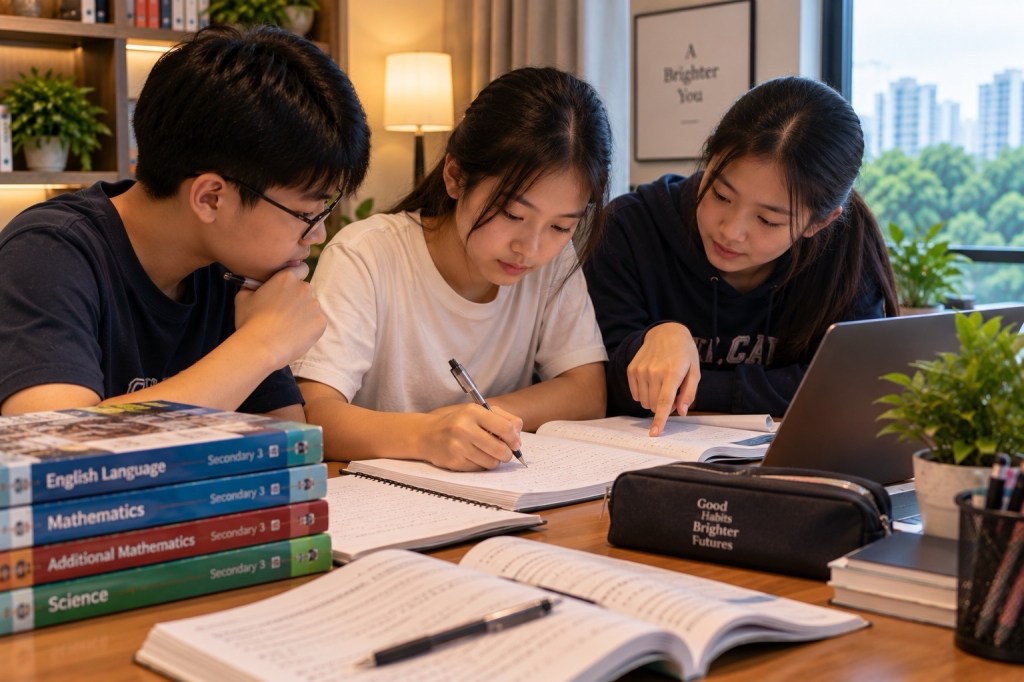
Learning G3 A-Math with a Woodlands tutor should turn symbolic complexity into a system the student can control. Additional Mathematics is cumulative: algebra supports functions, functions support graphs, trigonometry demands symbolic fluency, and calculus depends on earlier manipulation remaining available under pressure.
For 2027 SEC school candidates, SEAB lists G3 Additional Mathematics as K341, with 4049 shown as the earlier reference code. The official syllabus is organised around Algebra, Geometry and Trigonometry, and Calculus, and assumes knowledge of G3 Mathematics.
This is why a student who looks weak in calculus may actually have an older algebra problem. The visible chapter is not always the true cause.
eduKate Sengkang teaches Additional Mathematics in groups of up to three students. The small-group format allows the tutor to inspect every line of working and identify where mathematical meaning is lost.
G3 A-Math tuition may be useful for students who need to:
- make algebraic manipulation faster and more reliable;
- connect functions, equations and graphs;
- strengthen logarithmic and exponential reasoning;
- improve coordinate geometry;
- develop trigonometric identities and equation control;
- understand differentiation as rate of change and gradient;
- understand integration as accumulation and reverse differentiation;
- solve application questions with clearer modelling;
- show essential working consistently;
- prepare for the 2027 K341 SEC route.
Read: From O-Level A-Math 4049 to SEC G3 K341
Check the official 2027 SEC G3 syllabus list at SEAB
G3 A-Math Is Built on Dependencies
Additional Mathematics often feels difficult because several earlier skills are required at the same time.
A trigonometric problem may depend on factorisation. A differentiation application may depend on rearranging an equation. An integration problem may fail because index laws are unstable.
The tutor therefore traces errors backwards until the first weak dependency appears.
The fastest route forward in A-Math is often to repair the earliest thing that should already be automatic.
Algebra: The Core Operating System
Algebra is not one chapter in G3 Additional Mathematics. It is the language inside most chapters.
We train students to see expression structure, preserve equivalence, manage signs, choose useful forms and check transformations.
Fluency matters because routine symbolic work should not consume the same attention needed for the deeper idea.
Functions, Equations and Graphs
Functions are taught as relationships rather than notation to memorise. Students learn how algebraic form predicts graphical behaviour and how a graph can reveal information that is harder to see symbolically.
We encourage movement between representations: equation, factorised form, table, graph and verbal description.
This makes roots, intersections, turning behaviour and transformations more coherent.
Coordinate Geometry
Coordinate geometry sits at the boundary between algebra and space. Students work with gradients, lines, intersections, distances and geometric conditions.
A strong solution often uses the diagram and the algebra to check each other. The tutor trains students to mark known information before calculating.
Trigonometry
G3 A-Math trigonometry demands more than basic ratios. Students need to recognise identities, transform expressions, solve equations over specified intervals and understand graphical behaviour.
We teach the difference between an identity, an equation and a numerical evaluation. Confusing those categories creates many avoidable errors.
Students also learn to preserve a clear line of working so that one invalid transformation does not contaminate the entire solution.
Differentiation
Differentiation is first understood as gradient and rate of change. Rules follow from that meaning.
Students practise standard derivatives, product and quotient forms, chain-rule reasoning, tangents, normals, stationary points, increasing and decreasing behaviour, connected rates and optimisation according to the live syllabus sequence.
The tutor repeatedly reconnects the symbolic derivative to the graph or changing quantity so that calculus remains interpretable.
Integration
Integration is introduced as reverse differentiation and accumulation. Students practise standard forms, definite integrals and area applications according to K341 requirements.
We train careful notation and boundary handling. A student should know not only how to integrate but what the integral represents in the question.
The eduKate G3 A-Math Runtime
1. Diagnose
We identify whether the visible problem is conceptual, algebraic, representational or procedural.
2. Repair the prerequisite
Weak fractions, indices, factorisation or equations are repaired before they are allowed to interfere with advanced work.
3. Model the structure
The tutor makes the reason for the method explicit.
4. Vary the form
A familiar structure is disguised so that the student must recognise it rather than copy it.
5. Remove support
The student reconstructs the method independently.
6. Retrieve later
Earlier ideas return after delay.
7. Transfer across topics
The learner meets questions where several techniques may be possible and must decide which route is efficient.
Three G3 A-Math Student Pathways
Repair
The learner is already struggling and may be accumulating unfinished chapters. We return to the earliest unstable dependency and rebuild.
Stabilise
The learner understands lessons but loses marks inconsistently. We train mixed retrieval, checking, algebraic discipline and examination control.
Extend
The learner is strong. We use unfamiliar forms, multiple methods, explanation and deeper connections rather than simply pushing ahead.
Why Working Matters
G3 A-Math solutions are often long enough that working becomes part of error control.
Students are taught to show the equation or identity being used, keep transformations visible, preserve exact values where useful, label key quantities and check the final result against the problem.
The aim is not more ink. It is more transparent mathematics.
When Should a Woodlands Student Begin G3 A-Math Tuition?
- when algebra takes too long;
- when the student can follow examples but cannot start a changed problem;
- when sign and bracket errors are frequent;
- when identities are memorised without understanding;
- when calculus rules are known but applications remain difficult;
- when topical work is strong but mixed papers are weak;
- when earlier topics are being forgotten;
- when K341 preparation needs systematic retrieval;
- when a strong student needs deeper transfer and precision.
Woodlands Convenience and the Actual Classroom Location
A Woodlands A-Math tutor may offer a shorter weekly commute. Parents should also compare the teaching system: how errors are diagnosed, whether working is inspected, and whether corrected skills are tested again later.
eduKate Sengkang is not located in Woodlands. Our Sengkang/Punggol classroom is at 83 Punggol Central, Singapore 828761, by appointment.
Class Details
- Class size: up to 3 students
- Subject: G3 Additional Mathematics
- SEC route: K341 for 2027 school candidates
- Duration: 1.5 hours
- Focus: algebra, functions, coordinate geometry, trigonometry, calculus, problem solving and examination control
- Method: diagnose → repair → model → vary → independent attempt → retrieval → transfer
- Location: 83 Punggol Central, Singapore 828761
- Attendance: by appointment
Useful G3 A-Math Reading
- From O-Level A-Math 4049 to SEC G3 K341
- G2 K232 vs G3 K341: Match Tuition to the Correct SEC A-Math Level
- SEAB 2027 G3 Syllabuses
Learning G3 A-Math with a Woodlands Tutor
Good G3 A-Math tuition should make difficult mathematics reconstructible.
The learner should be able to see the structure, choose a method, carry out the symbolic work, check the result and recover when a first approach fails.
For students who are behind, we rebuild. For students who are inconsistent, we stabilise. For students who are ready, we extend.
The destination is independent mathematical control.
Rebuilt Learning Architecture for G3 Additional Mathematics
This section deepens the article to the same working standard as eduKate’s long-form local tutor guides. The intention is not to add length for its own sake. It is to show how diagnosis, explanation, practice, retrieval, transfer and examination performance fit together for a G3 learner from Woodlands. A parent should be able to see what the tutor is looking for, what the student is expected to do and how progress becomes visible over time.
Symbolic fluency
Students learn to recognise algebraic structure before manipulating it. Brackets, signs, indices, factors and exact values are controlled because small errors become expensive in long solutions.
In tuition, this area is not treated as a one-off chapter. It is revisited after correction, mixed with neighbouring demands and tested again when the student no longer has the worked example beside them. That delayed retrieval is important because immediate recognition can look like mastery even when the skill is still fragile.
Functions and graphs
Equations, tables and graphs are connected representations. Roots, intersections, turning behaviour and transformations become reasoning tools rather than isolated procedures.
In tuition, this area is not treated as a one-off chapter. It is revisited after correction, mixed with neighbouring demands and tested again when the student no longer has the worked example beside them. That delayed retrieval is important because immediate recognition can look like mastery even when the skill is still fragile.
Trigonometric structure
Identities, equations and interval control are distinguished carefully. The learner is taught why a transformation is valid instead of collecting tricks.
In tuition, this area is not treated as a one-off chapter. It is revisited after correction, mixed with neighbouring demands and tested again when the student no longer has the worked example beside them. That delayed retrieval is important because immediate recognition can look like mastery even when the skill is still fragile.
Calculus with meaning
Differentiation is tied to gradient and rate of change; integration is tied to accumulation and reverse differentiation. Procedure is trained without disconnecting it from meaning.
In tuition, this area is not treated as a one-off chapter. It is revisited after correction, mixed with neighbouring demands and tested again when the student no longer has the worked example beside them. That delayed retrieval is important because immediate recognition can look like mastery even when the skill is still fragile.
Error containment
Long solutions are protected through visible notation, exact values where useful, substitution checks, graphical sense and deliberate recovery when a line goes wrong.
In tuition, this area is not treated as a one-off chapter. It is revisited after correction, mixed with neighbouring demands and tested again when the student no longer has the worked example beside them. That delayed retrieval is important because immediate recognition can look like mastery even when the skill is still fragile.
Why the 3-Pax Format Matters
Three students create enough variation for comparison without turning the lesson into a lecture. The tutor can see how each learner begins, where hesitation appears, what is written before an error and whether the correction survives the next task. Students also hear alternative approaches, which helps them distinguish a method from one memorised sequence.
The design only works when independent attempts remain central. Each student needs time to think, write, explain and recover. The tutor should gradually speak less as the learner gains control. The destination is not dependence on fast correction; it is the ability to recognise and solve the next problem when the tutor is not beside the student.
Inside a 1.5-Hour Lesson
A useful lesson normally moves through retrieval, diagnosis, explanation, guided practice, independent performance and continuation planning. The precise timing changes with the learner, but the logic remains stable. Earlier knowledge is checked first because new teaching built on unavailable prerequisites will not hold.
The middle of the lesson develops the main repair or extension target. The later part removes support and changes the task. A student who succeeds only while looking at the example has understood less than a student who can reconstruct the method after the example is closed. The final minutes identify what should be practised between lessons and what evidence should return next week.
School Papers as Diagnostic Evidence
A school paper contains more information than the total mark. We classify mistakes into task reading, missing knowledge, retrieval failure, method selection, execution, notation or language, checking and time control. The pattern determines the intervention. Reteaching is appropriate for missing knowledge; spaced retrieval is better when knowledge exists but cannot be recalled; contrastive practice is better when the wrong method is repeatedly selected.
Corrections are therefore converted into future practice rather than filed away. The student should be able to state what went wrong, why the corrected method is valid and what clue will help recognise the same structure next time. A correction that cannot be retrieved later has not yet become learning.
Practice, Retrieval and Transfer
Early practice may be blocked so the learner can understand one method clearly. Later practice becomes mixed. Numbers change, wording changes, representations change and neighbouring topics appear. The purpose is to force selection. Examination papers do not announce which chapter the question belongs to, so the student eventually has to recognise the structure without that cue.
Transfer is tested by changing the surface while preserving the underlying idea. In English, the text or prompt changes. In Mathematics, the representation or context changes. In Science, the organism, device, material or experiment changes. In Additional Mathematics, the algebraic form may be disguised. The learner should increasingly be able to say, “This looks different, but I know what kind of thinking belongs here.”
Repair, School Alignment and Pre-Teaching
Tuition has to balance three needs: the school’s current sequence, older gaps and upcoming work. We do not restart an entire earlier syllabus when two specific prerequisites are blocking progress. We repair only what is carrying forward into the present difficulty. Equally, we do not race ahead when foundations remain unstable.
Pre-teaching is useful when the learner is ready. A calm first encounter with new terminology or structure can make the school lesson easier to follow. But teaching ahead is a readiness decision, not a prestige claim. The point is to reduce cognitive shock and improve learning in school, not simply to say that more chapters have been covered.
Independent Practice Between Lessons
Home practice should be small enough to complete well and specific enough to tell us something. A carefully selected retrieval set or correction task teaches more than a large packet that remains unfinished. The learner is encouraged to mark uncertainty honestly: which question required a hint, which correction still feels unclear and which method could be reproduced without notes.
Over time, this becomes self-diagnosis. The student begins to recognise personal patterns such as rushing the first read, losing signs, choosing vague evidence, omitting units or failing to develop an explanation. Once the learner can name the pattern, checking becomes more targeted and less dependent on an adult reminder.
What Progress Should Look Like
- starts unfamiliar work with less hesitation
- can explain why a method or answer works
- retrieves earlier learning after a delay
- shows clearer working or language
- recognises recurring personal error patterns
- handles mixed tasks with less dependence on topic labels
- uses checking deliberately
- recovers more quickly after one difficult question
- asks more precise questions
- needs progressively less prompting from the tutor
These signs often appear before a major change in grades. Marks remain important, but they are affected by paper difficulty and execution on the day. We therefore look for stability across several pieces of evidence. A skill is more convincing when it survives delay, mixed practice and a school assessment.
Preparing for K341: Paper Control
As assessment approaches, subject knowledge must be joined by performance control. Students practise deciding when to move on, how much working or explanation is enough, which answers deserve a second check and how to recover after a difficult item. Timed work is introduced only when enough underlying knowledge is stable; otherwise timing simply measures the same gap repeatedly.
Recovery is explicitly taught. A student who spends five extra minutes emotionally replaying one mistake can damage the rest of the paper. The learner practises marking the uncertainty, moving to available marks, regaining rhythm and returning later if time allows. This is not giving up on a question; it is protecting the whole assessment.
What Parents Can Do at Home
Parents do not need to become a second tutor. Useful questions include: What are you learning this week? Show me one correction you now understand. Which task can you do without notes? What is the first thing you will practise? These prompts require the student to retrieve and organise learning while preserving the tutor–student teaching relationship.
Routine also matters. A realistic start time, a regular place and a clear definition of what “finished” means can reduce friction. When a learner is behind, smaller completed tasks often restore momentum better than larger demands. When a learner is strong, challenge should come from depth and unfamiliarity rather than indiscriminate volume.
Local Fit for Woodlands Families
Families searching for a Woodlands tutor are balancing teaching quality with travel, school schedules, CCAs and the student’s energy. Convenience has real educational value because consistency matters. At the same time, proximity should not be confused with fit. The stronger question is whether the programme can identify and change the learner’s actual performance mechanism.
eduKate Sengkang’s classroom is at 83 Punggol Central, Singapore 828761, by appointment. Families from Woodlands can compare the commute against the three-student format and diagnostic approach described here. Families preferring a tutor physically in Woodlands can use the same standards when comparing alternatives: visible independent work, precise correction, delayed retrieval and evidence that the learner is becoming less dependent.
What Parents Can Bring to a Consultation
- recent school papers and weighted assessments
- marked homework, compositions or practical work
- teacher comments
- the current school topic sequence
- examples of questions the student cannot start independently
- examples of work the student can complete confidently
- upcoming assessment dates
- the student’s own description of what feels difficult
- any recent change in subject level or school programme
We are looking for the boundary between what the learner can already do independently and what still requires support. That boundary helps determine whether the immediate job is repair, stabilisation or extension.
Frequently Asked Questions
Is tuition necessary for every G3 student?
No. A student who is learning confidently, completing school work independently and producing stable results may not need tuition. Support becomes useful when there is a persistent gap, school pace is creating instability, examination performance is inconsistent or structured extension is difficult to achieve through self-study alone.
How quickly should improvement appear?
Some improvements appear early as better organisation, clearer working, stronger questions or less resistance to starting. Larger conceptual gaps take longer. The rate depends on the starting point, attendance, practice between lessons and proximity of the next assessment. Responsible tuition should make the process visible without promising an instant grade.
Do you follow the school’s topic order?
We take the school sequence seriously because tuition has to support the learner’s real week. However, we may temporarily step backward to repair a prerequisite or slightly forward to pre-teach an upcoming idea. The sequence is coordinated rather than copied mechanically.
Do you teach ahead?
Yes, when the learner is ready. Pre-teaching is useful when it provides a calm first encounter with new language and structure. We do not push ahead merely to claim faster coverage when foundations are unstable.
What happens after a mistake is corrected?
The learner completes a changed task, retrieves the skill later and eventually uses it in mixed work. Understanding the correction while looking at the worked answer is only the first step.
What if my child is already strong?
Strong students need greater precision, unfamiliar contexts, multiple representations and stronger explanation rather than endless repetition. Extension should deepen the system, not merely accelerate through pages.
Can a student join during the school term?
Yes, subject to a suitable three-student placement and timetable. Recent school work helps us judge whether the current group pace and the learner’s needs are compatible.
How do parents know whether tuition is working?
Look for reduced dependence as well as marks. The learner should increasingly start work independently, explain corrections, retrieve earlier learning, recognise personal error patterns and approach unfamiliar tasks with a clearer plan.
Helpful Reading Across the eduKate System
Further Learning Note: Difficulty Calibration
Good practice sits just beyond automatic success. If every task is easy, the learner rehearses comfort; if every task is overwhelming, the learner rehearses failure. Difficulty is adjusted by changing one dimension at a time—amount of information, number of steps, unfamiliarity, time or degree of guidance—so the student can see which added demand created the difficulty and learn how to manage it.
Further Learning Note: Correction Quality
A correction should contain a reason, not only a replacement answer. The student should be able to state what was wrong, what principle applies and what clue will help recognise the same structure next time. This turns correction into future decision-making rather than a neat page that is never used again.
Further Learning Note: Retrieval Strength
Knowledge that can only be recognised while notes are open is not yet dependable. We close the reference, wait and ask for the idea again. Spaced retrieval feels harder than rereading, but the difficulty is useful because it exposes whether the memory is genuinely available.
Further Learning Note: Transfer
Transfer is the reason context changes. The surface may look different while the underlying structure remains. The student should increasingly recognise that a new-looking task is asking for a familiar kind of thinking.
Further Learning Note: Pace
Pace should increase only after clarity. Speed built on fragile understanding creates fast errors. Once the method is stable, decision time is shortened and timed constraints are introduced selectively.
Further Learning Note: Confidence
Useful confidence is evidence-based. Repeated experiences of understanding, attempting, correcting and succeeding independently give the learner a process to trust rather than a slogan.
Further Learning Note: Independent Starts
We train a first-minute routine: identify the task, write what is known, choose a representation and make the smallest sensible first move. Starting well reduces helplessness and gives clearer evidence about what the learner can truly do.
Further Learning Note: Exam Recovery
Strong students still get stuck. They learn to notice when time spent is no longer productive, mark the uncertainty, move to available marks and return later. Recovery protects the rest of the paper.
Further Learning Note: Learning Language
The phrase “I don’t get it” becomes more useful when the learner can say, “I understand the example but cannot choose the method when the wording changes.” Precise learning language produces more precise help.
Further Learning Note: Long-Term Runway
The immediate assessment matters, but today’s foundations affect how easily later material can be learned. We avoid shortcuts that improve one worksheet while weakening the next stage.
What Counts as Mastery
Mastery is not the ability to follow a worked example while it is visible. It is the ability to retrieve the relevant idea after a delay, recognise when it belongs, carry it out accurately and explain enough of the reasoning to make the process inspectable. We therefore treat immediate success as provisional. The learner meets the idea again later, among other topics and in a changed context. Only when the skill survives those conditions do we begin to regard it as dependable.
This standard protects students from false confidence. Familiarity feels comfortable because the page, wording or method is recognisable. Examinations remove much of that familiarity. A student who has learned the structure can reconstruct the route; a student who has learned the page often waits for a cue that never arrives.
The Error Taxonomy We Use
Errors are sorted by mechanism rather than by emotion. A reading error means the task or information was misread. A knowledge error means the relevant idea is missing. A retrieval error means the idea exists but was unavailable. A selection error means the wrong method or evidence was chosen. An execution error means the method was appropriate but carried out incorrectly. A checking error means the learner had enough information to detect the problem but did not use it. A timing error means performance collapsed because decisions took too long.
This taxonomy matters because different errors require different interventions. More explanation will not fix a timing habit; more worksheets will not fix an unrecognised prerequisite; a motivational speech will not repair a missing concept. Precision in diagnosis is one of the reasons a small class can be valuable.
Knowledge Versus Performance
A student can know a subject and still underperform. Examination performance adds another layer: interpreting the paper, allocating time, tolerating uncertainty, choosing an order, maintaining notation or language under pressure and recovering after a difficult item. We therefore separate knowledge training from performance training. First the learner needs something reliable to perform with; then the conditions become more exam-like.
This distinction also helps parents interpret marks. A disappointing paper does not automatically mean the entire topic is unknown. Sometimes the evidence shows stable understanding with fragile execution. At other times apparently careless errors are actually symptoms of a concept that was never fully understood. The correction begins by deciding which situation is present.
How Homework Is Used
Homework is not punishment for unfinished learning. It is a diagnostic bridge between lessons. The most useful continuation work is short enough to complete, difficult enough to reveal independence and closely connected to the week’s repair target. We would rather see six questions attempted thoughtfully with uncertainty marked than thirty copied from a worked answer after the student became stuck.
The following lesson begins by sampling that work. The tutor is looking for what changed without immediate help. If the same error returns, the correction was not yet strong enough. If the student succeeds but only on an identical form, the next task changes the context. This keeps home practice connected to the learning system rather than turning it into a separate pile of work.
Assessment-Week Control
In the final approach to an assessment, we reduce unnecessary novelty. The learner reviews high-value errors, retrieves core methods and practises representative mixed sections. The aim is not to cover everything again. It is to make the most useful knowledge accessible, protect confidence with evidence and sharpen the decisions that matter under time.
Students are also taught to plan the final minutes. Checking should be selective: units, signs, question requirements, unanswered parts, suspiciously large or small results, unsupported claims or incomplete explanations depending on the subject. A student who knows what to check uses time better than one who simply rereads the whole paper.
Parent–Tutor Evidence
Useful parent communication is evidence-based. Instead of saying only that a lesson went well, the tutor should be able to point to the capability being built: the student can now start this type of question without prompting; the same grammar error has reduced; a graph is being interpreted correctly; an experiment can be explained with variables and evidence; a correction was retrieved after a week. These observations make progress more concrete.
Parents can support this by sharing changes seen at home and in school work. The goal is not daily surveillance. It is enough to notice whether homework starts more calmly, whether the student can explain what is being learned and whether old mistakes are appearing less often.
The Transfer Ladder
Transfer is built gradually. First the learner succeeds on a close example. Next one feature changes. Then several features change. Later the skill appears beside other topics. Finally the student meets an unfamiliar context where the method is not named. This ladder prevents the jump from a highly supported example straight to a full examination paper.
When transfer fails, we move back only one rung and identify what changed. That keeps the repair efficient. The student does not need to relearn everything simply because one unfamiliar version caused difficulty.
Fading Tutor Intervention
A successful tuition system should make the tutor less necessary over time. Early in a repair, the tutor may model, prompt and ask many leading questions. As the learner stabilises, those prompts are deliberately removed. The student is expected to choose a method, organise the work and initiate checking without being told.
This fading is important because constant help can create a false sense of fluency. If the tutor always supplies the first step, the learner never practises starting. Independence is therefore not something that appears at the end of tuition; it is trained inside every lesson.
What Extension Looks Like for Strong Students
Extension is not simply more pages or earlier chapters. Strong students benefit from problems that require comparison of methods, explanation of assumptions, unfamiliar representation, sharper language, deeper evidence evaluation or more efficient reasoning. The work should expose the structure of the subject more clearly.
This approach preserves motivation because challenge has intellectual purpose. The student is not being kept busy; the learner is being asked to notice more, justify more and transfer further. That is the kind of extension that supports the next stage rather than merely accelerating the calendar.
The Long Runway
Every current subject sits inside a longer educational runway. Foundations built now affect how easily the next level can be learned. We therefore avoid shortcuts that improve one worksheet while weakening later understanding. The aim is to leave the student with stronger language, notation, retrieval, checking and reasoning habits that can carry forward.
That long view is compatible with examination performance. In fact, the same habits usually support both: clear representation, precise language, accessible knowledge, disciplined working and the ability to recover when something unexpected appears.
Woodlands Learning Context
A local tuition page should reflect the real weekly conditions in which learning happens. Woodlands families are not choosing between abstract teaching systems; they are balancing school timetables, travel, CCAs, family routines and the student’s available attention. A strong programme therefore needs to be academically precise and logistically sustainable.
For Woodlands A-Math students, the greatest risk is often cumulative symbolic fatigue. A learner may understand a new idea in class but lose it later because algebraic routines are too slow. Short, regular practice on factorisation, equation manipulation, exact values and function recognition can protect the runway into trigonometry and calculus better than occasional marathon sessions.
The Woodlands/Marsiling/Admiralty context also makes deliberate lesson planning useful. When travel and school schedules are busy, the student should arrive knowing which current school chapter is active and which prerequisite is causing friction. This keeps a 1.5-hour lesson concentrated on the smallest change that will produce the largest improvement.
A practical weekly rhythm
A useful rhythm is simple: one focused tuition lesson, one short retrieval session, one school-linked correction task and one brief check of upcoming assessment demands. The exact pattern changes by student, but the principle is consistency. Learning becomes more reliable when the student repeatedly returns to high-value ideas instead of waiting for a large revision block immediately before a test.
Travel versus teaching fit
A tutor physically located in Woodlands may offer the shortest commute. eduKate Sengkang is at 83 Punggol Central, Singapore 828761, so Woodlands families should compare travel time honestly against the value of the three-student format and the teaching system described here. The correct choice is the one the student can attend consistently and benefit from academically.
What makes the page genuinely local
The area name is not enough. The article should help a Woodlands family think about actual scheduling, travel, school workload and the kind of independent practice that can fit between lessons. That local layer sits on top of a subject-accurate teaching system; it does not replace it.
Threshold Standard: durable independence
The final measure is whether the learner can meet a changed task, begin without rescue, retrieve the relevant idea and explain enough of the next step to show that the method is genuinely owned. That durable independence is the reason the article, the lesson and the assessment strategy are all built around retrieval, transfer and fading support rather than around volume alone.
Arrange a Parent–Student Consultation
Visit eduKate Sengkang for current class information, fees and contact details.
Continue learning: Additional Mathematics Learning Hub.
