
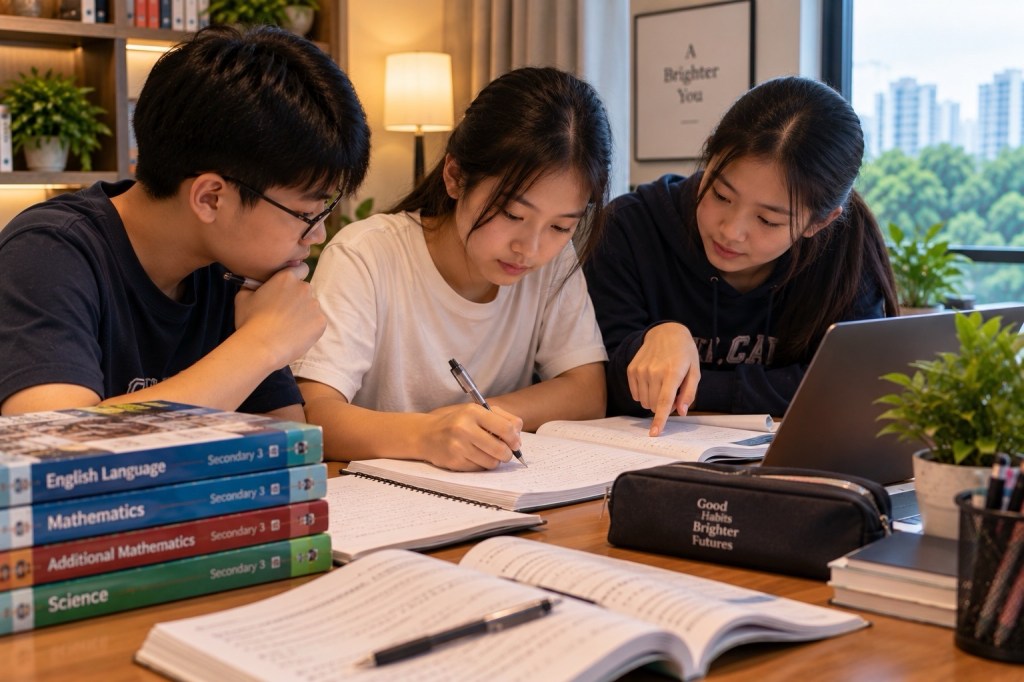
Learning G1 A-Math with a Bukit Batok tutor needs a clear qualification: there is no separate G1 Additional Mathematics subject in the 2027 SEC list. This article concerns mathematical readiness for a learner currently taking G1 Mathematics. It is not an official G1 A-Math course description, examination guide or promise that a private tutor can change a student’s school subject placement.
For Bukit Batok families exploring future Additional Mathematics, the useful starting point is whether the learner can explain a relationship in both directions. Can they calculate a result and recover the input? Expand an expression and verify its structure? Solve an equation and substitute the answer back? This guide develops forward and reverse checking so that early algebra becomes understandable rather than a collection of procedures remembered only beside a worked example.
SEAB’s G1 listing includes Mathematics K110. Formal Additional Mathematics is listed as G2 K232 and G3 K341. Begin with the student’s actual school year and enrolment. The tasks below are original foundation and extension examples, not a placement test or a new official syllabus.
eduKate Sengkang lists small-group Mathematics support at 83 Punggol Central, Singapore 828761. This does not establish a Bukit Batok branch or a dedicated G1 Additional Mathematics class. Ask about suitable current Mathematics support and realistic travel. The companion G1 Mathematics with Bukit Batok Tutor guide addresses the assessed subject directly.
The best first question is not how far ahead to teach
Imagine a student who can reproduce a long solution but cannot explain why a negative value needs brackets during substitution. More advanced-looking questions may make the folder impressive while preserving that uncertainty. A smaller task that exposes the sign relationship can be a more useful next lesson.
Now imagine another learner who solves ordinary school questions reliably and enjoys checking them by another route. That learner may be ready for a richer version of the current topic: a changed condition, an inverse question or a request to reject a false identity. Deeper reasoning does not require presenting every new symbol as a future examination topic.
The proposed standard is simple: a learner should know what the symbols mean, why a step preserves the relationship and how the result could be challenged. These questions guide teaching whether the student later takes Additional Mathematics or not. Stronger current Mathematics is valuable in its own right.
Do not mislabel ordinary Mathematics as an advanced course
The K110 subject-content pages include algebra, linear and quadratic work, simultaneous equations and graphs. Seeing one of those ideas does not mean a G1 learner has entered an Additional Mathematics syllabus. Name the work accurately and select its depth according to school teaching.
A foundation task can also be challenging without being advanced. Asking why two expressions are equivalent may reveal uncertainty hidden by routine calculation. Asking whether a proposed answer satisfies every condition may require more thought than substituting into a formula whose purpose has already been announced.
Keep extension separate from assessment claims. Where a task goes beyond the student’s current chapter, explain its purpose as optional mathematical exploration. Do not let a child’s curiosity become a reason to neglect current schoolwork or imply that early exposure guarantees later access to a particular subject combination.
Workshop 1: a reversible calculation has a clear sequence
Start with a number, multiply it by three and add five. If the original number is seven, the output is twenty-six. To recover the original from twenty-six, subtract five first and divide by three. Reversing the order incorrectly would produce a different value.
Ask the learner to describe the two forward actions before writing any letters. Then represent the output as 3x + 5. The algebra records the same sequence. A useful explanation says not only which inverse operations are used but why the last forward action must be undone first.
For an independent task, change the sequence to add five and then multiply by three. The expression becomes 3(x + 5), and the reverse route changes. This contrast tests whether the learner understands the order or has memorised “subtract five, divide by three” as a universal rule.
Workshop 2: negative inputs should remain visible
For y = 2x² + 1 at x = −3, substitute y = 2(−3)² + 1 = 19. The square applies to the negative input as a whole. Writing the substitution without suitable grouping can conceal which quantity is being squared.
Compare the expression with y = −2x² + 1 at the same input. It gives −17. The location of the negative sign changes the relationship. Ask the learner to explain each multiplication rather than count how many minus signs appear on the page.
A reverse check need not solve a complicated equation. Simply substitute another input and compare the two rules. The point is to preserve the intended structure during evaluation. If this is fragile, repair it before introducing a longer formula that makes the original sign error harder to find.
Workshop 3: equivalent fractions support later symbolic work
Four sixths and two thirds represent the same quantity. Dividing numerator and denominator by two changes the size of the counting parts, not the proportion described. Ask the learner to show this with a simple strip or a numerical comparison.
Then ask why dividing only the numerator gives a different value. The student should recognise that equivalent transformation depends on changing both parts appropriately. Later algebraic simplification builds on the same attention to the complete relationship, though its restrictions and structure may be more demanding.
At review, choose a new fraction and ask for two equivalent forms plus a size estimate. The learner should explain how to move between the forms and why the value stays unchanged. A correct simplified fraction without any sense of its magnitude may still hide a weak understanding of what the symbols describe.
Workshop 4: multiplication by a fraction can be undone
Two thirds of a positive quantity is eighteen. Dividing eighteen by two gives one third of the original, which is nine; three thirds is therefore twenty-seven. The equation (2/3)x = 18 expresses the same relationship and gives x = 27.
Check forward: two thirds of twenty-seven is eighteen. A student who multiplies eighteen by two thirds has answered a different question. The original asks for the whole that produced a known part, not for a further fraction of the part already supplied.
Change the fraction and keep the numbers manageable. Ask what one fractional part represents before choosing an operation. This prepares the learner to read algebraic coefficients as meaningful multipliers rather than mysterious obstacles that must be moved around by an unexplained rule.
Workshop 5: ratio scaling needs its conditions
In a fictional exercise, five identical packs cost $22.50 at a constant unit price. One pack costs $4.50 and eight cost $36. The reverse calculation recovers the same unit price from either purchase. That agreement supports the stated proportional model.
Add a fixed $2 charge to each order. The totals become $24.50 and $38. The total divided by pack count is no longer the same because a one-off contribution has been included. Ask the learner which quantity is still proportional and which is not.
This is a useful foundation for recognising the difference between a repeated rate and a fixed starting amount. The learner should not cross-multiply merely because two columns of numbers appear. A mathematical method needs a relationship that justifies it, and a changed condition may require a changed model.
Workshop 6: brackets communicate a decision about grouping
Compare 5x + 2 with 5(x + 2). At x = 4, they give twenty-two and thirty. The second expression contains five groups of the entire quantity x + 2; the first adds two only once after calculating five times x.
Ask the student to invent a short story for each expression. One could describe five items plus a single packing fee; the other could describe five items each receiving the same extra feature. Keep the invented prices clearly separate from real commercial information.
Then reverse the activity: provide a story and ask which expression fits. A learner who succeeds only in numerical evaluation may still misinterpret the model. Forward and reverse translation exposes whether the expression’s structure has meaning beyond its ability to produce a calculator result.
Workshop 7: distribution and collection should agree
Expand 4(x + 3) to obtain 4x + 12. The multiplier applies to both terms inside the bracket. Moving backwards, factor four out of 4x + 12 to recover 4(x + 3). Both forms should produce the same value for every allowed input.
A student who writes 4x + 3 has multiplied only one part. Substitute x = 2: the original gives twenty, while the incorrect form gives eleven. The mismatch rejects the proposed equivalence. It also shows why a numerical check is useful when the learner is unsure.
Do not mistake one matching test value for a proof of an identity. The structural explanation still matters: distribution accounts for every bracket term. Introduce negative coefficients only after the positive relationship is clear, then ask the learner to explain the new sign decisions explicitly.
Workshop 8: like terms are quantities of the same kind
Seven x plus two x is nine x. Seven x plus two y cannot generally be combined into nine x because x and y can represent different values. Ask the learner to test x = 1 and y = 4; the original becomes fifteen, not nine.
Next compare x + x with x × x. Addition gives 2x, while multiplication gives x². The repeated letter does not determine the operation. A student should read the sign and grouping, not respond to a visual pattern of matching symbols.
For a reverse task, ask for two different expressions that simplify to 9x. Examples such as 4x + 5x and 12x − 3x demonstrate flexibility. The learner should also explain why an expression involving an unrestricted y does not automatically belong to the same family.
Workshop 9: cancellation works with factors, not matching letters
For x ≠ 0, 12x divided by 4x equals three. Numerator and denominator share a factor that can be divided out. The condition excludes zero because the original denominator would vanish. Keeping that restriction is part of preserving the original meaning.
Compare (x + 12)/(x + 4). Crossing out the x terms does not generally give three. At x = 2, the original is 14/6, not three. The addition means the expressions have not been presented as a common factor multiplied across the whole numerator and denominator.
A useful teaching question is what would need to be true for cancellation to be valid. Encourage the learner to look for multiplicative structure rather than eliminate any repeated symbol. Keep later rational-expression tasks aligned with readiness instead of increasing complexity before this distinction is understood.
Workshop 10: equations preserve a relationship at every line
Solve 7x + 4 = 46. Subtract four from both sides to obtain 7x = 42, then divide by seven to obtain x = 6. The original equation confirms the result: forty-two plus four is forty-six.
Ask why an operation applied to one side alone would not preserve the same condition. This is more informative than memorising a phrase about moving numbers. A simple balance model can help initially, but the learner should gradually state the operation without needing the picture.
For a reverse task, give x = 6 and ask the student to create two different equations with that solution. Then check whether six really satisfies each. Creating a valid example requires the learner to think about the relationship from another direction instead of repeating one supplied sequence.
Workshop 11: a formula can be reconstructed around another subject
Let C = 5n + 8 describe an invented total cost in dollars, where n is a number of identical units. To recover n, subtract eight from the cost and divide by five: n = (C − 8)/5. At C = 43, the result is seven units.
The reverse formula follows the original sequence. Five times the count is formed first and a fixed amount is added afterwards; recovery undoes those actions in reverse order. Ask the learner to explain why C/5 − 8 would represent a different calculation.
Check forward with n = 7 and inspect the context. If the units must be whole items, a non-integer result may require further interpretation or indicate that the stated total does not match the model. Algebraic rearrangement and practical meaning should remain connected.
Workshop 12: two equations are two conditions, not two unrelated answers
For x + y = 15 and x − y = 3, the shared solution is x = 9 and y = 6. Adding the equations gives 2x = 18. Substitution produces y, and both original conditions confirm the pair.
A learner who gives ten and five has satisfied the total but not the difference. Ask which condition rejects that pair. This makes checking a logical task rather than a ritual at the end of working. The answer is valid only when every required relationship holds.
For a reverse task, supply a pair of values and ask for two independent simple conditions that determine them. At an accessible level, a total and a difference work well. This activity should support the student’s actual school sequence, not be marketed as evidence that an advanced subject placement has already been secured.
Workshop 13: an expanding pattern needs its starting position
The sequence 6, 10, 14, 18 increases by four. If its first term has position n = 1, a suitable rule is 4n + 2. The difference four explains the increase; the extra two makes the rule agree with the first value.
A learner who writes 4n has captured only part of the relationship. Use a position-value table and check the first two terms. Then ask which position gives the value thirty: solving 4n + 2 = 30 gives n = 7.
The forward task produces a term from its position, while the reverse task recovers a position from a term. This is a useful bridge between patterns and equations. Ask the learner what would happen if the initial position were labelled zero instead; the rule’s expression would need to reflect that convention.
Workshop 14: a line connects numerical and visual information
For y = 3x − 2, inputs zero, two and four give outputs −2, 4 and 10. A table, plotted points and equation should all agree. Increasing x by one increases y by three on this relationship.
Ask the student to check whether (4, 9) belongs to the line. Substitution rejects it because the required output is ten. A point that looks close on a sketch is not automatically correct. The numerical relationship is more reliable than the apparent position on a rough drawing.
For reverse interpretation, ask which input gives y = 13. The equation 3x − 2 = 13 gives x = 5. The learner has used the same relationship in two directions. That is more useful preparation for later function reasoning than simply memorising a name for the line’s form.
Workshop 15: one output need not identify one input
For y = x², both x = 4 and x = −4 produce y = 16. Reversing the relationship from the output alone therefore does not always identify a unique input. A learner who gives only four has overlooked another value unless the question restricts the allowed inputs.
Compare this with the earlier linear rule y = 3x − 2, where a given output determines one real input. The difference comes from the structure, not from a universal instruction that every calculation can be reversed in one unique way.
This can remain a simple curiosity exercise rather than a formal lesson on advanced function notation. Ask what extra condition would make the positive input appropriate, such as a non-negative length. The learner should state the condition instead of silently removing an algebraically valid alternative.
Workshop 16: factorisation can be checked by expansion
The expression x² + 7x + 12 can be written as (x + 3)(x + 4). Expansion produces x² + 4x + 3x + 12, restoring the original. The two constants must account for both the middle coefficient and the constant term.
The proposal (x + 2)(x + 6) also gives a constant twelve but produces a middle coefficient eight. Ask the learner to identify exactly which part fails. A near-looking expression is not an equivalent expression merely because some terms agree.
Work at the level the school is teaching. A student should not be labelled ready for Additional Mathematics simply because they have seen one quadratic. The meaningful evidence is whether they can construct and verify a new factorisation, recognise its purpose and explain why an incorrect candidate does not preserve the expression.
Workshop 17: solving and rewriting are different tasks
Rewriting x² + 7x + 12 as (x + 3)(x + 4) produces another expression. Solving x² + 7x + 12 = 0 asks for values of x, namely −3 and −4. A pair of brackets is useful working but not the complete answer when values are requested.
Ask the learner to read the instruction aloud and state the expected kind of answer before beginning. Is the task asking for an expression, a value, a graph, an explanation or a condition? This simple classification prevents a student from performing a familiar procedure while never completing the actual task.
At review, use a different expression and remove the chapter heading. Include one question asking for factorisation and another asking for a solution. The student should choose and finish each job correctly rather than always stop at the same point in the working.
Workshop 18: a model may exclude a numerical solution
Suppose an invented rectangle model uses x as a width in centimetres. A proposed value x = −2 cannot describe that physical width. The issue is not that negative numbers are always wrong; it is that the variable has been defined as a positive physical length.
Contrast a negative coordinate or temperature, where the sign may be perfectly appropriate. Ask the learner to name the actual restriction rather than use a blanket rule. Mathematical checking should refer back to the question’s definitions and conditions.
For a later task, use a whole-number count. A decimal value may be a useful intermediate result but not an available count of intact objects. The student should distinguish mathematical candidates from acceptable contextual answers. This habit helps prevent elegant symbolic work from ending with an impossible recommendation.
Workshop 19: a counterexample can reject an overgeneralised rule
Consider the claim that adding a positive number always doubles the original quantity. Starting with five and adding two gives seven, so the universal claim is false. A learner does not need to test every possible pair; one valid counterexample defeats the word always.
Ask how the statement could be repaired. Adding a positive quantity equal to the original positive quantity doubles it. The added condition matters. This moves the exercise beyond identifying a wrong claim towards explaining the circumstances in which a related statement is true.
Then try a more subtle claim about multiplication by a positive fraction. Keep the numbers accessible so the focus stays on reasoning and conditions. Such tasks can provide meaningful extension within current Mathematics without rushing to a new chapter or implying a change of official subject level.
Workshop 20: recognise when information is insufficient
A fictional question says that two students bought twelve items altogether and asks how many each bought. The total alone permits several pairs. Unless another condition is supplied, there is no unique answer. An arbitrary equal split may be possible, but it is not established by the statement.
Ask the learner to give two different pairs that satisfy the total. Then request an additional condition that would determine a particular pair, such as a stated difference. The student sees why a second independent relationship can matter.
This is a valuable independence test because not every mathematical task should reward immediate computation. Sometimes the correct first move is to identify what is missing. A learner who can explain the uncertainty has shown more control than one who invents a number to make the page look complete.
An original integrated task: reconstruct the hidden starting amount
A fictional organiser starts with a number of cards. She divides them equally among four groups and gives each group three additional cards from another supply. Every group then has eleven cards. How many cards were in the original supply?
Let the original number be N. Each group first receives N/4 cards, so N/4 + 3 = 11. Subtracting three gives N/4 = 8, hence N = 32. Check forward: thirty-two divided among four groups gives eight each, then three more gives eleven each.
Ask what changes if the organiser adds three cards to the original pile before dividing it. The relationship becomes (N + 3)/4 = 11, giving N = 41. Both scenarios end with eleven per group but describe different sequences. Brackets carry the difference in meaning.
A useful follow-up asks the learner to write the two stories from the equations without seeing the original wording. This tests translation in both directions. It also provides a compact piece of work that a parent or teacher can inspect: variable definition, relationship, solution, forward check and explanation of a changed condition.
Keep the first attempt and the later check together
For a selected skill, preserve an initial independent attempt, the explanation of its correction and a later changed task. Record what help was given. A result obtained after the tutor supplies the model is useful evidence of supported learning, but it should not be presented as an unassisted achievement.
The record need not contain every worksheet. Choose examples that reveal a decision: where a negative sign applies, which operation is undone first, whether a factor can be cancelled or which condition rejects a proposed answer. A short explanation beside the work can be more informative than a large private test score.
Do not convert this record into an invented admission threshold or readiness percentage. It supports teaching and discussion. Its purpose is to show what is secure, what remains fragile and what fresh task could clarify the next uncertainty. School placement remains a separate decision.
Use three different teaching responses
Repair applies when the learner cannot explain the current relationship even with time and accessible numbers. Begin with a simpler representation and a meaningful contrast. For a bracket misconception, compare two everyday sequences before adding negative values or longer expressions.
Stabilisation applies when the relationship is understood during teaching but not selected or retrieved later. Introduce a delay, remove the chapter heading and mix two different task types. Watch whether the learner can identify the method without being given the first line.
Extension adds a justified new demand: reverse the problem, compare two methods, state a restriction or test a general claim. These are teaching actions for particular skills, not fixed labels for the child. A learner can need all three responses in different areas at the same time.
Expand a clear boundary rather than leap over prerequisites
In the proposed Fencing Method application, establish one reliable relationship and add one new condition. For reverse operations, begin with positive whole numbers and two actions. Next add a bracket distinction. Later introduce a fraction coefficient or a contextual restriction, according to the learner’s school stage.
If a mistake first appears when a negative value is introduced, examine the sign relationship. There may be no need to reteach the entire earlier method. Equally, do not continue adding complexity if the student can only copy the supported example. The boundary should expand when changed independent work shows understanding.
A strong learner can be challenged within the boundary by explaining a false solution or creating a new problem. This gives depth without requiring premature calculus. The next question should make a mathematical decision more demanding, not merely make the page look more advanced.
A small-group lesson should make support progressively less necessary
In a three-student setting, begin with a short task that each learner attempts alone. Ask for the meaning of the expression or the first valid move. One student may misread the context while another handles the model correctly but loses a sign. Identical final answers do not imply identical teaching needs.
After explanation, change the problem and reduce the prompts. Students may compare valid methods, but each still needs an individual attempt. A peer supplying the opening line can conceal the very recognition skill the tutor is trying to assess.
Finish with a reverse check or another representation that can challenge the result. Then select a small continuation task. The next lesson should use that work to decide whether to repair, stabilise or extend, rather than simply move to the next worksheet because the calendar has advanced.
Four contact points for one important relationship
Use four modest encounters: explanation in the tutorial, an independent changed example, an application within school-linked work and a delayed review. These are proposed learning contacts, not four additional formal lessons. Their value lies in the different evidence each produces.
For cancellation, the lesson contrasts factors and added terms. The independent task changes the coefficients. A mixed question requires recognising when simplification is useful. At review, the learner explains why a supplied cancellation is invalid and checks it with an allowed numerical value.
Keep the practice load realistic. A few carefully chosen examples can show whether a skill survives without the original demonstration. A large page of identical work completed through imitation does not necessarily reveal more. Preserve the student’s questions as useful information for the next discussion.
A six-week review without a placement promise
Week one records selected current-school tasks and the support needed. Week two repairs the most important earlier relationship. Week three practises translating between words and symbols. Week four connects an equation with a table, graph or diagram appropriate to the learner’s stage.
Week five removes chapter labels and introduces a reverse check. Week six revisits early targets through unfamiliar examples. Compare the first move, explanation, validity of the steps and ability to verify an answer independently. Include unresolved difficulties rather than selecting only successful work.
The six weeks are illustrative, not a timetable for entry to another subject level. A learner may need longer on fractions or signs, while another may be ready for richer modelling sooner. The appropriate outcome is a clearer picture of present capability and the next sensible teaching target.
Keep future subject discussions with the school
Before planning for a different Mathematics level or Additional Mathematics, ask the school what options and review procedures apply to the learner. Bring recent work and an honest account of independence. A tutor can support learning, but cannot promise a school decision simply because a student has completed extra exercises.
A useful discussion includes current performance, interest, workload and the school’s expectations. The learner should have room to ask whether the subject fits their goals and available time. There is no requirement that every child curious about harder Mathematics must eventually choose the same pathway.
Even if no subject change follows, accurate algebra remains worthwhile. A student who can interpret a quantity, reverse a sequence, compare representations and reject an invalid result has strengthened current Mathematics. Future possibilities should be presented as possibilities, not as the sole justification for learning well now.
Bukit Batok families: preserve time for independent work
A programme elsewhere should be compared with nearby options using the whole weekly routine. Include departure from the actual school or home, waiting, meals, return travel and remaining assignments. Do not infer a convenient journey from a locality-focused title. Use current transport information and a realistic trial.
The NLB Bukit Batok Library page provides information about local reading and study facilities. Any visit should follow current rules and availability. It is not an eduKate venue, and a place to work should not be assumed to be available whenever a lesson plan mentions it.
At home, a useful task might be one expression, one explanation of its meaning and one reverse check. The activity should have an intelligible endpoint. Preserving curiosity matters; advanced-looking homework should not become a punishment for a student who has already completed a demanding school day.
Frequently asked questions
Is G1 A-Math an official SEC subject?
No. This is a foundation and readiness guide, with the formal subject distinction explained at the beginning. Use the student’s actual school enrolment and the relevant SEAB document for examination preparation. A website title should not create the impression of a qualification that is not listed.
Must readiness work begin with calculus?
No. Interpreting brackets, preserving signs, understanding fractions and checking equivalence can be more useful first targets. Curiosity about calculus can be welcomed, but an introductory demonstration is not evidence that its prerequisites are secure or that a student is ready for an assessed advanced course.
Why use reverse checks rather than simply repeat the calculation?
A different route can expose an error that the same repeated procedure would reproduce. Substitution tests an equation’s proposed solution; expansion tests a factorisation; interpreting a story tests an expression. The check should fit the relationship rather than become a compulsory trick applied to every task.
Does a correct answer always show understanding?
Not by itself. Ask how the learner chose the method, what support was given and whether a changed task can be solved later. A correct answer may be well understood, copied or obtained through cancelling mistakes. Inspecting the explanation helps distinguish those possibilities.
How can strong students extend current work?
Create a problem from an equation, identify a missing condition, compare two representations or provide a counterexample to an overgeneralised claim. These activities make reasoning deeper without automatically racing ahead to notation that the learner cannot yet interpret.
What should a parent ask the tutor to report?
Ask for the first weak decision, the explanation taught, evidence from a later independent attempt and the next target. The report should state which prompts were needed. Avoid treating pages completed or chapters introduced as a substitute for a clear account of what the learner can do alone.
Can tuition guarantee progression to G2 or G3?
No. School subject arrangements require school guidance and applicable procedures. Tuition can strengthen capability and supply useful examples of progress, but it cannot guarantee placement. A sound plan respects the student’s present subject and keeps future claims conditional on the actual school route.
Continue through the appropriate Mathematics guides
For current assessed work, use G1 Mathematics with Bukit Batok Tutor and the Mathematics Tuition hub. The Additional Mathematics hub provides context for the formal later subject. For other learning needs in the same locality, read G1 English with Bukit Batok Tutor and G1 Science with Bukit Batok Tutor. These guides support subject-specific planning; they do not establish a Bukit Batok classroom or guarantee a particular class is available.
The earlier Jurong West readiness guide explains how to keep a useful record of independent work. This Bukit Batok guide adds a specific way to test that work: move forwards through the relationship, then use a valid reverse or alternative check to see whether its meaning has been preserved.
Arrange a parent–student consultation
Contact eduKate Sengkang with the student’s year, current Mathematics subject level, recent work and reason for exploring further study. Ask for a foundation-first plan and an independent review point. Confirm present support, fees and the journey from Bukit Batok before committing to lessons.
