
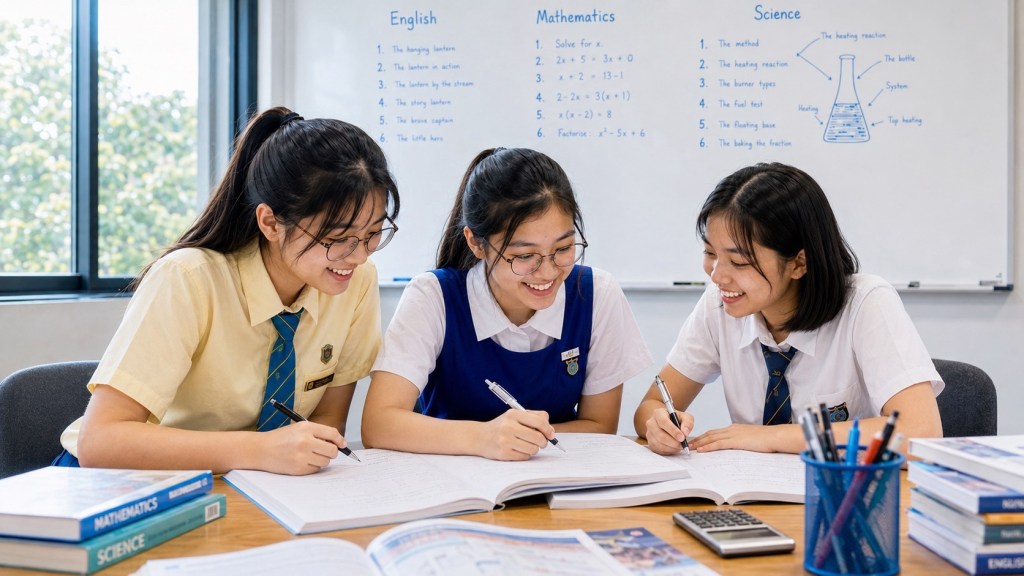
Advanced Additional Mathematics Tutorials continues with a parent buyer’s guide: How should families choose A-Math tuition in Sengkang? Search results can make comparison look simple—class size, price, location, notes, years of experience and testimonials. Those factors matter, but Additional Mathematics tuition should ultimately be judged by what happens to the learner’s mathematical independence.
For Secondary 3 and Secondary 4 students, a useful A-Math tutor should see more than a low mark. The tutor should separate conceptual weakness from algebra weakness, recognition problems from execution problems, school-content gaps from examination-control gaps. A student who knows the formula but cannot start requires different teaching from a student who chooses the correct method and loses marks to signs.
This guide is for parents searching for A-Math tutor Sengkang, Additional Mathematics tuition Sengkang, Secondary 3 A-Math tuition, Secondary 4 A-Math tuition, small-group A-Math tuition and how to choose a Mathematics tutor. It does not claim that every student needs tuition. It gives parents a practical set of questions to ask before enrolling.
Question 1: What problem is tuition supposed to solve?
Do not begin with “My child needs tuition.” Begin with “What is not working?”
Possibilities include weak algebra, school pace, poor method recognition, difficulty with trigonometry or calculus, inconsistent revision, falling marks or exam timing.
Question 2: How does the tutor diagnose?
Ask whether the tutor looks at recent school tests, written working, current syllabus, algebra prerequisites, unfamiliar-question behaviour, timing and recurring errors.
A tutor who sees only the final answer may miss the real weakness.
Question 3: Does the tutor know the student’s actual syllabus?
This matters across the 2026–2027 transition. Students graduating in 2026 remain on the GCE route. From 2027, SEAB lists G2 Additional Mathematics K232 and G3 Additional Mathematics K341, where offered.
Question 4: What happens when the foundation is weak?
A weak foundation should not automatically trigger a complete restart. Ask whether the tutor repairs only the prerequisite that blocks current work—for example indices before logarithms, factorisation before quadratics, line equations before tangent/normal work, or algebra before calculus applications.
Question 5: How does explanation become independence?
Look for a progression:
- model;
- guided attempt;
- independent attempt;
- changed question;
- delayed retest.
Support should reduce over time.
Question 6: Does the tutor teach method selection?
A-Math is not only formula execution. Students need to identify the mathematical object, choose a useful representation, select a method and recognise when a familiar method does not apply.
Question 7: How are school papers used?
Good tutors use school papers as diagnostic evidence. Ask whether errors are classified and retested rather than simply “gone through” once.
Question 8: How does the tutor handle three students?
If the class is small, ask what the tutor does with that smallness. Do students receive different repair targets, hints and levels of challenge? Do they compare methods? A three-student class should not simply be a smaller lecture.
Question 9: How is homework chosen?
Homework should have a purpose: independent reconstruction, delayed retrieval, algebra maintenance, mixed recognition or timed performance.
Question 10: How is progress measured?
Useful evidence includes fewer recurring errors, better method recognition, more complete working, improved timing, successful delayed retests, school-test trends and greater independence.
Question 11: What happens when tuition is no longer needed?
Good support should have an exit logic. If the student becomes stable, independent and able to diagnose and manage revision, the role of tuition should be reconsidered rather than assumed permanent.
Question 12: Is the logistics fit sustainable?
Location, travel time and schedule matter. A strong programme that destroys sleep or creates unsustainable travel can become counterproductive. For Sengkang families, local convenience can reduce friction, but teaching quality remains the central criterion.
Private tuition versus small-group tuition
Private tuition offers exclusive attention. Small-group tuition offers peer contrast, method comparison, shared discussion and less dependence on constant tutor attention. Neither format is automatically superior.
When a 3-pax class can work well
- students share the broad topic;
- the tutor can branch for short prerequisite repairs;
- individual working stays visible;
- students benefit from seeing different methods;
- the tutor can retest each learner independently.
Use What a 3-Student A-Math Tutorial Should Actually Do for the deeper instructional model.
Warning signs
- every student receives exactly the same intervention;
- the tutor supplies every first step;
- progress is described only by worksheet volume;
- school evidence is ignored;
- specific grades are guaranteed.
What eduKate Sengkang’s model is designed to do
eduKate Sengkang teaches Mathematics and Additional Mathematics in groups of up to three students, normally for 1.5 hours.
The small-group model is designed around diagnosing the first weak link, keeping student working visible, repairing prerequisites surgically, comparing methods, using controlled variation, reducing hints and testing independent transfer.
The canonical service page is Additional Mathematics Tuition Sengkang.
What to bring to an enquiry
- recent school papers;
- current school topic;
- student’s subject level;
- examples of homework difficulty;
- school schedule;
- the parent’s main concern.
Frequently asked questions
How do I choose an A-Math tutor?
Look for syllabus fit, diagnostic quality, clear teaching, appropriate practice, independent transfer and a sustainable class format.
Is private tuition better than group tuition?
Not automatically. The best format depends on the student’s needs and how the tutor uses the setting.
Is 3-pax tuition personalised?
It can be if students receive different diagnostic attention, prompts and repair targets within the shared lesson.
Should I choose the tutor with the most worksheets?
No. Practice volume matters, but question selection, feedback and transfer matter more.
How quickly should I expect improvement?
It depends on the cause and depth of the weakness. Look first for process changes—fewer repeated errors, stronger method selection and greater independence—before expecting stable score changes.
Does every A-Math student need tuition?
No. Some students progress very well through school and self-study. Tuition is useful when it solves a specific learning problem.
The larger idea
Choosing A-Math tuition is not mainly about buying more Mathematics. It is about choosing a learning system that can see the student accurately, change the right weakness and return the thinking to the learner.
