
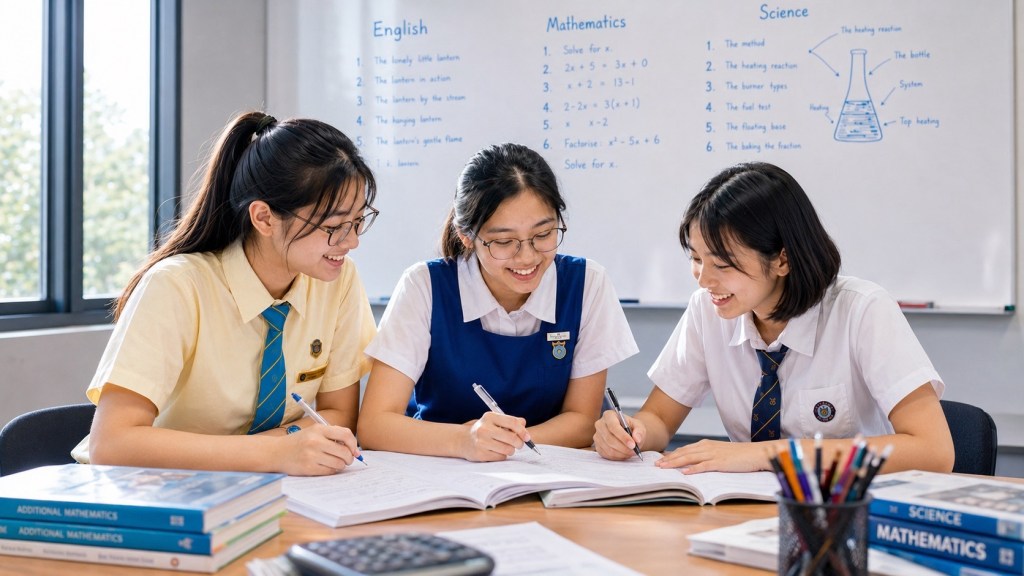
Secondary 3 Mathematics is where the upper-secondary workload becomes visible. Parents searching for Secondary 3 maths tuition, Secondary 3 Mathematics tuition in Sengkang, E-Math support, algebra help, coordinate geometry, trigonometry or mixed-problem practice often see a capable student whose marks become less stable even though individual chapters still seem understandable.
The difficulty is usually not one topic. Depending on the student’s G2 or G3 subject level and school sequence, algebra, graphs, proportion, geometry, Pythagoras, trigonometry, mensuration, statistics and probability can begin interacting inside more demanding assessment questions. At the same time, some students are also carrying Additional Mathematics, creating a second mathematical workload with different notation and pace.
At eduKate Sengkang, this Advanced Mathematics Tutorials article supports rather than replaces the commercial owner Secondary 3 Mathematics Tuition Sengkang | Upper Secondary Math, Transfer & SEC Readiness. This page focuses on one narrower problem: how students keep Elementary/General Mathematics stable when upper-secondary content, mixed questions and a heavier weekly workload arrive together.
Current Singapore upper-secondary Mathematics tuition pages commonly emphasise algebraic manipulation, geometry, trigonometry and problem-solving, while small-class providers also highlight personalised correction and examination preparation. The useful question for parents is not whether those topics are listed. It is whether the teaching system helps the student choose methods, preserve accuracy and transfer knowledge under mixed conditions.
Quick answer: why Secondary 3 Mathematics becomes harder
Secondary 3 raises both mathematical depth and coordination load. The student needs to know more, retrieve it faster and choose among more possible methods while school workload is increasing.
- Algebra becomes a tool used across topics rather than one chapter.
- Graphs and coordinate geometry connect symbolic and visual reasoning.
- Pythagoras and trigonometry require diagram reading before calculation.
- Mensuration can combine geometry, units and several steps.
- Proportion and rate require careful model choice.
- Statistics and probability require interpretation as well as arithmetic.
- Mixed papers remove topic labels and increase method-selection demand.
- Students taking A-Math must protect E-Math fluency while learning a second mathematical system.
- Longer questions make working organisation more important.
- Time pressure amplifies small retrieval and checking weaknesses.
The workload shift: more Mathematics is competing for the same attention
Secondary 3 students often do not have a pure Mathematics problem. They have a bandwidth problem. School subjects become heavier, assessments matter more, and Mathematics itself may split into E-Math and A-Math for some learners.
A student who understood Secondary 2 content may still lose marks because older algebra facts are no longer retrieved quickly enough. Every slow manipulation consumes attention that should be available for geometry, interpretation or planning.
The first intervention should therefore identify whether the bottleneck is knowledge, fluency, method selection or workload control.
Algebra must become infrastructure
By Secondary 3, algebra is not merely a chapter to revise before a test. It appears inside graphs, coordinate geometry, formula manipulation, proportion and many applied problems.
Students should be able to simplify expressions, solve equations and manipulate formulas with enough control that the algebra does not obscure the main idea of the question.
Repeated sign, bracket or fraction errors should be repaired explicitly because they have a high downstream cost.
Coordinate geometry: the graph is an algebraic object
Coordinate geometry asks students to connect points, gradient, distance, equations of lines and intersections. A graph is no longer just something to plot. It represents relationships that can be described algebraically.
A learner should move between a line on a graph and its equation, understand what gradient means and recognise how coordinates constrain the geometry.
Representation switching is the key skill: graph to equation, equation to graph, diagram to coordinate relationship.
Pythagoras and trigonometry begin with the diagram, not the calculator
Many upper-secondary geometry errors happen before any trigonometric ratio is selected. The student misidentifies the right triangle, labels the wrong side or uses an angle that does not correspond to the required relationship.
A disciplined route is to mark the known angle, identify opposite, adjacent and hypotenuse relative to that angle, decide whether Pythagoras or a trigonometric ratio is appropriate, then calculate.
Calculator fluency matters, but calculator speed cannot repair a misread diagram.
Mensuration: units and dimensions become a control system
Surface area, volume and composite solids require students to distinguish lengths, areas and volumes while tracking units. A numerical answer can look plausible even when the wrong dimension was used.
Students should label dimensions, state what quantity is being found and use units to check whether the operation makes sense.
This unit-aware discipline also supports Science and later applied Mathematics.
Why E-Math can slip when A-Math begins
Some students assume that A-Math automatically strengthens E-Math. The subjects do share algebraic foundations, but their demands are not identical. A student can spend so much revision time on A-Math that routine E-Math fluency, data work, mensuration or examination pacing weakens.
The solution is not to treat the subjects as rivals. Identify shared dependencies—algebra, notation, graph sense—and maintain E-Math-specific retrieval and mixed practice alongside A-Math learning.
Students not taking A-Math still face the same need for upper-secondary fluency and method selection; the exact content load simply differs.
Mixed practice is the real test of method selection
A topic worksheet tells the student what family of method to use. A mixed paper may move from coordinate geometry to probability to mensuration to algebra without warning.
This creates a recognition problem: what kind of mathematical structure is present, and which representation or method will expose it most clearly?
After focused topic learning, mixed practice should therefore become a regular part of Secondary 3 tuition.
The Secondary 3 error map
- Algebra error: manipulation, signs or fractions are unstable.
- Diagram error: the geometry is misread before calculation.
- Graph error: scale, gradient, coordinates or line relationships are misunderstood.
- Method-selection error: several known techniques compete and the wrong one is chosen.
- Sequence error: correct ideas are used in an unsafe order.
- Calculator error: mode, input or rounding is uncontrolled.
- Unit error: measurement meaning is lost.
- Working error: intermediate quantities cannot be traced.
- Time error: one hard question consumes marks elsewhere.
- Workload error: revision is dominated by one subject or topic while others decay.
A three-student tutorial should make reasoning visible
In a three-student class, the tutor can inspect how each learner begins the same question. One may identify the correct diagram but choose the wrong ratio; another may have perfect trigonometry but weak algebra; a third may understand everything but work too slowly.
Those students should not receive the same correction simply because the final answer is wrong.
Small-group teaching earns its value when observation leads to different prompts, practice and follow-up while still preserving useful peer comparison.
A useful 90-minute Secondary 3 lesson
Retrieval and dependency check
Use short algebra, graph and geometry items to make sure prerequisites are available.
Focused concept or repair
Teach one high-value relationship, such as gradient-line interpretation or trigonometric side selection.
Guided mixed application
Vary surface features and require students to state why a method applies.
Independent problem set
Students work without immediate rescue while the tutor watches method choice and working.
Timed transfer
Use a short mixed section to expose pace and recovery under pressure.
Error classification
Record whether the failure was concept, representation, selection, execution or time.
How to balance E-Math and A-Math when both are taken
- Protect short E-Math retrieval every week even during heavy A-Math periods.
- Use shared algebra skills efficiently, but do not assume all E-Math topics are automatically maintained.
- Keep one mixed E-Math set in the weekly routine.
- Track which subject is consuming disproportionate homework time.
- Do not use A-Math difficulty as an excuse to neglect E-Math examination technique.
- When both subjects show the same sign or algebra error, repair the shared dependency once and test transfer in both contexts.
When should parents consider support?
Support may be useful when Secondary 3 marks fall despite topic understanding, when the student cannot start mixed questions, when A-Math workload destabilises E-Math, when geometry diagrams are frequently misread or when long working repeatedly loses signs and intermediate values.
It may also help strong students who need better mixed-paper control and a stable runway into Secondary 4.
Bring recent school assessments. A useful diagnosis looks beyond the score to the distribution of error types and time losses.
A twelve-week Secondary 3 stabilisation route
Weeks 1–2: map dependencies and workload
Sample algebra, graphs, geometry, trigonometry, mensuration and mixed questions; also identify where weekly study time is going.
Weeks 3–5: repair the highest-cost weakness
Fix the dependency that damages the most topics, often algebra, diagram reading or method selection.
Weeks 6–8: build mixed transfer
Interleave topics and vary representations.
Weeks 9–10: timed sections
Introduce examination pacing without sacrificing working quality.
Weeks 11–12: Secondary 4 handover
Use broader mixed papers and require independent error correction.
What progress should look like
The student begins mixed questions more decisively, algebraic working becomes cleaner, diagrams are annotated before calculator use, and method selection requires fewer prompts.
If A-Math is also taken, revision becomes more balanced and shared algebra skills transfer more reliably between subjects.
Most importantly, one difficult question no longer destabilises the rest of the paper.
Frequently asked questions
Why did my child’s E-Math marks fall after starting A-Math?
The cause may be workload allocation rather than inability. E-Math-specific mixed practice and examination control can decay if all Mathematics time is redirected to A-Math.
Should Secondary 3 tuition focus on topical worksheets or papers?
Both are useful. Topical work builds or repairs methods; mixed-paper work trains selection, pacing and transfer.
Is trigonometry mainly about memorising SOHCAHTOA?
No. The student must first read the triangle correctly, identify sides relative to the chosen angle and decide whether trigonometry is the correct tool.
How important is algebra for E-Math?
Very important. Algebra functions as infrastructure across graphs, formulas, equations and applied problems.
When should exam-style timing begin?
After core accuracy is reasonably stable. Timing a weak method usually produces faster mistakes rather than useful fluency.
Where this article sits in the eduKate Sengkang Mathematics estate
The commercial owner is Secondary 3 Mathematics Tuition Sengkang | Upper Secondary Math, Transfer & SEC Readiness. Students taking A-Math can also use Secondary 3 Additional Mathematics Tuition Sengkang, while the Complete Mathematics Index connects the full estate.
This child page owns the upper-secondary workload and E-Math stability question. It is designed to feed the existing owners rather than duplicate them.
