
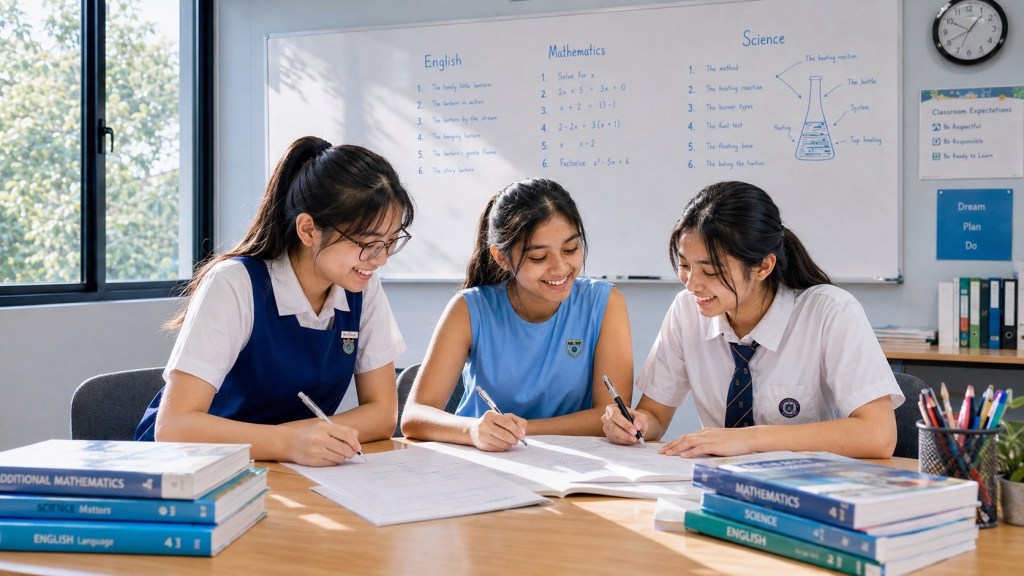
Secondary 2 Mathematics is the bridge year that quietly determines how comfortable a student will feel when upper-secondary Mathematics becomes denser. Parents searching for Secondary 2 maths tuition, Secondary 2 Mathematics tuition in Sengkang, algebra help, linear graphs, factorisation or upper-secondary preparation are often seeing a student who appears to be coping topic by topic but is beginning to struggle when several ideas have to work together.
The key change is structural. Secondary 2 Mathematics usually deepens algebraic manipulation, graphs, equations, inequalities, proportions, geometry, mensuration, probability and statistics. These topics are not isolated. Weak expansion affects factorisation. Weak factorisation affects later equations. Weak graph reading affects coordinate geometry. Weak proportional reasoning reappears in similarity, rate and applied questions.
At eduKate Sengkang, this Advanced Mathematics Tutorials article is a supporting child rather than the main local owner. Use Secondary 2 Mathematics Tuition Sengkang | Build the Bridge to Upper Secondary Math for the commercial route. This page focuses on the year-specific question: which Secondary 2 capabilities must become stable before Secondary 3 raises the algebraic and examination load.
Current Singapore Secondary 2 tuition programmes commonly emphasise algebraic manipulation, linear graphs, simultaneous equations, inequalities, factorisation, proportion, similarity, Pythagoras and trigonometric foundations. That tells parents something useful: the year is not merely “more Secondary 1”. It is where several mathematical languages begin to converge.
Quick answer: why Secondary 2 matters so much
Secondary 2 is a consolidation-and-connection year. The student needs enough algebra, graph sense and geometric reasoning that Secondary 3 can build upward instead of repeatedly repairing backward.
- Algebra should become fluent enough that manipulation does not consume all attention.
- Expansion and factorisation should be understood as inverse structures.
- Linear graphs should connect equations, coordinates, gradient and interpretation.
- Inequalities require sign and order control, not just equation habits.
- Ratio and proportion should become multiplicative reasoning.
- Geometry should move from recognition toward property-based reasoning.
- Working must remain readable across longer multi-step solutions.
- Mixed practice should become normal before upper-secondary assessment demands increase.
Algebraic manipulation is the central dependency
By Secondary 2, students often meet longer expressions, more brackets and more transformations. A weak sign habit can now affect several steps. A student who can simplify a short expression may still struggle when negative terms, fractions or nested brackets appear.
The goal is not raw speed at first. The student should be able to explain which terms can combine, why a bracket changes signs, and what remains invariant after a valid transformation.
Once structure is secure, fluency matters because later topics assume algebra is available rather than being relearned every question.
Expansion and factorisation should be taught as one reversible system
Expansion distributes multiplication across a sum; factorisation reconstructs a product from a sum. Students who learn the two as separate chapters often fail to see the inverse relationship.
A useful tutor places them side by side. If (x + 3)(x + 5) expands to x² + 8x + 15, the reverse question is what pair of factors rebuilds that quadratic structure. Even before full upper-secondary quadratic work, this reversible thinking matters.
Seeing operations in both directions reduces memorisation and prepares students for equation solving later.
Linear graphs are not just drawing exercises
A graph connects algebra to geometry. Coordinates represent values, gradient represents rate of change, and an equation describes a relationship between variables.
Students who treat graphs as picture-copying may plot correctly yet fail to interpret what a line means. Good teaching connects table → coordinates → graph → equation and asks the student to move in both directions.
This representation switching is one of the strongest preparations for Secondary 3 Mathematics.
Simultaneous equations introduce coordinated unknowns
Two equations with two unknowns require students to see that the unknown quantities are constrained together. Elimination and substitution are not merely procedures; they are methods for reducing a coupled system to something solvable.
A learner should know why a chosen operation eliminates one variable and how the remaining value is then used to recover the other.
Without that meaning, students often apply steps correctly until the coefficients look unfamiliar, then lose the route.
Inequalities require a different kind of attention
Students who treat inequalities exactly like equations can make sign-direction errors, especially when multiplying or dividing by negative quantities. The symbol describes order, not equality.
Number-line interpretation helps. Solving an inequality should end with a set or region of possible values rather than one isolated solution.
This shift from one answer to a range of valid values prepares students for later domain and constraint reasoning.
Proportion and rate should become structural
Direct and inverse proportion ask students to understand how one quantity changes when another changes. A memorised template is fragile if the learner cannot identify what stays constant.
Rate questions also depend on units. Students should be able to state what “per” relationship is being measured and whether the chosen division produces the correct unit.
This unit-aware reasoning becomes valuable in Science and upper-secondary Mathematics.
Geometry becomes more algebraic
Pythagoras, similarity, angles and mensuration begin to mix numerical calculation with formal geometric properties. Students need to read diagrams carefully, mark known information and distinguish given facts from conclusions they still need to prove or compute.
One common mistake is to use a formula because a familiar shape appears, without checking whether the required condition is present. The tutor should train property recognition before substitution.
The habit “name the relationship before using the formula” prevents many errors.
Why Secondary 2 students can look fine until mixed tests arrive
Topic worksheets remove method-selection uncertainty. A student who has just completed a chapter on factorisation already knows what to try. Mixed assessments remove that clue.
The learner must now distinguish an expansion problem from a factorisation problem, an equation from an inequality, a proportional relationship from a linear one, and a geometric application from an algebraic manipulation.
That is why mixed practice should begin well before Secondary 3. Method recognition is itself a skill.
The Secondary 2 error map
- Sign and bracket errors: algebraic manipulation is not stable.
- Factorisation errors: inverse structure is not recognised.
- Graph errors: coordinates, scale, gradient or equation meaning is weak.
- Equation errors: the balance principle or elimination logic is unclear.
- Inequality errors: order is being treated like equality.
- Proportion errors: additive reasoning is replacing multiplicative reasoning.
- Geometry errors: properties are not identified before formula use.
- Unit errors: applied quantities are not being tracked.
- Selection errors: blocked practice has not transferred to mixed work.
- Time errors: too much cognitive effort is spent on basic manipulation.
What a three-student Secondary 2 tutorial should do
A three-student class allows the tutor to see which dependency is blocking each learner. One student may need sign control, another graph interpretation and another extension in simultaneous equations. They can share a mathematical discussion without being forced into identical intervention.
The tutor should compare methods, ask for explanations and create independent transfer checks. Small-group value comes from visible reasoning and fast correction of the first wrong move.
For Sengkang families, the practical question is: can the tutor see enough of the student’s working to change the teaching route when the problem is not the topic it first appears to be?
A useful 90-minute Secondary 2 lesson
Warm-up retrieval
Use short algebra, graph and number items that reveal whether prerequisites are available.
One structural idea
Teach or repair a high-leverage relationship such as expansion-factorisation reversibility or equation-graph correspondence.
Guided application
Students explain decisions while the tutor checks signs, notation and method choice.
Independent mixed work
Remove topic labels and require the student to select the route.
Upper-secondary transfer
Use one question that shows how the skill will reappear in Secondary 3 without turning the lesson into premature acceleration.
Error review
Classify mistakes and assign targeted continuation work.
When should parents intervene?
Support may be useful when algebra takes too long, graphs are copied rather than understood, mixed tests are much weaker than chapter work, repeated sign or bracket errors persist, or the student enters every new topic needing to relearn earlier prerequisites.
Another warning sign is dependence on worked examples. If the student can continue only while a nearly identical model is visible, transfer is fragile.
Bring marked schoolwork. The pattern often reveals whether the next step is repair, stabilisation or extension.
A twelve-week Secondary 2 bridge
Weeks 1–2: dependency scan
Sample algebra manipulation, equations, graphs, inequalities, proportion and geometry.
Weeks 3–5: repair
Fix the highest-leverage weak link, often sign control, factorisation structure or graph interpretation.
Weeks 6–8: connect
Move among equations, graphs and proportional relationships so representations stop living in separate chapters.
Weeks 9–10: mix
Use assessment-style sets without topic labels.
Weeks 11–12: upper-secondary handover
Introduce selected Secondary 3-style demands only after current foundations are stable.
What progress should look like
The student manipulates algebra with fewer sign losses, recognises when factorisation is appropriate, reads graph relationships more confidently and begins mixed questions without waiting for a chapter cue.
Working becomes shorter because it is more controlled, not because steps are being skipped. The learner can also explain why one method is preferable to another.
That combination is a better indicator of readiness than finishing the Secondary 2 textbook early.
Frequently asked questions
Is Secondary 2 the right time to prepare for A-Math?
It is the right time to strengthen the algebra, graph and reasoning foundations that later support A-Math. Premature A-Math drilling is less useful if current Mathematics remains unstable.
Why does my child do well in homework but badly in tests?
Homework may be topic-labelled and supported. Tests require independent method selection, retrieval and time control.
Should tuition teach Secondary 3 content early?
Only selectively and after current dependencies are secure. The main objective is a strong bridge, not superficial acceleration.
What is the most important Secondary 2 skill?
There is no single chapter, but fluent algebraic manipulation is one of the most important dependencies because many later topics assume it.
How do we reduce repeated careless mistakes?
Classify them precisely—sign, bracket, copying, method, unit or time—and attach a specific control routine.
Where this article sits in the eduKate Sengkang Mathematics estate
The commercial owner is Secondary 2 Mathematics Tuition Sengkang | Build the Bridge to Upper Secondary Math. The broader Secondary G1, G2 and G3 Mathematics reset provides the pathway context, while the Complete Mathematics Index connects the full estate.
This child page owns the bridge-year question: what must become stable in Secondary 2 before upper-secondary Mathematics becomes heavier. That makes it supportive rather than competitive.
