
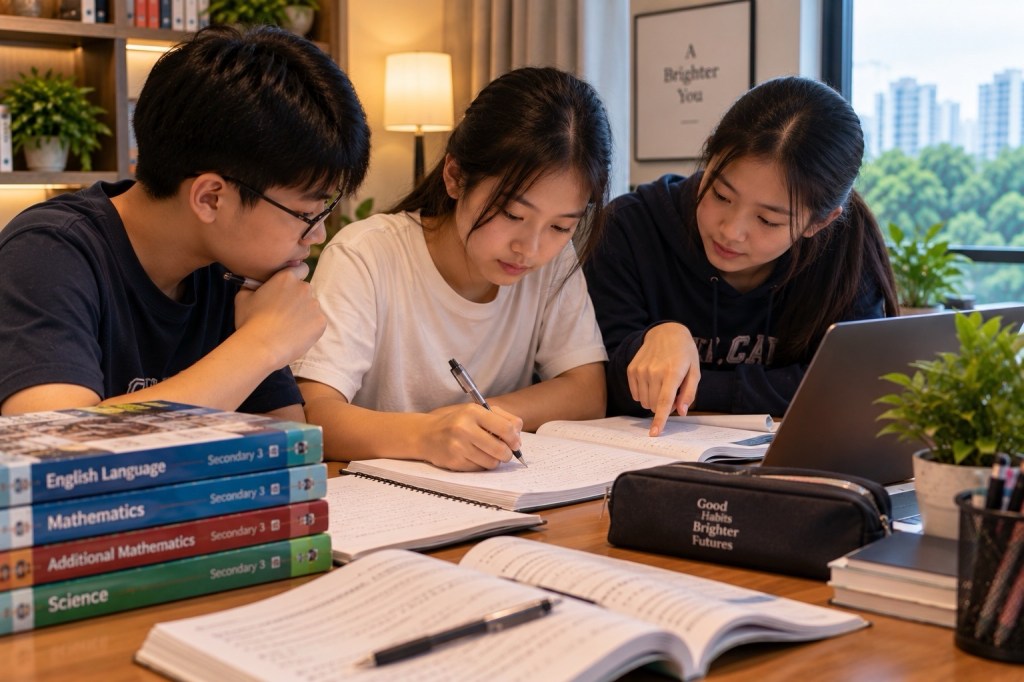
Learning G1 A-Math with a Serangoon tutor needs an important clarification: there is no separate G1 Additional Mathematics subject listed for the 2027 SEC. G1 school candidates have G1 Mathematics K110, while Additional Mathematics appears at G2 and G3.
So this page is a G1-to-A-Math readiness guide. The useful goal is not to imitate a syllabus that does not formally exist at G1. The goal is to build the mathematical foundations that keep later pathways open.
For Serangoon, Kovan, Upper Serangoon, Buangkok and the surrounding north-east corridor families thinking ahead, this distinction matters. Rushing into advanced-looking material can create the appearance of acceleration while leaving the underlying number and algebra system fragile.
eduKate Sengkang teaches Secondary Mathematics in groups of up to three students. For a G1 learner interested in later A-Math progression, we focus on prerequisite capability.
Useful readiness work may include:
- signed-number control;
- fractions and proportional reasoning;
- percentages and ratio;
- basic algebraic notation;
- substitution;
- simple equations;
- graph reading;
- coordinate thinking;
- geometry and measurement;
- clear mathematical working and checking.
SEAB 2027 G2 syllabuses, including K232 Additional Mathematics
Why This Is a Readiness Article
The title reflects the family’s search intent, but the academic distinction must remain accurate.
There is no official G1 Additional Mathematics paper in the 2027 SEC G1 list.
A G1 student can still prepare for future progression. Preparation should begin with the dependencies that later A-Math assumes.
The best early A-Math preparation is not early calculus. It is mathematics strong enough that later algebra has somewhere secure to stand.
Signed Numbers
Later algebra uses negative values constantly. A student who regularly loses signs will carry that error into equations, graphs and trigonometry.
We therefore train sign control until it becomes reliable.
Fractions
Fractions are one of the hidden engines of later algebra.
Students should be able to simplify, compare and operate with fractions without excessive hesitation.
Weak fractions create difficulty later in algebraic fractions, ratios, formulae and equations.
Ratio and Proportion
Proportional reasoning supports scale, rate, similarity and many applied situations.
Students learn to recognise multiplicative relationships rather than treating every change as additive.
Basic Algebra
The learner should understand what a variable represents, what an expression is and what equality means.
We train substitution, simple manipulation and equation solving while keeping the meaning visible.
The goal is not to rush into advanced symbols. It is to make algebra feel natural.
Graphs
Students learn to read axes, coordinates, scale and trends.
Later functions become easier when graphical thinking is already familiar.
We also connect simple equations and tables to their visual representations.
Why Rushing Ahead Can Backfire
A student may appear advanced because the learner has seen a difficult topic early. That does not guarantee understanding.
If number and algebra foundations remain unstable, early exposure becomes a memory exercise.
The learner may reproduce a familiar route but have no way to reconstruct it when the form changes.
The eduKate Readiness Runtime
1. Diagnose
We check whether the current G1 Mathematics foundation is genuinely secure.
2. Repair
Weak number, fraction, ratio or algebra skills are rebuilt.
3. Extend within the foundation
Questions become richer without prematurely pretending the learner is already taking G2 or G3 A-Math.
4. Introduce symbolic reasoning
The student generalises patterns and represents relationships.
5. Test independence
The learner meets unfamiliar problems without a worked model beside them.
6. Reassess pathway readiness
Future progression should be considered using school guidance, current performance and the learner’s mathematical maturity.
Who May Benefit From G1-to-A-Math Readiness Support?
- a G1 student who enjoys Mathematics and wants a stronger foundation;
- a learner whose school is discussing subject-level progression;
- a student with good conceptual understanding but slow algebra;
- a learner who wants to keep stronger mathematical pathways open;
- a student who needs foundation repair before considering acceleration;
- a family that wants an accurate pathway discussion rather than an unofficial pseudo-syllabus.
Serangoon Convenience and the Actual Classroom Location
A Serangoon Mathematics tutor may be convenient for local families. For A-Math readiness, parents should ask whether the tutor strengthens prerequisites or simply jumps into advanced-looking topics.
eduKate Sengkang is not located in Serangoon. Our Sengkang/Punggol classroom is at 83 Punggol Central, Singapore 828761, by appointment.
Class Details
- Class size: up to 3 students
- Current official G1 Mathematics route: K110
- G1 Additional Mathematics: not listed as a 2027 SEC G1 subject
- Readiness focus: number, fractions, ratio, algebra, graphs, geometry, working and independent problem solving
- Duration: 1.5 hours
- Location: 83 Punggol Central, Singapore 828761
Learning G1 A-Math with a Serangoon Tutor
For a G1 student, this should mean building the mathematics that later A-Math will require.
The strongest preparation is a foundation that remains stable when notation becomes denser and questions become less familiar.
Build the floor first. Then progression has somewhere secure to stand.
Task recognition
In G1 A-Math readiness, this part of the learning system is trained through algebraic readiness. The student is asked to do more than recognise a correct answer after it is shown. The learner must identify what the task requires, decide which knowledge or representation is useful, make an independent attempt and then inspect the result for signs that something has gone wrong. The tutor watches the decision process as carefully as the final answer because the same score can be produced by very different causes.
This matters for a student travelling from Serangoon because tuition time has to produce something that survives the journey back into school. A correction that only works inside the lesson is not enough. The idea should return later, appear in a changed form and eventually sit beside other topics so the learner has to choose it without being told. That sequence—understand, attempt, correct, retrieve, mix and transfer—is what turns a short-term success into a usable capability.
As the capability becomes more stable, support is reduced. The tutor stops supplying the first move, waits longer before intervening and asks the student to explain why the chosen route belongs. This can feel slower than simply showing the answer, but it builds a learner who can continue when the task is unfamiliar. The standard is therefore not perfect performance during tuition; it is increasingly organised performance when the tutor is silent.
Building a reliable first move
In G1 A-Math readiness, this part of the learning system is trained through functions. The student is asked to do more than recognise a correct answer after it is shown. The learner must identify what the task requires, decide which knowledge or representation is useful, make an independent attempt and then inspect the result for signs that something has gone wrong. The tutor watches the decision process as carefully as the final answer because the same score can be produced by very different causes.
This matters for a student travelling from Serangoon because tuition time has to produce something that survives the journey back into school. A correction that only works inside the lesson is not enough. The idea should return later, appear in a changed form and eventually sit beside other topics so the learner has to choose it without being told. That sequence—understand, attempt, correct, retrieve, mix and transfer—is what turns a short-term success into a usable capability.
As the capability becomes more stable, support is reduced. The tutor stops supplying the first move, waits longer before intervening and asks the student to explain why the chosen route belongs. This can feel slower than simply showing the answer, but it builds a learner who can continue when the task is unfamiliar. The standard is therefore not perfect performance during tuition; it is increasingly organised performance when the tutor is silent.
Correction that changes future work
In G1 A-Math readiness, this part of the learning system is trained through graphs. The student is asked to do more than recognise a correct answer after it is shown. The learner must identify what the task requires, decide which knowledge or representation is useful, make an independent attempt and then inspect the result for signs that something has gone wrong. The tutor watches the decision process as carefully as the final answer because the same score can be produced by very different causes.
This matters for a student travelling from Serangoon because tuition time has to produce something that survives the journey back into school. A correction that only works inside the lesson is not enough. The idea should return later, appear in a changed form and eventually sit beside other topics so the learner has to choose it without being told. That sequence—understand, attempt, correct, retrieve, mix and transfer—is what turns a short-term success into a usable capability.
As the capability becomes more stable, support is reduced. The tutor stops supplying the first move, waits longer before intervening and asks the student to explain why the chosen route belongs. This can feel slower than simply showing the answer, but it builds a learner who can continue when the task is unfamiliar. The standard is therefore not perfect performance during tuition; it is increasingly organised performance when the tutor is silent.
Retrieval after delay
In G1 A-Math readiness, this part of the learning system is trained through equations. The student is asked to do more than recognise a correct answer after it is shown. The learner must identify what the task requires, decide which knowledge or representation is useful, make an independent attempt and then inspect the result for signs that something has gone wrong. The tutor watches the decision process as carefully as the final answer because the same score can be produced by very different causes.
This matters for a student travelling from Serangoon because tuition time has to produce something that survives the journey back into school. A correction that only works inside the lesson is not enough. The idea should return later, appear in a changed form and eventually sit beside other topics so the learner has to choose it without being told. That sequence—understand, attempt, correct, retrieve, mix and transfer—is what turns a short-term success into a usable capability.
As the capability becomes more stable, support is reduced. The tutor stops supplying the first move, waits longer before intervening and asks the student to explain why the chosen route belongs. This can feel slower than simply showing the answer, but it builds a learner who can continue when the task is unfamiliar. The standard is therefore not perfect performance during tuition; it is increasingly organised performance when the tutor is silent.
Choosing between methods
In G1 A-Math readiness, this part of the learning system is trained through symbolic reasoning. The student is asked to do more than recognise a correct answer after it is shown. The learner must identify what the task requires, decide which knowledge or representation is useful, make an independent attempt and then inspect the result for signs that something has gone wrong. The tutor watches the decision process as carefully as the final answer because the same score can be produced by very different causes.
This matters for a student travelling from Serangoon because tuition time has to produce something that survives the journey back into school. A correction that only works inside the lesson is not enough. The idea should return later, appear in a changed form and eventually sit beside other topics so the learner has to choose it without being told. That sequence—understand, attempt, correct, retrieve, mix and transfer—is what turns a short-term success into a usable capability.
As the capability becomes more stable, support is reduced. The tutor stops supplying the first move, waits longer before intervening and asks the student to explain why the chosen route belongs. This can feel slower than simply showing the answer, but it builds a learner who can continue when the task is unfamiliar. The standard is therefore not perfect performance during tuition; it is increasingly organised performance when the tutor is silent.
Working under mixed conditions
In G1 A-Math readiness, this part of the learning system is trained through coordinate thinking. The student is asked to do more than recognise a correct answer after it is shown. The learner must identify what the task requires, decide which knowledge or representation is useful, make an independent attempt and then inspect the result for signs that something has gone wrong. The tutor watches the decision process as carefully as the final answer because the same score can be produced by very different causes.
This matters for a student travelling from Serangoon because tuition time has to produce something that survives the journey back into school. A correction that only works inside the lesson is not enough. The idea should return later, appear in a changed form and eventually sit beside other topics so the learner has to choose it without being told. That sequence—understand, attempt, correct, retrieve, mix and transfer—is what turns a short-term success into a usable capability.
As the capability becomes more stable, support is reduced. The tutor stops supplying the first move, waits longer before intervening and asks the student to explain why the chosen route belongs. This can feel slower than simply showing the answer, but it builds a learner who can continue when the task is unfamiliar. The standard is therefore not perfect performance during tuition; it is increasingly organised performance when the tutor is silent.
Checking before submission
In G1 A-Math readiness, this part of the learning system is trained through future trigonometry foundations. The student is asked to do more than recognise a correct answer after it is shown. The learner must identify what the task requires, decide which knowledge or representation is useful, make an independent attempt and then inspect the result for signs that something has gone wrong. The tutor watches the decision process as carefully as the final answer because the same score can be produced by very different causes.
This matters for a student travelling from Serangoon because tuition time has to produce something that survives the journey back into school. A correction that only works inside the lesson is not enough. The idea should return later, appear in a changed form and eventually sit beside other topics so the learner has to choose it without being told. That sequence—understand, attempt, correct, retrieve, mix and transfer—is what turns a short-term success into a usable capability.
As the capability becomes more stable, support is reduced. The tutor stops supplying the first move, waits longer before intervening and asks the student to explain why the chosen route belongs. This can feel slower than simply showing the answer, but it builds a learner who can continue when the task is unfamiliar. The standard is therefore not perfect performance during tuition; it is increasingly organised performance when the tutor is silent.
Explaining the reasoning
In G1 A-Math readiness, this part of the learning system is trained through future calculus foundations. The student is asked to do more than recognise a correct answer after it is shown. The learner must identify what the task requires, decide which knowledge or representation is useful, make an independent attempt and then inspect the result for signs that something has gone wrong. The tutor watches the decision process as carefully as the final answer because the same score can be produced by very different causes.
This matters for a student travelling from Serangoon because tuition time has to produce something that survives the journey back into school. A correction that only works inside the lesson is not enough. The idea should return later, appear in a changed form and eventually sit beside other topics so the learner has to choose it without being told. That sequence—understand, attempt, correct, retrieve, mix and transfer—is what turns a short-term success into a usable capability.
As the capability becomes more stable, support is reduced. The tutor stops supplying the first move, waits longer before intervening and asks the student to explain why the chosen route belongs. This can feel slower than simply showing the answer, but it builds a learner who can continue when the task is unfamiliar. The standard is therefore not perfect performance during tuition; it is increasingly organised performance when the tutor is silent.
Using school feedback
In G1 A-Math readiness, this part of the learning system is trained through exact values. The student is asked to do more than recognise a correct answer after it is shown. The learner must identify what the task requires, decide which knowledge or representation is useful, make an independent attempt and then inspect the result for signs that something has gone wrong. The tutor watches the decision process as carefully as the final answer because the same score can be produced by very different causes.
This matters for a student travelling from Serangoon because tuition time has to produce something that survives the journey back into school. A correction that only works inside the lesson is not enough. The idea should return later, appear in a changed form and eventually sit beside other topics so the learner has to choose it without being told. That sequence—understand, attempt, correct, retrieve, mix and transfer—is what turns a short-term success into a usable capability.
As the capability becomes more stable, support is reduced. The tutor stops supplying the first move, waits longer before intervening and asks the student to explain why the chosen route belongs. This can feel slower than simply showing the answer, but it builds a learner who can continue when the task is unfamiliar. The standard is therefore not perfect performance during tuition; it is increasingly organised performance when the tutor is silent.
Managing assessment time
In G1 A-Math readiness, this part of the learning system is trained through mathematical checking. The student is asked to do more than recognise a correct answer after it is shown. The learner must identify what the task requires, decide which knowledge or representation is useful, make an independent attempt and then inspect the result for signs that something has gone wrong. The tutor watches the decision process as carefully as the final answer because the same score can be produced by very different causes.
This matters for a student travelling from Serangoon because tuition time has to produce something that survives the journey back into school. A correction that only works inside the lesson is not enough. The idea should return later, appear in a changed form and eventually sit beside other topics so the learner has to choose it without being told. That sequence—understand, attempt, correct, retrieve, mix and transfer—is what turns a short-term success into a usable capability.
As the capability becomes more stable, support is reduced. The tutor stops supplying the first move, waits longer before intervening and asks the student to explain why the chosen route belongs. This can feel slower than simply showing the answer, but it builds a learner who can continue when the task is unfamiliar. The standard is therefore not perfect performance during tuition; it is increasingly organised performance when the tutor is silent.
Recovering after uncertainty
In G1 A-Math readiness, this part of the learning system is trained through algebraic readiness. The student is asked to do more than recognise a correct answer after it is shown. The learner must identify what the task requires, decide which knowledge or representation is useful, make an independent attempt and then inspect the result for signs that something has gone wrong. The tutor watches the decision process as carefully as the final answer because the same score can be produced by very different causes.
This matters for a student travelling from Serangoon because tuition time has to produce something that survives the journey back into school. A correction that only works inside the lesson is not enough. The idea should return later, appear in a changed form and eventually sit beside other topics so the learner has to choose it without being told. That sequence—understand, attempt, correct, retrieve, mix and transfer—is what turns a short-term success into a usable capability.
As the capability becomes more stable, support is reduced. The tutor stops supplying the first move, waits longer before intervening and asks the student to explain why the chosen route belongs. This can feel slower than simply showing the answer, but it builds a learner who can continue when the task is unfamiliar. The standard is therefore not perfect performance during tuition; it is increasingly organised performance when the tutor is silent.
Strengthening home practice
In G1 A-Math readiness, this part of the learning system is trained through functions. The student is asked to do more than recognise a correct answer after it is shown. The learner must identify what the task requires, decide which knowledge or representation is useful, make an independent attempt and then inspect the result for signs that something has gone wrong. The tutor watches the decision process as carefully as the final answer because the same score can be produced by very different causes.
This matters for a student travelling from Serangoon because tuition time has to produce something that survives the journey back into school. A correction that only works inside the lesson is not enough. The idea should return later, appear in a changed form and eventually sit beside other topics so the learner has to choose it without being told. That sequence—understand, attempt, correct, retrieve, mix and transfer—is what turns a short-term success into a usable capability.
As the capability becomes more stable, support is reduced. The tutor stops supplying the first move, waits longer before intervening and asks the student to explain why the chosen route belongs. This can feel slower than simply showing the answer, but it builds a learner who can continue when the task is unfamiliar. The standard is therefore not perfect performance during tuition; it is increasingly organised performance when the tutor is silent.
Keeping earlier learning available
In G1 A-Math readiness, this part of the learning system is trained through graphs. The student is asked to do more than recognise a correct answer after it is shown. The learner must identify what the task requires, decide which knowledge or representation is useful, make an independent attempt and then inspect the result for signs that something has gone wrong. The tutor watches the decision process as carefully as the final answer because the same score can be produced by very different causes.
This matters for a student travelling from Serangoon because tuition time has to produce something that survives the journey back into school. A correction that only works inside the lesson is not enough. The idea should return later, appear in a changed form and eventually sit beside other topics so the learner has to choose it without being told. That sequence—understand, attempt, correct, retrieve, mix and transfer—is what turns a short-term success into a usable capability.
As the capability becomes more stable, support is reduced. The tutor stops supplying the first move, waits longer before intervening and asks the student to explain why the chosen route belongs. This can feel slower than simply showing the answer, but it builds a learner who can continue when the task is unfamiliar. The standard is therefore not perfect performance during tuition; it is increasingly organised performance when the tutor is silent.
Connecting one topic to another
In G1 A-Math readiness, this part of the learning system is trained through equations. The student is asked to do more than recognise a correct answer after it is shown. The learner must identify what the task requires, decide which knowledge or representation is useful, make an independent attempt and then inspect the result for signs that something has gone wrong. The tutor watches the decision process as carefully as the final answer because the same score can be produced by very different causes.
This matters for a student travelling from Serangoon because tuition time has to produce something that survives the journey back into school. A correction that only works inside the lesson is not enough. The idea should return later, appear in a changed form and eventually sit beside other topics so the learner has to choose it without being told. That sequence—understand, attempt, correct, retrieve, mix and transfer—is what turns a short-term success into a usable capability.
As the capability becomes more stable, support is reduced. The tutor stops supplying the first move, waits longer before intervening and asks the student to explain why the chosen route belongs. This can feel slower than simply showing the answer, but it builds a learner who can continue when the task is unfamiliar. The standard is therefore not perfect performance during tuition; it is increasingly organised performance when the tutor is silent.
Learning from repeated errors
In G1 A-Math readiness, this part of the learning system is trained through symbolic reasoning. The student is asked to do more than recognise a correct answer after it is shown. The learner must identify what the task requires, decide which knowledge or representation is useful, make an independent attempt and then inspect the result for signs that something has gone wrong. The tutor watches the decision process as carefully as the final answer because the same score can be produced by very different causes.
This matters for a student travelling from Serangoon because tuition time has to produce something that survives the journey back into school. A correction that only works inside the lesson is not enough. The idea should return later, appear in a changed form and eventually sit beside other topics so the learner has to choose it without being told. That sequence—understand, attempt, correct, retrieve, mix and transfer—is what turns a short-term success into a usable capability.
As the capability becomes more stable, support is reduced. The tutor stops supplying the first move, waits longer before intervening and asks the student to explain why the chosen route belongs. This can feel slower than simply showing the answer, but it builds a learner who can continue when the task is unfamiliar. The standard is therefore not perfect performance during tuition; it is increasingly organised performance when the tutor is silent.
Extending a strong learner
In G1 A-Math readiness, this part of the learning system is trained through coordinate thinking. The student is asked to do more than recognise a correct answer after it is shown. The learner must identify what the task requires, decide which knowledge or representation is useful, make an independent attempt and then inspect the result for signs that something has gone wrong. The tutor watches the decision process as carefully as the final answer because the same score can be produced by very different causes.
This matters for a student travelling from Serangoon because tuition time has to produce something that survives the journey back into school. A correction that only works inside the lesson is not enough. The idea should return later, appear in a changed form and eventually sit beside other topics so the learner has to choose it without being told. That sequence—understand, attempt, correct, retrieve, mix and transfer—is what turns a short-term success into a usable capability.
As the capability becomes more stable, support is reduced. The tutor stops supplying the first move, waits longer before intervening and asks the student to explain why the chosen route belongs. This can feel slower than simply showing the answer, but it builds a learner who can continue when the task is unfamiliar. The standard is therefore not perfect performance during tuition; it is increasingly organised performance when the tutor is silent.
Serangoon Learning Context
A local tuition page should reflect the conditions in which learning actually happens. Serangoon families are balancing school timetables, travel, CCAs, family routines and the student’s available attention. A strong programme therefore needs to be academically precise and logistically sustainable.
For a G1 learner in Serangoon, A-Math readiness should remain academically accurate. There is no official G1 Additional Mathematics SEC subject. The correct work is to strengthen K110 Mathematics—signed numbers, fractions, ratio, algebra, graphs and clear working—so that later progression remains possible if the learner’s school route and readiness support it.
Serangoon families can therefore judge future A-Math readiness from evidence rather than acceleration theatre. Independent mathematical control, stable algebraic foundations and the ability to learn unfamiliar structures matter more than seeing advanced notation early.
A practical weekly rhythm
A useful rhythm is one focused tuition lesson, one short retrieval session, one school-linked correction task and one brief check of upcoming assessment demands. The exact pattern changes by student, but consistency matters more than occasional bursts of heavy revision.
Travel versus teaching fit
A tutor physically located in Serangoon may offer the shortest commute. eduKate Sengkang is at 83 Punggol Central, Singapore 828761, so families should compare travel time honestly against the value of the three-student format and the teaching system described here. The correct choice is the one the student can attend consistently and benefit from academically.
What makes the page genuinely local
The area name is not enough. The article should help a Serangoon family think about actual scheduling, travel, school workload and the kind of independent practice that can fit between lessons. That local layer sits on top of a subject-accurate learning system; it does not replace it.
Serangoon Continuity Check
This local article is not complete merely because it is long. The teaching system must connect tuition to school, one week to the next and familiar tasks to unfamiliar ones. A realistic weekly routine, targeted retrieval and visible independence matter more than occasional heavy revision.
The area name helps the family find the page; subject accuracy, diagnostic clarity, small-group teaching, retrieval, transfer and learner independence are what make the page educationally useful.
Arrange a Parent–Student Consultation
Visit eduKate Sengkang for current class information, fees and contact details.
Continue learning: Additional Mathematics Learning Hub.
