

Secondary 3–4 Additional Mathematics | Individual Calibration in Small Groups of 3 | eduKate Sengkang
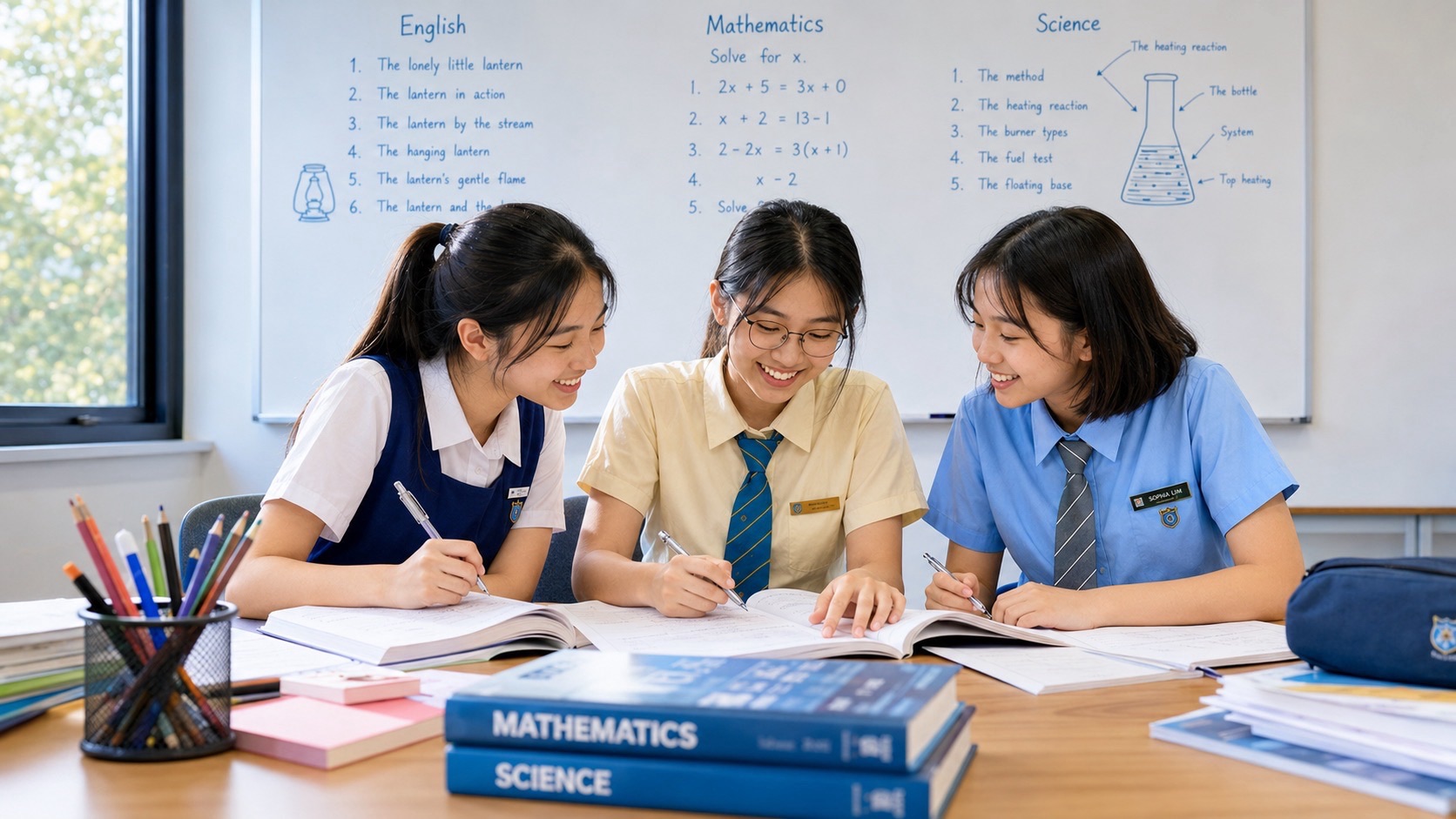
Two students can sit in the same Additional Mathematics class.
They can study the same chapter.
Attempt the same question.
Receive the same wrong answer.
And still need completely different teaching.
Student A may not understand the concept.
Student B may understand the concept but have weak algebra.
Student C may know both, but select the wrong method when the question changes.
From the outside, all three appear to have the same problem:
Wrong answer.
At higher resolution, they are three different mathematical states.
That is what personalized Additional Mathematics tuition means to us.
It does not mean that every student needs an entirely different syllabus.
It does not mean that a student should permanently work alone.
And it does not mean that every lesson needs to become one-to-one tuition.
At eduKate Sengkang, personalization happens inside our small-group model of up to 3 students per class, where the tutor can observe each student’s working closely enough to identify where their mathematical route is actually breaking. The current eduKate Sengkang programme lists Mathematics and Additional Mathematics within this 3-pax, 1.5-hour lesson structure.
The shared Mathematics may be the same.
The required repair can be different.
That gives us a simple principle:
Same syllabus.
Different student state.
Different next move.
Personalization Begins With Diagnosis
Suppose a Secondary 3 student says:
“I am bad at A-Math.”
That diagnosis is too broad to be useful.
Additional Mathematics contains a large network of capabilities.
The real problem might be:
algebraic manipulation
or:
quadratic equations
or:
functions
or:
graphs
or:
trigonometry
or:
calculus
But even those labels may still be too broad.
A student who appears weak in calculus may actually understand differentiation perfectly.
Their real failure may occur later:
differentiate correctly
↓
form stationary-point equation correctly
↓
algebraic manipulation fails
↓
final answer wrong
The visible failure is:
Calculus.
The actual weakness is:
Algebra.
If we repair the wrong thing, the student can spend hours practising differentiation while the real failure remains untouched.
Personalized teaching begins by finding the earliest broken link.
The Mathematical Route
A Mathematics solution is a route.
Consider:
QUESTION
↓
RECOGNISE STRUCTURE
↓
SELECT METHOD
↓
REPRESENT
↓
TRANSFORM
↓
CALCULATE
↓
INTERPRET
↓
CHECK
The final answer only tells us where the student ended.
The working tells us how they travelled.
That is why one of the most important questions in A-Math tuition is:
Show me how you got there.
The student’s working is not merely something to mark.
It is diagnostic information.
Wrong Answers Are Telemetry
A wrong answer tells us that something happened inside the mathematical system.
For example:
Student A
Chooses the wrong formula.
This may be a:
SELECTION ERROR
Student B
Uses the correct method but expands incorrectly.
This may be an:
ALGEBRA ERROR
Student C
Completes every calculation correctly but gives the wrong final interpretation.
This may be an:
INTERPRETATION ERROR
Student D
Understands the entire solution when shown, but cannot begin independently.
This may be a:
RETRIEVAL / ROUTING ERROR
The score may treat all four simply as lost marks.
Teaching should not.
We Type the Failure Before Choosing the Repair
A useful diagnostic vocabulary for Additional Mathematics includes:
Concept Error
The underlying mathematical idea is not understood.
Representation Error
The student has converted the problem into the wrong mathematical form.
Selection Error
The student knows several methods but chooses one that does not fit.
Algebra Error
The correct route is damaged by manipulation.
Execution Error
The method is correct but a local calculation fails.
Retrieval Error
The student learned the technique previously but cannot access it when needed.
Connection Error
Two individually known topics are not connected.
Checking Error
An impossible or inconsistent answer survives to submission.
Runtime Error
The student can perform without pressure but becomes unreliable under examination conditions.
These errors require different interventions.
That is personalization.
Do Not Treat “Careless” as a Diagnosis
A student loses ten marks.
The conclusion is:
“Careless.”
But what does careless mean?
Perhaps the student:
- dropped a negative sign;
- copied a coefficient incorrectly;
- forgot a second root;
- confused inverse notation;
- differentiated correctly but simplified wrongly;
- failed to check the domain;
- answered only part of the question.
Those are observable failures.
Once the failure is observable, we can build a repair.
“Careless” tells us very little.
Find the Earliest Invalid State
Suppose the student’s solution contains eight lines.
Lines 1–4 are valid.
Line 5 contains an invalid algebraic transformation.
Lines 6–8 follow logically from the incorrect Line 5.
Correcting only the final answer is inefficient.
The useful process is:
FINAL ERROR
↓
trace backwards
↓
LINE 5: FIRST INVALID TRANSFORMATION
↓
repair
↓
rerun solution
This is one of the most important habits students can learn.
Find where the mathematical world first changed incorrectly.
Personalization Is Not Easier Mathematics
Personalized teaching does not mean reducing every difficult question until the student never struggles.
The objective is not:
Make Mathematics comfortable forever.
It is:
Give the student the right difficulty at the right state.
If the work is far below the student’s capability, little develops.
If it is far above the student’s current architecture, the learner may only copy.
The useful region is where the student can:
attempt
↓
struggle productively
↓
receive correction
↓
reconstruct
↓
try again
That difficulty changes as the student changes.
Same Student, Different State Over Time
Personalization is also not permanent.
Suppose a student begins Secondary 3 with weak algebra.
January:
repair algebra
March:
algebra stabilises.
Now the highest-value target may become:
functions
Later:
functions become stable.
Now:
trigonometric manipulation
Later still:
mixed-topic transfer
The student state changes.
Teaching should change too.
This gives us:
STATE₀
↓
TEACH
↓
PRACTISE
↓
CORRECT
↓
STATE₁
↓
RECALIBRATE
Personalization is therefore dynamic.
The Next Move Depends on the Current State
Imagine three students learning functions.
Student A
Cannot understand what a function represents.
Next move:
build conceptual model
Student B
Understands functions but makes substitution errors.
Next move:
execution stability
Student C
Handles routine functions easily.
Next move:
composition, inverse relationships and unfamiliar representations
Same class.
Same broad topic.
Different frontier.
That is how small-group personalization can work.
Why Additional Mathematics Needs This More Than Many Earlier Subjects
Additional Mathematics is highly dependent.
Later topics repeatedly call earlier capabilities back into use.
A weakness does not remain neatly inside one chapter.
For example:
weak algebra
↓
affects equations
↓
affects functions
↓
affects trigonometry
↓
affects calculus
↓
affects mixed examination questions
One unstable component can appear to create five different topic weaknesses.
This is why diagnosis matters so much.
Mathematical Debt
When a weakness is repeatedly bypassed instead of repaired, mathematical debt accumulates.
For example:
Secondary 2:
factorisation is unstable.
Student moves on.
Secondary 3:
quadratic work becomes difficult.
Student memorises additional procedures.
Later:
functions call quadratic algebra again.
Later:
calculus produces equations that need the same algebra.
The original weakness keeps returning.
That is mathematical debt.
Additional Mathematics often exposes debt that earlier Mathematics allowed the student to hide.
Repair the Dependency, Not Only the Symptom
Suppose a student struggles with:
trigonometric equations
We could assign fifty more trigonometric questions.
But inspection reveals:
fractions are unstable
and:
algebraic rearrangement is unreliable.
Those are upstream dependencies.
The more efficient repair may be:
fractions
↓
algebra
↓
simple trig equation
↓
complex trig equation
↓
return to original question
Sometimes the fastest way forward begins by going backwards.
The Bonsai Principle: Keep What the Student Actually Needs
A struggling student can easily accumulate:
- more notes;
- more formulas;
- more model solutions;
- more worksheets;
- more techniques.
Eventually the student has a huge mathematical warehouse.
But they still cannot decide what to use.
More is not always better.
Sometimes improvement requires pruning.
Remove unnecessary routes.
Stabilise the important ones.
Make retrieval cleaner.
The mathematical system becomes smaller but more reliable.
A Good Method Has to Be Retrievable
A student may have learned three ways to solve a quadratic equation:
factorisation
quadratic formula
completing the square
That knowledge is useful.
But during an examination, the student also needs to know:
Which one fits now?
That creates another layer of personalization.
One student may need:
more methods
Another may already know too many methods and need:
better selection.
Same subject.
Opposite intervention.
Method Selection Is a Capability
Consider:
x² − 9 = 0
Several methods are valid.
Factorisation is immediate.
Using the quadratic formula is also valid.
But it may be unnecessarily expensive.
Now consider:
2x² + 7x + 1 = 0
Factorisation may be less obvious.
Another method may be safer.
The question is no longer:
Do you know the quadratic formula?
It is:
Can you select an appropriate route from the tools you know?
That is higher-level mathematical control.
Additional Mathematics as a Wiring Problem
An unfamiliar A-Math problem may require several mathematical modules.
For example:
FUNCTION
↓
ALGEBRA
↓
DIFFERENTIATION
↓
QUADRATIC SOLVING
↓
INTERPRETATION
The question does not always tell the student:
Connect these five things in this order.
The student has to assemble the route.
That is one reason students who are good at chapter exercises can struggle with mixed papers.
Chapter practice gives them the module.
Mixed practice asks them to wire the modules together.
Personalization Means Finding the Missing Connection
Suppose a student knows:
functions
and:
differentiation
individually.
But when both appear together, performance collapses.
The problem may not be missing content.
It may be a missing corridor.
We therefore practise:
FUNCTION
→
DIFFERENTIATE FUNCTION
→
INTERPRET DERIVATIVE
The student learns how existing capabilities connect.
Sometimes the required intervention is not another new skill.
It is a new connection between existing skills.
The Mathematical ID Card
One way to improve routing is to teach students to identify the mathematical object before selecting the method.
For example:
Quadratic
Look for:
- highest power 2;
- roots;
- turning-point relationships;
- quadratic graph structures.
Possible tools include:
- factorisation;
- quadratic formula;
- completing square;
- graphical interpretation.
Function
Look for:
- input-output relationships;
- domain and range;
- composition;
- inverse;
- graphs.
Differentiation
Look for:
- gradient;
- rate of change;
- stationary points;
- optimisation.
Integration
Look for:
- accumulation;
- area relationships;
- reverse differentiation where applicable.
Once the object is identified, the possible tools become easier to filter.
From Random Search to Constrained Search
A weak student may approach a difficult question like this:
Try formula A.
Doesn’t work.
Try formula B.
Doesn’t work.
Try formula C.
A stronger student first constrains the search space.
What type of object is this?
↓
What is being asked?
↓
Which tools are compatible?
↓
Which route is shortest or safest?
This greatly reduces mathematical wandering.
The Null Route
Sometimes the first method does not work well.
That is useful information.
Suppose the student attempts a complicated trigonometric transformation.
Each line becomes uglier.
No useful structure appears.
The student should be allowed to conclude:
This route is not producing progress.
Return.
Try another representation.
Mathematical independence includes knowing when to stop forcing a bad route.
Personalization Includes Teaching Recovery
Some students are excellent when they know the route immediately.
The moment they do not, they freeze.
For those students, the highest-value capability may be recovery.
A recovery sequence can be:
STOP
↓
WHAT IS GIVEN?
↓
WHAT IS REQUIRED?
↓
WHAT TYPE OF MATHEMATICS?
↓
CAN I REWRITE IT?
↓
CAN I DRAW IT?
↓
CAN I TEST A SIMPLE VALUE?
↓
CAN I WORK BACKWARDS?
↓
CAN I TRY ANOTHER ROUTE?
Confidence becomes less dependent on immediate recognition.
Confidence Should Come From Recoverability
There are two kinds of mathematical confidence.
Fragile confidence:
I am confident because I know this question.
Robust confidence:
I am confident because even if I do not know the route immediately, I have ways to inspect the problem.
The second is more useful for Additional Mathematics.
The examination can always produce an unfamiliar combination.
A recoverable student is harder to destabilise.
Algebra Is Often the Hidden Personalization Layer
Two students can both say:
“I am weak in A-Math.”
But one may need a new concept.
The other may need algebra repair.
This is particularly important because algebra sits underneath so much of Additional Mathematics.
A student can understand:
- functions;
- trigonometry;
- calculus;
and still lose marks repeatedly because symbolic manipulation is unstable.
So we inspect algebra continuously rather than treating it as a chapter that was completed and retired.
Algebra Is the Operating Language
Additional Mathematics often uses algebra as its operating language.
The mathematical idea may come from calculus.
The execution still travels through algebra.
The concept may come from functions.
The expression still has to be manipulated algebraically.
That means algebra needs to become sufficiently automated that it does not consume all of the student’s cognitive bandwidth.
Mathematical Load
Consider a student solving a calculus question.
They need to hold:
the question goal
differentiation rule
algebra
current expression
next step
checking
If algebra remains slow and uncertain, it consumes a large portion of the available working memory.
The student may then lose the larger route.
Personalized teaching therefore sometimes targets load reduction.
Automate what should be automatic so attention remains available for reasoning.
Strong Foundations Buy Thinking Space
If algebraic manipulation becomes reliable, the student no longer needs to devote as much attention to each local step.
That frees capacity for:
- strategy;
- interpretation;
- checking;
- alternative methods;
- examination management.
A foundation is valuable not only because later Mathematics depends on it.
It also reduces cognitive load.
Functions Need Conceptual Personalization
Another student may be excellent at algebra but weak in functions.
They can substitute values mechanically.
But they do not understand:
input
↓
rule
↓
output
or how:
function
inverse
composition
and:
graph
relate.
For this student, more algebra drilling would miss the problem.
We need to rebuild the mathematical object.
Same A-Math class.
Different intervention.
Multiple Representations Can Repair Understanding
A function can be represented as:
equation
table
graph
mapping
If one representation remains opaque, rotate.
For some students:
equation first works.
For others:
graph first.
The objective is not to permanently personalise the Mathematics into one preferred style.
It is to use one representation to help the learner eventually move between all valid representations.
Personalization Should Expand Flexibility, Not Create Dependence
We do not want the student to conclude:
I can only understand functions when someone draws the graph for me.
The temporary scaffold should eventually disappear.
A useful progression is:
support
↓
guided use
↓
reduced support
↓
independent reconstruction
The end state is greater flexibility.
Trigonometry Exposes Route Selection
Trigonometric questions can often be solved in several ways.
The difficulty may be less:
Do you know an identity?
and more:
Which transformation creates useful progress?
Personalized instruction therefore looks at the student’s decision behaviour.
Do they:
- transform randomly?
- recognise useful targets?
- preserve equivalence?
- know when to stop?
- check solution ranges?
Different weaknesses require different drills.
Calculus Exposes Dependency Chains
Calculus is particularly diagnostic because it sits on top of earlier Mathematics.
A differentiation problem may expose:
- index weaknesses;
- algebra weaknesses;
- function weaknesses;
- equation-solving weaknesses.
This means a calculus error is not automatically a calculus problem.
We trace the dependency chain.
Personalized Teaching Is Dependency Tracing
The core process is:
VISIBLE FAILURE
↓
WHAT OPERATION FAILED?
↓
WHAT DOES THAT OPERATION DEPEND ON?
↓
IS THAT DEPENDENCY STABLE?
↓
REPAIR EARLIEST WEAK POINT
↓
REBUILD FORWARD
This creates a much more targeted intervention than:
Student got differentiation wrong → assign more differentiation.
Secondary 3 and Secondary 4 Require Different Personalization
The student’s year level changes the objective too.
Secondary 3 Additional Mathematics
The major task is:
BUILD
Students need:
- foundations;
- conceptual models;
- symbolic fluency;
- strong algebra;
- correct first connections;
- early repair of mathematical debt.
At this stage, time is still an asset.
We can repair thoroughly.
Secondary 4 Additional Mathematics
The major task increasingly becomes:
RUN
Students need:
- retrieval;
- connection;
- mixed-topic transfer;
- examination routing;
- time control;
- error reduction;
- recovery;
- stability.
A Secondary 4 student may know enough Mathematics but fail to run it reliably.
That requires a different intervention.
Personalized Does Not Mean Slow
A student who is already strong should not be held inside endless routine work merely because the class contains another student who needs repair.
The strong learner may need:
greater unfamiliarity
mixed topics
alternative methods
proof
efficiency
higher transfer
examination optimisation
Small-group calibration allows the frontier to move.
Strong Students Need Pruning Too
High-performing students sometimes collect too many methods.
They know five ways to attack a problem.
Then spend too long deciding which one to use.
Their issue is not lack of knowledge.
It may be route proliferation.
For them, improvement may involve:
reduce unnecessary branches
↓
recognise structure faster
↓
select reliable route
↓
execute cleanly
Sophistication can mean fewer moves.
A Mature Mathematical System Becomes Simpler to Operate
At the beginning, the student may need:
ten separate rules.
Later, they realise several are variations of one underlying relationship.
The internal system becomes:
smaller
but:
more powerful.
This is an important developmental direction.
Mathematical maturity is not simply accumulating more formulas forever.
It is increasingly seeing how they belong together.
Personalized Correction
Consider three incorrect solutions.
Error 1
(x + 2)² = x² + 4
Repair:
algebraic expansion.
Error 2
Student differentiates when the question asks for an area.
Repair:
method selection / question interpretation.
Error 3
Student reaches:
x = 3, −2
but reports only:
x = 3
Repair:
completeness / checking.
We do not respond to all three with:
Do another full paper.
Each has a smaller, more precise repair.
The Smallest Useful Repair
A student does not always need another two-hour exercise.
Sometimes the highest-value intervention is ten minutes spent repairing one recurring transformation.
Then test it in:
simple context
↓
mixed context
↓
unfamiliar context
↓
timed context
If it survives, move on.
This is efficient personalization.
Repair → Return
An important rule is:
Always return to the problem that exposed the weakness.
Suppose a calculus question reveals weak algebra.
We pause.
Repair algebra.
Then we must return to the original calculus problem.
Otherwise the student may improve the prerequisite but never reconnect it to the higher-level task.
The full loop is:
CALCULUS FAILURE
↓
ALGEBRA DIAGNOSIS
↓
ALGEBRA REPAIR
↓
RETURN TO CALCULUS
↓
SUCCESSFUL RECONSTRUCTION
That closes the circuit.
Personalized Practice Should Change Over Time
Practice can evolve through several states.
Stage 1 — Isolated
Practise the new operation.
Stage 2 — Varied
Change numbers and forms.
Stage 3 — Mixed
Combine with other topics.
Stage 4 — Rotated
Ask the relationship from another direction.
Stage 5 — Unfamiliar
Hide the method inside a new context.
Stage 6 — Timed
Run under examination constraints.
The student’s current state determines where practice should begin.
Retrieval Is Part of Personalization
Some students learn quickly but forget quickly.
Others learn slowly but retain strongly.
Same immediate classroom performance.
Different long-term requirement.
A student with retrieval weakness may need more spaced return.
A student with stable retrieval may need more transfer.
This is why a single worksheet schedule does not always fit every learner.
Stored Mathematics vs Live Mathematics
There is an important difference between:
I learned this before.
and:
I can use this now.
A formula sitting somewhere in memory is stored.
A formula that can be retrieved, selected and used during an unfamiliar question is live.
We want movement through:
STORED
↓
RETRIEVABLE
↓
SELECTABLE
↓
EXECUTABLE
↓
TRANSFERABLE
↓
STABLE UNDER LOAD
That is the journey towards examination-ready capability.
Mixed Practice Tests the Selector
A chapter worksheet tells the student:
Use this chapter’s method.
A mixed paper asks:
What method belongs here?
That is a different operation.
For students who know content but underperform in examinations, mixed work can expose the missing selector.
The Student Needs an Internal Router
Eventually, the student should be able to see:
quadratic structure
→ possible quadratic tools.
rate-of-change language
→ consider calculus.
composite function
→ function operations.
trigonometric structure
→ appropriate identities or equation methods.
The question enters.
The learner routes it.
That is mathematical independence.
Time Changes the Personalized Target
A Secondary 3 student and a Secondary 4 student may possess the same weakness.
But they may need different intervention because the available time differs.
Secondary 3:
repair deeply.
Secondary 4 close to examinations:
identify the highest-leverage repair and stabilise enough of the system to perform reliably.
Time changes the optimal route.
Highest-Leverage Repair
Suppose a Secondary 4 student has weaknesses in five topics.
But 70% of their mistakes across those topics originate from algebra.
Then algebra may be the highest-leverage target.
Another student loses most marks through poor time allocation despite strong Mathematics.
Their highest-leverage target may be examination management.
Personalization means we do not assume that the visible topic list tells us the priority.
Practice Papers Should Generate a Personal Error Map
A paper should produce more than:
68%.
It should tell us where the marks went.
For example:
Algebra execution: 8 marks
Selection errors: 6 marks
Forgotten prerequisite: 4 marks
Incomplete solutions: 3 marks
Time / unanswered: 7 marks
Now we have a map.
The next lesson can respond to the map.
Paper → Telemetry → Recompile
A useful examination loop is:
PRACTICE PAPER
↓
MARK
↓
TYPE ERRORS
↓
COUNT REPEATED FAILURES
↓
FIND HIGHEST-LEVERAGE REPAIR
↓
TARGET PRACTICE
↓
RETEST
↓
COMPARE NEW STATE
The next action is determined by evidence from the previous action.
That is personalized tuition at runtime.
Why 3-Pax Works Differently From a Large Class
In a large class, the tutor may need to move according to the average pace.
In a three-student class, there is more room to observe individual mathematical behaviour.
Student A may be repairing algebra.
Student B may be applying the same chapter at examination level.
Student C may be explaining an alternative method.
The shared topic remains useful.
The level of intervention can vary.
The current eduKate Sengkang programme describes its Mathematics tuition as 3-pax classes with 1.5-hour lessons, including E-Math and A-Math support.
Three Students Can Improve Mathematical Resolution
Small-group learning also has another advantage.
Different students often expose different routes.
Suppose all three solve the same equation.
Student A factorises.
Student B uses the quadratic formula.
Student C completes the square.
Now the class can compare:
validity
efficiency
risk
information revealed
The goal is not to force everyone into one identical route.
It is to understand why different routes work and when each is useful.
Peer Explanation Makes the Model Visible
A student who can execute a method may still have shallow understanding.
Ask them to explain it to another student.
Now hidden weaknesses can appear.
Why can you perform this transformation?
Why is that solution rejected?
Why is this method better here?
Explanation forces the mathematical model outward.
That makes it inspectable.
The Tutor Should Eventually Disappear From the Route
At first, the tutor asks:
What type of question is this?
Later, the student asks themselves.
Tutor:
Check your second line.
Later:
student notices independently.
Tutor:
Is there another route?
Later:
student changes method without prompting.
Teaching progresses when the control loop transfers from tutor to student.
Personalized Tuition Should Reduce Dependency
A paradox:
Good personalized tuition should not make the student permanently dependent on personalized tuition.
The goal is:
external diagnosis
↓
guided correction
↓
student recognises pattern
↓
student self-corrects
↓
independent mathematical control
The personalization becomes internalised.
Secondary 3: Build the Internal System
For Secondary 3 students, the aim is increasingly to install:
recognise
select
transform
check
Students should begin learning not only mathematical methods but how to control their own mathematical work.
Secondary 4: Stabilise the Internal System
For Secondary 4 students, the aim becomes:
retrieve quickly
select efficiently
execute accurately
recover when stuck
manage time
check strategically
The system should become more reliable under examination load.
Current Singapore Examination Context
For school candidates sitting the 2026 Singapore-Cambridge GCE O-Level examination, SEAB lists Additional Mathematics as subject 4049.
From the 2027 Singapore-Cambridge Secondary Education Certificate (SEC) examinations, SEAB lists Additional Mathematics at G3 as K341 and at G2 as K232.
This is important for the way we build the page.
The examination container can change.
The underlying mathematical problem remains:
Can the student understand, connect and operate the required Mathematics at the appropriate subject level?
Do Not Build the Student Around an Old Label
A student is not:
“an O-Level Mathematics machine”
or:
“a G3 machine.”
The examination label describes the current assessment context.
The learner underneath still has a mathematical state.
We therefore think:
STUDENT
↓
CURRENT MATHEMATICAL CAPABILITIES
↓
CURRENT SUBJECT LEVEL
↓
CURRENT EXAMINATION REQUIREMENTS
↓
NEXT CAPABILITY
This keeps the architecture usable even as national assessment structures evolve.
Personalized Additional Mathematics Tuition Is a State Problem
The central idea can now be expressed very simply.
Personalization does not begin with:
Which worksheet should we give this student?
It begins with:
What state is this student in?
Then:
What needs to change next?
That gives us:
STATE₀
↓
DIAGNOSE
↓
SELECT REPAIR
↓
TEACH
↓
PRACTISE
↓
CORRECT
↓
TEST
↓
STATE₁
↓
RECALIBRATE
The process repeats.
A-Math Tuition as a Control Loop
The larger teaching loop is:
Student Attempts
↓
Tutor Observes
↓
Error Reveals State
↓
Diagnose Dependency
↓
Choose Smallest Useful Repair
↓
Student Reconstructs
↓
Transfer to Different Question
↓
Check Stability
↓
Increase Difficulty
↓
Observe Again
This is what makes personalization dynamic rather than cosmetic.
When a Student Is Struggling
Personalized Additional Mathematics tuition may be useful when a student:
- feels lost despite attending lessons;
- understands examples but cannot start independently;
- has weak algebra;
- repeatedly forgets earlier methods;
- struggles when topics combine;
- selects the wrong method;
- performs well by chapter but poorly in mixed papers;
- makes recurring symbolic errors;
- understands conceptually but loses marks in execution;
- becomes stuck on unfamiliar questions;
- performs much better without time limits;
- has accumulated mathematical debt.
The relevant question becomes:
Where does this student’s mathematical route first become unreliable?
When a Student Is Already Strong
A strong student may need personalization too.
Their next frontier may be:
- faster recognition;
- cleaner route selection;
- unfamiliar combinations;
- alternative representations;
- mathematical proof;
- efficiency;
- examination stability;
- reduced careless losses;
- deeper transfer.
Personalization is not remediation alone.
It means the next task matches the learner’s actual frontier.
The Student Should Know Their Own Error Profile
By Secondary 4, a student should increasingly know:
My algebra becomes risky when fractions appear.
or:
I rush domain restrictions.
or:
I spend too long trying to force one route.
or:
I know the Mathematics but do not check final interpretation.
This creates self-awareness.
The student can enter an examination with a personal checking strategy.
That is much more useful than:
Be careful.
Personalized Checking
Student A needs to check:
signs
Student B:
domain
Student C:
complete all roots
Student D:
units / interpretation
Student E:
time
A generic final instruction:
Check your work.
becomes:
Check the errors you are actually known to make.
That is personalization at the last stage of the loop.
Personalization and Confidence
Confidence grows when students can explain their own improvement.
Instead of:
I hope I do better next time.
the student can say:
I kept losing marks because I expanded incorrectly. We repaired that, and now I know what to check.
That turns improvement into something observable.
The learner gains more control.
Calm Mathematics Comes From Greater Control
A-Math can feel frightening when every new question looks like an unpredictable puzzle.
It becomes calmer when the student begins recognising:
types
relationships
routes
failure signals
recovery options
Uncertainty decreases.
Not because the Mathematics became trivial.
Because the learner’s internal map improved.
Personalized Additional Mathematics Tuition in Punggol
eduKate Sengkang currently teaches Mathematics in small groups of up to 3 students, with 1.5-hour lessons, including support for Additional Mathematics. The current teaching location is 83 Punggol Central, Singapore 828761.
For current Secondary 3 and Secondary 4 Additional Mathematics schedules, fees and suitable class availability, parents can contact eduKate Sengkang directly.
Our use of personalized means:
individual diagnosis
targeted correction
different repair where needed
appropriate challenge
continued recalibration
within the small-group learning environment.
It does not require every student to be taught in isolation.
What We Want the Student to Become
At the beginning:
“Teacher, which formula?”
Later:
“This is a quadratic structure. Factorisation looks efficient.”
At the beginning:
“I don’t know what to do.”
Later:
“My first route isn’t working. I’ll return and transform it another way.”
At the beginning:
“Careless mistake again.”
Later:
“I lost the negative sign during this transformation. That is one of my recurring errors, so I need to check signs here.”
That change is important.
The student is becoming capable of diagnosing and controlling their own Mathematics.
Personalized Additional Mathematics | The Voyage Series
Additional Mathematics becomes increasingly powerful because its representations become increasingly compressed.
A small expression can describe a large mathematical world.
But every student enters that world with a different history.
Different foundations.
Different mathematical debt.
Different strengths.
Different error patterns.
Different rates of retrieval.
Different frontiers.
So the teaching problem is not simply:
Deliver A-Math.
It is:
Connect the current student to the next mathematical capability through the most appropriate valid route.
That gives us the personalized A-Math Voyage:
Observe
↓
Diagnose
↓
Find Earliest Weak Link
↓
Repair
↓
Reconnect
↓
Practise
↓
Rotate
↓
Transfer
↓
Add Load
↓
Check
↓
Recalibrate
The destination is not a student who needs a tutor to recognise every problem for them.
It is a student who can increasingly say:
“I know what kind of mathematical object I am looking at. I know which parts of my Mathematics are reliable. I can recognise when a route is failing, find another route, check my own work and keep moving.”
That is what personalized Additional Mathematics should ultimately produce:
greater mathematical independence.
eduKate Sengkang Personalized Additional Mathematics Tuition
Levels: Secondary 3 and Secondary 4
Subject: Additional Mathematics
Class model: Small groups of up to 3 students
Lesson duration: 1.5 hours
Location: 83 Punggol Central, Singapore 828761
2026 examination reference: GCE O-Level Additional Mathematics 4049.
2027 SEC reference: G3 Additional Mathematics K341 and G2 Additional Mathematics K232.
Core personalization: Diagnose → Repair → Reconnect → Transfer → Recalibrate
Core mathematical development: Algebra, functions, trigonometry, calculus, representation, method selection, checking and examination control
Contact eduKate Sengkang for current timetable, fees and suitable class placement.
Personalized A-Math does not mean a different syllabus for every child. It means identifying each student’s actual mathematical state, repairing the earliest weak link, reconnecting the system and recalibrating as the student improves.
 eduKate Sengkang