
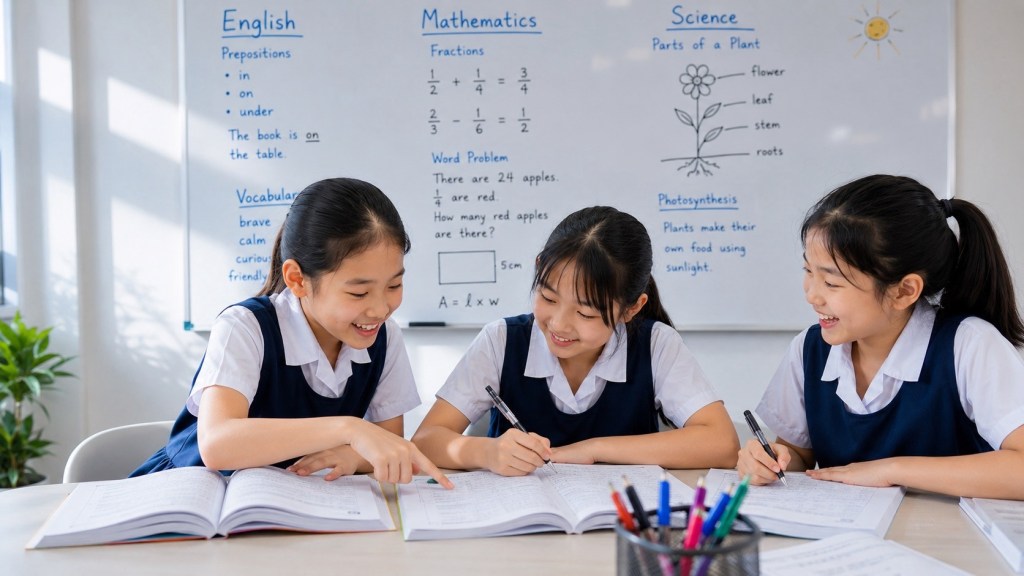
Sengkang Science Tuition for Primary 5 Students: Build the Foundation Before the PSLE Year
Primary 5 is often described as the first of the two PSLE preparation years. Yet the real importance of the year goes beyond completing more topics or attempting harder worksheets.
It is the year when Science begins to reveal whether a student can do more than remember information.
A child may know that plants need light. The harder question is whether the child can study an unfamiliar experiment, identify what changed, interpret the results and explain precisely how light affected the plant.
A child may remember the parts of a system. The examination may instead ask what happens when one part is blocked, removed or changed.
This shift—from knowing isolated facts to applying connected ideas—is why Primary 5 Science tuition should be carefully chosen. The right tuition does not simply add more work. It helps each student find the most effective route forward.
At eduKate Sengkang, our aim is to help children understand Science properly, communicate their reasoning clearly and enter Primary 6 with a foundation strong enough for serious PSLE preparation.
Why Primary 5 Science Feels Different
Science in the earlier primary years introduces children to the natural and physical world. They learn to observe, compare, classify and describe.
By Primary 5, the subject becomes more interconnected.
Students must recognise relationships between concepts, follow changes through a system, interpret experimental evidence and explain cause and effect. Topics can no longer be studied as separate chapters that disappear after the test. Earlier knowledge is repeatedly brought back and combined with new material.
The current Primary Science syllabus is organised around five broad themes: Diversity, Cycles, Systems, Energy and Interactions. These themes help students see Science as a connected body of ideas rather than a collection of unrelated facts. (Ministry of Education)
This is where some students begin to struggle.
They may have memorised the correct words without understanding how the ideas work together. They may recognise a familiar diagram but become uncertain when the same concept appears in a new setting. They may understand the answer internally but lack the language needed to express it accurately.
Primary 5 is the ideal time to correct these difficulties because there is still enough runway to rebuild weak foundations before the compressed pace of the Primary 6 year.
PSLE Science Is Not Only a Test of Memory
The latest published PSLE Science specifications assess two major areas:
- Knowledge and understanding of scientific facts, concepts and principles.
- The application of knowledge and scientific inquiry.
Scientific inquiry includes making predictions, interpreting information, evaluating observations and methods, and communicating explanations with reasoning.
This distinction matters.
A student can read a textbook several times and still struggle in an examination because the paper does not always present knowledge in the same form in which it was learnt.
A familiar concept may be placed inside:
- an unfamiliar experiment;
- a graph or table;
- a comparison between two set-ups;
- a sequence of changes;
- a real-world situation;
- or a question requiring several ideas to be connected.
The latest published examination format, revised for 2026, consists of a 60-mark multiple-choice section and a 40-mark structured-question section, completed within one hour and forty-five minutes. (SEAB)
This means students need both range and depth. They must answer efficiently across many multiple-choice questions while preserving enough attention and precision for structured responses.
More practice can help, but only when the practice is correcting the right problem.
Why Capable Students Still Lose Science Marks
Many Primary 5 students who appear weak in Science are not necessarily weak thinkers.
Their marks may be falling because of one specific obstruction.
The child may:
- misunderstand one foundational concept;
- overlook a key word in the question;
- confuse the changed variable with the measured variable;
- describe the result without explaining its cause;
- use a correct scientific term in the wrong relationship;
- give an incomplete comparison;
- or rush past evidence presented in a diagram or table.
These are different problems. They should not all receive the same solution.
A student with a conceptual gap needs the idea rebuilt.
A student with weak question-reading habits needs a method for identifying what the question is truly testing.
A student who understands the concept but writes incomplete answers needs close correction of language and reasoning.
A student already scoring well needs more complex applications, not another stack of routine questions.
This is one of the most important reasons to choose tuition carefully. A useful Science lesson should not merely deliver material. It should observe how the student thinks and decide what the student needs next.
Different Students Need Different Routes
In a well-run Primary 5 Science class, students may be studying the same general topic without being pushed through exactly the same learning route.
The tutor watches for where each student becomes uncertain.
For one child, the next step may be returning to an earlier concept and rebuilding it with a clearer diagram or physical example.
For another, the next step may be learning how to turn observations into a complete scientific explanation.
For a stronger student, the next step may be an unfamiliar application that requires two or three concepts to be connected.
The destination remains strong Science performance. The route changes according to the learner.
For Students Who Are Falling Behind
A struggling student does not need Science to become larger and louder.
The child needs the subject to become clearer.
We begin by locating the earliest point of confusion. Sometimes the difficulty began in Primary 3 or Primary 4, when a basic concept was remembered for an examination but never fully understood. New knowledge was then placed on top of that uncertain foundation.
The repair process may include:
- revisiting prerequisite concepts;
- reducing a complicated question into smaller stages;
- using diagrams to make relationships visible;
- separating observations from explanations;
- teaching one reliable answering structure;
- and practising a smaller number of carefully selected questions.
The first objective is not to force the child through the entire syllabus at speed. It is to restore control.
Once the child can see why an answer works, Science becomes less threatening. Confidence improves because the student is no longer guessing blindly.
For Students in the Middle
Many Primary 5 students understand lessons reasonably well but produce uneven results.
They may perform strongly when a question resembles classroom examples, then lose marks when the context changes. Their knowledge exists, but it is not yet flexible.
For these students, tuition should strengthen transfer.
They learn to ask:
- What concept is hidden inside this question?
- What evidence has been provided?
- What changed between the two situations?
- What must remain constant for the comparison to be fair?
- What is the complete cause-and-effect chain?
- Which part of my answer directly addresses the question?
With repeated guided application, the student becomes less dependent on recognising a familiar worksheet pattern.
The goal is to produce a learner who can enter a new question calmly, identify its structure and construct an answer from first principles.
For Stronger Science Students
A student who is already doing well should not spend the year waiting for the rest of the class.
Strong students need wider questions.
They benefit from:
- less familiar experimental settings;
- questions connecting multiple topics;
- comparisons involving several variables;
- evaluation of experimental methods;
- alternative explanations;
- more efficient answer construction;
- and closer examination of why tempting answers are wrong.
The purpose is not simply to move ahead for the sake of speed.
It is to deepen scientific judgement.
A strong student should become more precise, more adaptable and more capable of explaining complex ideas simply. This prepares the child not only for a higher Science score, but also for the demands of secondary-school learning.
What Good Primary 5 Science Tuition Should Actually Teach
A complete tuition programme should develop several abilities together.
1. Conceptual Understanding
Students should know more than a definition.
They should understand the relationship between parts of a system, the direction of a process, the conditions needed for a change and the consequences when those conditions are altered.
A useful test of understanding is whether the student can explain the idea without copying the textbook.
2. Question Interpretation
Many mistakes begin before the student starts writing.
The child may answer what appears familiar rather than what was actually asked.
We train students to identify:
- the command word;
- the object being compared;
- the relevant evidence;
- the scientific concept involved;
- and the exact outcome that must be explained.
This short pause can prevent a large number of avoidable errors.
3. Evidence-Based Reasoning
Science answers should be supported by information from the question.
Students learn to refer to observations, measurements, diagrams, graphs and differences between experimental set-ups rather than offering a general fact that does not fully address the situation.
A good answer does not merely sound scientific. It shows how the evidence leads to the conclusion.
4. Clear Scientific Language
Structured questions reward precision.
Students need to distinguish between everyday language and scientific explanation. Words such as “more,” “faster,” “increase” or “decrease” are often insufficient unless the child also states what is changing, why it changes and what effect follows.
We help students form complete explanations without making their answers unnecessarily long.
5. Examination Control
Knowing Science is only part of performing well.
Students must also manage time, sustain attention, check answer options carefully and avoid spending too long on one difficult question.
These habits are developed gradually during Primary 5 so that Primary 6 does not become a sudden attempt to learn content, answering technique and examination control at the same time.
Why Three-Student Small Groups Work Well for Science
eduKate Sengkang conducts lessons in three-student small groups because Science requires close observation of the learning process.
A tutor needs to see more than the final answer.
We need to notice:
- where the student first misread the question;
- which scientific relationship was misunderstood;
- why a particular option seemed attractive;
- whether the child can explain the reasoning verbally;
- and whether the mistake is occasional or becoming habitual.
In a very large class, a student may copy corrections and appear to have understood. The misunderstanding can remain hidden until the next test.
In a three-student group, there is less room for uncertainty to disappear unnoticed.
Each child receives individual correction while still benefiting from the thinking of classmates. Students hear alternative explanations, compare approaches and learn that the same scientific idea can be examined from more than one direction.
The class remains active without becoming noisy.
There is enough interaction to stimulate thought and enough attention to protect accuracy.
A Lesson Should Change According to What the Tutor Sees
The best lesson plan is structured, but it should not be rigid.
Suppose three students are answering a question about an experiment.
The first student selects the wrong answer because a foundational concept is unclear. The tutor may pause and reconstruct that concept using a simpler example.
The second selects the correct answer but cannot explain why. The tutor may ask the student to identify the relevant evidence and complete the reasoning chain.
The third answers correctly and explains it well. The tutor may extend the question by changing one condition and asking the student to predict the new outcome.
All three students continue progressing, but their next tasks are different.
This is how tuition becomes more valuable than simply assigning identical worksheets.
The tutor is continuously deciding whether to repair, consolidate or extend.
What Progress Should Look Like During Primary 5
Improvement in Science is not always visible as an immediate jump in marks.
The earliest signs are often changes in behaviour.
A student begins to underline the correct information.
The child stops answering before reading the entire question.
Explanations become more complete.
Diagrams are interpreted with less hesitation.
Corrections are understood rather than copied.
Previously repeated mistakes begin to disappear.
These changes matter because they show that the student is gaining control over the subject.
As the year progresses, the aim is to move through three stages.
First: Stabilise
Weak concepts are repaired and careless routines are reduced.
The student understands what went wrong and has a reliable way to approach common question types.
Second: Strengthen
Knowledge becomes connected across topics.
The student can interpret unfamiliar presentations and explain scientific relationships with greater precision.
Third: Prepare for Primary 6
By the end of Primary 5, students should have organised notes, corrected misconceptions and developed a dependable answering process.
Primary 6 can then be used for consolidation, integration and examination preparation rather than emergency repair.
Signs That Your Child May Benefit from Primary 5 Science Tuition
Tuition may be useful when a child:
- remembers facts but cannot apply them;
- performs very differently from one paper to another;
- regularly loses marks in structured questions;
- gives vague or incomplete explanations;
- avoids difficult Science homework;
- repeats the same mistakes after correction;
- has gaps from earlier primary levels;
- or is already strong and needs greater challenge.
Parents do not need to wait for a major fall in results.
A gradual decline in confidence, increasing dependence on model answers or persistent difficulty explaining concepts can be enough to indicate that the present learning route is not working well.
Early intervention is often calmer than late intervention because there is more time to identify the real problem and correct it properly.
Why Choose eduKate Sengkang for Primary 5 Science Tuition?
Parents looking for Sengkang Science tuition are not simply looking for another place where their child can complete worksheets.
They are looking for clarity.
They want to know that someone is paying close attention to how their child learns, where the difficulty began and what should happen next.
At eduKate Sengkang, our Primary 5 Science tuition is designed around that responsibility.
We focus on:
- three-student small-group attention;
- careful diagnosis of misconceptions;
- syllabus-aligned conceptual teaching;
- structured answering techniques;
- close correction of written explanations;
- progressive PSLE preparation;
- and suitable extension for stronger learners.
We do not assume that every student needs to move at the same pace.
A child who needs repair is given a clearer and more manageable path.
A child who is ready to progress is shown how to connect and transfer knowledge.
A child who is already strong is given a wider field in which to think.
This allows tuition to remain supportive without becoming passive and challenging without becoming overwhelming.
Primary 5 Is the Year to Build, Not Panic
Primary 5 Science tuition should not make childhood feel like a continuous examination.
Its purpose is to create order before pressure increases.
When students understand the subject, homework becomes more manageable. Revision becomes more purposeful. Parents no longer need to repeatedly reteach topics at home. The child enters Primary 6 knowing that difficult questions can be approached systematically.
That confidence is earned through preparation.
It comes from understanding why an answer is correct, recognising how concepts connect and learning how to recover when a question initially appears unfamiliar.
The strongest preparation is rarely the loudest.
It is a steady sequence of accurate lessons, timely corrections and increasingly independent thinking.
Frequently Asked Questions About Sengkang Primary 5 Science Tuition
Is Primary 5 too early to begin PSLE Science preparation?
Primary 5 is an appropriate time to begin because students can strengthen their concepts and examination habits without the compressed schedule of the final PSLE year.
The focus should not be on endless full papers. It should be on building the knowledge, reasoning and communication skills that later PSLE practice will depend on.
Can tuition help a child who is already scoring well?
Yes.
A strong student may need less repetition and more unfamiliar application. Tuition can help the child improve precision, analyse more demanding experiments and connect concepts across topics.
The objective is to prevent the student from becoming comfortable only with familiar question patterns.
What if my child dislikes Science?
Dislike often grows from repeated confusion.
When lessons are too fast, answers seem arbitrary and corrections are not understood, a child may conclude that Science is simply difficult.
A calmer approach can change this. Once the student sees the structure behind the question and experiences small successes, interest often begins to return.
Is memorisation still necessary?
Students need a secure knowledge base, including correct scientific terms and key relationships.
However, memorisation alone is insufficient. Students must know when a fact is relevant, how it applies to the evidence and how to use it in a complete explanation.
Should we wait until Primary 6?
Waiting may be reasonable for a student who is progressing independently and demonstrating strong understanding.
For a child with persistent gaps, Primary 5 provides more time for careful repair. Entering Primary 6 with unresolved misconceptions can make revision considerably harder because new work, school assessments and PSLE preparation arrive together.
Sengkang Science Tuition That Helps Every Student Move Forward
Children do not all become better at Science in the same way.
Some need the subject slowed down until its structure becomes visible.
Some need their existing knowledge organised and strengthened.
Some need harder questions that open a wider route towards excellence.
The responsibility of a good tutor is to recognise which student is sitting in front of them and make the next lesson useful for that child.
At eduKate Sengkang, our Primary 5 Science tuition provides the close attention, structured teaching and careful progression needed to prepare students for Primary 6 and the PSLE journey ahead.
Less confusion. Better reasoning. Stronger Science.
Enquire about eduKate Sengkang Science Tuition for Primary 5 students and secure a place in our three-student small-group classes.
At eduKate Singapore, we understand the pivotal role that Primary 5 plays in your child’s preparation for the SEAB Primary School Leaving Examination (PSLE). The academic demands of Primary 5 set the foundation for PSLE success, particularly in Science, which requires not only memorization but a deep understanding of scientific principles and their application. Our Sengkang Science Tuition for Primary 5 students is specifically designed to strengthen core concepts, develop critical thinking, and prepare students for more advanced learning in Primary 6.
Why Choose Our Sengkang Science Tuition for Primary 5 Students?
1. Individualized Attention in Small Groups
At eduKate Singapore, we believe that every child learns differently. Our Primary 5 English small group tuition allows for a more personalized approach, where tutors can tailor lessons to meet the individual needs of each student. This ensures that your child receives the attention they require to grasp complex scientific concepts and overcome any challenges they may face.
2. Focus on Active Participation
A smaller class size fosters a more engaging and interactive learning environment. Students are encouraged to ask questions, participate in discussions, and collaborate with their peers. This active participation not only boosts their confidence but also deepens their understanding of scientific concepts through group problem-solving and critical thinking exercises.
3. Customized Lessons Aligned with the SEAB PSLE Science Syllabus
Our Primary 5 Science tuition program in Sengkang is meticulously aligned with the Ministry of Education’s (MOE) SEAB PSLE Science syllabus. We focus on the essential topics your child needs to master, such as Systems, Cycles, Energy, Interactions, and Diversity, ensuring that they build a solid foundation for their Primary 6 year.
Sengkang Science Tuition for Primary 5 Students: A Comprehensive Guide
Quick Summary for Parents
- What it is: Tailored tuition program for Primary 5 students in Sengkang, focusing on Science.
- Improving it: Continuous adaptation to individual learning styles, new teaching methods, and student feedback.
- How to Learn: Different approaches, including online tutorials, face-to-face lessons, and interactive sessions.
- How to Prepare: Tips on lesson planning, understanding the curriculum, and making learning fun.
- What Can Be Done: Parental involvement, use of modern technology, and fun learning activities.
- The Reasons: Understanding why science tuition is essential at the Primary 5 level in Sengkang.
What is Sengkang Science Tuition for Primary 5 Students?
Sengkang Science Tuition for Primary 5 Students is a specialized program designed to meet the learning needs of students in the Sengkang area. With a focus on the Singaporean MOE Primary 5 Science curriculum, this program offers personalized instruction from skilled teachers who understand the unique requirements of this critical learning stage.
Improving Sengkang Science Tuition
To further enhance the effectiveness of Sengkang Science Tuition for Primary 5 Students, several key areas can be focused on:
- Personalized Teaching Methodology: Utilizing various teaching strategies tailored to individual learning styles.
- Integration of Technology: Using educational apps and online resources to make learning more engaging.
- Regular Assessments: Periodic testing and feedback to gauge student progress and make necessary adjustments.
How to Learn: Various Approaches
Sengkang Science Tuition for Primary 5 Students offers multiple learning approaches to suit different needs:
- Traditional Face-to-Face Lessons: Personalized attention and real-time feedback.
- Online Tutorials: Flexible scheduling and learning from the comfort of home.
- Interactive Group Sessions: Collaborative learning to foster problem-solving and critical thinking skills.
How to Prepare: Tips for Success
Preparation is key to making the most of the Sengkang Science Tuition for Primary 5 Students program:
- Understanding the Curriculum: Familiarize yourself and your child with the syllabus and key concepts.
- Scheduling: Plan lessons in advance to avoid last-minute stress.
- Making Learning Fun: Incorporate games, experiments, and field trips to stimulate curiosity.
What Can Be Done: Enhancing the Learning Experience
There are several ways parents and educators can improve the overall experience of Sengkang Science Tuition for Primary 5 Students:
- Parental Involvement: Engage in your child’s learning process by discussing lessons and offering encouragement.
- Use of Modern Technology: Encourage the use of interactive apps and websites that complement the curriculum.
- Fun Learning Activities: Organize science-related outings and hands-on experiments to reinforce concepts.
The Reasons: Why Opt for Science Tuition in Sengkang
Science education is vital in today’s rapidly evolving world. Here’s why Sengkang Science Tuition for Primary 5 Students is essential:
- Strong Foundation: Builds a solid grounding in scientific principles.
- Critical Thinking Development: Encourages logical reasoning and problem-solving skills.
- Alignment with Future Trends: Prepares students for higher education and careers in STEM fields.
Links to Relevant International Websites
- NASA’s Educational Resources – For space-related experiments and information.
- National Geographic Kids – For a global perspective on science.
- BBC Bitesize Science – For interactive lessons and quizzes tailored to primary students.
Sengkang Science Tuition for Primary 5 Students offers a comprehensive and tailored approach to science education in the Sengkang region. Through continuous improvement, various learning methods, proper preparation, and engaging activities, this program promises to build a strong foundation in science for the students of tomorrow.

Additional Resources and Support: Sengkang Science Tuition for Primary 5 Students
Extracurricular Opportunities
Sengkang Science Tuition for Primary 5 Students doesn’t stop in the classroom. Explore these additional resources:
- Science Clubs and Competitions: Encourage participation in local science clubs and contests to foster healthy competition and collaboration.
- Educational Field Trips: Regular trips to science museums, botanical gardens, or observatories can add excitement to learning.
- Community Involvement: Collaboration with local scientists, researchers, and community leaders can provide real-world insights.
How Parents Can Help
Parents play an essential role in supporting Sengkang Science Tuition for Primary 5 Students. Here’s how:
- Open Communication with Tutors: Regular dialogue with tutors to understand progress and areas of improvement.
- Home Experiments: Simple experiments at home can reinforce learning. Safety always comes first!
- Encourage Curiosity: Foster a love for science by encouraging questions and seeking answers together.
Enhancing Collaboration between Schools and Tuition Centers
For a more holistic learning experience, collaboration between schools and Sengkang Science Tuition centers for Primary 5 Students is crucial:
- Alignment with School Curriculum: Ensuring tuition lessons align with school syllabi can provide a seamless learning experience.
- Regular Updates: Frequent communication between schools and tutors about academic progress and upcoming exams.
- Joint Activities: Organizing science fairs, workshops, and lectures can further enrich the student’s educational experience.
Leveraging Technology: Virtual Learning and Beyond
Technology is an integral part of Sengkang Science Tuition for Primary 5 Students:
- Online Learning Platforms: Utilize platforms like Khan Academy for supplementary video lessons and quizzes.
- Virtual Laboratories: Virtual labs like PhET Interactive Simulations allow students to conduct experiments safely online.
- Educational Apps: Apps like DragonBox Elements make learning about scientific principles fun.
Considering Special Needs and Accessibility
Sengkang Science Tuition for Primary 5 Students must also cater to diverse learning needs:
- Special Education Support: Tutors trained in special education can assist students with different learning abilities.
- Accessible Learning Materials: Providing materials in various formats ensures that all students can participate fully.
Monitoring and Evaluation: Keeping Track of Progress
Continuous assessment of Sengkang Science Tuition for Primary 5 Students ensures effectiveness:
- Regular Assessments: Both formal exams and informal assessments can monitor student progress.
- Parent-Tutor Meetings: Scheduled meetings between parents and tutors to discuss performance and areas for improvement.
- Feedback Loops: Encourage students to provide feedback on their learning experience, and use this feedback to improve the program continually.
Primary 5 Science Tuition Program Highlights
Our Sengkang Primary 5 Science tuition aims to provide students with a comprehensive understanding of scientific concepts while preparing them for the challenges of the PSLE. Below are some of the key features of our program:
Comprehensive Syllabus Coverage
- Systems: A detailed exploration of the human body systems (digestive, respiratory, and circulatory), plant systems, and electrical systems. Students will learn about how these systems function and interact within both human and environmental contexts.
- Cycles: Understanding the water cycle, life cycles of plants and animals, and the process of recycling in nature is a core component of the syllabus. We teach students to connect these concepts to the broader environmental system.
- Energy: From heat and light to electrical energy, we teach students the fundamentals of energy transfer, conservation, and real-world applications.
- Interactions: Students learn how forces like magnetism, gravity, and friction work and how they affect the world around us. This lays the groundwork for understanding cause-and-effect relationships in scientific phenomena.
- Diversity: We cover the wide variety of living organisms and materials, focusing on classification, characteristics, and how these different entities interact with their environments.
Expert Tutors with Hands-On Learning Approach
At eduKate Singapore, we believe in making Science engaging and relatable. Our tutors are highly qualified, with extensive experience in teaching the SEAB Science syllabus. They employ hands-on experiments, visual aids, and real-life examples to simplify complex concepts, ensuring students fully grasp the material. Through interactive lessons, students learn to connect textbook knowledge with the world around them.
Key Features of Our Science Tuition Program for Primary 5 Students
1. Answering Techniques for Maximum Marks
Our tuition program equips students with the right techniques to answer both structured and open-ended questions effectively. We teach students to understand what examiners are looking for, helping them craft precise and accurate answers that cover key points required in PSLE-style questions.
2. Time Management Skills
Primary 5 students often struggle to manage their time during exams. Our tutors incorporate timed practices and mock exams to help students learn how to pace themselves, ensuring they complete all sections of the exam efficiently.
3. Regular Exposure to PSLE-Style Questions
Our tuition program includes regular exposure to past-year PSLE questions and exam papers. This helps students familiarize themselves with the exam format, common question types, and how to approach challenging problems.
4. Development of Scientific Process Skills
In addition to content mastery, our Primary 5 Science tuition emphasizes process skills essential for PSLE success. Students will develop competencies such as:
- Observing: Making accurate observations and recording findings.
- Classifying: Learning to categorize objects based on characteristics.
- Inferring: Drawing logical conclusions from observations and data.
- Hypothesizing: Formulating hypotheses and testing them through experiments.
- Predicting: Anticipating outcomes based on current knowledge.
These skills are critical for tackling open-ended questions that require higher-order thinking.
Challenges Faced by Primary 5 Students and How We Help
As Primary 5 students transition to more advanced topics in Science, they often face several challenges. Our Sengkang Science tuition is designed to help students overcome these obstacles:
1. Understanding Complex Concepts
- Challenge: Primary 5 introduces more difficult scientific topics, including human body systems, energy forms, and environmental interactions, which require abstract thinking and application skills.
- How We Help: Tutors use simplified analogies, diagrams, and hands-on experiments to break down complex concepts, making them easier to understand and retain.
2. Applying Knowledge in Exam Situations
- Challenge: The PSLE exam focuses heavily on the application of scientific knowledge, especially in open-ended questions that require students to think critically.
- How We Help: We provide targeted practice with real-world applications, encouraging students to apply their knowledge in various contexts. This prepares them for the higher-order thinking required in the PSLE exam.
3. Time Management During Exams
- Challenge: Many Primary 5 students struggle with completing their exams on time, especially when tackling both structured and open-ended sections.
- How We Help: Our program includes timed mock exams that help students practice time management and develop strategies to efficiently allocate time between different question types.
4. Building Scientific Vocabulary and Answer Precision
- Challenge: Using the correct scientific terminology in open-ended questions is critical for scoring well, but students often find this difficult.
- How We Help: Our tutors emphasize the importance of precise language and train students to use the right scientific terms in their answers. We also provide model answers to demonstrate how to structure responses effectively.
Teaching Methodology: How We Support Primary 5 Students
At eduKate Singapore, we adopt a comprehensive teaching methodology that ensures students not only understand scientific concepts but can also apply them effectively in exams and real-world scenarios.
1. Inquiry-Based Learning
Our inquiry-based approach encourages students to ask questions, conduct experiments, and explore concepts independently. This method develops critical thinking and analytical skills that are essential for success in Science.
2. Hands-On Learning
Science is best understood through experience. We incorporate hands-on experiments and practical activities in our lessons to bring scientific concepts to life. This not only enhances understanding but also helps students retain knowledge better.
3. Interactive Lessons
Our lessons are designed to be engaging and interactive, using multimedia tools, visual aids, and group activities to make learning more enjoyable. Students participate actively in lessons, which fosters a deeper interest in the subject.
Extra Support for Our Students
- Homework Assistance: We offer guidance on school assignments, helping students reinforce what they have learned in class.
- Regular Parent Updates: We keep parents informed about their child’s progress through regular updates, ensuring they are aware of areas where improvement is needed.
- Additional Learning Materials: Students have access to extra worksheets, notes, and resources to support their revision and practice at home.
Prepare Your Child for PSLE Success with Sengkang Science Tuition
Our Sengkang Science Tuition for Primary 5 Students offers a holistic approach to mastering the PSLE Science syllabus. With a focus on personalized teaching, hands-on learning, and strategic exam preparation, we help students overcome challenges and build the confidence they need to excel in their PSLE Science exams.
Contact Us Today
Ready to give your child the support they need for PSLE Science? Contact us to learn more or to book a consultation:
- Phone: +65 82226327
- Email: admin@edukatesg.com
- Website: edukatesingapore.com
At eduKate Singapore, we are committed to delivering high-quality education that prepares students not just for their exams, but for lifelong learning. Join us and set your child on the path to PSLE Science success!
Conclusion: A Brighter Future through Science Education
Sengkang Science Tuition for Primary 5 Students represents a holistic approach to primary science education in the Sengkang region. With various learning approaches, collaboration with schools, integration of modern technology, considerations for special needs, and continuous monitoring, this program promises to build a strong foundation in science. The involvement of parents, community, and educators ensures that Primary 5 students in Sengkang will be well-prepared for their future endeavors in the world of science.
Explore More
If you’re interested in learning more about Sengkang Science Tuition for Primary 5 Students or have any inquiries, please feel free to contact us. Together, we can ignite the passion for science in our children and shape the scientists, engineers, and thinkers of tomorrow.
