
eduKate Sengkang · PRIMARY SCIENCE · SEE → RELATE → MODEL → TEST → EXPLAIN → TRANSFER
Primary Science Tuition Sengkang
The P3–P6 developmental map: from seeing what happened to rebuilding why it happened.
Primary Science tuition should not make a child better at memorising our answers. It should make the child better at looking at evidence, rebuilding the scientific relationship and explaining it when the question changes shape.
The 50-Second Answer
Primary Science changes from Primary 3 to Primary 6, but the deeper learning job stays connected.
P3 Observe → P4 Relate → P5 Systems → P6 Reconstruct
A strong learner gradually becomes able to notice what matters, connect cause and effect, track variables and interacting systems, select evidence, rebuild a mechanism and explain only what the evidence supports.
If a child can do a familiar worksheet but becomes lost when the diagram, experiment, organism or wording changes, the problem is often not “more revision”. It is that the Science has not yet become portable.
A Cold Bottle on the Table
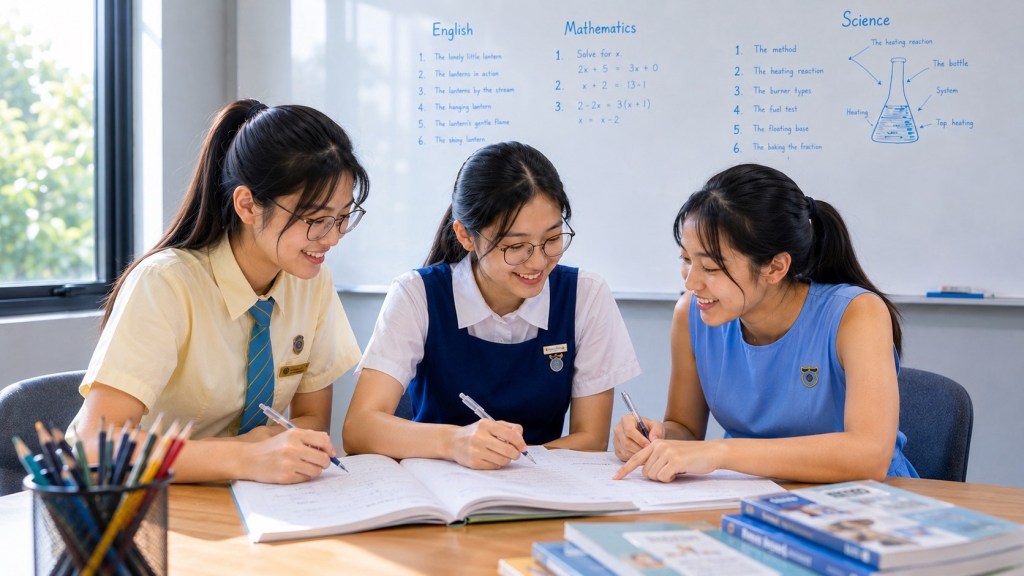
In this classroom scene, Alicia joins Tricia and Kai Kai at the Science table in Sengkang. Between them is a cold bottle taken from the refrigerator.
After a few minutes, small droplets appear on the outside.
Alicia looks at it first.
“The bottle is leaking.”
Tricia has seen a question like this before.
“Condensation.”
Kai Kai looks from the droplets to the bottle.
“How do we know?”
All three responses are useful because they expose different stages of scientific thinking.
Alicia has an explanation, but it is an inference that still needs evidence. Tricia has the correct scientific word, but the word alone does not show whether she can reconstruct the mechanism. Kai Kai has asked the question that Science needs next: what observations or comparison would let us decide?
Science tuition becomes useful when it can see the difference between a guess, a keyword and a defensible explanation.
Why Three Students Can Be So Revealing in Science
The value of a three-student class is not simply “more attention”. Science reasoning is often invisible until a child has to say what they think.
The same bottle produced three different starting points. A tutor can now ask each learner a different next question.
For Alicia
“What did you actually observe that shows the water came through the bottle?”
For Tricia
“Good word. Now explain where the water came from and why it became liquid there.”
For Kai Kai
“What comparison could help us decide between leaking and condensation?”
Now the group is not doing three identical worksheets. It is doing three precise pieces of scientific learning around one shared phenomenon.
That is why the tutor has to hear the reasoning, not only mark the final answer.
What Primary Science Tuition Is Actually For
Some students need to catch up. Some need to keep up. Some are already strong and need the Science to travel farther.
Catch Up
Find the first weak link: observation, concept, vocabulary, relationship, variable, evidence, explanation or question reading. Repair the earliest useful failure instead of adding random volume.
Keep Up
Stabilise current concepts, models and scientific language so new topics can connect to something dependable rather than creating another fragile layer.
Move Ahead
Change the surface, combine concepts, ask for stronger evidence, introduce unfamiliar representations and reduce prompting so the learner carries more of the scientific route.
The right workload follows the learner state. “More Science” is not automatically the same thing as better Science.
The Same Bottle, Four Different Science Jobs
The P3→P6 progression becomes easier to understand if we keep the phenomenon and change what we expect from the learner.
P3: What do you see?
P4: What relationship explains it?
P5: What variables and system conditions matter?
P6: Can you reconstruct the Science when the object and question are unfamiliar?
This is why the same study method should not simply be repeated harder every year. The shape of the reasoning changes.
P3 → P6: What Should Grow?
Primary 3 · Observe
Science begins by making ordinary noticing more disciplined. What changed? What stayed the same? Which feature is relevant? What was actually observed, and what has already been inferred?
With the cold bottle, P3 Science can begin by separating “there are droplets outside” from “the bottle leaked”.
Primary 4 · Relate
Facts have to connect. Structure to function. Condition to effect. Observation to evidence. The child should increasingly explain relationships rather than list correct statements.
With the bottle, the word “condensation” must become a relationship between the cold surface, surrounding water vapour and the formation of liquid droplets.
Primary 5 · Systems
Several conditions may now matter at the same time. Variables, controls, flows, interacting parts and evidence have to stay attached to the correct causal chain.
With the bottle, P5 can ask how to design a fair comparison: cold bottle versus room-temperature bottle, same environment, same time, observe the outside surfaces.
Primary 6 · Reconstruct
Now the learner must enter an unfamiliar setup, identify the scientific world, extract the relevant evidence, choose the concept, rebuild the mechanism and communicate it under examination conditions.
If the bottle becomes a chilled metal can, a cold window or another unfamiliar surface, can the learner still recognise and explain the same Science?
Where Did the Science Actually Break?
“Weak in Science” is too compressed to tell us what to teach next. Two children can lose the same mark for completely different reasons.
Observation
The important detail, label, comparison or change was never noticed.
Concept / Vocabulary
The scientific idea or word is missing, vague or attached to the wrong meaning.
Relationship / Model
The facts are known, but the child cannot connect condition → mechanism → result.
Variables / Evidence
The child cannot identify what changed, what stayed controlled, what was measured or which evidence supports the claim.
Explanation / Language
The Science is partly understood but the causal bridge does not survive into the written answer.
Transfer / Execution
The child can do the familiar form but cannot recognise the Science in a changed or mixed question—or cannot deploy it reliably under paper conditions.
The 8 Capabilities Behind Strong Science page owns the deeper diagnostic map. This page keeps the parent-facing question simpler: where did the scientific route first become unreliable?
The Keyword Is Not the Science
Tricia saying “condensation” is not wrong. Scientific vocabulary matters. Facts matter. Definitions matter.
The problem begins when a stored sentence replaces the model.
A child can memorise “condensation is the change of state from gas to liquid” and still fail the bottle question if the child cannot identify where the water vapour came from, what was cooled or why droplets appeared on the outside surface.
Plain idea → correct Science word → evidence → mechanism → precise answer.
This is the same principle used across the wider eduKate Primary Science teaching course: make the world understandable first, then attach accurate scientific language to a model the learner can actually use.
Change the Representation and See What Survives
A familiar worksheet can make learning look stronger than it is because the page itself supplies cues.
Useful Science practice gradually removes those cues.
- Turn prose into a diagram.
- Turn a diagram into an explanation.
- Read a table without being told the relationship.
- Read a graph as evidence rather than decoration.
- Change the organism or object while preserving the same mechanism.
- Reverse the direction of the question.
- Remove the chapter heading.
- Return days later and ask again.
- Mix topics so the learner has to select rather than imitate.
This is why eduKate’s teaching material treats diagrams, models, experiments and verbal scenarios as different representations of scientific relationships rather than separate tricks.
If the relationship survives the representation change, the Science is becoming transferable.
Experiments Are Evidence, Not Entertainment
Hands-on Science can be wonderful. But an activity is not automatically good teaching because something moved, fizzed, floated or lit up.
A useful experiment should make a scientific relationship testable:
Question → changed condition → observation or measurement → comparison → explanation → conclusion.
If Alicia, Tricia and Kai Kai remember that they used two bottles but cannot tell us what was changed, what was controlled or which observation challenged the leaking explanation, the activity was memorable without being scientifically complete.
The point is not to do more experiments. It is to make evidence do more work.
What Parents Can Watch Without Re-Teaching Science at Home
Parents do not need to become the second Science tutor.
- Can the child say what was actually observed before explaining it?
- Can the child explain a Science word instead of only defining it?
- Can the child identify what changed and what was kept the same in an investigation?
- Can the child point to the evidence that supports an answer?
- Can the child trace the missing middle between cause and result?
- Can the child read a diagram or graph before asking which chapter it belongs to?
- Do corrected misconceptions stay corrected later?
- Does a changed context cause total confusion, or can the child recognise the familiar scientific relationship?
- Are open-ended answers becoming more complete with fewer prompts?
These observations tell us much more than “we revised for two hours”. They show whether the learning is becoming usable.
If the child can explain the Science orally but repeatedly loses it when reading or writing the question, the problem may sit partly at the Science–language interface rather than in the concept alone. That distinction matters because the right repair may not be another content worksheet.
Choose the next useful guide
Do not open everything. Choose the smallest route that answers the question you actually have.
My child needs a simple way in
Primary Science for Students
See it → understand it → name it → explain it → test it → use it somewhere new.
I want the full teaching course
Primary Science Specialist Library
Choose level → syllabus topic → lesson → teach, check, repair and continue.
I want the developmental map
Primary Science Hub
P1–P2 Discovery → P3 Observe → P4 Relate → P5 Systems → P6 Reconstruct → PSLE Perform.
I need a diagnosis
What a Science Tutor Should Be Able to See
Locate the first unstable step instead of prescribing “more Science”.
The PSLE paper is the problem
Use the Paper to Find the Failure
Paper → classify failure → isolate capability → repair → retest → recombine.
The question goes beyond Primary Science
Science Hub
Continue by level, big idea or scientific practice without forcing advanced Science back into the Primary curriculum.
For Secondary and post-secondary Science, continue to Secondary & Post-Secondary Science. This page keeps its P3–P6 Primary Science tuition job.
Back to the Bottle
At the end of the lesson, the droplets are still on the outside of the bottle.
But Alicia is no longer satisfied with “it leaked”. She asks what evidence would support that claim.
Tricia still knows the word “condensation”, but now she can connect the word to the mechanism instead of using it as the whole answer.
Kai Kai’s “How do we know?” has become a scientific route: compare conditions, inspect the evidence, test the explanation and change it if the world disagrees.
Primary Science should leave the learner increasingly able to reconstruct the world from evidence.
That is why the route is useful:
Observe accurately → relate carefully → model the system → test with evidence → explain precisely → transfer to a changed world.
The final goal is not for the learner to remember exactly what the tutor said about one bottle. It is for the learner to meet the next unfamiliar scientific situation and know how to find out what is happening.
