
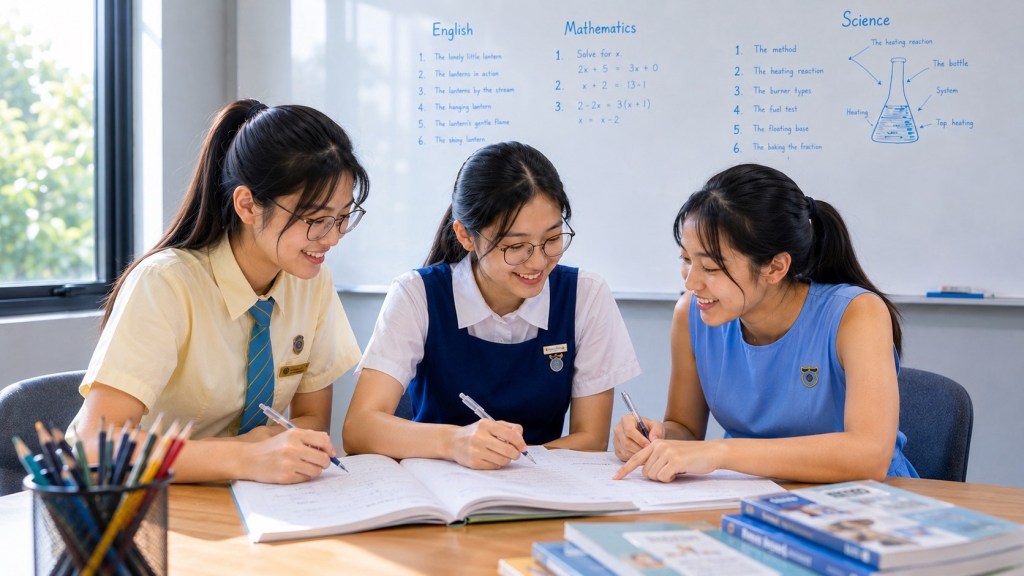
Small Group Tutorials

Here to help students catch up, keep up, and move ahead. Book a consultation here.

Direct WhatsApp

Sengkang | Science Tutor – Science Tuition for Sengkang 

Sengkang Science Tutor – Science Tuition for Sengkang Students

Clearer Concepts. Better Answers. A Stronger Path Through Science.

A student may remember the facts in a Science chapter and still struggle to answer the questions.

They may know that plants need light. They may understand that forces can change the movement of an object. They may remember the parts of a digestive system, the properties of materials or the conditions needed for an electrical circuit to work.

Yet when the same concept appears inside an unfamiliar diagram, experiment, graph or real-world situation, the answer becomes uncertain.

This is where good Science tuition becomes valuable.

At eduKate Sengkang, Science tuition is not simply another round of worksheets. Our tutor first works out where the student’s understanding begins to weaken. The lesson is then adjusted so that the student receives the explanation, practice and correction needed for the next stage of progress.

A student who is struggling needs a clearer route back into the subject.

A student who is coping needs stronger connections between topics.

A student who is already doing well needs broader and more demanding questions that develop deeper scientific reasoning.

The destination may be the same examination, but not every student should be taught through exactly the same route.


Why Science Becomes Difficult Even for Capable Students

Science appears straightforward when a chapter is first introduced. There are keywords, diagrams, definitions and examples to learn.

The difficulty increases when students must use that knowledge.

A school examination may ask the student to:

  • identify the scientific concept hidden inside an unfamiliar situation;
  • compare two experimental conditions;
  • interpret a graph or table;
  • explain a cause-and-effect relationship;
  • predict what will happen when one variable changes;
  • evaluate whether an experiment is fair;
  • connect information from several parts of a diagram; or
  • write an answer using precise scientific language.

This means that Science is not only a memory subject.

It is a subject of knowledge, observation, interpretation, application and explanation.

The current PSLE Science assessment reflects this clearly. From the 2026 examination, students are assessed on both knowledge with understanding and the application of knowledge through scientific inquiry. This includes making predictions, interpreting information, evaluating methods and communicating explanations and reasoning.

A student can therefore study hard and still lose marks when one of the following links is weak:

The concept is incomplete

The student remembers a phrase but does not understand the mechanism behind it.

The question is misunderstood

The student answers the topic generally but misses what the question is specifically asking.

The reasoning is not connected

The student knows two relevant facts but cannot connect them into a complete explanation.

The scientific language is too vague

Words such as “more,” “less,” “better,” “stronger” or “it helps” are used without stating exactly what changes and why.

The student cannot transfer knowledge

A familiar worksheet can be completed, but the same concept becomes difficult when the diagram or context changes.

Corrections are not retained

The student understands an error when it is explained but repeats the same mistake several weeks later.

Effective Science tuition must address these problems separately. Giving every student more questions without identifying the weak link can create more work without creating more progress.


What a Good Sengkang Science Tutor Should Do

A good Science tutor should not only explain the correct answer.

The tutor should discover why the student did not reach it independently.

Two students can write the same wrong answer for entirely different reasons.

One may not know the concept.

Another may know the concept but misread the graph.

A third may understand the graph but use imprecise language.

A fourth may rush because the question looks familiar.

The correction must match the cause.

At eduKate Sengkang, our Science tutor pays attention to the student’s working process, not only the final mark. This allows lessons to respond to the student more precisely.

The aim is to help each learner move through three important stages:

  1. Understand the scientific idea clearly
  2. Recognise when and where it should be used
  3. Express the reasoning accurately under examination conditions

When these stages work together, students become less dependent on memorised model answers and more capable of handling unfamiliar questions.


Different Students Need Different Routes

A small Science class should not behave like a large lecture compressed into a smaller room.

Its real advantage is that the tutor can see what each student needs next.

For a student who is struggling

The immediate aim is not to rush into more difficult papers.

The tutor may return to an earlier concept, rebuild essential vocabulary, use diagrams to make an invisible process visible and divide a complicated question into smaller reasoning steps.

The student may need to learn how to identify:

  • what changed;
  • what remained the same;
  • what was observed;
  • what caused the observation;
  • which concept explains it; and
  • how to state the conclusion properly.

This creates a more secure route through the subject.

The work becomes manageable because the student is no longer being asked to leap across missing foundations.

For a student who is around the class average

The priority is usually connection and consistency.

The student may understand individual topics but struggle when questions combine ideas from different chapters. Tuition helps the learner organise knowledge into a connected structure rather than a collection of separate notes.

The tutor can introduce questions that require the student to:

  • compare related concepts;
  • identify common traps;
  • connect evidence to conclusions;
  • explain changes across several stages;
  • distinguish observation from inference; and
  • check whether every part of the question has been answered.

The student gradually becomes more reliable across different paper styles.

For a student who is already strong

Strong students do not benefit from endlessly repeating work they can already complete.

They need wider intellectual space.

Their lessons should include more unfamiliar applications, deeper comparisons, experimental evaluation and questions with several possible approaches. They should be challenged to defend their reasoning, identify hidden assumptions and improve an answer that is already technically correct.

This is how a good student becomes a more thoughtful and adaptable Science student.

The tutor is not merely pushing the student to finish the syllabus faster. The tutor is opening a wider route through the subject.


Primary Science Tuition in Sengkang

Primary Science begins formally in Primary 3, but the habits built during the first two years of the subject can influence the entire journey towards the PSLE.

Students need time to become comfortable with scientific vocabulary, diagrams, relationships, experiments and open-ended answers.

The current Primary Science syllabus is intended to provide a foundation for later scientific studies while developing the skills and attitudes associated with scientific inquiry. (Ministry of Education)

Our Primary Science tuition for Sengkang students therefore develops both content knowledge and the ability to think scientifically.


Primary 3 Science Tuition: Building the First Framework

Primary 3 is a new beginning.

Students encounter a subject that asks them to observe closely, classify accurately and explain natural phenomena using specific concepts.

At this stage, a child may understand the lesson conversationally but find written Science questions unexpectedly difficult. The wording feels different from ordinary speech, and answers must become more precise.

Primary 3 Science tuition focuses on helping students:

  • understand new concepts rather than recite definitions;
  • learn essential scientific vocabulary;
  • read diagrams and labelled illustrations;
  • distinguish living and non-living things;
  • compare materials and their properties;
  • identify patterns and relationships;
  • answer in complete, relevant statements; and
  • develop orderly study habits from the beginning.

The aim is to make Science feel logical and approachable before confusion accumulates.


Primary 4 Science Tuition: Strengthening Connections

Primary 4 is often where differences in understanding become more visible.

The syllabus grows, questions become less direct and students are increasingly expected to connect information from several sources.

A child may perform well in topical exercises but become inconsistent during weighted assessments because the examination mixes chapters, question types and unfamiliar situations.

Primary 4 Science tuition helps students move beyond chapter-by-chapter recall.

Lessons can focus on:

  • connecting related concepts;
  • interpreting tables and diagrams;
  • identifying variables in simple investigations;
  • explaining observations using evidence;
  • recognising common misconceptions;
  • improving open-ended answers; and
  • building a correction routine that prevents repeated errors.

This is an important year for stabilising the foundation before the demands of Primary 5.


Primary 5 Science Tuition: The First of Two PSLE Preparation Years

Primary 5 is a significant transition.

Students encounter more content, more complex systems and questions that require several reasoning steps. Their school papers may also begin to resemble PSLE-style assessment more closely.

The difficulty is not simply that there is more to remember. Students must learn how ideas interact.

They may need to follow a process across several stages, explain what happens when one condition changes or compare two experimental arrangements before drawing a conclusion.

Primary 5 Science tuition should therefore strengthen:

  • conceptual understanding;
  • topic-to-topic connections;
  • experimental reasoning;
  • data interpretation;
  • answering techniques;
  • time management;
  • review of accumulated topics; and
  • confidence with unfamiliar applications.

A well-planned Primary 5 year gives the student sufficient time to improve without turning Primary 6 into a last-minute repair exercise.


Primary 6 Science Tuition: Precision for the PSLE

Primary 6 requires students to bring several years of learning together.

By this stage, effective preparation should include more than repeated completion of examination papers. Practice is useful, but each paper must reveal something about the student’s current performance.

The tutor should be able to see:

  • which topics remain insecure;
  • which question structures cause hesitation;
  • whether the student reads all the information provided;
  • whether mistakes arise from knowledge, interpretation or expression;
  • how much time is being spent on each section; and
  • whether corrections are improving future performance.

From 2026, the PSLE Science examination consists of one written paper lasting 1 hour and 45 minutes. Booklet A contains 30 multiple-choice questions worth 60 marks, while Booklet B contains 10 to 11 structured questions worth 40 marks.

This format rewards two different forms of control.

For multiple-choice questions, students need accuracy, efficient reasoning and the discipline to examine every option.

For structured questions, they need clear scientific explanations, relevant evidence and precise cause-and-effect language.

Our PSLE Science tuition for Sengkang students works on both.

Booklet A preparation

Students learn to:

  • identify the tested concept quickly;
  • eliminate options for scientific reasons;
  • detect qualifiers and changes in conditions;
  • avoid answering from surface familiarity;
  • interpret diagrams before choosing; and
  • manage time without careless rushing.

Booklet B preparation

Students learn to:

  • identify the exact command in the question;
  • select the relevant scientific concept;
  • connect evidence to explanation;
  • state the direction of change clearly;
  • use precise terminology;
  • complete every required reasoning step; and
  • check that the answer explains rather than merely describes.

The goal is not to produce rigid, memorised paragraphs.

It is to help the student construct a correct answer from scientific understanding.


Secondary Science Tuition for Sengkang Students

The transition from Primary Science to Secondary Science is substantial.

Students begin moving more distinctly into Biology, Chemistry and Physics. Concepts become more specialised, measurements become more important and explanations require greater technical accuracy.

Under Full Subject-Based Banding, students may take subjects at different G1, G2 or G3 levels according to their strengths and learning needs. The former Express, Normal (Academic) and Normal (Technical) streams have been replaced for cohorts entering Secondary 1 from 2024. (Ministry of Education)

This makes a strong lower-secondary foundation particularly important.

Students should not think of Secondary 1 and Secondary 2 Science as years that can simply be passed before serious preparation begins. These years introduce the language, laboratory habits and conceptual structures needed for upper-secondary Science.

Lower Secondary Science tuition can help students:

  • adjust to faster lesson pacing;
  • understand laboratory measurements and procedures;
  • connect Primary Science knowledge to Biology, Chemistry and Physics;
  • interpret graphs and experimental data;
  • learn formulas without separating them from concepts;
  • write more technical explanations;
  • revise across a larger body of content; and
  • prepare for later subject choices.

The G2 and G3 Lower Secondary Science syllabus is organised around themes aligned with Primary Science while extending learning into the disciplines of Biology, Chemistry and Physics. (Ministry of Education)

This continuity matters. A tutor can help the student see that Secondary Science is not an entirely unrelated subject. It is a deeper and more precise continuation of earlier ideas.


Preparing for Upper Secondary Science and the SEC Years

Singapore’s first Singapore-Cambridge Secondary Education Certificate examinations will begin in 2027 for the first Full Subject-Based Banding cohort.

At G3, the published 2027 SEC offerings include individual Physics, Chemistry and Biology subjects, as well as combined Science options such as Physics and Chemistry, Physics and Biology, and Chemistry and Biology. (SEAB)

Students approaching upper secondary therefore need both present competence and future readiness.

A good Science tutor helps the student develop the habits required for the next level:

  • accurate use of terminology;
  • disciplined presentation of working;
  • careful reading of experimental procedures;
  • interpretation of graphs and numerical data;
  • connection between theory and observation;
  • cumulative revision; and
  • independent correction.

The strongest preparation is not created by predicting every future question.

It is created by giving the student a dependable way to think.


Why Three-Student Science Tuition Works

eduKate Sengkang uses small, three-student classes because Science learning requires visibility.

The tutor needs to hear how students explain an idea, see where their reasoning changes direction and identify the exact line where an answer becomes incomplete.

In a three-student class, there is enough space for individual attention while retaining the benefits of learning beside others.

The tutor can check understanding immediately

A nod does not always mean that a student understands.

The tutor can ask the learner to explain the concept in their own words, apply it to a new situation or draw the relationship being described.

Misconceptions are corrected before they settle

Science misconceptions can remain hidden for a long time because a student may still obtain some correct answers.

Frequent interaction allows the tutor to detect these misunderstandings early.

Students see alternative ways of thinking

One student may notice a pattern that another has missed. One may explain a concept clearly but overlook an experimental control.

Carefully guided discussion allows students to learn from these differences without turning the lesson into an uncontrolled group activity.

The pace can remain responsive

When a foundation is weak, the tutor can pause and rebuild it.

When the students are ready, the lesson can move into deeper application instead of repeating familiar work.

Every student must participate

It is difficult to disappear quietly inside a group of three.

Students are expected to answer, explain, compare and correct. This builds confidence while making their actual understanding visible.


What Happens During a Science Tuition Lesson?

A well-structured lesson should move the student from recognition to independent use.

While lessons vary according to the topic and level, a productive session may include the following stages.

1. Retrieval

Students revisit earlier knowledge without immediately referring to notes.

This shows what has been retained and what needs reinforcement.

2. Concept clarification

The tutor explains the central scientific relationship using diagrams, examples, demonstrations or comparisons.

The emphasis is on why the process occurs, not only what happens.

3. Guided application

Students attempt questions with the tutor prompting them to identify clues, variables, evidence and relevant concepts.

4. Independent practice

Students complete questions without step-by-step support so that the tutor can assess genuine understanding.

5. Precise correction

Errors are classified.

Was the problem a missing fact, a misunderstood diagram, an incomplete link, vague wording or careless execution?

6. Extension

Students apply the same concept in a different context. Stronger learners may receive questions involving additional variables, unfamiliar data or experimental evaluation.

7. Review

The lesson closes by identifying what the student should remember, what should be practised and which mistake must not be repeated.

This creates continuity between lessons instead of treating every worksheet as an isolated task.


Learning to Answer Open-Ended Science Questions

Open-ended questions are a common source of frustration.

Parents may hear that the child “understands the topic” but still loses marks because the answer is incomplete.

A strong answer usually needs four elements:

The relevant condition

What changed or what is different between the situations?

The scientific process or concept

Which idea explains what happened?

The direction of the effect

Did something increase, decrease, move faster, lose heat, receive less light or experience a greater force?

The resulting observation

What was eventually seen or measured?

Students often omit one of these links.

For example, they may state an observation without explaining the cause. They may mention a concept without connecting it to the information in the question. They may write a memorised sentence that is scientifically true but irrelevant to the situation presented.

Our Science tutor teaches students to build explanations deliberately.

The answer should not merely contain keywords. The keywords must be connected in the correct scientific relationship.


Learning From Mistakes Properly

Correction is one of the most valuable parts of tuition, but only when it changes future performance.

Simply copying the model answer can create the appearance of learning. The student may understand the correction at that moment but remain unable to produce it independently.

A stronger correction process asks:

  1. What did the question require?
  2. What did the student think it required?
  3. Where did the reasoning begin to move away from the correct path?
  4. Which concept or answering skill was missing?
  5. How would the student recognise a similar problem next time?
  6. Can the student now answer a parallel question without help?

This turns an error into useful information.

Over time, the student begins to recognise personal patterns:

  • rushing through graphs;
  • ignoring units;
  • failing to compare both conditions;
  • giving descriptions instead of explanations;
  • using everyday language where scientific precision is needed; or
  • changing a correct answer after unnecessary doubt.

Progress becomes more stable when these patterns are identified and corrected consistently.


Signs That Your Child May Benefit From Science Tuition

A student does not need to be failing before additional guidance becomes useful.

Science tuition may help when your child:

  • studies regularly but receives inconsistent marks;
  • remembers facts but cannot answer application questions;
  • leaves structured questions partially completed;
  • gives vague explanations;
  • struggles to interpret experiments, tables or graphs;
  • repeatedly makes the same mistakes;
  • depends heavily on model answers;
  • loses confidence when a question looks unfamiliar;
  • completes work too slowly;
  • rushes through multiple-choice questions;
  • has gaps from earlier Primary Science topics; or
  • needs greater challenge than routine school exercises provide.

The purpose of tuition should be clear.

For some students, it is recovery.

For others, it is stability.

For stronger learners, it is expansion.

The right class should know the difference.


Science Tuition Should Reduce Confusion, Not Add More Work

Families often worry that tuition will create another layer of homework in an already busy week.

Poorly planned tuition can do that.

Good tuition should reduce wasted effort.

When the tutor identifies the actual problem, practice becomes more focused. A student who needs help with experimental reasoning should not spend the entire week copying definitions. A student who understands the content but writes incomplete answers needs correction in expression, not another summary sheet.

The value of tuition is not measured by the height of the worksheet stack.

It is measured by whether the student can do something more independently, accurately and confidently than before.

The best lesson often feels calm because the work has been selected carefully.

There is less noise, less guessing and less repetition without purpose.


Why Parents Choose eduKate Sengkang for Science Tuition

Parents are not only looking for someone who knows Science.

They are looking for a tutor who can see their child clearly.

At eduKate Sengkang, our small-group Science tuition is designed around close observation, careful explanation and purposeful progression.

Three-student classes

The tutor can check each student’s understanding, working habits and written answers during the lesson.

Teaching from the student’s actual level

Weak foundations are repaired before more difficult work is added. Students who are ready for greater challenge are not held indefinitely at routine practice.

Strong conceptual teaching

Students learn the mechanisms and relationships behind scientific facts so that knowledge can be used in unfamiliar situations.

Precise answering guidance

The tutor helps students distinguish between describing, comparing, predicting, explaining and evaluating.

Continuous correction

Mistakes are reviewed as patterns rather than treated as isolated losses of marks.

Preparation for present and future demands

Primary students build towards the PSLE, while secondary students develop the foundations required for the Full SBB and SEC pathway.

A calm learning environment

Students are expected to work seriously, but they are also given room to ask questions, think aloud and correct themselves without embarrassment.


Science Tuition for Sengkang, Compassvale and Rivervale Families

eduKate Sengkang serves students from Sengkang, Compassvale, Rivervale and neighbouring Punggol communities.

Our classes are conveniently accessible near Punggol MRT, allowing Sengkang families to reach lessons through established MRT, LRT and bus connections. eduKate Sengkang’s existing programmes are designed around three-student classes and serve families from both Sengkang and Punggol. (eduKate Sengkang)

For many parents, a practical location matters.

A long and tiring journey can reduce the value of even a good lesson. Tuition should fit sensibly into the student’s school week, leaving sufficient time for rest, schoolwork and family life.


Frequently Asked Questions About Sengkang Science Tuition

Which Primary levels do you teach for Science?

Primary Science tuition is suitable for students from Primary 3 to Primary 6. The emphasis changes with each level, from building the first conceptual framework in Primary 3 to examination preparation and precise application in Primary 6.

Does my child need tuition if school results are currently acceptable?

Not necessarily. However, acceptable marks can sometimes conceal weak areas that appear when questions become more complex. Tuition may also be useful for a capable student who needs deeper challenge, greater consistency or preparation for the next level.

Is Science tuition mainly about memorising keywords?

No. Scientific terminology matters, but keywords alone do not create a complete answer. Students must understand the relationship between the conditions, the scientific process and the resulting observation.

Can tuition help with open-ended questions?

Yes. Open-ended questions often reveal gaps in interpretation, reasoning and expression. The tutor teaches students how to identify what the question requires and construct a complete explanation using relevant evidence.

How does a small group help a quiet student?

A three-student class gives the tutor frequent opportunities to involve every learner. Quiet students can answer in a less intimidating environment, receive immediate guidance and gradually become more confident in explaining their thinking.

Will a stronger student receive more difficult work?

Yes. Once the tutor confirms that the student has secure foundations, the work can widen into unfamiliar applications, deeper experimental reasoning and more demanding comparisons.

How early should PSLE Science preparation begin?

Primary 5 is an important preparation year because students need time to consolidate earlier topics while learning more complex content. Primary 6 can then focus on integration, precision and examination execution rather than hurriedly rebuilding the entire foundation.

Is the 2026 PSLE Science format different?

The examination format used from 2026 consists of one 1-hour-45-minute paper. Booklet A has 30 multiple-choice questions worth 60 marks, and Booklet B has 10 to 11 structured questions worth 40 marks.

Do you also support Secondary Science?

Yes. Secondary Science tuition helps students manage the transition into more specialised Biology, Chemistry and Physics concepts while developing stronger laboratory, analytical and written-answer skills.


The Right Science Tuition Creates a Better Next Step

A child who is struggling does not always need more pressure.

The child may need the subject to be reorganised into a route that can be understood and followed.

A child who is doing well does not always need more of the same work.

The child may need a wider route that introduces deeper questions, unfamiliar situations and greater independence.

This is the work of a thoughtful Science tutor.

The tutor notices where understanding becomes uncertain, restores the missing connection and selects the next challenge carefully. Each lesson should leave the student with a clearer idea of what Science means, how questions work and how an accurate answer is constructed.

At eduKate Sengkang, our Science tuition is designed for families who value close attention, calm teaching and steady intellectual progress.

Three students.

Careful correction.

Clearer thinking.

A stronger route towards the PSLE, Secondary Science and the years beyond.

Enquire About Science Tuition for Sengkang Students

Speak with eduKate Sengkang about a suitable Science tuition class for your child.

We will consider the student’s current level, recent results, learning habits, confidence, school demands and immediate areas of concern before recommending an appropriate next step.

Science Tuition for Sengkang Students
Primary 3 to Primary 6 and Secondary Science
Three-Student Small Groups
Serving Sengkang, Compassvale, Rivervale and nearby Punggol families

Here’s a concise point-form guide for Sengkang | Science Tutor – Science Tuition for Sengkang


Why Choose eduKate Sengkang for Science Tuition

  • Science Tuition Sengkang with experienced tutors aligned to the latest MOE SEAB syllabus.
  • Small-group Science Tutorial classes (max 3 pax) so each learner gets personalised Science coaching.
  • Located near Sengkang MRT / Compass One for easy access to Science Tuition in Sengkang.

Who We Teach

  • Primary Science Tuition Sengkang (P3–P6, PSLE prep).
  • Secondary Science Tuition Sengkang (Sec 1–Sec 4: Lower Secondary Science, Pure/Combined at upper levels).
  • Bridging & Head-start: from Primary → Sec 1 to smooth the transition with targeted Science Tuition.

Core Teaching Approach

  • First-Principles Understanding: explain concepts (matter, cells, forces, energy) before formulas.
  • Concrete → Representational → Abstract (CRA) to make Science Tuition Sengkang memorable.
  • Fencing Method: start simple, layer details, test understanding—ideal for Science Tuition mastery.
  • Retrieval & Spaced Practice: weekly quizzes + spaced revision to retain Science facts & skills.

Skills We Build (Sec 1 Focus)

  • Scientific Vocabulary & definitions (variables, hypotheses, reliability, accuracy).
  • Experimental Skills: identifying variables, fair tests, graphing, data analysis, error sources.
  • Answering Techniques: command words (“describe”, “explain”, “compare”) for exam-ready responses.
  • Cross-topic Links: particles ↔ states of matter; energy ↔ heat transfer; cells ↔ systems.

Customised Support

  • Diagnostic check to tailor Science Tuition Sengkang to each learner’s gaps.
  • Targeted worksheets for weak topics (e.g., Measurement, Kinematics, Diversity, Interactions).
  • Weekly progress updates to parents with clear next steps for Science Tuition improvement.

Exam & Assessment Strategies

  • Paper Skills: time management, marks allocation, structured-answer phrasing.
  • Graph Mastery: plotting, interpreting gradients, anomalies—key in Sec 1–2 Science.
  • Common Pitfalls: misconceptions about density, forces vs mass/weight, energy vs temperature.
  • Mock Tests: realistic timing & feedback loops—hallmark of our Science Tuition Sengkang.

Motivation & Confidence

  • Small wins every week to build momentum in Science Tuition.
  • Real-world links (Singapore weather, MRT systems, home experiments) to make Science relevant.
  • Student explains back (“teach-back”) to confirm deep understanding.

What You’ll See in 4–8 Weeks

  • Stronger fundamentals and clearer exam answers.
  • Fewer careless errors; better graph/data questions.
  • Improved confidence and consistent scores from our Science Tuition Sengkang program.

Class Format & Materials

  • 3-pax small groups (quiet, focused), or 1-to-1 upon request.
  • Tutor-crafted notes, checklists, and error-analysis sheets for Science Tuition.
  • WhatsApp support for quick questions between lessons.

Enrolment & Locations

  • Science Tuition Sengkang near Compass One / Sengkang MRT with flexible slots.
  • PSLE and Lower Secondary Science Tuition classes available weekdays & weekends.
  • Consultation available (subject to class limits) for placement and learning plan setup.

Call to Action
Ready to boost results with Science Tuition Sengkang? Book a consultation with eduKate Sengkang to start a personalised learning plan for your child.


Sengkang Science Tutor – Science Tuition for Sengkang Students

(Near Punggol MRT | Small Group Classes with eduKateSG.com)


Empowering Young Minds with Science Tuition in Sengkang

In the heart of Sengkang, eduKateSG.com delivers a transformative learning experience through specialised Science Tuition Sengkang programmes designed to ignite curiosity, deepen understanding, and strengthen academic performance. Located conveniently near Punggol MRT, our Sengkang Science Tutor team provides expert, small-group lessons for Primary and Secondary students following the MOE SEAB Science syllabus.

At eduKateSG.com, we believe that Science is not just a subject—it’s a way of thinking. Our tuition classes build strong conceptual foundations, encourage inquiry, and train students to think like scientists: to observe, analyse, and connect ideas across Physics, Chemistry, and Biology.


Why Choose eduKateSG.com for Science Tuition in Sengkang

1. Experienced Sengkang Science Tutors

Our Sengkang Science Tutors bring over 20 years of experience in teaching Primary PSLE Science and Secondary GCE O-Level Science. Each lesson is carefully structured to ensure Science students grasp scientific principles clearly and apply them confidently in exams.

Our tutors specialise in:

  • Primary Science (P3–P6) – Focusing on inquiry-based learning, concept mastery, and PSLE Science question analysis.
  • Lower Secondary Science (Sec 1–2) – Building solid foundations in Physics, Chemistry, and Biology before subject specialisation.
  • Upper Secondary Science (Sec 3–4) – Preparing for GCE O-Level Physics, Chemistry, and Biology with mastery techniques, experiment analysis, and data interpretation.

2. Small-Group Science Tuition for Personalised Learning

Our Science Tuition in Sengkang is conducted in intimate 3-pax small group sessions, enabling personalised coaching, immediate feedback, and interactive discussions. With small class sizes, Science tutors can adapt to each student’s learning pace—helping weaker learners catch up and stronger students push beyond school curriculum expectations.

Each class includes:

  • Hands-on concept reinforcement using real-life examples.
  • Diagnostic worksheets tailored to each student’s strengths and weaknesses.
  • Step-by-step exam techniques for structured answering.
  • Ongoing WhatsApp/SMS support for after-class questions.

3. Proven Results from Sengkang and Punggol Students

Our Science Tuition Sengkang classes consistently help students achieve AL1–AL3 distinctions in PSLE Science and A1–A2 grades in GCE O-Level Combined and Pure Sciences.

Many parents and students from Sengkang, Punggol, Compassvale, and Fernvale have trusted eduKateSG.com for their academic journey because our method produces measurable improvement. We teach Science not as memorisation, but as understanding—the difference between knowing the answer and knowing why it works.

“Our daughter joined eduKate when she was struggling with PSLE Science concepts. Within six months, she improved from AL6 to AL2 and started loving Science. The small-group setting made all the difference.”
— Parent of P6 student, Sengkang


Our Approach to Science Mastery

At eduKateSG.com, Science education is about conceptual understanding, application, and confidence.

1. Conceptual Clarity Through the Fencing Method

We use our proprietary Fencing Method—a structured, step-by-step teaching technique where students learn by breaking complex topics into manageable parts.
For instance, when teaching “Photosynthesis,” we start with light and chlorophyll as individual “fences” before connecting them into the overall process.

This approach ensures:

  • No knowledge gaps across key Science themes.
  • Clear understanding before memorisation.
  • Strong foundations for future topics in Secondary Science.

2. Learn, Understand, Memorise, and Test Framework

Our Sengkang Science Tutor lessons follow a 4-step learning process:

  1. Learn with clear explanations and visual demonstrations.
  2. Understand by connecting concepts across topics (e.g., how the Digestive System relates to Energy).
  3. Memorise using guided recall strategies and science diagrams.
  4. Test through topical quizzes, exam-style questions, and mock papers.

This cyclical approach reinforces retention and boosts exam readiness.


3. Teaching the MOE SEAB Science Syllabus Effectively

Our Science Tuition in Sengkang adheres strictly to the latest MOE SEAB syllabus:

We teach beyond textbook knowledge—students learn scientific inquiry, reasoning, and analysis skills that are essential for both PSLE and GCE O-Level success.


4. Real-World Learning Beyond the Classroom

Science is about exploration. Our Science tutors often link lessons to everyday contexts to make learning engaging:

  • Understanding energy conversion through roller coasters and cars.
  • Learning diffusion and osmosis with kitchen experiments.
  • Exploring forces and motion using Singapore’s MRT system.

These real-world applications make abstract ideas memorable and relevant—cultivating long-term interest in Science.


Science Tuition Sengkang Programmes

Primary Science Tuition (P3–P6)

  • Inquiry-based lessons following MOE guidelines.
  • Concept maps for easy visual recall.
  • Intensive PSLE Science revision programmes.

Lower Secondary Science Tuition (Sec 1–2)

  • Foundation-building across all three sciences.
  • Introduction to data analysis, graph reading, and experiment design.
  • Bridging from Primary to Secondary syllabus using real-life applications.

Upper Secondary Science Tuition (Sec 3–4)

  • Pure Science (Physics, Chemistry, Biology) and Combined Science options.
  • Exam-focused lessons with lab-based question analysis.
  • Emphasis on structured answering using key command words (“explain,” “describe,” “compare”).

Advantages of Joining eduKateSG.com

FeatureBenefit to Students
3-Pax Small Group ClassesMaximum tutor attention for individualised learning.
20+ Years of ExperienceProven methods tailored to Singapore’s education system.
All Materials ProvidedComprehensive worksheets and topical tests included.
MOE-Aligned Curriculum100% updated with current SEAB examination requirements.
Accessible LocationConveniently located near Punggol MRT and Sengkang.
Ongoing Parent-Tutor FeedbackRegular progress updates for continuous improvement.

Building Confidence, One Student at a Time

Our mission at eduKateSG.com is to nurture a generation of thinkers who are confident, disciplined, and curious about the world around them. Through our Sengkang Science Tuition, students don’t just memorise facts—they learn to question, analyse, and innovate.

With personalised guidance, a supportive classroom environment, and expert tutors, we turn Science anxiety into Science mastery.

“Our Sec 4 student achieved A1 in O-Level Combined Science after joining eduKate for one year. The lessons were clear, focused, and motivating.”
— Parent of Sec 4 student, Compassvale Secondary


Join Our Sengkang Science Tuition Today

If your child struggles to make sense of scientific concepts or wants to achieve top results in PSLE or O-Level Science, eduKateSG.com is ready to help.

✅ Located near Punggol MRT, easily accessible from Sengkang, Compassvale, Anchorvale, and Fernvale.
✅ Flexible class timings and tailored materials.
✅ Small, focused, and interactive Science lessons.

Book a consultation with our Sengkang Science Tutor team today to secure a slot in our small-group classes.

Visit eduKateSG.com to learn more about our Science programmes or reach out via WhatsApp/SMS for available timings.


Conclusion

Science is about discovering how the world works—and at eduKateSG.com, our Science Tuition Sengkang programme is designed to make that journey inspiring, structured, and successful. Whether your child is preparing for PSLE, building Secondary foundations, or targeting an O-Level distinction, our Sengkang Science Tutors provide the tools, guidance, and motivation to achieve excellence.

Start your child’s Science success story today—right here in Sengkang, near Punggol MRT—with eduKateSG.com.


References