
EDUKATE SENGKANG · PRIMARY 3–6 SCIENCE
Science tuition.
The next clear step.
Teaching that helps your child understand, explain and try again.
ABOUT 50 SECONDS
Science tuition helps a child understand a concept, use the evidence in a question and explain an answer independently. At eduKate Sengkang, Primary 3–6 classes have up to three students, with 1.5-hour lessons at 83 Punggol Central.
Bring your child’s year, current course and one recent Science answer. Prefer to read first? Follow the six friends below.
CHOOSE YOUR CHILD’S SCHOOL YEAR
Start where the schoolwork is now.
Open one year for the teaching route and learning guides. Your child’s current topic, course and recent work will help a teacher choose the right starting point. Schools may sequence their topics differently.
Primary 3 · A first clear understanding
Naming, grouping and explaining need meaning behind the words. Begin with the current topic and one answer that shows how your child is deciding.
Primary 4 · Help the facts connect
A child may remember the parts but leave out the relationship. Look at a comparison or explanation that became difficult.
Primary 5 · Keep the system in view
Follow the interacting parts, the changed condition and the measured result. Earlier ideas may need another explanation as the questions grow.
Primary 6 · Use the learning in a new question
Choose priorities from the current work, then connect concept teaching, useful practice and PSLE preparation for the child’s actual course.
Primary 1–2 · discovery before formal Science
Formal Primary Science begins at Primary 3. Earlier exploration can involve noticing, sorting, comparing and describing. Ask about the current preparatory arrangements and choose activities suited to the child.
SIX FRIENDS · SOMETHING YOU MAY RECOGNISE
Does this sound like your child?
Start with something you have seen or heard. More than one story may fit, and the same child can need different help on different tasks. Keep one recent answer nearby; let your child show you what she meant.
Unsure where to begin? Finding the First Weak Link helps you look at one piece of work before deciding what needs teaching.
WHAT SHOULD HAPPEN IN A USEFUL LESSON?
An answer gives the teaching somewhere to begin.
The question for a Science tutor is practical: what would you help this child understand and do next? These four moments make that conversation concrete.
Hear the first attempt
Let the child explain, draw or write before the adult supplies the missing part. The response helps distinguish an unclear concept from a misread question or an incomplete sentence.
Teach the relevant connection
Explain the idea, model or comparison that the task requires. Use an example the child can understand, with the conditions made clear.
Give the child another attempt
Ask for an answer she can build herself. A small, relevant variation can show which part of the explanation has become usable.
Choose what follows
Select practice for the remaining need. Tell the family what the work is for and which uncertainty should come back to the teacher.
THE STORY · FOURTEEN CHAPTERS
The Question Beside the Notebook.
The six friends have finished A Small Book of Questions. On another afternoon together, Beatrice brings a Science answer folded inside her badminton bag. Her parents want to know what useful teaching would help her do next.
Continue from Science — A Question Worth Following, or begin here. Beatrice and Ciara are in Primary 6 and Primary 5. Alicia, Denise, Emily and Faith bring their separate school experiences and memories of earlier learning.
Choose a chapter
- 01 · The question beside the notebook
- 02 · Beatrice has the word, but needs the link
- 03 · Ciara wants the light to land there
- 04 · Alicia remembers being new to Science
- 05 · Denise needs the question to hold still
- 06 · Emily puts the model before the neat page
- 07 · Faith asks for a harder question
- 08 · What three places at a table make possible
- 09 · The lesson after the lesson
- 10 · Four school years, different teaching needs
- 11 · When the paper enters the room
- 12 · A lesson has to fit a life
- 13 · What would make this worth continuing?
- 14 · The next page belongs to her
Read in order, choose a familiar experience, or use the year guides whenever you need them.
CHAPTER 01 OF 14
The question beside the notebook
Something finished, something still difficult
A Small Book of Questions lay on the sideboard with a strip of paper marking Alicia's grandmother's favourite photograph. The six friends had made something they could show another person. There were observations from their walks at Sengkang Riverside Park, explanations they had worked on afterwards, and a small animal whose identity they had left uncertain. The book had an ending. Their curiosity did not.
On the next afternoon that the families met, Beatrice brought a different kind of page. It had neither photographs nor a title she had chosen. It was a piece of Primary 6 Science work, folded once to fit inside the pocket of her badminton bag. Nora had asked whether she wanted to bring it. Beatrice had said yes, provided it did not become the first thing everyone discussed.
For a while, it did not. Ciara examined the notebook's cover to see whether the corner needed reinforcing. Denise asked Alicia for permission to draw from one of the photographs. Emily found that the bookmark covered half a caption. Faith wanted to know whether the little animal should have its own question mark in the contents.
“It already has two,” Beatrice said. “We are giving it more punctuation than identification.”
Nora waited until the others had moved towards the table before taking the folded page from her daughter. Waiting, she was discovering, could be an active part of helping.
The answer was a single word
The question described a wooden block sliding across two different level surfaces. The block entered each surface at the same speed, with the other relevant conditions kept comparable. Friction was the force slowing it in this classroom model. On one surface it travelled farther before stopping. Beatrice had written the word friction.
“She knows it,” Nora said quietly to Grace. “That is what makes it confusing. We revised this.”
Grace recognised the feeling of having done the sensible things and still not knowing what should happen next. Read the chapter. Learn the terms. Complete the questions. Check the corrections. Each instruction sounded reasonable. Together they could fill an evening without revealing why this particular answer was incomplete.
Leonard looked at the page. “Did the teacher explain what was missing?”
“She has asked Beatrice to explain the difference between the two surfaces. Beatrice will go through it at school. I am wondering about the larger pattern. It happens in other topics as well.”
They left the page where Beatrice could see it. No one called her over to perform her understanding for a circle of adults. A little later she came back herself.
“I know the word isn't the whole answer,” she said. “I don't always know what else they want.”
That was a more useful beginning than either “she knows Science” or “she is weak in Science”. It made room for teaching.
What brought you to this page?
You may be here for the same reason as Nora. Your child studies, recognises the topic and still loses marks on explanations. Perhaps the difficulty looks different: an experiment is misread, a diagram seems unfamiliar, or a good spoken idea becomes a vague sentence on paper. Perhaps Science is going well, and you want a lesson that gives an interested child something worth thinking about.
You may simply need to know whether there is suitable Primary Science tuition, where it takes place, and whether a weekly lesson can fit your family. Those are proper questions. You do not need to read a long story before asking them.
eduKate Sengkang's Science tuition route is for Primary 3 to Primary 6, with small groups of up to three students and 1.5-hour lessons at 83 Punggol Central, Singapore 828761. Ask about the child's current course, a suitable group, fees, timing and availability. The Primary Science tuition map gives another way to look at the teaching needs.
This story stays with the question behind that enquiry: what should a useful Science lesson help your child do next? The answer has to be visible in something the learner understands, attempts, explains or checks. A full folder is not enough information by itself.
The parents have different first thoughts
Kelvin arrived carrying the food Nora had asked him to collect. He heard the end of the conversation and suggested more practice with open-ended questions. He was thinking of how repetition had helped Beatrice become steadier at a badminton serve. The first attempts had been awkward; the movement had become more dependable with practice.
Nora was thinking about the evenings already given to practice. “What if she repeats the same missing part?”
Both concerns deserved a place. Practice could make a sound explanation more accessible. It could also rehearse an incomplete one. They needed to know what Beatrice could currently do before deciding how much of the next lesson should be explanation, guided work or independent practice.
Leonard pushed the serving dishes closer to the middle. “Perhaps the question for a tutor is what they would ask her to do with this page.”
“And what happens after that,” Grace said.
Beatrice listened, then added her own condition. “I don't want to copy a better answer before I understand mine.”
Nora wrote that down later. It was less polished than the phrases on tuition pages and more useful to her. Her daughter wanted the missing connection to be taught. That was a concrete thing to discuss.
A book and a lesson do different work
The notebook from the Science Hub story had helped the friends follow questions into the world. A wet path led to possible explanations. A photograph led to a discussion about evidence. Their separate school lessons supplied ideas they could use when the observations alone were insufficient.
Tuition adds a more deliberate teaching commitment. Someone must choose a task suited to the learner, listen to the attempt, explain what is missing and give the learner another useful opportunity. The choice of example matters. So does the moment when the teacher stops explaining and lets the child work.
A parent cannot see all of that from a page of model answers. The story therefore goes inside the decisions that make a lesson useful. It follows Beatrice's current Primary work, Ciara's questions and several earlier or current school experiences of their older friends. They attend different schools and are at different stages. Their family gatherings remain time with friends.
For the wider development from Primary 3 to Primary 6, the Science developmental map provides a separate route. Here, we stay close to the experience of being taught: the uncertainty before an explanation, the relief of seeing a connection, and the effort still required to use it.
Something small enough to discuss
Nora had almost brought Beatrice's entire Science file. It was thick enough to make the problem feel official. Beatrice had suggested the single page instead. There were other questions to examine later, but this one allowed them to start without turning the afternoon into a review of everything she had ever found difficult.
Grace understood the temptation of the large file. More evidence could be helpful. It could also become a way for an anxious adult to avoid choosing where to begin. A recent paper, the child's own account and teacher feedback could show a pattern; one selected answer could then make the next conversation precise.
“We can bring the rest if it helps,” Nora said. “For now, I want to understand what happens between this and an answer she can write herself.”
She placed the original beside a blank sheet. She did not ask Beatrice to fill the blank sheet immediately. The space represented a future attempt, after someone had taught the relevant idea.
Ciara came past and asked whether the blank sheet was spare. She needed a screen for a small shadow picture she was planning.
“That one is taken,” Beatrice said, and found her another. For the first time that afternoon, the empty page looked less like extra homework and more like somewhere a useful lesson might lead.
Before the next attempt
The families ate. Denise told Ruth about a ruler that had made a perfectly straight line through the wrong part of her comic. Emily helped clear a patch of table. Faith asked Ciara whether her shadow picture needed a larger screen or a smaller object. They disagreed briefly about whether this counted as helping.
Nora put Beatrice's page back into its folder before any food reached it. She had not solved the Science, chosen a class or settled the timetable. She had done something smaller: she could now describe what she wanted a teaching conversation to reveal.
If you are at that point, you have enough to begin. Keep the original work. Ask your child what she was trying to say. Let the teacher see both the answer and the uncertainty. You can use Finding the First Weak Link when the cause is unclear, then return here to consider what teaching should follow.
Beatrice's next step would happen at school, where the question had begun. Nora's next step was to listen carefully when her daughter described it. The difference between those two responsibilities would make the coming week easier for both of them.
CHAPTER 02 OF 14
Beatrice has the word, but needs the link
The teacher asks her to keep the first answer
At school, Beatrice opened the page before the lesson began. She could have erased friction and left more room. Instead, she kept it. The word showed where she had started, and the teacher wanted to hear why she had chosen it.
“The block stops because of friction,” Beatrice said.
“That is relevant. What is the question asking you to explain?”
Beatrice reread it. The question was about why the same wooden block travelled a shorter distance on surface B than on surface A. The setup stated that the block entered each level surface at the same speed, with other relevant conditions comparable and friction providing the opposing force in the model. The teacher's example gave stopping distances of 64 centimetres on A and 31 centimetres on B. These were supplied classroom values, not measurements the friends had made at home.
“Why B is shorter,” Beatrice said.
“The distance is shorter. Tell me what is happening to the block.”
That small correction mattered. A surface was not shorter, and the letter B was not doing the moving. Beatrice needed the block, the surfaces and the motion to remain attached to one another as she explained the comparison.
The teacher had not rejected her word. She had shown Beatrice the work the word still needed to do.
Put the moving thing back into the sentence
The teacher drew a simple block moving to the right across a level surface. An arrow showed the direction of sliding. Another showed the frictional force opposing that sliding. The diagram was deliberately plain; it gave Beatrice fewer decorative features to read and a relationship she could point to.
For the stated comparison, surface B exerted a greater opposing frictional force on the sliding block. With the same block and the same starting speed on the test surface, the block slowed more quickly and stopped over a shorter distance. The answer needed to connect the difference in friction to the difference in motion.
Beatrice first said, “More friction, so less distance.”
“Which surfaces are you comparing?”
She tried again, naming B and A. Then she added what the greater friction did to the moving block. The teacher asked her to check that she had not changed the direction of the force or claimed that friction made the block speed up.
It was an explanation she could now build, rather than a phrase she had to recognise. The guide to cause and effect in Science develops this kind of connection: keep the cause, the process and the stated outcome in the same account.
Why another keyword would not have repaired it
At home, Nora might have suggested adding the word rough. It often appeared near friction in the questions she remembered. The teacher was more careful. The supplied comparison had to support the claim being made. A memorised association between roughness and friction was not a substitute for reading what the surfaces and motion actually did in this setup.
Beatrice did not need a universal claim about every material. Friction depends on the interacting surfaces and conditions. For a Primary explanation, the immediate job was to use the stated comparison accurately. She could discuss the greater friction in this example without declaring that any rough surface always produces a particular stopping distance.
The teacher also kept a later energy explanation separate from the immediate repair. Beatrice did not need a paragraph about every force and energy transfer to answer this question. She needed one complete causal connection at a level she understood.
That restraint is part of useful teaching. A teacher can know much more than a child currently needs and still choose the smallest explanation that is sufficient. Adding vocabulary before the relationship is secure may make an answer longer while leaving the learner's difficulty intact.
Nora would later find this reassuring. Better teaching did not necessarily mean making every question more complicated.
The first independent sentence
The teacher turned the diagram aside and asked Beatrice to write. Beatrice began with the result, stopped, and decided to start with the comparison instead. She wrote that surface B exerted greater friction on the sliding block than surface A, so the block slowed more quickly and travelled a shorter distance before stopping.
Her teacher asked her to point to the comparison in the question and check that her sentence answered it. Beatrice could do that. The 31 and 64 centimetres belonged to the outcome; the explanation connected the outcome to the opposing force under the stated conditions.
This was a useful change, but its meaning had limits. She had just received teaching. The example was still familiar. The lesson had shown that she could form the connection with the recent explanation available to her; later work would show how readily she could use it again.
The teacher did not spoil the achievement by immediately demanding that it prove everything. She acknowledged what Beatrice had done and selected the next question.
The observation, evidence and explanation guide is helpful here. A result tells the reader what happened. A relevant scientific relationship explains why it happened in the situation described. Both need to remain accurate.
A changed question deserves a fresh reading
The next question did not ask why the block stopped sooner. It asked which surface would be more suitable if the purpose was to help a sliding object stop within a shorter space, with the other stated conditions unchanged.
Beatrice started to copy her entire previous answer. Then she saw that she had been asked to make and support a choice. She chose B and gave the relevant reason. The Science overlapped with the earlier question; the job of the answer had changed.
That was the kind of small variation a useful lesson can make visible. Changing a question is not always about making it harder. Sometimes it shows a child that understanding a concept and recognising what she has been asked to do are related skills that require separate attention.
Another variation changed the starting speeds of the blocks. Now the earlier comparison could not be reused as though the conditions were identical. A shorter stopping distance alone would not establish the same conclusion about friction without considering the changed motion at the start.
Beatrice found that question less comfortable. She asked for help identifying which condition mattered. The request was productive. She had noticed that the old sentence no longer fitted, and the teacher could work on that uncertainty rather than congratulate a fluent but unsupported answer.
What Nora hears that evening
“We did friction,” Beatrice said when Nora asked about the lesson.
Nora almost replied that they had already done friction. Instead, she asked what had become clearer.
Beatrice showed the two pages. On the first was the single word. On the second was the comparison she had written after the teaching. She explained the moving block and the force opposing it. Then she showed the changed-speed question, where she had needed another prompt.
“So this part is better,” Nora said, pointing to the explanation. “And this condition is what you still need to watch.”
It was a more useful conversation than asking whether all the corrections were complete. Nora could see a taught connection and a remaining need. She could also hear that Beatrice had done some of the thinking herself.
Kelvin asked whether a few more suitable questions would help. This time Nora agreed with the purpose. The practice would give Beatrice opportunities to recognise the comparison and use the relationship, not simply write friction repeatedly.
For parents considering Primary 6 Science tuition, this is a concrete question to bring: what will the learner practise after the missing explanation has been taught, and how will the teacher notice when the task needs to change?
A lesson can end with a useful uncertainty
Beatrice put the changed-speed question behind the corrected one. It irritated her slightly that there was still something to work on. She had hoped understanding the first question would make the rest of the page straightforward.
Nora did not tell her that irritation was good for her. She let it remain a reasonable feeling. A child can be pleased to understand one thing and tired of discovering the next difficulty at the same time.
“Do you want to put a note beside the condition?” she asked.
Beatrice wrote, Check what is the same before comparing. The note was for this kind of task; it was not a replacement for reading future questions. She tucked it inside the folder, where it could help during practice and eventually be set aside.
Then she went to find her badminton grip, which had disappeared into a pocket she had already checked twice. Kelvin found it under the folded worksheet and resisted the temptation to turn that into another lesson about observation.
The Science lesson had earned its place in the day. It had made an explanation possible and revealed a sensible next piece of practice. It did not need to occupy the rest of the evening to count.
CHAPTER 03 OF 14
Ciara wants the light to land there
The picture that grew for the wrong reason
Ciara's proposed shadow picture began with a cardboard bird. Its beak was too large and one wing looked like a leaf, but she liked the way it appeared on the paper screen. She wanted to make the bird seem to fly towards the people watching.
At Grace and Leonard's home, she moved the bird closer to the torch. The shadow grew. Then she moved the screen as well, because it was leaning against a box she wanted for something else. When Faith asked what had made the shadow larger, Ciara answered with confidence that lasted until she tried to repeat it.
“The bird was closer.”
“Closer to which thing?”
Ciara looked at the torch, the cardboard and the screen. She had arranged them for the picture she wanted, which was a perfectly reasonable artistic decision. Explaining which movement caused which change was a different task.
Elaine knew better than to ask her to dismantle the whole thing. Ciara had recently learned to preserve the working parts of her miniature city, including the history recorded by its old water mark. Her mother suggested keeping this version and writing down the question.
Ciara did not want a long note. She drew three small shapes: light, bird, screen. That was enough to carry the uncertainty into a later conversation.
A familiar topic is worth revisiting
At school, Ciara asked her teacher about the picture. She was in Primary 5, but the useful teaching did not depend on pretending that shadows were a brand-new Primary 5 topic. Earlier ideas can need another look when a child starts using them for a purpose she has chosen.
The teacher began with the arrangement, not with a sentence for Ciara to memorise. For a simple model, imagine a small light source, an opaque object and a screen. Light travels in straight lines through the same uniform medium. The object blocks some paths that would otherwise reach the screen. The shadow marks the region receiving less or no direct light from that source.
Ciara traced two boundary lines around the object towards the screen. When the light and screen stayed fixed, moving the object towards the small source made the shadow larger in that simple arrangement. The drawing showed why: the blocked region spread over more of the screen.
A real torch has a source with size and a beam that is not an ideal point. The teacher did not promise that every edge would be perfectly sharp. She used the simple drawing to teach a relationship, then returned to what Ciara could actually see.
The Science models guide offers more on using a representation without confusing it with the whole physical situation.
The hands have to wait for the thought
Ciara wanted to move everything again as soon as the teacher finished drawing. It was how she discovered possibilities. Her hands often reached the next arrangement before her explanation had caught up.
The teacher gave those hands a precise job. Keep the source and screen in their marked positions. Change only the position of the bird for this comparison. Decide what you expect to happen, then look.
That instruction did not diminish Ciara's inventiveness. It created one controlled comparison inside a larger activity where she could later change several features for artistic effect. The teacher was careful to explain the difference. Making the best shadow picture and finding the effect of one movement were both worthwhile aims; they required different choices.
Ciara predicted a larger shadow when the bird moved towards the source. She observed the result, then returned the bird to its earlier position. When the shadow became smaller again, she could connect the change to a movement she had deliberately controlled.
For Primary 5 Science support, this is often a useful teaching opportunity. A learner may know the names of the parts and still need help tracking which relationship an investigation is asking her to examine. Activity alone does not make that relationship explicit.
The sentence that arrived after the diagram
Writing came after the drawing and comparison. Ciara explained that with the source and screen fixed, moving the opaque bird closer to the small light source produced a larger shadow on the screen. She referred to the spreading boundary paths in her drawing rather than saying only that the bird was nearer.
The teacher asked her to read her first note again. Light, bird, screen. It had been brief, but it had preserved the objects that mattered. The later explanation added the conditions and relationship.
Ciara noticed that her original answer had not been entirely wrong. It had been incomplete in a way that mattered. Nearer was meaningful only after she named the reference object and kept the other positions clear.
This distinction can change the tone of teaching. A child who hears only “wrong” may throw away a useful intuition. A teacher who says “you have noticed a relationship; now let us make the conditions clear” can keep the productive part while correcting the explanation.
That does not mean praising every guess as though it were sound. It means identifying accurately what the child has and has not established. The guide to observation and inference helps keep that distinction visible.
When the question is no longer about a bird
The teacher then drew an unfamiliar opaque shape between a light source and a screen. There was no cardboard bird to recognise. Ciara had to read the positions and the requested change.
For a moment she asked which way the bird had moved in her own setup. Then she caught herself. The new diagram supplied its own arrangement. Remembering a direction from the earlier activity would not be enough.
She traced the light paths again. The teacher watched rather than immediately pointing at the answer. Ciara made one line pass through the opaque object, noticed the problem and redrew it at the edge. The correction showed more about her understanding than a quick choice of the expected answer would have done.
Later, a question moved the screen while keeping the source and object fixed. She needed to work through the model again. This was a useful variation because the changed condition was relevant to the relationship. It was not an arbitrary surprise designed to make a child fail.
The guide to diagrams, tables and graphs is a good next route when a child treats the picture as decoration. Here, the diagram carried the conditions that made the explanation possible.
What her mother can see
Elaine heard the story in the car after school, in pieces. First there was the bird. Then there were the lines. Then there was Ciara's irritation that moving the screen counted as another change even though she had only moved it to reach the box.
“It counted for the comparison,” Elaine said. “You were still allowed to move it for your picture.”
Ciara considered this. It mattered that understanding an experiment did not mean losing permission to make things. She wanted Science to help her design, not turn every design into a set of forbidden movements.
At home, Elaine asked which position they should keep fixed if Ciara wanted to show the effect of moving the bird. Ciara could tell her. Elaine did not need to teach the light model again. She could see the meaning of one practical instruction and leave the fuller explanation to the school lesson and suitable guides.
Adrian found a sturdier support for the screen. He asked before changing its position. Ciara appreciated this more than she said. Adults often corrected a child's experiment by silently altering half the arrangement, then wondered why the child could no longer describe what had happened.
The picture was becoming easier to make because the family was becoming clearer about which job they were doing.
Room for the picture itself
When the friends next saw the bird, it flew badly. The shadow grew too quickly, a piece of tape caught on the support, and Denise laughed at exactly the wrong moment. Ciara accused her of laughing at the Science.
“I'm laughing at the beak,” Denise said. “It looks as if it is collecting rent.”
Ciara laughed too. She shortened the beak. No one required a controlled comparison for that decision.
There was a useful lesson inside the activity, and there was also an activity worth enjoying. The two could coexist. The teaching had made Ciara more able to explain the position changes; it did not require the family to assess every choice she made afterwards.
For a parent considering tuition, that is a worthwhile expectation. A lesson should clarify a piece of Science sufficiently for the learner to use it, while leaving room for curiosity, humour and purposes that belong to the child.
Ciara kept the three-shape note. Beside it she added a drawing of the bird at two positions, with the source and screen staying where they were. The note was not beautiful. It would tell her more next time than a photograph of the finished picture alone.
CHAPTER 04 OF 14
Alicia remembers being new to Science
An older friend is allowed to remember
Alicia liked the shadow bird enough to photograph it. She asked Ciara to hold one position while she framed the screen, then another. Afterwards, looking at the two images, she remembered the pleasure of being younger and discovering that something ordinary could have an explanation she had never considered.
She also remembered feeling unexpectedly wrong about things she thought she already knew. By Secondary 1, the first formal Science lessons of Primary 3 seemed a long way behind her. They were not as effortless in memory as adults sometimes made early learning sound.
Grace had kept a few of Alicia's older school pages in a folder. Not every worksheet, and certainly not enough to reconstruct each term. One page had a collection of objects to group. Alicia remembered it because she had been pleased with her grouping before discovering that it did not answer the question.
She told Nora about it while Beatrice was looking at the photographs. It was not advice from a successful older child to a younger one. Alicia still had her own uncertainties. Remembering an earlier difficulty simply helped her understand why being told “this is basic” could feel so unhelpful.
“I thought I had a good reason,” she said. “It just wasn't the reason they had asked for.”
The grouping made sense to its maker
In that earlier Primary 3 lesson, the teacher had provided pictures of several familiar things and asked the children to separate living things from non-living things. Alicia had put a toy car with an animal because both could move. A seed had gone into the other group because it was doing nothing she could see.
The answer exposed an understandable first rule: movement that could be noticed immediately. The teacher did not need to infer a general lack of ability. She needed to show why that rule could not reliably distinguish the groups in the task.
A toy car might move because it was pushed or because a mechanism powered it. Movement alone did not make it alive. A viable dormant seed could remain alive while showing little visible change. Whether a seed was viable could require evidence beyond its appearance at one moment.
The teacher introduced characteristics and life processes in language the class could use. Living things were not identified by a single dramatic action in a picture. The children needed to consider relevant characteristics together and learn which observations could support a decision.
Alicia's original grouping had a logic. Teaching improved the criterion rather than merely replacing the positions of two cards. The classification guide follows that movement from noticing a feature to using a suitable basis for grouping.
What the teacher supplies
There are moments when asking more questions will not supply knowledge a child has not yet been taught. Alicia did not know enough about dormant seeds to repair the rule through guessing. She needed an explanation and suitable evidence.
The teacher described how a viable seed could germinate when the necessary conditions were met. She also explained why a photograph of an unchanged seed would not settle every question about it. The class could learn an appropriate general idea while recognising the limit of one observation.
Then the teacher chose examples that helped the children compare. A moving toy challenged the rule that movement proved life. A plant challenged the idea that a living thing must travel from place to place. The examples were useful because each illuminated the criterion, not because the teacher had collected an impressive number of objects.
Alicia could ask questions without being expected to invent the whole subject from experience. Discovery and instruction were working together. The adult supplied reliable knowledge; the child used it to reconsider an answer.
For Primary 3 Science tuition, that balance matters. Curiosity is a strong beginning, but formal learning also brings vocabulary, distinctions and methods that deserve to be taught clearly. A patient lesson does not leave a child indefinitely guessing at a definition.
A second criterion changes the task
On another part of the page, the teacher asked the children to group objects by a different characteristic. Now a grouping that would have been wrong for living and non-living could be sensible for a question about how something moved or what material it was made from.
Alicia found this both satisfying and troublesome. She liked the possibility of making more than one meaningful arrangement. She disliked discovering that the instruction mattered before she began.
The teacher asked her to say the grouping rule first. That gave her a way to keep the task steady while examining the items. She could then explain why an object belonged in a group and check whether she had applied the same rule to the other objects.
This was an early version of a skill that would return in later subjects. A set of correct observations is not automatically an answer to the particular question. The criterion decides which observations are relevant.
Grace remembered Alicia bringing that page home and wanting to show the new arrangement. At the time, she had mostly noticed that the corrections were finished. Hearing the story again, she realised that the important part had been the changed rule in her daughter's thinking.
The exercise had ended. The distinction between a reasonable idea and a relevant answer had continued to matter.
The parent does not need to recreate the classroom
Nora asked what Grace had done at home after that lesson. Grace could not remember an elaborate plan, because there had not been one. Alicia had shown her the pictures. They had spoken briefly about the seed. Then there had been a missing shoe, dinner to prepare and something else to sign for school.
It was an ordinary answer, and Nora found it comforting. Looking back can make a child's development seem like a carefully designed series of parental interventions. Much of it consists of school teaching, manageable practice, questions answered when they arise and a family life that leaves enough room for those things to work.
Parents can help by hearing the rule a child is using. If it is mistaken, they can preserve the precise question for the teacher instead of launching a general campaign against careless work. If it is sound, they can let the child apply it without supplying every choice.
The Parents' Guide gives that wider family decision more space. Science tuition should fit within it. The service should make a teaching need clearer and easier to address, rather than requiring every parent to become a second subject specialist.
Nora looked again at Beatrice's friction answer. There was a rule or relationship to hear there too. She did not need to know every possible explanation before asking her daughter where she had started.
Early exploration has its own pace
Alicia remembered how much she had wanted Emily's older schoolbooks, though she could not yet understand most of the pages. Ciara had preferred the pictures. They had been reaching towards different things even then. Now, listening to Beatrice, Alicia could remember the impatience of wanting an explanation to make sense before she quite had the knowledge for it.
Before formal Science, a younger child could enjoy sorting leaves by visible features, noticing which materials became wet, or describing what changed in a picture. There was no need to pretend that every such conversation was a Primary Science examination in miniature.
The Primary 1 Discovery route and Primary 2 preparatory route keep that earlier stage available. Parents should ask about the actual activity and current arrangements, while remembering that formal Primary Science starts at Primary 3.
A useful beginning leaves a child willing to notice and ask. Later teaching can make the noticing more disciplined without treating the earlier curiosity as inadequate. The same child can need a simple explanation now and enjoy a much more demanding question years later.
That is why a long learning story has room for memories. It allows an older learner's competence to have a history, including the moments when someone else had to explain the first distinction.
The photograph does not take the question away
Alicia sent Ciara the two shadow photographs after asking which she preferred. Ciara chose the less tidy one because the outline showed what had changed. Alicia had expected her to choose the prettier image.
“I have another picture for pretty,” Ciara said.
Alicia thought about the grouping page again. The purpose altered the choice. She did not say this aloud; not every connection needed to become a speech. She labelled the photographs clearly enough that Ciara could find the version she wanted.
When Grace saw the old Primary 3 page later, she put it back into the folder. It did not need to join the notebook or become a display. Its brief return had done something useful: it had reminded the adults that a child can be thinking seriously even while using a rule that needs teaching.
The present question remained Beatrice's, and the next lesson would be hers. Alicia's memory had not supplied an answer to friction. It had helped the parents approach an incomplete answer with more curiosity and less haste.
That change in the conversation made room for the person who could teach the Science, and for the child who would have to use it afterwards.
CHAPTER 05 OF 14
Denise needs the question to hold still
A page with too many helpful voices
Denise was drawing a new comic in which three speech bubbles competed for the same small square. One character was giving directions. Another was asking which direction had been meant. The third had begun walking before either of them finished.
Ruth recognised the scene without needing to be told where it came from. At home, useful suggestions sometimes arrived too quickly for Denise to keep her own question in view. Her grandmother might ask what the teacher had said while Ruth asked which part was difficult, and a younger cousin would want the ruler Denise was using.
The problem was not that any of them meant to interrupt. Their concern simply travelled faster than her explanation.
That week, Denise had a Science question about a spring in her Secondary 2 schoolwork. She could read every number on the page. What she wanted to know was which length she was supposed to find. The more everyone talked about calculating the answer, the harder it became to ask that first question.
Denise asked to write her question before anyone answered it. Ruth moved the ruler away from the cousin and waited.
Which length does this number describe?
The school example supplied a spring with an original length of 10 centimetres. Under the stated loads of 2, 4 and 6 newtons, its lengths were 12, 14 and 16 centimetres. These were teaching values for a spring behaving regularly over the range shown.
Asked for the extension under the 6-newton load, Denise had written 16 centimetres. She had not misread the table. Sixteen was there, in the correct row. The difficulty lay in the relationship between the labelled length and the requested extension.
Her teacher drew the original spring and the loaded spring beside one another, aligning their top ends. The full loaded length was 16 centimetres. The extra length beyond the original 10 centimetres was 6 centimetres. Extension named that increase, not the whole final length.
Denise put brackets beside the drawing. One bracket covered the original length, another the extension, and a third the total loaded length. The numbers now occupied different places in a representation she could inspect.
The teacher had not repaired this by telling her to look more carefully. She had taught the meaning of the requested quantity. That is why measurement and units belong inside scientific reasoning rather than at the end as a formatting check.
A calculation can be right for the wrong quantity
The next part asked Denise to put the data on a graph. Before she drew an axis, the teacher asked what she was going to plot: spring length or extension. Either could be represented, but the labels and points had to match the choice and the question.
For extension, the supplied values were 0, 2, 4 and 6 centimetres at loads of 0, 2, 4 and 6 newtons. For total length, the corresponding values were 10, 12, 14 and 16 centimetres. These were related descriptions, not interchangeable labels for the same list.
Denise saw why beginning at zero on the vertical axis did not magically make a graph about extension. The plotted quantities still had to be calculated and named correctly. A neat graph could preserve the original misunderstanding with impressive precision.
The teacher also kept the conclusion within the data. This example showed a regular relationship over the measured range. It did not justify extending the straight line indefinitely and claiming that the spring could stretch without limit.
Denise liked that part. A graph had an edge to its permission. Beyond it, a person needed more knowledge or evidence. The guide to extrapolation explores that boundary more fully when the learner is ready.
The question she had been trying to ask
At home, Denise showed Ruth the two brackets. “I wasn't asking how to subtract,” she said. “I was asking which length it meant.”
Ruth understood why her first suggestion had missed the point. She had seen a calculation error and was ready to explain subtraction. Denise had been uncertain one step earlier, at the meaning of the quantity. Practising the arithmetic alone would not have made the next Science table clearer.
They did not turn this into a rule that Denise always had language problems or always needed diagrams. The work showed a particular uncertainty. On another page, the definition might be clear and the calculation itself might need attention.
Ruth asked whether the drawing had helped. Denise said yes, especially because she could look at it while forming the question. A spoken explanation was useful after the parts stayed in place long enough to discuss.
For a parent choosing teaching, this is worth noticing. The format of a child's response can affect how accurately an adult understands the difficulty. Giving a learner time to draw or write may reveal a precise question that disappears under rapid conversation.
The Science tutor guide provides a route into what a teacher should be able to notice before choosing the next piece of work.
A teacher can make participation easier
During a later lesson, Denise's teacher gave the class a short period to label an unfamiliar diagram before discussing it. Denise wrote first. When the teacher asked for explanations, she had something stable to refer to.
She did not suddenly become the first person to speak. That was not the aim. She could now ask why a particular distance began at one point rather than another, and the teacher could answer the actual question.
In a small tuition group, similar choices can matter. A teacher can invite a short written attempt, then ask a focused question; allow one learner to finish a thought before opening it to the group; and return to each child's own work after a shared explanation. The advantage depends on what the teacher does with the small group, not simply on counting the chairs.
It would be unhelpful to label quietness as a scientific weakness. A child may understand well and prefer time to formulate an answer. It would also be unhelpful to assume that silence proves understanding. An appropriate task gives the teacher evidence without demanding a performance of confidence.
Denise's spring drawing was such a task. It made the uncertainty visible, and it made a later change in understanding possible to see.
The example changes, the distinction returns
The teacher later supplied a different spring with an original length of 8 centimetres. Under a stated load, its length was 13 centimetres. Denise identified the extension as 5 centimetres and explained which two lengths she was comparing.
This time she did not need the teacher to draw the brackets. She drew them herself. The new values prevented her from repeating the earlier number, while the same distinction remained useful.
That was evidence of a specific improvement. It did not establish that she could interpret every graph or handle every unfamiliar investigation. The lesson had taught one relationship, and she had used it on another appropriate example.
Ruth could describe the progress without a technical label. “She now checks what the number measures before calculating,” she told Grace. “At least on these questions. We will see where else she uses it.”
Grace liked the last sentence. It left room for hope without pretending the evidence was larger than it was.
The guide to Science representations offers further practice when a child needs to connect a diagram, table, calculation and sentence. The starting point should be the representation that is causing trouble now, with the others introduced for a clear purpose.
Three speech bubbles become two
Denise returned to her comic. She removed one speech bubble, gave the questioning character a small drawing, and moved the walking character into the next panel. The scene became easier to follow.
Her grandmother said the character with the drawing looked annoyed. Denise said she was concentrating. Her grandmother considered this and accepted the correction.
Ruth did not make a lesson out of the exchange, though she noticed it. Adults could misread an expression just as they could misread an incomplete answer. Asking could be more accurate than deciding too quickly.
When the friends saw the comic, Ciara immediately wanted the paper screen in the background for her shadow bird. Denise said it belonged to the drawing. Ciara asked whether she could make a real version, and the conversation became a practical one about size and support.
The spring page stayed in Denise's school folder. The comic continued into ordinary life. Each had become clearer because someone had allowed a question enough room to take its proper shape.
That is a reasonable thing to expect from Science teaching: not an endlessly patient silence, and not an uninterrupted stream of explanation, but enough accurate listening to teach the thing the child actually needs.
CHAPTER 06 OF 14
Emily puts the model before the neat page
She already knows that pictures can help
Emily had been careful with the Science notebook. She had checked captions, separated the friends' observations from supplied classroom examples and helped keep the labels readable. The work on dissolving had also given her a useful experience of using a particle model to explain something she could not see directly.
That did not mean every new particle picture would interpret itself. In her current Secondary 3 schoolwork, she met an example of a fixed amount of gas in a sealed cylinder with a movable piston. The diagram showed a smaller volume after compression. She understood that the same amount of gas remained inside, but her first drawing made the particles smaller to fit the reduced space.
The page looked neat. The model was wrong in a way that mattered.
Emily noticed the conflict when she tried to explain the picture aloud. If the same gas remained inside, why had she drawn smaller particles? The shrinking symbols had solved a problem on the page that was not the scientific change she needed to represent.
She marked the drawing rather than beginning another clean copy. Angela saw the untidy note and asked whether it was a correction. Emily said it was the question she wanted to take back to the lesson.
What has changed, and what has not?
The teacher returned to the conditions. The cylinder was sealed, the amount of gas was fixed, and the model comparison treated the temperature as unchanged. Compressing the gas reduced the space available to it. It did not require the individual particles to shrink or disappear.
In a simple particle drawing, the same number of same-sized symbols could represent the same sample in the smaller volume. The average spacing between particles would be reduced. The symbols stood for particles; the white space between them was not another invisible substance that had to be squeezed out.
The teacher also distinguished the picture from a literal photograph. The circles were symbols, greatly enlarged, and only a tiny representative number could be shown. Their arrangement on paper was a model choice, not a claim that gas particles sat still in neat rows.
Emily redrew the two states with the same number and size of symbols. The first useful repair was visible before she wrote a paragraph. She could now point to what stayed the same and what changed.
The guide to scientific models gives this work its own space. A diagram becomes useful when the learner understands what its features represent and which inferences it is intended to support.
A stronger explanation needs its conditions
For the later explanation, the teacher used the gas model to connect the smaller volume to a greater pressure at the same temperature. With the same number of gas particles in less space and their typical speeds unchanged in this comparison, collisions with the container walls occur more frequently per unit area. The pressure increases.
The condition about temperature was doing real work. A rapid compression in a real apparatus can warm the gas; the simplified comparison was not permission to ignore temperature in every situation. The teacher made the model's conditions explicit rather than allowing Emily to memorise “smaller means higher” as an unrestricted rule.
Emily underlined the temperature condition. It had looked like a small detail when she first read the question; now it decided which explanation she could give. She left space beside it for the next comparison. This was the part she wanted her notes to help her remember: look at the situation before choosing the sentence.
For a parent whose child needs an earlier introduction to air as matter, the American Chemical Society's air lesson provides a separate resource. Choose the part appropriate to the learner; a more advanced explanation is not automatically a better starting point.
Notes keep their place, but change their job
Emily still liked a well-organised page. There was nothing wrong with that preference. The difficulty arose when rewriting gave her the feeling of progress before she had checked whether the idea made sense.
This time, her notes began with the two particle drawings and a short statement of the conditions. Beside the first mistaken version, she wrote why she had changed it. The note recorded a decision she understood, rather than hiding the moment when the explanation had been incomplete.
Marcus asked whether she wanted a new sheet. She said she would use one later if she needed a clean reference. For the present, seeing the difference between the two attempts was helpful.
Useful Science tuition can preserve a student's good habits while changing their sequence. Careful notes can support learning after an explanation has been examined. A worked example can be a valuable reference after the learner has tried the relationship herself. Organisation becomes more useful when it helps retrieve and apply an idea that has meaning.
The guide to memorising and applying Science explores that familiar parent concern. The answer is not to ban memorisation; facts and accurate terms matter. It is to connect stored knowledge to tasks that reveal how the student is using it.
The teacher changes the container
The next example used a rigid sealed container being warmed. This time the volume remained fixed. Emily could not reuse the smaller-volume explanation unchanged. She had to identify which condition differed and which remained constant.
The teacher asked her to compare the two situations before answering. In the earlier model, the space decreased at the same temperature. In the new one, the space stayed the same while the temperature increased. The particle account therefore had to change.
Emily described the particles moving faster on average when the gas was warmer. Their collisions with the walls became more frequent and involved greater momentum changes on average, so the pressure increased for the fixed-volume sample. The teacher helped her express the level of detail appropriate to the lesson.
The two questions shared vocabulary but required attention to different conditions. That made them a useful pair. A learner who copied the earlier sentence might appear fluent until the explanation was checked against the actual setup.
Emily found the comparison satisfying. It gave her a reason to organise the notes in two columns. The tidy page now followed a distinction she could explain.
This is one way teaching can turn a familiar strength into a better learning tool, without treating the student's existing effort as wasted.
Angela asks a smaller question
Angela was not going to conduct an oral examination on gas pressure after dinner. She asked Emily what had been wrong with the first picture and listened to the answer. The smaller circles had represented something that was not happening. The improved model kept particle size and number consistent with the stated situation.
“So you changed the drawing because you changed the explanation,” Angela said.
“I changed the drawing to see the explanation,” Emily replied.
Both descriptions had a part of it. The representation and reasoning had helped correct one another. Angela did not need to settle the wording of that distinction before recognising that the lesson had done useful work.
She also did not assume that Emily's careful explanation meant there was no need for further practice. A fresh question without the two-column notes would provide different evidence. The teacher would decide when and how to introduce it.
The How We Know Learning Has Held page takes that later question further. Here, the immediate teaching had moved from a mistaken picture to a usable model and an appropriate comparison. That was enough to describe honestly.
Emily put the page away before helping clear the dishes. She sang the beginning of a song she had been practising, forgot the next line and began again without opening a notebook.
What younger families can take from an older scene
Nora heard about the particle drawings when the parents next spoke. She did not conclude that Beatrice needed Secondary gas questions. The useful connection was simpler: a teacher should be able to find out what a child's representation means before deciding that the answer needs better wording.
For one Primary learner, the drawing might show a complete circuit with a missing connection. For another, arrows in a food relationship might point the wrong way. A third might place the result of a change beside the wrong part of a plant. Each picture could look plausible while carrying a different misunderstanding.
The right teaching starts at that actual need. It does not rush a younger child into a more advanced model because an older friend finds it interesting. Nor does it dismiss a diagram as a lesser form of explanation when it could reveal the relationship clearly.
Emily's experience gave the parents a useful question for a Science tutor: how will you know whether my child understands the picture she is using?
That question could be answered through work. It did not require a slogan, an impressive list of topics or a promise about a future result. A teacher could choose a suitable representation, listen to the child's explanation and show what needed to happen next.
CHAPTER 07 OF 14
Faith asks for a harder question
More pages were not what she meant
Faith had asked for a harder Science question and received several more questions resembling the one she had just answered. She completed them. They gave her practice, but they did not satisfy the particular curiosity behind her request.
Anita asked what would have made them more interesting.
“Something where I have to decide what would prove it,” Faith said.
She was thinking about the uncertain animal photograph in the friends' notebook. They had learned to keep the identification modest because the image could not show enough detail. That did not mean they had to stop asking questions. It meant the next step should obtain evidence that could answer the question they actually had.
At her own school, a later discussion about magnets gave Faith such a problem. An object was attracted to one end of a known bar magnet. Was that enough to conclude that the object was itself a magnet?
She initially said yes. Then she remembered that a piece of suitable magnetic material could also be attracted. Her first answer had collapsed two possibilities into one.
Faith liked the problem immediately. It used familiar ideas but required a more careful decision about what an observation could establish. The difficulty had increased through the quality of the question, not the number of pages.
Attraction leaves more than one possibility
The teacher distinguished an object that was a magnet from a piece of material that could be attracted by one. Attraction alone did not separate those possibilities. An unmagnetised iron object and another magnet, suitably oriented, could both be attracted to a pole of the known magnet.
Faith needed an observation that would discriminate between them in the classroom context. Repulsion between a pole of the known magnet and a suitable end of the tested object would provide evidence that the tested object was itself acting as a magnet. Like poles repel; opposite poles attract.
The teacher did not present this as a trick to remember without understanding. She asked Faith to explain why attraction was insufficient and why repulsion was more informative for this question.
Faith drew two cases before writing the conclusion. In one, the tested object was magnetic material without an established pole pair in the simple classroom model. In the other, it was a magnet. The cases made the difference in evidence visible.
For a strong learner, this can be worthwhile teaching. A familiar topic becomes deeper when the student has to compare plausible explanations and select a useful test. The guide to competing scientific explanations develops that reasoning beyond one example.
A negative result needs care too
Faith then asked whether an object that did not visibly move could be declared non-magnetic. The teacher asked what might prevent visible movement. The object could be too far from the magnet, the magnetic effect too weak for that arrangement, or friction and the way the object was supported could obscure the response.
That did not mean every result was useless. It meant a conclusion depended on the method and the question. A suitable classroom test could provide good evidence under appropriate conditions; a casual attempt from across a table could not support the same confidence.
Faith recognised the connection to their animal photograph. An absence in a limited observation might reflect the limits of the observation. She also saw a danger in becoming so cautious that she refused to conclude anything at all.
The teacher helped her keep both ideas. Be precise about what the test can show. Use a sensible method. Then state the conclusion at the strength the evidence supports. Science would not become more thoughtful merely because every answer ended with perhaps.
The guide to negative results is useful when this is the learner's actual question. It does not need to be assigned to every Primary child simply because the page exists.
The teacher still has something to teach
Faith enjoyed arguing through the cases, but there were parts she could not derive alone. She needed the relevant magnetic relationships and a clear account of the test. Her teacher supplied them, then asked her to use them on a changed example.
A strong child can still need direct instruction. Being curious or quick with familiar work does not mean she should be left to discover every missing concept independently. It also does not mean that helping other students is sufficient extension for her own learning.
Joel understood this when Faith described the lesson. She had sometimes been asked to explain work to a classmate after finishing early. That could be valuable for both children. It was not the whole answer to what she should learn next.
“You wanted a question you couldn't finish straight away,” he said.
“I wanted one where finishing meant more than choosing an option.”
The distinction helped him. He did not need to request acceleration into a particular future course. He could ask how a lesson would deepen the reasoning available at Faith's current level.
The Science questions and uncertainty guide offers a route when an interested learner is ready to work on the strength and limits of a conclusion.
Depth should remain connected to the schoolwork
There was still ordinary Science work to complete. Faith did not get to ignore the wording of a school question because she could imagine a more complicated experiment. Sometimes the question supplied enough information for a clear answer within the model being taught.
Her teacher asked her to separate the answer required by the task from the further question she wanted to explore. Faith wrote the answer first. Under it, she put the extension she wished to discuss when there was time.
That arrangement respected both responsibilities. The teacher could see that she understood the current concept and could also give her curiosity a suitable place. A longer answer full of unrelated exceptions would not necessarily have been better Science communication.
Parents of capable children can ask for this kind of balance. Is the student accurate in the required work? Does she have opportunities to make predictions, justify choices or compare explanations? Can the teacher introduce depth without making the child careless about the question in front of her?
For wider exploration, the Science Hub opens into subjects and methods a curious learner can follow. Start with the question that interests the child, then choose the depth she can use. Faith wanted somewhere to take her further question once she had answered the one in front of her.
The group is not an audience for one person
At the next family gathering, Faith began explaining the magnet problem while Ciara was still trying to position her shadow bird. Ciara asked whether the magnet would hold the screen upright. Faith said that depended on what the support was made from, then caught the look on her friend's face.
“You want to finish the picture,” she said.
“Yes. You can ask the screen difficult questions afterwards.”
Faith helped find a suitable clip and left the explanation for later. The ability to see a deeper question did not give her first claim on everyone else's attention.
Anita noticed the exchange. It was the kind of social judgement that mattered in learning groups as well. A quick learner needed room for demanding work, but other learners needed room to think without being overtaken. The teacher had to manage that balance rather than assume the group would organise itself.
Faith could contribute a question, listen to another answer and still have a task of her own. The lesson did not have to make her either the star or the assistant teacher.
When Beatrice later asked about the magnet problem, Faith explained the two possibilities. She paused before the conclusion and let Beatrice say what the repulsion would show. This time, the conversation had been invited.
What a parent can ask for
Anita's description of Faith's need became more specific after that lesson. She wanted depth that required a reason, a comparison or a decision about evidence. She also wanted someone to notice when Faith's confident first answer moved faster than the conditions allowed.
Those aims could coexist. A strong learner may need both challenge and careful correction. Progress is not a ladder on which correction belongs only to the lower steps.
For a Primary family, the same principle can begin with much simpler tasks. Ask a child to explain why one test is useful, choose between two claims or give an example that does not fit an overbroad rule. Teach any missing knowledge before expecting the reasoning. The challenge should be accessible enough to enter and substantial enough to make the effort worthwhile.
Faith put the magnet cases into her own school notes. They did not replace the question mark beside the animal in the shared notebook. Different uncertainties deserved different methods.
She had received the harder question she wanted. More importantly, she had received teaching that helped her do something with it. That was the distinction her parents would remember when they next considered what a lesson should offer.
CHAPTER 08 OF 14
What three places at a table make possible
Six friends are not one class
When all six girls gathered around Ciara's shadow picture, the table became crowded. Denise wanted a view of the screen, Emily was protecting a cup from an elbow, and Beatrice had put her bag where Faith needed to stand. Alicia moved back to take a photograph and asked everyone to stop improving the picture at the same time.
It was a lively afternoon with friends. It was not a model of a tuition lesson. The girls attended different schools, lived in different parts of Singapore and were at different stages. A teacher choosing a learning group would have other responsibilities besides finding six people who enjoyed one another's company.
Nora was thinking about class size because the current eduKate arrangement was up to three students. She asked Grace what three actually changed. Grace said she would want to know how the teacher used the time.
Leonard, who had once tried to divide a lesson into equal portions of personal attention, admitted that the arithmetic did not describe the whole job. A shared explanation could help more than one learner. An individual attempt could remain valuable while the teacher listened to someone else. Both required thoughtful organisation.
The number of chairs created possibilities. The teaching had to make those possibilities useful.
Listen before the first confident answer takes over
Beatrice described a small group task from school. Before the group discussed a question, each student wrote a short answer independently. Their teacher wanted the starting ideas, not three versions of the first confident response.
That made the later discussion more useful. One learner had selected the relevant concept but omitted the comparison. Another had misread what was measured. A third had a sound explanation but had attached it to the wrong labelled surface. The same task had exposed different needs.
In Science tuition, a teacher can use a similar sequence: obtain an individual attempt, hear the reasoning, teach the shared idea where appropriate, then address the differences. A small group gives the teacher a practical chance to see each response. It does not remove the need to look.
Nora could imagine Beatrice benefiting from hearing another explanation. She could also imagine her copying a phrase that sounded convincing. The independent opening helped separate what Beatrice had brought to the task from what she had heard afterwards.
The small-group Science discussion compares format choices more fully. The useful question is what the arrangement allows the teacher and learner to do, and whether that fits this child's present need.
Shared teaching, different next moves
A group need not receive three unrelated lessons. Students can work on a common topic while needing different amounts or kinds of support. The teacher must still judge whether their levels and pace are compatible enough for the arrangement to serve each learner.
For a question about a sliding block, one child may need the meaning of friction explained with a simple drawing. Another may understand the force but need help expressing the comparison. A third may be ready to examine what happens when a relevant starting condition changes. Those next moves are connected, but they are not identical.
It would be unfair to leave the first child guessing while the third completed extension after extension. It would also be unfair to make the third spend every lesson waiting for work she already understood. Suitable grouping, task choice and teacher attention all matter.
At eduKate Sengkang, the up-to-three-student arrangement is intended to make the child's reasoning visible and allow teaching to respond to it. Parents can ask how this is handled in the current class being considered. A description of the intended method should lead to a practical conversation about the actual learner and group.
No class size can promise an outcome independently of the teaching, attendance, practice and fit. The number is useful information, not the whole decision.
Quiet work can be part of the lesson
Denise said she liked having time to draw before speaking. Faith said she liked a question with room to argue. Beatrice said she liked knowing when an explanation was finished enough that she could attempt the work.
Their preferences were not permanent categories. They described different ways a lesson could give a learner access to the thinking. A teacher could invite written work before discussion, ask for one reason rather than a long performance, or set a task that a student could begin without waiting for another prompt.
A quiet period is not automatically lost attention. It may be when a learner carries the work herself. But silence can also hide confusion. The teacher needs to check the response rather than assume that a child who is not asking questions is learning comfortably.
Grace thought of Alicia's tendency to leave uncertainty unspoken. A small class would be useful only if someone noticed what she did with the task. Asking “understand?” at the end would not provide the same evidence as seeing her attempt a suitable question.
The guide to choosing a Science tutor gives parents several questions about that process. They are most useful when connected to a real work sample, so the answer can become concrete.
One-to-one remains a reasonable possibility
Kelvin asked whether a one-to-one lesson would make the decision simpler. Nora could see the attraction: fewer competing needs, a flexible pace and more sustained attention to one child.
Those can be genuine advantages. A learner with a particular access need, an unusual schedule or a concentrated teaching problem may benefit from individual work. The question is whether that format fits the need and is available, not whether a general article has declared one arrangement superior for everyone.
A well-run small group can offer close teaching alongside comparison with other responses. A well-run individual lesson can also build independence by giving the child space to attempt work without interruption. Either format can become unhelpful if the adult supplies every next move or leaves the wrong concept unexamined.
Nora wrote two questions for a future conversation: how would Beatrice's first answer be heard, and what would she do herself after the explanation? She could ask them about any format.
Nora would ask about eduKate's current small-group arrangement and whether a suitable group had room for Beatrice. Knowing which format to discuss was a beginning. The next conversation needed to connect it to her daughter's work, the group's pace and the family's possible times.
The lesson does not divide into three equal slices
Leonard returned to his earlier arithmetic. “I used to think ninety minutes with three students meant thirty minutes each,” he said.
Emily asked whether he divided dinner conversation in the same way. He said that depended on who was explaining why they had not eaten the vegetables.
The comparison made them laugh, but the underlying point was useful. A lesson contains shared explanation, individual attempts, feedback, practice and decisions about what happens next. Some parts serve several learners at once. Other parts require close attention to one response. The balance changes with the work.
A parent can ask for a clear account of that balance without demanding a stopwatch report. Does the child get meaningful opportunities to think? Does the teacher notice the errors that matter? Is there enough time to use the explanation rather than merely hear it? Does the next task fit what the response showed?
The tuition centre story explores a useful lesson across subjects. Science adds particular demands: diagrams, evidence, investigations and causal explanations often need to be reconstructed aloud or on paper. Small-group time earns its value when those demands become visible enough to teach.
Nora crossed out the note she had made about minutes per child. She kept the questions about what Beatrice would actually do.
A group needs somewhere to return
After a shared discussion, each learner needs a route back to her own answer. Hearing an explanation can help; it does not show that the child can yet use the relationship without someone else carrying it.
A teacher might therefore ask for a fresh sentence, a labelled diagram or a changed question. The response need not be long. It needs to reveal whether the relevant idea has become usable and where support is still required.
For Beatrice, that could be a clear comparison between two surfaces. For a younger learner, it might be choosing a suitable grouping rule and explaining one item. For another child, it could be identifying what an investigation measured before interpreting its result.
At the family table, the six friends eventually found positions from which they could see the shadow bird. Ciara asked for quiet, moved it too quickly, and began again. This time the others let her finish.
Nora watched them enjoy one another's company without trying to extract evidence of learning from the moment. A tuition class needed a deliberate teaching purpose. An afternoon with friends could have a different purpose and still be valuable.
The family was considering one lesson in a life that already contained many useful things. The lesson would have to earn its place among them.
CHAPTER 09 OF 14
The lesson after the lesson
A clearer page still has to come home
Beatrice placed her corrected friction answer on the table and went to wash her hands. Nora looked at the page without touching the new writing. It was tempting to treat its completeness as the end of the problem. The explanation now named the surfaces, the opposing force and the change in motion. Everything that had been missing from the original single word appeared to be there.
Then she noticed the small note about changed starting conditions. That part still needed attention. The page contained both an achievement and a next step.
The teacher had given a short set of related questions. Some kept the conditions familiar so Beatrice could practise expressing the relationship clearly. Others altered the question or a relevant condition. Nora asked which one her daughter wanted to begin with and then moved to the other end of the table.
Beatrice was relieved. She wanted help available, but she did not want every pause interpreted before she had decided what it meant.
The home task was not to recreate the whole lesson. It was to give the taught idea another appropriate use and preserve any question that remained. Nora could support that without becoming the person who supplied the answer.
Practice has a particular job
Useful practice is not one undifferentiated thing. A learner may need to make an accurate explanation easier to produce, recognise the relationship in varied examples, select among concepts in mixed work, or manage the same work with less support. The task should match the purpose.
For Beatrice, a few familiar comparisons could help the causal sentence become more dependable. If every item changed many conditions at once, she might spend the whole session trying to interpret new setups before the recently taught connection had settled. If nothing ever changed, she might become fluent only in the original wording.
The teacher's sequence could therefore move from a clear example to a modest variation, then eventually to a question in which Beatrice had to select the relevant idea herself. The steps were not a fixed ladder that every child had to climb at the same speed. Her responses would determine where more teaching or practice was needed.
The transfer guide gives later variation a more focused treatment. For the parent at home, the immediate question can remain ordinary: what is this practice helping my child learn to do, and is she getting a chance to do that work herself?
The prompt that takes too much away
Beatrice paused over a question in which two blocks entered the surfaces at different speeds. Nora almost said, “Remember to check what is the same.” It was the exact reminder Beatrice had written in her folder.
She stopped because she wanted to see whether her daughter would notice the changed condition. A prompt at that moment would supply part of the very decision the task was meant to reveal.
Beatrice reread the first sentence and put a small mark beside the speed information. Then she asked whether she could compare the friction in the same way as before. Nora did not know enough to settle the whole question confidently. She asked Beatrice to write what was known and what she was unsure about, so the teacher could respond to the actual uncertainty.
This was not a rule against helping. If a child is stuck on an unknown term, an unclear instruction or an idea that has not been taught, withholding all support can waste time and increase frustration. The question is which part of the work the child is being asked to carry, and which support remains appropriate.
Nora had left room for a decision. When the uncertainty became specific, she helped preserve it. Those were two different useful actions.
A mistake returns with information
On the next question, Beatrice copied a surface label incorrectly. Her explanation described the intended relationship, but the letter attached it to the wrong surface. She noticed when checking the final sentence against the setup.
Nora initially thought the earlier learning had failed. Beatrice showed her the copied label and explained the difference. The friction relationship was still there; this mistake had occurred while carrying information from the question into the answer.
They corrected the label and kept the checking point visible. There was no reason to reteach the entire concept on the evidence of that one copying error. There was also no reason to dismiss it as harmless, because the written answer had communicated the wrong comparison until it was corrected.
Good feedback keeps those distinctions proportionate. A missing concept needs teaching. An unreliable transfer of data needs a practical check. A vague phrase may need clearer language. Some answers contain more than one problem, and the teacher must decide which part to address first.
The Science capability map provides detail when a repeated pattern needs investigation. At the kitchen table, Nora could use simpler words: the idea is clearer; the label needs checking; this other condition still needs an explanation.
The amount of work belongs to the purpose
Kelvin asked whether Beatrice should complete another page while the topic was fresh. He was not trying to punish her. He wanted the useful lesson to last.
Beatrice showed him what she had completed and the question she was taking back. There was also schoolwork in another subject and a bag to prepare. Adding more Science would require a reason stronger than the fact that another page was available.
They agreed to finish the assigned work and leave the unresolved question clearly marked. Extra practice could be chosen later if it served a known need. That decision did not mean practice was unimportant. It meant that the family was trying to connect its quantity to its purpose.
For tuition, parents can ask how practice between lessons is selected and what to do when a child gets stuck. Is the work for consolidation, a particular misconception, varied application or examination preparation? What should the child attempt independently? Which uncertainty should be brought back rather than solved through repeated guessing at home?
Those questions help a weekly lesson connect to the rest of the week. A well-explained homework task can reduce the pressure on parents to invent a teaching plan each evening. The family should know what the work is for and how much has actually been requested.
Feedback can be brief and still useful
Nora imagined the kind of update she would find helpful from a tutor. It did not need to be a long report after every lesson. A concise explanation could identify the task, the teaching and the next observation.
For example: the child can now connect greater opposing friction to a shorter stopping distance under comparable starting conditions; she is practising clear comparisons and still needs help when a relevant starting condition changes. Such a note would describe a specific learning need without claiming a complete transformation.
It would be less useful to receive only “good progress” or a count of completed questions. Those might be encouraging, but they would not tell Nora how the next lesson should differ or what she should watch at home.
The parent decision guide can help frame that conversation. Ask about the communication available in the actual arrangement. Do not assume that a generic description on a website is a promise of a particular reporting schedule.
Nora wrote her own short note for the school follow-up: the changed-speed question was still uncertain. Beatrice added the sentence she had tried. Between them, they had made it easier for the teacher to pick up where the work had stopped.
The folder closes for a reason
When Beatrice finished, the folder contained an original attempt, a clearer explanation, a checked copying error and one remaining question. It was not a flawless collection. It was a usable record of learning.
She closed it and asked Kelvin whether they still had time to look for the badminton grip tape he had promised to help her find. They did. The Science work had not expanded to occupy every available minute simply because the adults remained anxious about the subject.
Nora put the unresolved question on the small list of things to discuss, beside the teacher's feedback. She did not keep reopening the folder to reassure herself. Another look that evening would not create evidence from the future.
Later independent work would matter. So would changes in the kinds of questions Beatrice could handle. The learning-held guide provides a route into that longer view. For now, the work had a clear place to stop and a clear place to resume.
The next lesson would begin with something more informative than “we did the homework”. It would begin with what Beatrice had managed, what she had corrected and what she still needed someone to teach.
CHAPTER 10 OF 14
Four school years, different teaching needs
The year matters, but it is not the whole child
Nora opened the Primary routes on the Science Tuition page. Primary 3, Primary 4, Primary 5, Primary 6. The labels were immediately useful. She needed to find the part of the programme relevant to Beatrice, not inspect every subject guide on the site.
Grace was looking at a different question. She wanted to understand how the teaching changed as a child grew. Alicia had already entered secondary school, but Grace remembered how easily one year's method could be carried into the next without anyone asking whether the work now demanded something more.
The two questions belonged together. A year route helps a family find suitable material and teaching. A work sample helps the teacher see what the learner needs within that year. Neither can replace the other.
Ciara was in Primary 5 and could ask a thoughtful question about an investigation. Beatrice was in Primary 6 and still needed help with a particular comparison. That did not reverse their school years or turn the younger child into the stronger learner in every respect.
The route should make the next choice easier while preserving the detail of the child. It should not become another label that adults use instead of looking at the work.
Primary 3: make the first distinctions clear
Formal Primary Science introduces children to more disciplined ways of noticing, naming, grouping and explaining. The teacher has to connect familiar experiences to ideas that can be used consistently, including when a picture or example is less familiar.
Alicia's earlier grouping task showed why that matters. The child had a reason for her choice. The teacher supplied a more suitable criterion, explained the knowledge it required and gave her a chance to apply it. A correction became a change in how she decided.
Useful Primary 3 tuition can therefore involve much more than preparing a child to recognise textbook phrases. It may need to teach a term carefully, distinguish an observation from an explanation or show why a particular feature belongs in a comparison.
At home, parents can ask what the child means by a word and let her point to the feature she is using. If the knowledge is missing, bring that precise gap to the teacher. If the idea is secure, allow practice to make it more dependable.
The Primary 3 learning hub provides topic guides for a chosen teaching need. It is a resource to enter with a question, not a list a family must complete before a child can be considered ready.
Primary 4: help the facts connect
As the work grows, knowing several correct facts may no longer be enough for the answer. A child has to connect parts, conditions and outcomes, and describe the relationship in language that remains clear to another reader.
This is not a skill reserved exclusively for Primary 4. Younger children make connections too, and older learners still need to revisit them. The year route is a practical way of organising teaching, not a claim that every child changes in the same way on the first day of a new school year.
In Primary 4 Science tuition, a useful lesson may ask the child to explain how a condition affects a result, connect a diagram to a process, or compare two cases using the same basis. The teacher should teach any missing concept before treating an incomplete explanation as a writing problem alone.
A child who says “it changes” may need to name what changes and how. Another may name the outcome but omit the mechanism. A third may understand the mechanism and need help making the sentence unambiguous.
The Primary 4 learning hub gives those lessons a place to continue. The parent does not need to choose every branch. One appropriate guide can be enough for the next question.
Primary 5: keep the interacting parts in view
Ciara's shadow picture helped Nora see why a child could be enthusiastic and still lose track of a comparison. The challenge was not merely to remember three objects. It was to keep their positions and the intended change clear while deciding what the result showed.
Upper Primary work often asks children to follow interacting parts, processes and conditions. A plant, a circuit or an investigation can become difficult when several correct facts have to remain connected. A pupil may know the vocabulary and still need a model that holds the relationships together.
Primary 5 Science tuition should therefore respond to the actual work: what system is described, which condition changes, what is observed or measured, and how the relevant concept explains the outcome. Earlier ideas may need revisiting because they now serve a more demanding task.
Ciara did not have to abandon her ability to make things. Teaching gave her a clearer way to explain a choice and design a comparison. A lesson can build on that strength while addressing what it does not yet provide.
The Primary 5 learning hub offers routes into the current schoolwork. Ask the teacher which topic and kind of reasoning should receive attention now, rather than assuming that every difficulty requires a full restart.
Primary 6: select, explain and use the earlier learning
For Beatrice, the Primary 6 route had an immediate practical meaning. The examination was ahead, but the teaching still had to distinguish a concept that needed explanation from an answer that needed clearer evidence, a changed condition or a better checking decision.
Earlier topics remain relevant. The difficulty may now be selecting and connecting them in mixed or unfamiliar questions, while communicating the answer within the demands of the paper. Repeating every chapter equally is not always the best use of the remaining teaching time.
Primary 6 Science tuition can use a recent paper to choose priorities, teach a specific gap, provide targeted practice and then return to broader work. The paper should inform the lesson rather than replace it.
Nora found it useful to separate the Primary 6 learning hub from the PSLE Science guide. One offered a route through connected concepts and learning. The other could help with question types, explanations, investigations and revision.
She did not need to decide the whole sequence herself. She needed enough clarity to discuss the selected work with a teacher and understand why one kind of practice was being chosen before another.
Match the actual course and the current teaching
School year is only part of the information a teacher needs. Standard and Foundation Science have different examination arrangements and may require different choices of emphasis and support. A family's enquiry should identify the child's actual course and current schoolwork.
The SEAB page for the 2026 PSLE formats provides the official Standard and Foundation Science documents. Both assess understanding and application, but their paper structures and provisions differ. Check the relevant current document when examination details matter; an older practice paper should not silently set the expectations for a current candidate.
Schools may also sequence topics differently. A useful tuition conversation should therefore begin with what the child is studying and what a recent attempt shows. The page's year routes provide orientation, while the teacher and school material supply the immediate context.
Nora added Beatrice's course to the information she was preparing. It was a small detail that would prevent a much larger misunderstanding.
She also kept a place for strengths. Beatrice could recognise relevant concepts, explain some comparisons clearly and identify a changed condition when she slowed down enough to read it. The teaching plan should use those abilities, not describe the child only through the errors that had brought the family to the page.
The next year should not erase this one
Grace asked Alicia what she wished adults had remembered when she moved from Primary to Secondary school. Alicia said she wished they had remembered that a new difficulty did not mean she had learned nothing before.
It was a plain answer with a long history behind it. The earlier Science still mattered. So did the earlier English and Mathematics. New representations, vocabulary and expectations could make the work feel unfamiliar while depending on ideas the child already possessed.
The Science developmental map gives parents another view of that growth. The wider Science Hub continues into Secondary and beyond when the learner needs those resources.
Nora closed the other year sections and left the Primary 6 route open. The larger map had helped her understand the direction. It did not require her to visit every stage tonight.
Beatrice came to ask whether the family could leave soon. She had remembered something for school that needed doing before bed. Nora said yes and put the selected page into her bag.
The hub had done its work when a large collection became one useful next destination. A family could leave with more clarity and less to carry.
CHAPTER 11 OF 14
When the paper enters the room
Nora puts the score to one side
Nora had begun with one answer because it was small enough to discuss. Eventually, she returned to the larger Science paper. The score still mattered to her. She did not pretend otherwise. It influenced the family's worry, their sense of time and the questions they wanted answered before choosing more support.
But the score could not explain every mark by itself. Beatrice sat beside her and pointed out which questions she had understood after the teacher's explanation, which she had misread, and which still felt uncertain. Nora listened before deciding what the next practice should be.
The friction answer was one kind of loss: a relevant word without the causal comparison. Another answer contained an incorrectly copied label. A later question had been left unfinished when Beatrice spent too long trying to decide between two possible explanations elsewhere.
The paper therefore did not produce one simple verdict. It contained subject teaching, checking and pacing questions. A useful programme would need to decide how those jobs should be addressed and in what order.
The PSLE Science tuition guide starts from the returned work in this way. The point is to make the paper useful for the next lesson, not merely to make the child sit another one.
Can she do it when the pressure changes?
Nora asked Beatrice to look at an unfinished question when she was no longer working under the paper's time limit. This was not enough to diagnose examination anxiety or establish a permanent pattern. It was a way to learn something about the specific work.
Beatrice could begin one of the unfinished questions calmly, using a concept she already knew. Another remained difficult because she did not understand a relationship in the setup. Extra time had changed the conditions of the attempt; it had not supplied the missing Science.
That distinction mattered for teaching. The unresolved concept needed explanation and suitable practice. The question she could manage outside the timed setting raised a different question about how she selected work, used time and recovered when uncertain.
A tutor should be cautious about attributing every blank to pacing. A child may leave a question because she cannot interpret it, cannot retrieve the relevant knowledge, becomes stuck on wording, or runs out of time after another task. More than one cause can be present.
The Examination Craft page gives the paper's demands a separate treatment. It becomes useful alongside subject teaching when the learner has knowledge to deploy and needs practice managing the conditions in which that knowledge must be shown.
An explanation needs to answer this question
Beatrice had sometimes treated a familiar Science word as permission to reproduce the explanation she remembered. The friction lesson had shown why the actual command and conditions still mattered. A question could ask for a comparison, a prediction, a suitable choice or a conclusion supported by data.
Those are not invitations to write the same paragraph at different lengths. The answer should do the job requested. An explanation connects a relevant process to the outcome. A comparison identifies the basis and the difference. A conclusion stays within what the evidence supports. A prediction uses the stated conditions and a relevant relationship.
The teacher can teach those distinctions with a manageable set of questions around one concept. That reduces the number of new things competing for the child's attention. Later mixed work can ask the student to choose both the concept and the answer form.
Nora began to see why a model-answer collection was useful but insufficient on its own. It could provide examples of accurate language. The learner also needed to understand why that answer fitted that question and when its wording would cease to apply.
The PSLE Science learning guide offers routes into explanation and question practice. Choose the section that matches the actual difficulty, then let the child's next attempt show what teaching is still needed.
The official format belongs in the plan
When examination arrangements matter, use the official format for the child's actual course and year. The 2026 Standard Science document and 2026 Foundation Science document both assess understanding and application, including work communicated through words and representations. Their structures differ.
For 2026, Standard Science has a 1-hour-45-minute paper; Foundation Science has a 1-hour-15-minute paper and includes a word list that is not exhaustive. The official documents give the complete details. Later cohorts should use the current SEAB information, rather than assume every older practice paper matches their arrangements.
Nora did not need those documents to become another evening's reading assignment for Beatrice. She needed them to help the adults choose appropriate materials and expectations. A teacher should know which course the child is taking and how the current format affects preparation.
The paper's structure also does not remove the need for understanding. Multiple-choice work can expose a misconception even when no explanation is written. A structured answer can require the learner to interpret information and communicate a relationship. Teaching should prepare the Science and the response, with practice suited to each.
Timing should reveal a useful question
Kelvin suggested timing every piece of practice so that Beatrice would become faster. Beatrice said she needed some questions to remain slow enough that she could work out what was happening.
They discussed the difference. Untimed teaching could clarify a concept. Short, appropriately chosen timed practice could later help her manage a task more efficiently. A full paper added the need to choose, sustain attention, check and move between topics. Each arrangement revealed different information.
There was no single number of minutes after which every child should abandon every difficult question. A decision depended on the paper, the marks, the available time and whether the attempt was making progress. Those decisions could be taught and practised rather than left to a child's frustration in the examination room.
Nora wrote that as another question for a Science tutor: how will you decide when the child needs more explanation and when she is ready for timed or mixed work?
The answer should refer to evidence from the learner. A calendar can tell a family that the examination is approaching. It cannot by itself tell the teacher whether a particular concept is sufficiently understood to practise under greater time pressure.
Beatrice kept one question untimed that evening. She used the time to make the setup clear, which was the reason it had been selected.
Protect the rest of the day as well
A disappointing practice paper could change the atmosphere at home before anyone had chosen a useful response. Nora recognised how easily she could become quieter, inspect the homework more closely and ask questions in a tone that made Beatrice feel the whole evening was being marked.
She did not need to pretend that the result had no significance. She needed to decide when and how to discuss it. A conversation with the paper and a clear purpose was more useful than remarks that followed Beatrice from dinner to her school bag.
Grace and Leonard had learned something similar in their own household. They had needed to stop adding work simply because they were worried. The Start Here recovery story begins with that practical task: make the next attempt possible, then repair what needs teaching.
For Nora, that meant keeping the school commitments visible, choosing a time for the teacher question and letting the evening contain other subjects and ordinary conversation. It did not mean avoiding the paper forever.
When Beatrice asked whether they could still go for the planned badminton session, Nora looked at the actual work remaining. She made the decision from the day they had, not from a wish to make the disappointing score hurt enough to produce improvement.
The next paper should not have the same job by default
After teaching and targeted practice, a later mixed task would provide new evidence. Could Beatrice select the relevant relationship without the chapter heading? Could she keep the labels accurate? Could she make a sensible decision when a question took longer than expected?
The answers might improve unevenly. A clearer explanation could appear before a better pacing decision. A checking routine might work on one task and need adapting on another. The next lesson should respond to what the work actually showed.
Nora placed the paper behind the smaller friction sequence. The whole paper showed the wider demands; the selected questions showed the teaching in more detail. Neither had to do the other's job.
For families arriving here because of PSLE, that is a useful way to begin a discussion about tuition. Bring the current course, recent work and the child's account. Ask what should be taught first, how practice will follow and what later evidence would make the teacher change the plan.
Beatrice took the folder back to her room. It was no lighter in weight, but its contents no longer represented one large, indistinguishable problem. There were things she could do, things she was learning to do, and a next conversation that could be made specific.
CHAPTER 12 OF 14
A lesson has to fit a life
The timetable is already occupied
Nora spread the family's week across the table on a sheet of paper. There was school, travel, homework, meals, Kelvin's changing work arrangements, her own commitments and Beatrice's badminton. The spaces between them looked larger on paper than they felt in an ordinary evening.
She could see how easily a tuition lesson might be added as a rectangle while the journeys and the work around it remained invisible. A 1.5-hour lesson did not occupy only the time between its start and finish. Someone had to get there, come home, eat and prepare for the next day.
Kelvin asked which slot she was considering. Nora said she was still identifying the family's possible times; she had not confirmed a class or availability. The distinction prevented a hopeful pencilled box from becoming a commitment that other people were expected to organise themselves around.
Beatrice looked at the sheet and moved her finger to a space Nora had left blank. “That is when I usually finish the other homework.”
Nora wrote it in. The child's account of the week was information, not an obstacle to be overcome before the adults could make a good decision.
Sengkang families, a Punggol Central classroom
The current Science tuition information placed the lessons at 83 Punggol Central, Singapore 828761. Nora made sure she had the actual location, rather than assuming that the name of the Sengkang website described the exact journey the family would make.
Nora had opened the page between two other tasks. Seeing the year, location and class format together had helped her decide whether to keep reading. Now she could consider the teaching itself, with the practical shape of the lesson already clear.
eduKate Sengkang's formal Primary Science route covers Primary 3 to Primary 6, in groups of up to three students, with 1.5-hour lessons. The family should ask about the available group for the child's year and course, current timing, fees and any arrangements that affect attendance. A published description is not confirmation that a particular slot remains open.
Nora considered the journey from the family's own home in Hougang. She did not use another family's travel time as a promise. The useful question was whether the actual weekly route would leave Beatrice able to attend, participate and manage the rest of her work.
The tuition centre page offers the broader service conversation. The Science enquiry should add what the child's Science work currently needs.
Cost is a proper question
Kelvin asked about fees before they had decided whether to enquire. Nora had hesitated to lead with cost because she did not want the conversation to sound as though teaching were interchangeable. He said that knowing the cost was part of making the arrangement sustainable.
He was right. A family can care deeply about educational quality and still need clear information about fees, payment arrangements and the full commitment. Asking does not diminish the child's learning need.
Nora added a question about current fees and what was included. She also wanted to understand the terms for missed lessons or changes. Another centre's policy might be different. Confirming the details directly would let the family consider the full commitment before making a decision.
The educational question remained equally concrete: what would the lesson help Beatrice do that she was not reliably doing now? Cost and purpose belonged in the same decision. A convenient price would not repair an unsuitable teaching plan, and a promising method still had to fit the family's resources.
They did not calculate the value of every childhood hour. They simply wanted a commitment they could keep without making the household continually compensate for a plan that had looked easier on the first page.
Ask the child what the lesson is meant to change
Beatrice listened while her parents discussed the week. Then Nora asked what she wanted a Science lesson to help with. The answer had become more specific since the single word friction.
“I want to know which part of my explanation is missing,” she said. “And I want to try again before I forget why it changed.”
Kelvin asked whether more questions would bother her. She said suitable questions would be fine. What she disliked was copying a correction and then discovering on the next page that she still could not decide how to begin.
Her answer did not determine every practical decision, but it improved the discussion. The adults could now ask about feedback, independent attempts and practice after the explanation. They could also tell a teacher something about how Beatrice experienced her current work.
A child need not provide an elegant learning objective. “I get lost in the picture”, “I don't know what the table is comparing”, or “I know the word but cannot explain it” can be useful starting points. The teacher's job is to turn that account and the work into a more precise teaching decision.
The six-student stories can help a parent recognise an experience. The child should still be allowed to say when the chosen description does not fit.
The enquiry becomes shorter as it becomes clearer
Nora's first draft contained nearly everything she was worried about. It moved from the examination to homework, from confidence to careless mistakes, from timing to the number of Science questions Beatrice had completed. Reading it back, she could not tell which question she wanted answered first.
She shortened it to the essentials: Primary 6, the current course, a recurring difficulty with explaining relationships in unfamiliar questions, and a request to discuss suitable Science teaching. She mentioned that she could bring recent work and asked about current class timing, fees and availability.
Beatrice suggested including the two attempts at the friction question. Nora agreed. The original and corrected answers showed the issue more clearly than a long description of being weak in Science.
You can ask eduKate about Primary Science tuition on WhatsApp with the same kind of information. There is no need to identify a technical category before making contact. The first conversation can begin with the child's year, the work and the practical questions your family needs answered.
Nora saved her draft while Kelvin checked which of their possible times would work. She wanted to send a question the family was ready to discuss, with enough detail for the reply to be useful.
Keeping an activity can support the plan
Badminton remained on the family's sheet. That did not mean it could never change. It meant the adults would discuss the actual demands rather than automatically treating an enjoyable activity as the first thing to remove when school became difficult.
Beatrice valued the game, the movement and the people she saw there. Kelvin also knew that she worked differently after a day that contained only tasks she felt she was failing. None of this guaranteed a particular academic effect. It mattered because the family was choosing a life they could sustain, not only a timetable they could fill.
Grace recognised the decision from the earlier conversations about Alicia. A quieter evening could make a useful attempt possible. A clear school commitment could prevent a pause from becoming avoidance. The balance came from the actual child and week, not a rule that every activity must always stay or always go.
The Parents' Guide considers those wider decisions. The Science page should help identify teaching that belongs within them.
Nora drew the possible lesson times in pencil. Beatrice left badminton where it was. Kelvin wrote in a journey Nora had missed. The sheet began to resemble the week they would actually have to live.
A family can ask without already being certain
By the end of the conversation, they knew more than they had at the beginning. They knew the location, the general format, the work sample they would bring and the questions they needed answered. They still did not know whether a suitable current group would fit the family.
That uncertainty did not make the enquiry premature. It gave the enquiry a purpose. A parent can ask about teaching and practical arrangements before deciding whether to proceed. The conversation should make the decision better informed, not require certainty as its admission price.
Nora put the weekly sheet beside the Science folder. Beatrice checked that her original answer was still there. Kelvin said he would confirm the work detail that affected one possible time.
Each of them had contributed something the others needed: the work sample, the possible times, the difficulty Beatrice wanted help with. Arranging support had become a shared task. Nora felt less alone with the decision now that she could see which part belonged to each person.
When Nora closed the folder, Beatrice asked what was for dinner. The question sounded unrelated. In fact, it belonged to the same household the Science plan had to fit.
CHAPTER 13 OF 14
What would make this worth continuing?
The question comes before the commitment
Nora had not chosen a class, but she was already thinking about how the family would know whether the arrangement was useful. She did not want to wait until another disappointing result before asking what had changed.
Kelvin thought they could look at the marks. Nora agreed that marks belonged in the picture. She also wanted to understand the work between one paper and the next. Beatrice's two friction attempts had shown a change that a total score alone could not describe: the causal comparison was clearer, while recognising changed starting conditions still needed attention.
“If we begin,” Nora said, “I want us to know what we are looking for.”
Grace suggested asking the teacher how a review would work in the actual arrangement. What would be taught first? What would the learner attempt later? What evidence would lead to continuing the plan, changing it or deciding that a particular piece of extra support was no longer needed?
Nora added the review question to her notes. It helped to imagine a later conversation with actual work on the table: what had become clearer, what remained difficult, and what the next lesson should do about it.
Compare work that answers a useful question
A before-and-after pair can be informative, but only if the comparison is understood. A corrected answer immediately after a full explanation is different evidence from a fresh answer completed later with less support. Both can be useful; they should not be described as the same achievement.
For a child learning to explain friction, the teacher might first look for a complete causal connection in the taught setup. Later, the teacher could change the labels, context or relevant conditions to see which parts the learner could manage independently. The comparison should test the intended learning rather than introduce so many new demands that the result becomes hard to interpret.
Nora did not need to design those tasks. She wanted the teacher to explain why they had been chosen and what the response showed. That would make a review more useful than opening a folder at random and asking whether the handwriting looked neater.
The learning-held page gives delayed and changed-context work its own treatment. In a tuition decision, the practical question is how that evidence will affect the teaching. If the learner improves, the lesson should have somewhere appropriate to go next.
Improvement can reveal a different need
Beatrice's corrected label had helped Nora understand this. Once the scientific relationship was clearer, a copying mistake could be seen for what it was. The next response did not have to be another explanation of friction. It could involve checking that the evidence and the sentence referred to the same surface.
Ciara had a similar experience with her shadow picture. She could explain what happened when one position changed, but making the bird move smoothly was still difficult. The remaining problem involved how she handled the puppet and arranged the performance. It was not proof that the light explanation had disappeared.
Emily's improved particle model did not guarantee that she would always choose the right condition in another question. Denise's correct extension calculation did not establish that every graph would be easy. Faith's thoughtful magnet cases did not mean her first interpretation would always be cautious enough.
A review should therefore ask what has changed and what now deserves attention. Keeping the original label of weak in Science after the evidence changes can lead to unnecessary repetition. Declaring the whole subject repaired after one success can lead to withdrawing support too quickly.
The teacher's judgement matters between those extremes. It should be explainable through the learner's work, with uncertainty stated where the evidence is still limited.
A child can tell you what the lesson feels like
Nora also wanted to hear Beatrice's experience. Did she understand why a task had been selected? Could she ask a question before the correction was finished? Was she getting a chance to try again? Did the pace leave her continually behind, or did the work feel empty because it repeated what she already knew?
The child's account would not settle every teaching question, but it was important evidence about the arrangement. A lesson could feel demanding and still be useful. It could feel enjoyable while leaving a learning gap untouched. It could also be both enjoyable and effective. The adults needed more than one signal.
Beatrice said she would want someone to notice if she kept writing an incomplete answer for the same reason. She also wanted the teacher to notice when she no longer needed the same reminder.
Kelvin recognised the second point. Adults could become attached to a help routine after the child had begun to outgrow it. Continuing the prompt might then hide the very independence they hoped to see.
The Goal of Tuition explores that longer direction. For this family, it became a simple review question: which part of the Science work can Beatrice increasingly carry, and what support is still useful?
Keep the evidence proportionate to the decision
A single difficult week would not necessarily justify changing the whole arrangement. Schoolwork could become more demanding, a concept might be new, or an ordinary disruption could affect practice. Equally, a pattern of confusion should not be ignored indefinitely because everyone had become used to the timetable.
Nora wanted a review that could separate those situations. She would bring the work, teacher feedback and Beatrice's account, then ask what the next period of teaching was intended to change. A clear plan could be continued. An unclear or unsuitable one could be discussed and adjusted.
No universal number of lessons could guarantee that decision. Different starting points and needs required different amounts of teaching and practice. A provider should be able to explain the current priorities without promising a fixed improvement in marks by a date the evidence could not support.
The family's practical experience mattered too. Were they attending consistently? Was the amount of work manageable? Had the journey made other commitments repeatedly harder? An academically useful lesson still needed a sustainable arrangement around it.
Nora found this easier to think about when the questions remained concrete. She did not need to rate the entire future. She needed enough information to decide whether the next stretch of support made sense.
Sometimes the right next step is smaller
Grace remembered how easily she had once treated uncertainty as a reason to add another resource. A new guide, another subject page, a different set of questions: each offered the comfort of action. The Parents' Guide had helped her see that an appropriate decision could also be to keep a working arrangement and make one precise change.
For Science, that might mean using an existing school explanation more carefully, asking a teacher about one repeated error, or replacing a vague homework routine with a small amount of purposeful practice. Another child might need a dedicated lesson because the concept remained unclear or the same reasoning difficulty travelled across topics.
The point was not to make a family reluctant to seek help. It was to make the help answer a real question. Tuition should be considered when its teaching can do useful work that the learner currently needs.
Nora asked Beatrice whether the present school feedback had helped. It had. She asked which difficulty still seemed to return across questions. Beatrice could now describe it more precisely. That combination gave the family a better basis for an enquiry than either dismissing all extra support or assuming it was inevitable.
They could ask about teaching without turning the question into a verdict on the school, the child or themselves.
The notebook shows another kind of progress
At Grace's home, the shared Science notebook had begun to look used. One page had a softened corner. The bookmark was no longer perfectly straight. Alicia's grandmother had asked about a caption, and the friends had added a few words that made the photograph easier to understand.
Nora noticed that the changes were small but purposeful. No one had rewritten the whole book because one reader needed a clearer reference. The useful parts stayed, and the particular ambiguity received attention.
She did not turn the notebook into proof that the girls were now strong at Science. It was a shared project, not a school assessment. It did show something about how they were learning to work with feedback: a question could improve a page without making the earlier effort worthless.
Beatrice opened the folder beside it and looked at the first friction answer. She was not embarrassed to see the single word now. It explained why the next lesson had mattered.
When Nora asked whether she wanted to keep both attempts for the enquiry, Beatrice said yes. The first page showed where the teaching should begin. The second showed what a clearer explanation could look like. Between them lay a question worth asking any Science tutor: what would you help her do next?
CHAPTER 14 OF 14
The next page belongs to her
An afternoon without another exhibition
The friends agreed that Ciara's shadow picture would not become another family exhibition. Beatrice insisted on this before anyone could assign refreshments or measure the furniture. They would look at the bird, enjoy the improved beak, and then find something else to do.
Ciara said that was acceptable, provided everyone looked properly at least once. Denise brought the comic with the quieter speech bubbles. Emily carried a small sheet to protect the screen from the clip. Faith arrived with no plan for improving anything, which she announced so clearly that the others immediately became suspicious.
Alicia wanted a photograph of the bird and the hand holding it. Earlier, she would have framed only the shadow. Now she liked seeing part of the arrangement that made the picture possible. It was an artistic choice as well as a record of the setup.
The Science notebook remained on the sideboard. It did not have to absorb every new piece of work to remain important. The questions it had opened could continue elsewhere: in school folders, conversations, a comic and a cardboard bird whose outline was finally beginning to resemble a bird.
The little performance needs its own kind of practice
Ciara kept the source and screen in place, then moved the bird slowly enough for its changing shadow to be visible. The picture grew. She moved it back and made it smaller again. This time, she could explain the position change if someone asked.
No one interrupted. She finished the small movement she had planned and looked up. Beatrice clapped with the solemnity of someone attending a much larger production. Denise said the bird could now leave the rent collection business.
Ciara wanted to repeat the movement once because she had rushed the end. The practice had an obvious purpose. She knew what she was trying to improve and what she would look for on the next attempt.
Nora watched without making the comparison aloud. Her daughter's Science practice would be different in content and demands, but the same practical questions helped: what has been taught, what is being attempted, and what should this attempt reveal?
Ciara moved the bird again. It was smoother, though a strip of tape still caught near the screen. Adrian left the tape alone until she asked him to adjust it. The person doing the work had a say in when help entered.
The girls have different pages to take home
Alicia checked the photographs and showed Ciara the one with the hand visible. Ciara liked it. Denise wanted to draw a version for the next comic, and Alicia asked her to keep the strange angle of the wing because it made the picture more interesting.
Emily was thinking about her own model comparison, which belonged in a school folder rather than this afternoon's activity. Faith wanted to return to the question of what an observation could establish, but she waited until Beatrice asked about the magnet example again.
They were not six fixed kinds of learner. The same girl who needed help explaining one thing could offer a useful observation about another. The interests and habits that made them recognisable continued, while their difficulties changed with the work.
That matters for a parent using these stories. You may recognise your child in Beatrice's single keyword, Ciara's busy hands, Denise's need for a stable drawing, Emily's careful page, Alicia's earlier grouping or Faith's search for a more demanding question. The recognition is a way to begin a conversation. It does not assign the child a permanent place.
The Which Student Are You? page keeps the six experiences available. Bring the recognition back to your child's actual work and let her tell you which part fits.
Nora reads the enquiry to Beatrice
Before they left, Nora asked Beatrice to look at the short message she had prepared. It stated the current school year and course, described the recurring difficulty with Science explanations, and asked about suitable teaching and practical arrangements. She had kept the request clear enough that a teacher could see where to begin.
Beatrice asked her to change one phrase. Nora had written that she could not explain unfamiliar questions. Beatrice said sometimes she could; the difficulty was knowing which relationship the answer needed and noticing when a condition changed.
Nora revised it. The more accurate description did not weaken the enquiry. It helped distinguish a repeated need from a claim that the child could never manage such work.
Kelvin had confirmed the work detail affecting their possible times. They could now ask about a group with a realistic account of the week. The message remained ready for the family's next step; no class, fee or place had been confirmed.
Beatrice checked that the original friction answer and the later attempt were together. “Those two,” she said. “Then they can see what I mean.”
The pages made the conversation easier to begin than any grand statement about potential. They showed a child trying to understand and a particular kind of teaching that had helped her move forward.
You can begin with less than a complete explanation
If you have arrived at this point with a paper beside you, you may still be unsure what caused the mistakes. That is enough for an enquiry. The useful starting information is the child's year and course, the work, what she says was difficult and the practical questions your family needs answered.
For local Primary 3–6 teaching, you can contact eduKate Sengkang about Science tuition. Ask how the current group and teaching could fit the learner. If you are still deciding which question to bring, use Finding the First Weak Link or the relevant year route on this page.
If the child mainly needs a learning resource, the Primary Science library offers guides without requiring a tuition decision. If the question is about the paper, Examination Craft provides the next route. If curiosity has taken the family beyond schoolwork, the Science Hub gives that interest room.
Each route can be useful for a different reason. You do not need to open all of them. Choose the one that helps the next piece of work or the next family decision, and return when the question changes.
What the lesson is there to do
Nora had begun by asking why a child who knew the word still lost the mark. She now had a more useful picture of the teaching between those two facts. Someone needed to hear the first attempt, identify the missing relationship, explain it accurately and let Beatrice use it. Practice would then reveal what had become clearer and what still needed attention.
The expectation was demanding in a practical way. It required the teacher to see the work, choose well and respond to the learner. It required Beatrice to attempt the Science rather than only collect explanations. It required the adults to make room for appropriate support without taking over every next move.
It did not require certainty about every future result before the first conversation. It required a clear purpose for the next lesson and evidence that could improve the decisions afterwards.
Grace helped Ciara fold the screen so that it could travel without bending the bird. Leonard found the bag that had been placed behind the wrong chair. Everyone had something small to finish before leaving, and the room returned to the familiar disorder of families gathering their belongings.
Nora put away her phone. The message was ready. Beatrice was looking for one shoe.
A question can travel without filling the whole day
The shoe was under the table, where it had been nudged aside during the shadow performance. Beatrice retrieved it and sat down to fasten it properly. She put the Science folder into her bag with the two attempts facing one another.
Alicia's grandmother asked whether Ciara would bring the bird again. Ciara said she might make a second one, but would first find out whether two shadows made the picture better or simply crowded the screen. Faith looked as though she could suggest a method. She smiled and said she would like to see it.
There would be more schoolwork. A later paper would contain another unfamiliar setup. Some explanation would be clear in conversation and awkward on the page. The girls would meet ideas that required more teaching than the previous year had asked of them.
They would also make things, disagree, play, visit their families and notice something interesting when no one had assigned a question. Useful teaching belonged inside that continuing life. It helped a child meet the next task with more understanding and enough room to try.
At the door, Beatrice lifted her bag and waited for Nora. The folder was inside, with its answer, its correction and its remaining question. Then she stepped out into the afternoon, where the light had no chapter heading.
WHEN YOU WANT TO WORK ON ONE THING
Choose a guide for the next attempt.
Use the question that fits the current work. A guide helps you explore the difficulty; the child’s attempt and the teacher’s feedback help decide what to teach or practise.
The Science word is there, but the explanation is missing
Keep the object, the cause and the stated result connected.
A familiar answer stops working when the question changes
Read the new conditions before deciding which relationship still applies.
The activity is enjoyable, but the comparison is unclear
Name what changes, what is measured and what needs to stay comparable.
The numbers are right, but the answer describes the wrong thing
Ask what each number measures and which quantity the question requests.
The diagram looks tidy, but the model does not make sense
Ask the child what the symbols, spaces and arrows represent.
A rule works for one example and fails on the next
Make the grouping rule or condition explicit, then test an appropriate contrast.
The confident answer goes further than the evidence
Keep the observation separate from what it can establish.
Science is clearer in a lesson than in the paper
Separate the concept that needs teaching from the decisions the paper requires.
PRIMARY SCIENCE TUITION · SENGKANG FAMILIES
Bring the question. We can begin there.
Tell us your child’s year, current course and what is difficult in a recent Science answer. Ask about suitable teaching, current fees, lesson timing and availability. You do not need the technical name of the problem before making contact.
Primary 3–6 Science lessons are held at 83 Punggol Central, Singapore 828761, in groups of up to three students, with 1.5-hour lessons. Confirm the current group and arrangements for your child before committing.
A useful first message: “My child is in Primary __, taking __ Science. We are finding __ difficult. May I ask about suitable teaching, current timing, fees and availability? We can bring a recent answer.”
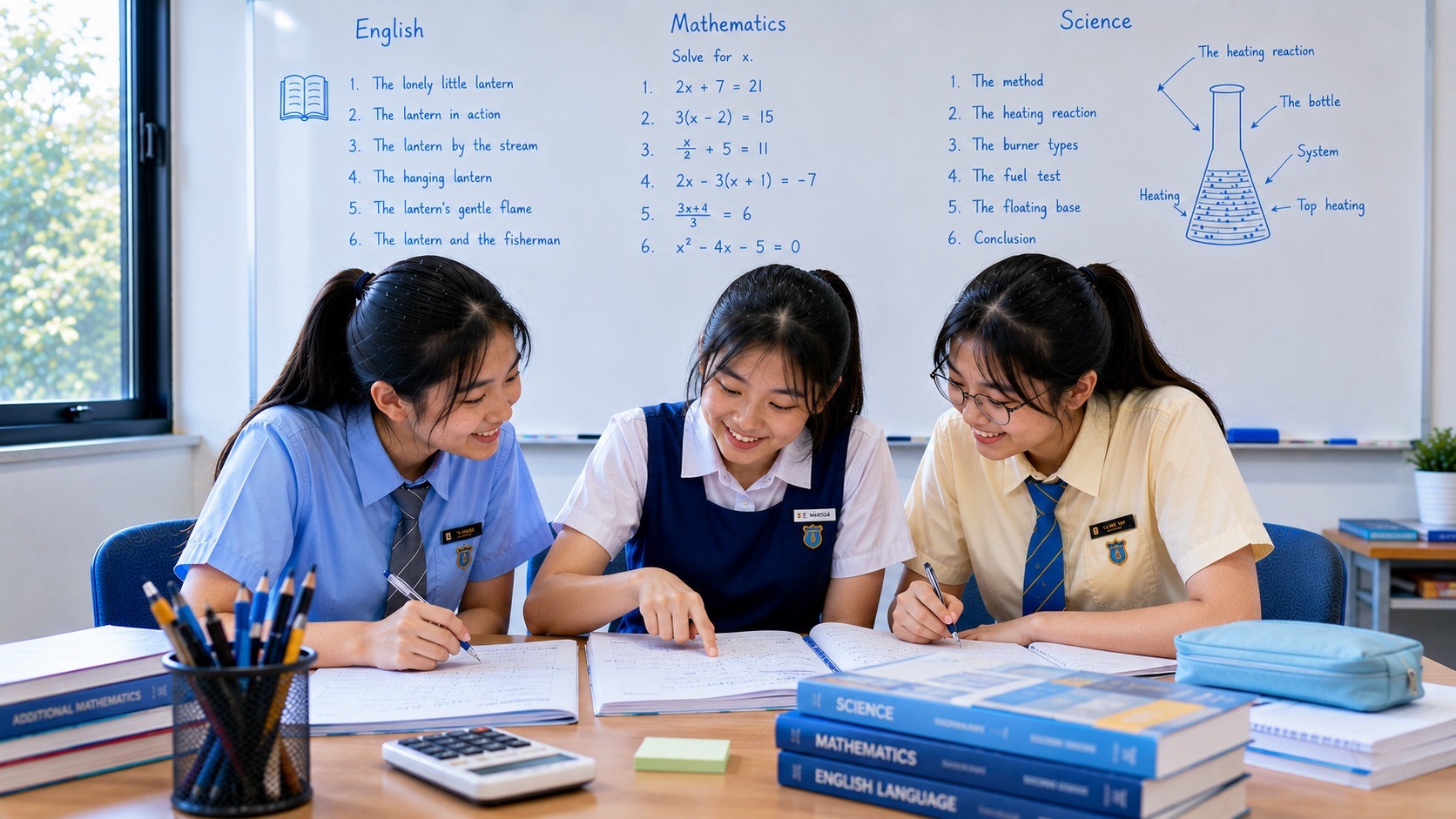
Looking for a resource first? Open the Primary Science learning map. Secondary and wider Science reading continues through the Science Hub. Those learning routes are separate from the Primary tuition arrangements described here.
QUESTIONS PARENTS ASK
A few practical answers.
Why does my child know the chapter but lose open-ended marks?
A relevant term may be present while the comparison, evidence or causal connection is missing. Keep one answer and ask the child what she meant. Beatrice’s story shows how teaching can connect the word to the result the question asks about.
Should my child memorise model Science answers?
Accurate terms and useful phrasing matter. A model answer can show how an explanation is expressed. The learner also needs to understand why it fits the conditions, then try a suitable question independently. Otherwise, a familiar sentence may be copied into a situation it does not explain.
Does Primary 1 or Primary 2 have formal Science?
Formal Primary Science begins at Primary 3. The earlier Discovery routes involve preparatory exploration such as noticing, comparing and describing. Ask about current arrangements and choose activities appropriate to the child.
What should I send before a consultation?
Give the child’s year and actual course, your main concern and a recent work sample. An original answer with teacher feedback is useful. Include practical questions about the group, timing, fees and availability. The first enquiry can be short.
Where are the Science lessons, and how large are the groups?
The current Primary 3–6 Science route uses groups of up to three students, with 1.5-hour lessons at 83 Punggol Central, Singapore 828761. Ask about the current group and arrangements for your child’s year and course.
Is one-to-one tuition always better than a group of three?
The useful choice depends on the learner, teaching need, pace, access and schedule. Individual work can be appropriate for concentrated support. A suitable small group can allow close teaching and comparison between responses. Ask how the actual lesson gives each child time to attempt work and receive relevant feedback; class size alone does not settle the decision.
What if my child is quiet and does not ask questions?
A short written answer or drawing can give the teacher something precise to discuss. Quietness alone does not show either confusion or understanding. Ask how the teacher checks each learner’s own attempt and leaves room for a question to take shape.
What if my child already does well in Science?
A useful next task may ask for a reason, a prediction, a comparison of explanations or a decision about evidence. Teach any missing knowledge and choose depth that fits the learner. Faith’s story shows challenge through a better question rather than simply a larger stack of familiar work.
How much extra Science practice should we add?
Begin with the purpose of the practice and the work already assigned. The child may need a concept explained before more questions will help. Ask what should be attempted independently, how much work is intended and which uncertainty should return to the teacher.
Do Standard and Foundation Science need different preparation?
The enquiry should name the child’s actual course. The official examination structures and provisions differ. Use the relevant current SEAB document, recent schoolwork and teacher feedback to choose materials and priorities.
How will we know whether the teaching is helping?
Look at what the child can explain or attempt after teaching, then at suitable later work with less support. Ask which difficulty remains and how that changes the next lesson. Marks, the child’s experience and the family’s ability to sustain the arrangement also inform the decision.
What are the current fees and available times?
Ask directly about the suitable group, current fees, what is included, timing, availability and relevant attendance or payment terms. A general description of the programme does not reserve a place or confirm a particular schedule.
WHEN YOUR QUESTION NEEDS MORE DEPTH
The Science teaching library.
Open the part that matches your question. These guides cover specific ideas and teaching choices; use the year routes above for the clearest starting point. Some guides introduce greater depth than a Primary child currently needs.
Explain what happened
- How Science Answers Move From Observation to Evidence to Explanation
- How Students Separate Observation, Inference and Conclusion
- How Students Trace Cause-and-Effect Chains in Science Systems
- How Students Compare Competing Scientific Explanations Against Evidence
- How Multiple Pieces of Evidence Build a Strong Scientific Explanation
- How Scientific Vocabulary Becomes Precise Meaning
- Why Students Memorise Science but Struggle to Apply Concepts
Plan a useful investigation
- How Fair Tests Work | Variables, Controls and Valid Conclusions
- How Students Learn to Ask Testable Scientific Questions
- How Scientific Predictions Grow From Patterns, Evidence and Mechanisms
- How Observational and Experimental Evidence Answer Different Scientific Questions
- How Replication and Reproducibility Strengthen Scientific Evidence
- How Unexpected Results Reveal Hidden Variables in Science
Understand measurements and their limits
- How Scientific Measurement Becomes Evidence | Units, Precision and Repeatability
- How Calibration and Reference Standards Make Scientific Measurements Comparable
- How Operational Definitions Turn Scientific Ideas Into Measurable Variables
- How Measurement Resolution Limits the Smallest Change Students Can Detect in Science
- How Students Distinguish Systematic and Random Error in Science
- How Students Judge Scientific Uncertainty, Limits and Confidence
Connect pictures, models and systems
- How Students Read Science Diagrams, Tables and Graphs as Evidence
- How Scientific Models Help Students Explain Things They Cannot See Directly
- How Students Move Between Parts, Systems and Scales in Science
- How Conservation Reasoning Helps Students Track Matter and Energy
- How Students Recognise Cycles, Flows and Repeating Processes in Science
- How Students Connect Structure to Function in Science
Compare conditions, rates and changes
- How Initial Conditions Shape Later Outcomes in Science Systems
- How Time Delays Change Cause-and-Effect Reasoning in Science
- How Cumulative Effects Build Across Time in Science Systems
- How Students Reason About Rates, Thresholds and Changing Conditions in Science
- How Limiting Factors Constrain Scientific Systems
- How Concentration and Total Amount Describe Different Scientific Quantities
- How Gradients Drive Flow in Science Systems
Follow a changing system
- How Feedback and Stability Shape Science Systems
- How Dynamic Balance Helps Students Understand Stable Science Systems
- How System Boundaries Define What Science Tracks
- How Students Distinguish Properties From Processes in Science
- How Reversible and Irreversible Changes Reveal Direction in Science Systems
Judge what the evidence can show
- How Classification Builds Scientific Thinking | From Characteristics to Groups and Keys
- How Students Distinguish Direct and Indirect Evidence in Science
- How Negative Results and Missing Effects Shape Scientific Conclusions
- How Students Separate Signal From Noise in Scientific Data
- How Sampling and Representativeness Shape Scientific Conclusions
- How Scientific Explanations Change When New Evidence Appears
- How Extrapolation Beyond Observed Data Changes Scientific Confidence
Primary 1–2 discovery guides
Primary 3 teaching and local guides
- Primary 3 Science Tuition Sengkang | Observe, Classify & Explain
- Primary 3 Science Sengkang | Observation & Classification Diagnostic
- Primary 3 Science | When Curiosity Becomes Scientific Observation
- Why Primary 3 Science Needs More Than Curiosity | From Seeing to Evidence
- Punggol Primary 3 Science | Local Entry to Observation & Evidence
- Primary 3 Science Punggol | Observation, Classification & Evidence
Primary 4 teaching and local guides
- Primary 4 Science Tuition Sengkang | Relationships, Evidence & Explanation
- Primary 4 Science Sengkang | Relationships & Evidence Diagnostic
- Primary 4 Science | When Facts Have to Become Relationships
- Why Primary 4 Science Needs More Than Memorised Facts | Relationships & Explanation
- Punggol Primary 4 Science | Local Entry to Relationships & Evidence
- Primary 4 Science Tuition at Punggol | Building Strong Foundations with eduKate
Primary 5 teaching and local guides
- Primary 5 Science Tuition Sengkang | Systems, Variables & PSLE Foundations
- Primary 5 Science Sengkang | Systems & Variables Diagnostic
- Primary 5 Science | When Science Becomes a Systems Problem
- Why Primary 5 Science Needs Systems Thinking | Variables, Evidence & Transfer
- Primary 5 Science Tuition Punggol | Systems, Variables and Interactions | The Voyage Series
- Primary 5 Science Punggol | Systems, Variables & the PSLE Runway
- Primary 5 Science Punggol | Legacy Entry to Systems & Variables
Primary 6 teaching and local guides
- Primary 6 Science Tuition Sengkang | 2026 PSLE Science & Scientific Reasoning
- Primary 6 Science | Reconstruct the World Before You Answer
- Why Primary 6 Science Needs More Than Model Answers | Reconstruction & Examination Control
- Sengkang Science Tuition for Primary 6 Students
- Punggol Primary 6 Science | Local Entry to PSLE Reconstruction
- Primary 6 Science Punggol | PSLE Reconstruction & Examination Craft
PSLE Science preparation
- PSLE Science Tuition Sengkang | Use the Paper to Find the Failure
- PSLE Science AL1 | Why Ten Tips Are Not Enough | Voyage to Examination Craft
- PSLE Science 2026 | What Students Must Adapt | Examination Craft
- PSLE Science 2026 | What the Syllabus Requires Students to Do
- PSLE Science Tuition Punggol | From Reconstruction to Examination Craft
Choosing Science teaching in Sengkang and Punggol
- Science Tutor Sengkang | See the First Weak Link in P3–P6 Science
- Science Tutor Punggol | Local Entry to P3–P6 Primary Science
- Sengkang Science Tutor | What a Tutor Should Be Able to See
- How to Choose Science Tuition in Sengkang | 7 Questions That Reveal Scientific Learning
- Do You Need 1-to-1 Science Tuition? | Why We Usually Prefer 3-Pax
- Why Primary Science Tuition in Sengkang? | When More Revision Is Not Enough
- Sengkang Science Tuition | From Knowing Facts to Using Science
- Primary Science Tuition Punggol | P3–P6: Observe → Relate → Systems → Reconstruct
- Primary Science Tuition Sengkang | Managing Education
THE NEXT PART OF YOUR FAMILY’S QUESTION
Find the help that fits.
A Science lesson belongs within a larger school and family life. Choose one route when that is the question you need to answer next.
Getting your bearings and choosing help
- Enter Here · a first route through eduKate Sengkang
- Parents’ Guide · what would help your family next?
- When Learning Slips · steady the next day and begin a repair
- Which Student Are You? · recognise a familiar experience
- Finding the First Weak Link · look at the current work
- Learning Hall · help, courage and the next step
Teaching, independent work and the paper
Understanding learning and the school journey
Official syllabus, examination formats and further reading
Use the official document for the child’s actual course and examination year. The 2026 formats below are specific to that cohort; SEAB’s main PSLE page is the route to current information.
For another Science question, return to the Science Hub.
Atlas return routes | Primary Science Tuition
- Science Hub — for the wider Science map and question routes.
- Learning Atlas V2.0 — when the Science concern needs learner-state routing.
- Learning Runtime — when the issue is retrieval, stability, transfer or independence.
- Examination Craft — when Science knowledge is present but PSLE paper execution is failing.
- The Tutor System — when Science repair needs human tutoring support.
- Parents’ Guide — for decisions about fit, frequency, overload and whether tuition is still needed.
