
Small Group Tutorials

Here to help students catch up, keep up, and move ahead. Book a consultation here.

Direct WhatsApp

Sengkang Science Tuition for Primary 2 Students Preparatory Program

Sengkang Science Tuition for Primary 2 Students – Preparatory Program

Primary 2 is a quiet but important year in a child’s education.

There is no need to turn it into an examination year. There is no advantage in rushing a young child through large amounts of Primary 3 Science content before the foundations are ready. Yet Primary 2 is also an excellent time to prepare the habits that will make Science feel natural when the subject formally begins.

Under the current Singapore primary curriculum, the Primary Science syllabus is organised from Primary 3 to Primary 6. At Primary 3, students begin learning themes such as diversity, cycles, materials and magnets through observation, investigation, discussion and application. (Ministry of Education)

The Sengkang Science Tuition for Primary 2 Students – Preparatory Program is therefore not designed as an early examination course.

It is a carefully paced introduction to scientific thinking.

Children learn to observe more accurately, describe what they notice, classify objects, identify changes, follow sequences, ask useful questions and explain simple ideas clearly. These abilities make the transition into Primary 3 Science considerably smoother.

For some children, the program strengthens the foundations that are still developing.

For others, it opens a wider learning path so that curiosity can become disciplined thinking.

The purpose is not to make Primary 2 more stressful. It is to make Primary 3 less unfamiliar.


Why Prepare for Science in Primary 2?

Science can look deceptively simple when a child first encounters it.

The early topics involve familiar things:

  • animals and plants,
  • living and non-living things,
  • materials,
  • life cycles,
  • magnets,
  • everyday objects and natural events.

However, school Science is not merely about knowing interesting facts.

A child may know that a caterpillar becomes a butterfly but still struggle to arrange a life cycle correctly. A student may recognise a plant but be unable to identify the characteristics used to classify it. Another may understand what happened during an activity but find it difficult to explain the observation in a complete sentence.

The real transition into Primary 3 Science involves several changes at once.

The child must learn to:

  • read a question carefully;
  • notice the important clue;
  • separate observation from assumption;
  • compare objects using appropriate characteristics;
  • place events in the correct sequence;
  • connect a cause to an outcome;
  • use accurate vocabulary;
  • communicate an answer clearly.

These abilities are easier to develop gradually than to repair after confusion has already accumulated.

A good Primary 2 Science preparatory program gives children time to build these skills without the pressure of chasing marks.


Primary 2 Science Preparation Should Not Be Primary 3 Tuition Brought Forward

There is an important difference between preparation and acceleration.

Acceleration moves ahead quickly. It introduces more chapters, more terminology and more worksheets.

Preparation builds the mental tools needed to understand those chapters properly later.

At Primary 2, children are still developing their reading confidence, attention, working memory and ability to express relationships in language. Presenting advanced material too early can make a child appear knowledgeable while leaving the underlying thinking fragile.

They may remember a definition but not recognise the concept in a new situation.

They may complete a familiar worksheet but become uncertain when the picture, object or wording changes.

They may know the answer but be unable to explain why it is correct.

At eduKate Sengkang, we prepare the child for the structure of Science rather than simply moving the textbook forward.

The tutor pays attention to how the student thinks:

  • Does the child observe carefully or answer too quickly?
  • Can the child group objects using a consistent rule?
  • Can the child explain a change in the correct order?
  • Does the child understand the vocabulary used?
  • Can the child transfer an idea to a different example?
  • Is the child curious but disorganised?
  • Is the child quiet because the concept is unclear or because confidence is low?

Once the tutor understands where the child is, the lesson can take the right route.

That is where small-group tuition becomes especially valuable.


A Different Route for Different Learners

Two Primary 2 students may sit beside each other and require completely different forms of help.

One child may need a calmer route.

The tutor may reduce the language load, use real objects, strengthen basic vocabulary and guide the student through one clear relationship at a time. The immediate aim is not speed. It is to help the child understand what is being observed and express it without fear.

Another child may already recognise patterns quickly.

That student should not be given more of the same work simply to remain occupied. The tutor can widen the task by asking the child to predict an outcome, compare alternative explanations, design a simple test or apply the idea to an unfamiliar situation.

Both students are progressing, but they are not travelling along identical paths.

For children who need stronger foundations

The tutor may focus on:

  • reading and understanding short Science passages;
  • learning essential vocabulary through context;
  • distinguishing between two similar ideas;
  • sorting and classifying accurately;
  • sequencing events;
  • completing clear oral explanations;
  • turning spoken ideas into written sentences;
  • building confidence through achievable steps.

The lesson creates a more stable path into Primary 3.

For children who are already ready to stretch

The tutor may introduce:

  • more detailed comparisons;
  • prediction and reasoning;
  • simple investigations;
  • alternative examples;
  • evidence-based explanations;
  • unfamiliar applications;
  • open-ended questions;
  • connections between Science and daily life.

The learning path becomes wider rather than merely faster.

This quiet adjustment is one of the central strengths of the eduKate Sengkang approach. The tutor does not force every child through one fixed worksheet sequence. Lessons are redirected according to what will produce the most meaningful next step.


What Changes When Science Begins in Primary 3?

The current Primary Science syllabus aims to stimulate curiosity, build basic scientific concepts, develop the skills and attitudes needed for inquiry, and help students apply Science when understanding the world around them.

This means that Primary 3 Science is not only a new collection of facts.

It introduces a new way of learning.

Children are expected to engage with questions such as:

  • What do you notice?
  • How are these objects similar?
  • How are they different?
  • What characteristic should be used to group them?
  • What changed?
  • What may have caused the change?
  • What evidence supports the answer?
  • Does the conclusion match the observation?

The syllabus is taught through an inquiry-based approach that includes introducing concepts, exploring through hands-on experiences and applying ideas in different contexts.

A student who enters Primary 3 already comfortable with these habits has more attention available for the new content.

Instead of trying to learn the vocabulary, question style, explanation structure and topic knowledge simultaneously, the child already understands how a Science lesson works.

That reduces unnecessary cognitive load.

It also helps the student participate more confidently during class discussions and practical activities.


The Five Foundations of Our Primary 2 Science Preparatory Program

1. Observation

Science begins with noticing accurately.

Young children often look at an object and describe what they already know about it. Scientific observation requires them to pay attention to what can actually be seen, heard, felt or measured.

A child may say, “The leaf is healthy.”

The tutor may ask:

  • What do you observe that makes you say that?
  • What colour is it?
  • Is the surface smooth or rough?
  • Are the edges straight or curved?
  • How is it different from the other leaf?

The child gradually learns that a useful answer contains specific details.

This improves not only Science but also comprehension, oral communication and descriptive writing.

2. Classification

Classification is one of the earliest structures children encounter in Primary Science.

Students need to understand that objects can be grouped according to shared characteristics. They also need to apply the same rule consistently.

For example, animals may be grouped by physical characteristics, movement, habitat or other observable features. Materials may be grouped by properties. Objects may belong to different groups depending on the characteristic being studied.

This sounds simple until the examples become unfamiliar.

In the preparatory program, students learn to ask:

  • What rule am I using?
  • Does every item in this group follow the rule?
  • Is there an item that does not belong?
  • Can the same objects be grouped differently using another valid characteristic?

This creates flexible thinking without sacrificing precision.

3. Sequence and Change

Many Science topics involve events occurring in a particular order.

Life cycles, growth, changes in materials and simple processes all require children to understand sequence.

The tutor helps students use language such as:

  • first;
  • next;
  • before;
  • after;
  • eventually;
  • changes into;
  • develops from;
  • remains the same.

Students may arrange images, explain a process orally, complete a diagram and then write a short description.

This progression makes the thinking visible. It also allows the tutor to identify whether the difficulty lies in the concept, vocabulary or organisation of the answer.

4. Scientific Language

Science has its own language.

Words such as observecompareclassifypropertystagematerialsimilardifferentattract and repel may be unfamiliar to a Primary 2 child even when the underlying idea is understandable.

Vocabulary should therefore be taught through meaningful examples rather than memorised as an isolated list.

The student sees the word, hears it used correctly, applies it to a real object or picture and then uses it in an explanation.

This approach helps the child retain the word and recognise it when the wording of a question changes.

5. Explanation

A child can understand an idea without yet being able to communicate it.

That gap matters because school Science increasingly requires students to show their reasoning.

At Primary 2, explanations remain short and age-appropriate. However, the child can begin learning a useful structure:

What happened? Why did it happen? What evidence supports the answer?

For example:

The paper clip moved towards the magnet because the paper clip is made of a magnetic material.

The tutor may first help the child say the idea aloud. Keywords are then identified, and the student learns to form a complete sentence.

Over time, the child becomes less dependent on prompts.


A Calm Introduction to Primary 3 Science Topics

The Primary 3 curriculum currently introduces areas including the diversity of living and non-living things, classification of living things, life cycles, diversity of materials and magnets. (Haig Girls’ School)

Our Primary 2 Science Preparatory Program may introduce selected ideas from these areas, but the purpose is not to complete the Primary 3 syllabus early.

The topics serve as rich settings in which foundational skills can be developed.

Living and non-living things

Children observe, compare and identify characteristics. They learn that classification should be supported by relevant evidence rather than surface appearance alone.

Animals, plants, fungi and bacteria

Students begin recognising that the living world contains different groups. The emphasis is on noticing characteristics, asking questions and avoiding careless generalisations.

Life cycles

Children arrange stages, identify changes and communicate sequences clearly. They learn that different living things may have different life cycles.

Materials

Students examine everyday objects and distinguish between an object and the material from which it is made. They compare simple properties and consider why particular materials may be chosen for particular uses.

Magnets

Children explore attraction and repulsion through guided activities. They learn to observe the result before forming a conclusion and to avoid assuming that every object attracted to a magnet is itself a magnet.

Each topic becomes a vehicle for learning how to think.


Why Science Depends on English More Than Many Parents Expect

A child’s early Science performance is often affected by language.

The student may understand a demonstration but misread the question. They may recognise the answer in a picture but struggle to explain it. They may confuse two terms that sound similar or omit an important comparison word.

This is why good Primary 2 Science tuition must pay attention to reading and expression without turning the lesson into another English class.

The tutor helps the child understand:

  • the meaning of the question;
  • the instruction word;
  • the important Science vocabulary;
  • the relationship being tested;
  • the form the answer should take.

Consider the difference between:

  • name;
  • identify;
  • describe;
  • compare;
  • state a difference;
  • arrange;
  • explain;
  • predict.

These words ask the child to perform different thinking tasks.

Early familiarity with them can prevent many avoidable mistakes later.

For weaker readers, the tutor may simplify the sentence, clarify the vocabulary and rebuild the original question gradually.

For stronger readers, the tutor may introduce denser information, unfamiliar contexts and questions containing distracting details.

Again, the learning route is adjusted without labelling the child.


Why a Three-Student Small Group Works Well at This Age

Primary 2 students benefit from personal attention, but they also learn through interaction.

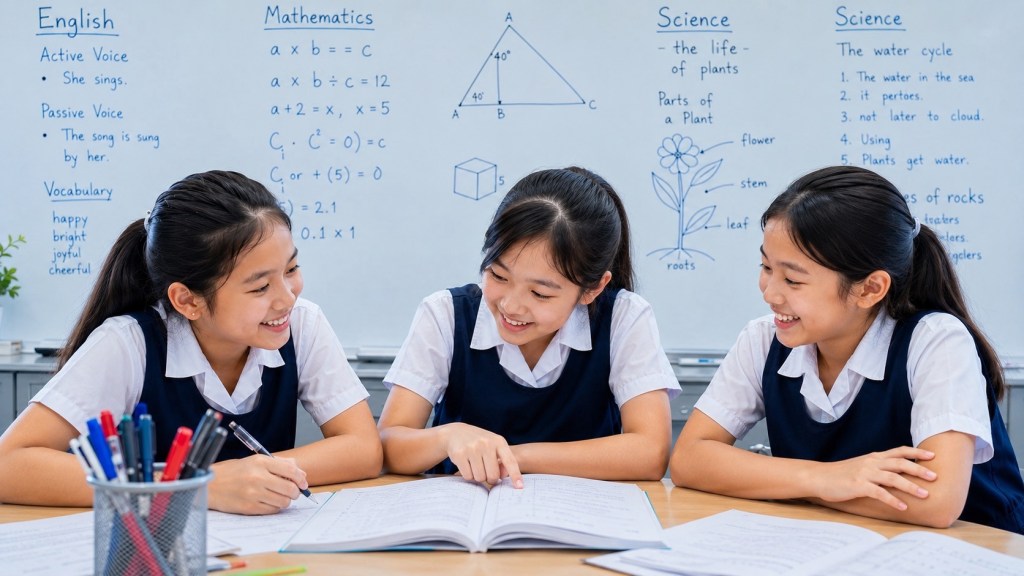
In eduKate Sengkang’s 3-pax small groups, the tutor can observe each child closely while preserving the benefits of discussion.

A student may notice a detail that another student missed.

One child may explain an answer in a way that helps a classmate understand.

A misconception can be discussed before it becomes established.

Students can compare classifications, test predictions and learn that an answer should be supported rather than guessed.

The group is small enough for the tutor to:

  • hear every child’s explanation;
  • check individual understanding;
  • correct vocabulary immediately;
  • adjust the level of questioning;
  • provide additional support discreetly;
  • give stronger students meaningful extension.

This is particularly important for young learners.

In a larger class, a child may copy the correct answer without revealing that the reasoning is still unclear. In a three-student setting, the tutor can ask a gentle follow-up question and see whether the concept is genuinely understood.


How a Typical Lesson Progresses

A well-designed lesson has movement.

It should not consist of a child sitting through a long explanation followed by several pages of repetitive work.

A typical preparatory lesson may begin with an object, photograph, short demonstration or familiar situation.

The tutor invites the students to observe.

Questions are used to direct attention:

  • What do you notice first?
  • What else can you see?
  • Which detail may be important?
  • How could we group these?
  • What do you think will happen?
  • Why do you think so?

A key concept or vocabulary item is then introduced.

Students explore the idea through guided discussion, manipulation of materials, diagrams or a short activity. They practise expressing the concept orally before completing suitable written work.

The tutor checks whether each student can transfer the idea to a slightly different example.

The lesson ends with a brief review:

  • What did we discover?
  • Which word did we learn?
  • What mistake should we avoid?
  • Where might we notice this idea outside the classroom?

This gives the child a complete learning experience: curiosity, observation, instruction, application and reflection.


Tuition Without Unnecessary Pressure

Singapore removed weighted assessments and examinations for Primary 1 and Primary 2 so that the early primary years can place greater emphasis on building confidence and establishing sound learning foundations. (Education Conversations)

A Primary 2 preparatory program should respect that intention.

We do not believe that a seven- or eight-year-old needs repeated formal testing to prove that learning is taking place.

Progress can be observed through:

  • the quality of the child’s questions;
  • increasing accuracy in observation;
  • clearer use of vocabulary;
  • better organisation of sequences;
  • greater confidence when explaining;
  • fewer unsupported guesses;
  • improved ability to apply an idea independently.

Short practices and reviews remain useful, but they should inform teaching rather than create anxiety.

The tutor uses the child’s responses to decide what should happen next.

When a foundation is weak, the lesson slows down and repairs it.

When understanding is secure, the lesson expands.


Which Primary 2 Students May Benefit From Science Preparation?

The program can support a wide range of learners.

The child who is curious but unstructured

This student asks many questions and enjoys discovering how things work. However, the child may jump between ideas, answer before observing or struggle to explain a conclusion.

Tuition helps organise curiosity into disciplined thinking.

The child who needs more confidence

This student may hesitate, speak softly or avoid attempting unfamiliar questions. The difficulty may not be ability. The child may simply require a smaller setting, clearer steps and time to formulate an answer.

Tuition provides a safer place to practise.

The child whose reading is still developing

Science questions can become difficult when vocabulary and sentence structure interfere with understanding.

The tutor supports the language while preserving the Science concept.

The child who learns quickly

A fast learner does not necessarily need to rush into upper-primary worksheets.

The student needs richer questions, deeper comparisons, better reasoning and broader application.

Tuition gives the child room to stretch thoughtfully.

The child who prefers to see and do

Some students understand more readily through objects, diagrams and guided activities than through verbal explanation alone.

The preparatory program gives these learners multiple ways to access the same concept.


What Parents May Notice Over Time

The first improvements may not appear as marks because Primary 2 Science preparation is not built around a formal examination.

Parents may instead notice that their child:

  • observes more carefully;
  • asks more precise questions;
  • explains ideas in fuller sentences;
  • notices Science in daily life;
  • uses new vocabulary naturally;
  • organises events in the correct order;
  • becomes more willing to attempt unfamiliar tasks;
  • relies less on guessing;
  • approaches Primary 3 with interest instead of apprehension.

These are valuable signs.

They indicate that the child is becoming ready not only to receive Science content, but to work with it.


The Advantage of Starting From the Child, Not the Worksheet

Worksheets are useful, but they cannot decide what a child needs.

A worksheet does not know whether the wrong answer came from weak vocabulary, careless observation, a misconception, poor reading or uncertainty about how to write the response.

A tutor can find out.

At eduKate Sengkang, the lesson begins with the learner.

When a child struggles, we do not automatically give more questions of the same kind. The tutor identifies the point at which understanding became unstable and creates a clearer route forward.

When a child is doing well, we do not keep the student on repetitive work merely because it is part of the page. The tutor widens the discussion, increases the depth of reasoning and introduces a more demanding application.

This makes learning more efficient without making it feel hurried.

The child receives what is needed for the next stage.


Preparing for Primary 3 Without Taking Away Primary 2

A child should still have time to play, read, explore and enjoy being young.

Science preparation can fit naturally into that life.

A walk through a Sengkang park connector can become an opportunity to notice different leaves, insects and materials.

Cooking can introduce change, heat and observation.

A refrigerator magnet can begin a conversation about attraction.

A puddle after the rain can prompt questions about water and evaporation.

A broken toy can lead to a discussion about materials and why they were selected.

The role of tuition is not to replace this natural curiosity with academic pressure.

It is to help the child give shape to what is already being noticed.

Once curiosity is paired with accurate language and careful reasoning, the child begins to see the world differently.

Science becomes less like a school subject that suddenly appears in Primary 3 and more like a method for understanding everyday life.


Frequently Asked Questions

Is Science formally taught in Primary 2?

The current MOE Primary Science syllabus is structured from Primary 3 to Primary 6. The eduKate Sengkang Primary 2 program is therefore a preparatory course rather than a replacement for a formal Primary 2 school Science subject. (Ministry of Education)

Will my child be pushed through the Primary 3 syllabus early?

No. Selected Primary 3 ideas may be used as age-appropriate learning contexts, but the central aim is to develop observation, classification, vocabulary, sequencing, reasoning and explanation.

Is this program only for weaker students?

No. Students who need support receive a clearer and more carefully structured route. Students who are already confident receive wider applications, deeper questions and more opportunities for inquiry.

Will there be worksheets?

Yes, where written practice supports the lesson. However, worksheets are combined with discussion, observation, diagrams, objects and guided activities. The child should understand the idea rather than merely complete a page.

Is the course examination-focused?

The course is preparation-focused. Strong examination performance later depends on secure concepts, accurate reading and clear explanation. These are built progressively rather than forced through premature testing.

Can the program help a child who struggles with English?

Yes. The tutor can clarify vocabulary, question instructions and answer structures while teaching the Science idea. This helps the child access the subject without turning the lesson into rote memorisation.

What happens when my child enters Primary 3?

The child should already be familiar with the basic habits of a Science lesson: observing, comparing, classifying, predicting, explaining and applying. Tuition can then move naturally from preparation into support for the formal Primary 3 curriculum.


Why Choose eduKate Sengkang for Primary 2 Science Preparation?

Parents usually look for tuition because they want something to improve.

Sometimes the child is already struggling.

Sometimes the parent can see a difficult transition approaching.

Sometimes the student is doing well but needs a more thoughtful place to grow.

The Sengkang Science Tuition for Primary 2 Students – Preparatory Program is designed for all three situations.

Our 3-pax small-group format allows the tutor to see the child clearly. Lessons can be slowed down, rebuilt, extended or redirected without drawing unnecessary attention to the adjustment.

We help developing students find a more secure route.

We help confident students discover a wider one.

The result is not simply an early collection of Science facts. It is a child who knows how to look, think, question and explain.

That is the foundation Primary 3 Science requires.


Begin Primary 3 Science With Confidence

Primary 2 is not too early to build good learning habits.

It is simply too early to replace curiosity with pressure.

With the right preparation, a child can enter Primary 3 already understanding that Science is not about guessing the teacher’s answer. It is about observing carefully, using evidence, making connections and communicating ideas clearly.

At eduKate Sengkang, we prepare students gently but purposefully.

We strengthen what is uncertain.

We extend what is ready.

We give each child a learning route that makes the next stage feel possible.

Sengkang Science Tuition for Primary 2 Students – Preparatory Program

Small-group guidance. Stronger foundations. A smoother beginning to Primary 3 Science.

At eduKate Singapore, we believe that building a strong foundation in Science begins as early as Primary 2. Our Sengkang Science Tuition Primary 2 Preparatory program is designed to instill curiosity, develop foundational scientific skills, and spark a love for SEAB PSLE Science in young learners. Tailored to meet the specific needs of Primary 2 students, this preparatory program introduces key scientific concepts in a fun, interactive, and engaging way, laying the groundwork for future academic success in upper primary levels.

Why Start Early with Primary 2 Science Tuition?

Early exposure to scientific principles is crucial for developing inquiry-based learning and problem-solving skills in students. While Science is introduced formally in later years, building curiosity and understanding basic concepts early on sets a positive trajectory for students. Our Primary 2 Science Tuition in Sengkang nurtures a sense of wonder and encourages exploration of the world around them.

Key Benefits of Our Primary 2 Science Preparatory Program in Sengkang:

  • Fostering Curiosity and Exploration: Children at this age are naturally curious about their environment. We channel this curiosity into structured learning, encouraging them to ask questions, explore ideas, and seek answers through hands-on activities and guided discussions.
  • Interactive Learning Environment: Our small group tuition classes create a warm and engaging environment where students can participate in fun experiments, group activities, and interactive lessons that make learning Science enjoyable.
  • Building Foundational Knowledge: We introduce basic scientific principles such as understanding living and non-living things, the environment, and energy sources, ensuring that students develop strong foundational knowledge that will support their future studies.

Our Approach to Primary 2 Science in Sengkang

Our Primary 2 Science Tuition program is designed to nurture scientific curiosity in young learners through an inquiry-based approach. This involves using everyday experiences, interactive lessons, and hands-on experiments to make Science relatable, fun, and understandable for children.

Key Focus Areas of the Program:

  1. Understanding the World Around Us
    • Exploring living and non-living things, their characteristics, and how they interact with the environment.
    • Learning about different habitats and the importance of taking care of our surroundings.
    • Introducing concepts of day and night, weather changes, and the water cycle in an age-appropriate manner.
  2. Developing Process Skills
    • Encouraging children to make observations, ask questions, and predict outcomes based on simple experiments.
    • Teaching basic classification skills to identify and group objects based on similarities and differences.
    • Introducing the concepts of exploration, discovery, and recording observations through simple activities.
  3. Hands-on Experiments
    • Fun, practical experiments that engage students and enhance their understanding of scientific concepts.
    • Examples include observing plant growth, understanding magnetism, and simple water-based experiments to demonstrate floating and sinking.
    • Encouraging creativity through experiments that involve everyday materials, helping children relate Science to their daily lives.

Sengkang Science Tuition for Primary 2: Individualized Attention in Small Groups

We understand that every child learns at a different pace. That’s why our Primary 2 Science Preparatory Program in Sengkang is offered in small group settings, allowing our experienced tutors to focus on each student’s individual learning needs. This personalized approach ensures that each child receives the guidance, encouragement, and support needed to excel.

Why Small Group Tuition Works:

  • Personalized Guidance: Small class sizes mean more one-on-one attention from our tutors, who can address each student’s strengths and areas for improvement.
  • Encouraging Active Participation: With fewer students in each class, there are more opportunities for everyone to participate in discussions, activities, and experiments, building their confidence and communication skills.
  • Building a Collaborative Learning Environment: Students benefit from interacting with their peers, working together to solve problems, share ideas, and complete group tasks.

Expert Tutors for Primary 2 Science Tuition in Sengkang

Our eduKate Singapore team comprises dedicated and experienced tutors who specialize in nurturing young learners. We use a child-centered approach to make learning Science enjoyable and accessible, ensuring that students are engaged and motivated throughout their tuition journey.

Our Tutors Provide:

  • Age-Appropriate Lessons: Our tutors design lessons that are suited to the developmental stages of Primary 2 students, ensuring they grasp concepts at a comfortable pace.
  • Creative Teaching Methods: Lessons are filled with creative teaching aids such as visual representations, stories, multimedia resources, and hands-on activities to cater to various learning styles.
  • Positive Reinforcement: We believe in using positive reinforcement to encourage participation, build self-confidence, and develop a love for learning in students.

What Our Sengkang Science Tuition Covers

The Primary 2 Science Tuition Program at eduKate Singapore covers a broad range of topics that align with the MOE curriculum. While Science is not a formal subject in the Primary 2 syllabus, we introduce foundational concepts that will prepare students for their future learning in Primary 3 and beyond.

Topics Covered Include:

  1. Introduction to Living and Non-Living Things
    • Understanding the differences between living and non-living objects.
    • Exploring life cycles, plant growth, and animal habitats.
  2. The Environment and Weather
    • Learning about the weather, including the water cycle and how weather affects our environment.
    • Observing changes in nature and understanding the importance of taking care of our surroundings.
  3. Basic Energy Concepts
    • Introducing simple concepts of energy, including light, heat, and movement.
    • Demonstrating how energy is used in everyday life through simple experiments.
  4. Exploring Materials
    • Classifying objects based on their materials such as wood, plastic, metal, and more.
    • Understanding properties like hardness, flexibility, and waterproofing through fun experiments.

Preparing for Future Science Success

At eduKate Singapore, we aim to develop a strong foundation in Science that will not only help your child in Primary 3 and beyond but also instill a lifelong interest in exploring the world around them.

Key Program Outcomes:

  • Boost Confidence in Science: By providing engaging and interactive lessons, we help students develop the confidence they need to explore scientific topics further.
  • Develop Process Skills: Early exposure to inquiry-based learning teaches students essential skills such as observation, classification, and simple problem-solving.
  • Foster a Love for Science: We create a learning environment that nurtures curiosity and creativity, ensuring students enjoy the learning process and stay motivated.

Why Choose eduKate Singapore for Sengkang Science Tuition?

  • Proven Track Record: Our Primary 2 Science Tuition Preparatory Program has helped many students build a strong foundation, and we are committed to fostering a love for Science in every child.
  • Small Group Tuition: Individualized attention and a collaborative learning environment ensure your child receives the best possible support.
  • Hands-On Learning: We bring Science to life through interactive experiments, making learning both engaging and fun.

Join Our Sengkang Science Tuition Program Today

If you are looking to give your child an early start in Science and ensure they are well-prepared for their academic journey, our Sengkang Science Tuition for Primary 2 Students is the perfect choice. With expert tutors, engaging lessons, and personalized attention, your child will develop the skills and confidence they need to excel in Science.

Contact Us Now:

Start your child’s journey to Science success today with eduKate Singapore!

Learning Science for Primary 2: Why It’s Important to Prepare Early and What to Expect with Sengkang Science Tuition

Science is a subject that sparks curiosity, fuels creativity, and encourages young learners to explore the world around them. For Primary 2 students in Singapore, introducing science early on is crucial to laying a strong academic foundation. As your child embarks on their learning journey, enrolling in Sengkang Science Tuition for Primary 2 offers the perfect opportunity to nurture their interest in science and prepare them for future success.

This guide explores the importance of early preparation in science for Primary 2, what to expect from science tuition in Sengkang, and the advantages of starting science learning with expert tuition.

Why Early Preparation in Science is Crucial for Primary 2 Students

Starting science education early has numerous benefits for young learners. At Primary 2, students are at a developmental stage where their minds are eager to absorb new information. Here’s why it’s essential to begin science education early:

1. Develops Critical Thinking Skills
Science helps children develop critical thinking by encouraging them to ask questions, analyze data, and make informed decisions. Starting early prepares Primary 2 students to become more analytical thinkers, an essential skill not only for science but also for all academic subjects.

2. Builds a Strong Foundation for Future Learning
By introducing scientific concepts early, Primary 2 students build a solid foundation that supports more complex learning in the upper primary levels. Basic concepts such as observation, classification, and problem-solving skills introduced at this stage pave the way for a deeper understanding of the world around them.

3. Encourages Curiosity and Creativity
Primary 2 students are naturally curious, and science tuition channels this curiosity into productive learning. By exploring scientific concepts such as nature, life cycles, and simple machines, young learners become creative problem-solvers who approach challenges with an open mind.

4. Prepares Students for the MOE Science Curriculum
Although formal science education begins in Primary 3, starting early ensures that students are already familiar with scientific concepts and inquiry methods. This head start reduces stress and helps students transition smoothly into the more structured MOE Primary Science curriculum in the higher primary levels.

5. Boosts Confidence and Motivation
When Primary 2 students develop an early interest in science, they are more likely to feel confident and motivated as they progress through school. Early exposure allows them to build skills gradually, leading to greater success in future exams and assessments.

What to Expect with Sengkang Science Tuition for Primary 2

At Sengkang Science Tuition for Primary 2, the focus is on providing young learners with an engaging and hands-on experience that sparks their interest in science. Here’s what you can expect from the tuition program:

1. Fun and Interactive Lessons

Science is all about discovery, and our tutors at Sengkang ensure that every lesson is fun, interactive, and filled with hands-on activities. Through simple experiments, educational games, and engaging discussions, students get to explore scientific concepts in a way that feels more like play than study.

2. Focus on Foundational Skills

The tuition program emphasizes building a strong foundation in scientific thinking. Students are introduced to basic scientific concepts, such as understanding living and non-living things, life cycles, habitats, and more. These concepts are aligned with the MOE curriculum, ensuring that students are well-prepared for what lies ahead.

3. Inquiry-Based Learning

Inquiry-based learning is at the heart of science education. Our Primary 2 science tuition encourages students to ask questions, investigate answers, and draw conclusions based on observations. This approach nurtures curiosity and teaches students how to think critically about the world around them.

4. Individualized Learning Plans

At Sengkang Science Tuition, each child receives personalized attention. Tutors assess the student’s unique learning style and adjust the lessons to meet their specific needs. Whether your child needs extra support or is ready for more advanced material, the individualized learning plans ensure optimal progress.

5. Small Group Settings

We keep our class sizes small to provide personalized attention and allow for active participation. In these small groups, students benefit from peer collaboration, discussions, and more interaction with the tutor, all of which enhance their learning experience.

The Advantages of Enrolling in Sengkang Science Tuition for Primary 2

Choosing Sengkang Science Tuition for your child’s Primary 2 Science education offers numerous advantages that go beyond the classroom.

1. Early Exposure to Science

Starting science tuition early ensures that your child is introduced to important scientific concepts before they encounter them in school. This exposure gives them a head start and prepares them for more advanced learning in Primary 3 and beyond.

2. Strengthening of Core Skills

Primary 2 Science tuition strengthens core skills such as observation, critical thinking, and problem-solving. These skills are essential for success in both science and other academic areas, making early tuition a valuable investment in your child’s overall education.

3. Engaging and Enjoyable Learning

With interactive lessons and hands-on experiments, science becomes an enjoyable subject that students look forward to. The more students enjoy learning, the more motivated they are to continue exploring new concepts.

4. Encourages Lifelong Curiosity

Sparking an interest in science early can lead to a lifelong passion for discovery. By encouraging students to ask questions and explore the world around them, Sengkang Science Tuition fosters a love of learning that extends beyond the classroom.

5. Prepares Students for Future Challenges

By building a strong foundation in science at an early age, students are better equipped to tackle more complex topics in later years. This early preparation helps students excel academically and gives them the confidence to face future challenges with ease.

Why Choose EduKate Sengkang for Primary 2 Science Tuition?

At EduKateSengkang, we understand the importance of early preparation in science education. Our specialized Primary 2 Science Tuition program is designed to make learning enjoyable, engaging, and effective for young students. Here’s why parents choose EduKateSengkang:

  • Expert Tutors:
    Our tutors are experienced in teaching young learners and understand how to make complex scientific concepts accessible and fun for Primary 2 students.
  • Personalized Learning Plans:
    Every child learns at their own pace, and we create individualized learning plans that cater to each student’s unique needs and learning style.
  • Interactive and Hands-On Learning:
    We believe that science should be experienced, not just memorized. Our lessons are filled with experiments and activities that make learning come to life.
  • Small Group Classes:
    With small class sizes, every student gets the attention they need to thrive. Tutors can focus on each child’s progress and provide the support necessary to ensure success.
  • Holistic Development:
    We focus not just on academics, but on building confidence, creativity, and a love for learning in every student. Our goal is to develop well-rounded learners who are prepared for future academic challenges.

FAQs: Sengkang Science Tuition for Primary 2

Q: What topics are covered in Sengkang Science Tuition for Primary 2?
A: Our tuition covers fundamental science topics such as life cycles, habitats, living and non-living things, and basic scientific inquiry methods.

Q: How are lessons structured at EduKate Sengkang?
A: Lessons are interactive, focusing on hands-on activities, fun experiments, and inquiry-based learning to make science enjoyable for young learners.

Q: Does EduKate Sengkang provide regular progress updates?
A: Yes, we keep parents informed about their child’s progress through regular feedback and reports to ensure they are on track.

Q: What class sizes can I expect at EduKate Sengkang?
A: We maintain small group classes to provide personalized attention to each student, ensuring they receive the support they need.

Q: How can I enroll my child in EduKate Sengkang’s Primary 2 Science tuition?
A: You can contact us via our website to learn more about our enrollment process and available class times.

Conclusion

Starting science education early with Sengkang Science Tuition for Primary 2 sets your child on the path to academic success. With engaging lessons, individualized learning plans, and expert tutors, EduKateSengkang provides the ideal environment for your child to develop a love for science while building the foundational skills they need for the future. Contact us today to find out how we can support your child’s learning journey in science.