
Primary 2 Discovery Science in Sengkang: From Noticing to Explaining
Primary 2 Discovery Science develops scientific habits before formal Primary Science begins. The child moves beyond noticing differences towards recognising patterns, making fairer comparisons, forming simple predictions, checking ideas against evidence and explaining what the available information supports.
Observe → Classify → Compare → Predict → Check → Explain → Revise
Quick Read
Primary 1 Discovery Science asks the child to notice carefully. Primary 2 can ask for something more demanding: hold several observations together, recognise a pattern, make a prediction, compare conditions and explain why one conclusion is better supported than another.
The child is still not being pushed into premature upper-primary Science. The developmental job is different:
From “What do I see?” towards “What pattern do I see, what might happen next, and how could I check?”
The One-Sentence Answer
Primary 2 Discovery Science helps children organise observation into patterns, comparisons, predictions and simple evidence-based explanations so they enter formal Primary 3 Science with better habits of thinking, not merely more facts.
At a Glance
| Level | Primary 2 |
| Programme | Discovery Science / cross-subject scientific thinking |
| Class size | Up to 3 students |
| Lesson duration | 1.5 hours |
| Location | 83 Punggol Central, Singapore 828761 |
| Main focus | Observation, classification, patterns, prediction, fair comparison, evidence and explanation |
What Changes From Primary 1 to Primary 2?
The difference should not be “more Science content”. It should be a larger thinking job.
| Primary 1 emphasis | Primary 2 development |
|---|---|
| Notice a difference | Compare several differences and decide which matters |
| Describe what happened | Sequence change and look for a pattern |
| Group objects | State and defend a classification rule |
| Ask “why?” | Ask what evidence could distinguish possible explanations |
| Make a simple guess | Make a prediction with a stated reason |
| Say what was seen | Separate observation, interpretation and confidence |
The learner begins carrying more of the reasoning instead of waiting for the adult to supply the route.
Patterns: More Than Repetition
Children are naturally attracted to patterns. The important educational move is to connect the pattern to a rule or relationship.
Suppose a child observes that a puddle becomes smaller over several hours. The useful questions are not only:
- What happened?
- What happened next?
We can add:
- Is the change happening in one direction?
- Did it happen at the same speed each time we looked?
- What else changed around the puddle?
- What would you predict if we came back later?
Pattern recognition becomes more scientific when the child can say what was repeated, what changed and what prediction the pattern supports.
Prediction Is Not Random Guessing
At Primary 2, we can make an important distinction:
A prediction should have a reason connected to what we already observed.
For example:
“I think the cloth near the fan will dry faster because the last cloth near moving air became drier sooner.”
The prediction may still turn out to be wrong. That is acceptable. What matters is that the learner can state the basis of the prediction and later compare it with what actually happened.
Evidence Before Certainty
Children often want a definite answer. Science sometimes needs a more careful one.
- The evidence shows…
- This suggests…
- One possible reason is…
- We cannot tell yet because…
- We would need to check…
These phrases are not about making a child sound academic. They teach an early principle: the strength of the conclusion should match the strength of the information.
That habit becomes increasingly valuable later when formal Science asks students to reason from investigations, diagrams, data and competing explanations.
Fairer Comparisons: Change Less, Learn More
Primary 2 children can begin to understand the logic behind a fair comparison without needing formal variable terminology.
Imagine comparing how quickly two wet cloths dry. One cloth is small and spread open in moving air. The other is large, folded and placed in still air.
If one dries first, what caused the difference?
Too many relevant things changed at once.
If we want to understand one difference, try not to change many important differences at the same time.
This is the beginning of controlled comparison. The vocabulary can come later. The logic should come first.
Classification With Reasons
At Primary 1, a child may successfully sort objects. At Primary 2, we can ask whether the same rule can survive harder cases.
Suppose the child groups objects into “things that float” and “things that sink”. Then we introduce an unfamiliar object.
Can the learner predict which group it belongs to? What property is being used? Does one surprising result force the rule to be reconsidered?
Classification becomes a thinking tool when the learner can:
- state the rule;
- apply it consistently;
- explain borderline cases;
- notice when a result does not fit;
- revise the rule if necessary.
A Worked Example: Which Ice Cube Changes Faster?
Place two similar ice cubes in two different locations. The adult already knows many possible explanations. The Discovery Science job is to let the child build the route.
Step 1 — Observe
What do the cubes look like at the beginning? What happens after five minutes?
Step 2 — Compare
Which cube became smaller? Is there more liquid water around one?
Step 3 — Identify the changed condition
What was different about where the cubes were placed?
Step 4 — Predict
If we repeated it, what do you expect? Why?
Step 5 — Check the explanation
Does the observation support the child’s first idea? What else would we need to control or repeat before becoming more confident?
The child is learning an important habit: an explanation is stronger when it survives contact with evidence.
The Voyage of Water
Water remains a useful recurring world because it can be observed in containers, wet surfaces, weather, plants, ice, movement and everyday routines.
At Primary 1, the learner may simply notice that water appears, disappears, moves or changes shape with its container.
At Primary 2, the questions can become more structured:
- Which condition changed?
- What pattern appeared?
- What do you predict next?
- How could we make the comparison fairer?
- What evidence would support your explanation?
The familiar context reduces unnecessary novelty so the reasoning itself can become more demanding.
When the First Explanation Is Wrong
A powerful Science habit is learning that being wrong is not the end of the investigation.
Suppose a child predicts that the heavier object will always sink, but a heavy piece of wood floats.
The weak response is to erase the first idea and replace it with the teacher’s statement.
The stronger response asks:
- What did you predict?
- What actually happened?
- Which part of your rule no longer works?
- What new question should we ask?
Prediction → observation → mismatch → better question → revised idea.
This is a small version of a very important intellectual habit: evidence can require us to change our explanation.
What Can Go Wrong at Primary 2?
| What we see | Possible learning need |
|---|---|
| The child predicts without giving a reason. | Connect predictions to earlier observations |
| The child changes the answer after hearing a peer. | Commit to an independent observation before discussion |
| The child thinks one result proves a rule forever. | Introduce repetition and uncertainty |
| The child notices a pattern but cannot state it. | Language for sequence, comparison and relationship |
| The child accepts a comparison where many conditions changed. | Build fair-comparison logic |
| The child refuses to revise an explanation. | Normalise evidence-led correction |
| The child memorises an adult explanation but cannot use it in a changed situation. | Return to observation and transfer |
Diagnosis Before More Activity
Discovery Science can become busy very easily. More experiments, more craft, more colourful materials. But activity is not automatically learning.
If a child struggles to explain a result, the problem may not be lack of activity. The learner may need more precise observation, comparison language, a clearer sequence, stronger connection between evidence and conclusion, or more practice making a prediction before seeing the answer.
The question is not “What activity shall we do next?” It is “What thinking move should become more independent next?”
Why Small Groups of 3?
Primary 2 is an ideal age for comparing explanations because children can already produce reasons but may still change them quickly in response to another person.
In a group of up to three, each learner can observe and predict independently first. Then the class can compare answers.
If the three explanations differ, the tutor does not need to choose the loudest one. Everyone can return to the evidence:
- Which observation supports this idea?
- Which idea explains more of what happened?
- What information is still missing?
- What could we test next?
The group becomes useful because disagreement creates a reason to inspect evidence more carefully.
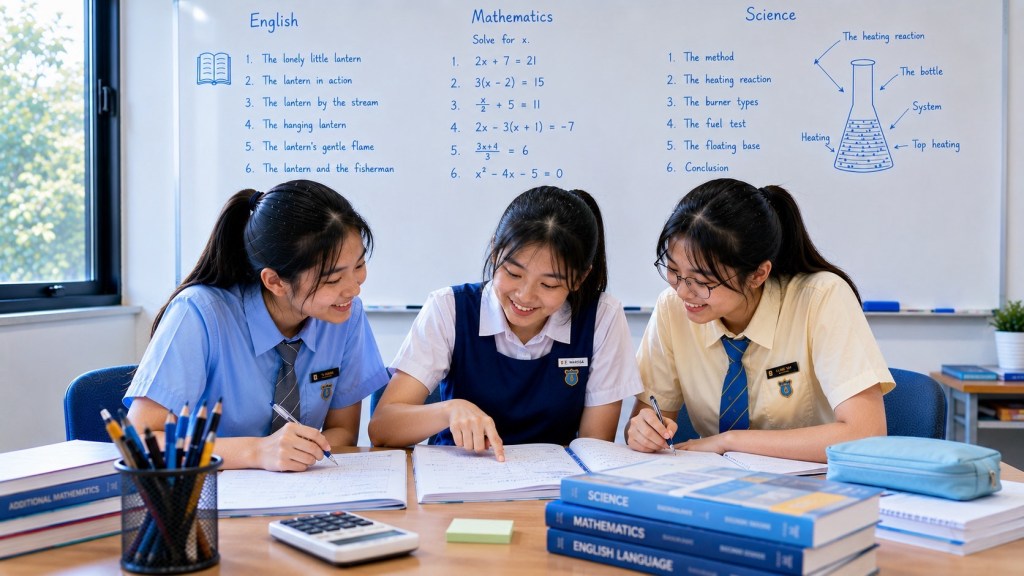
How Primary 2 Discovery Science Supports English and Mathematics
- English: sequence observations, use because/therefore/but, describe a pattern, qualify certainty and explain a reason.
- Mathematics: compare quantities, organise simple tables, notice trends, measure, order and interpret more/less or faster/slower relationships.
- Science: ask a testable question, compare conditions, predict, inspect evidence and revise an explanation.
The subjects remain distinct. The child carries improving attention, language and relational thinking between them.
What Progress Looks Like
- classification includes a stated rule;
- predictions include a reason;
- the child distinguishes observation from explanation more reliably;
- comparisons become fairer and more deliberate;
- patterns are described rather than merely noticed;
- the learner can say what information is missing;
- certainty becomes more calibrated;
- the child can revise an explanation after conflicting evidence;
- simple cause-and-effect chains become clearer;
- the learner can transfer a familiar idea into a slightly changed context.
Preparing for Formal Primary 3 Science
Primary 3 is where formal Primary Science begins in the eduKate Science pathway. The handover should not feel as though a completely new way of thinking suddenly appears.
A child entering P3 is better prepared when the learner can already:
- observe before guessing;
- compare using a clear basis;
- classify with a rule;
- make a prediction from prior information;
- understand why fair comparisons matter;
- separate what happened from why it happened;
- explain a simple conclusion using evidence;
- change an idea when the observation does not fit.
P1: Notice → Observe → Compare.
P2: Observe → Classify → Compare → Predict → Check → Explain.
P3: Formal Science begins to organise these habits into scientific concepts and practices.
Next: Primary 3 Science Tuition Sengkang
What Parents Can Do at Home
- Ask for a prediction before revealing what happens.
- Ask “What makes you think that?” rather than immediately correcting.
- Compare two situations and identify which important condition changed.
- Use simple tables to record repeated observations.
- When results disagree with the prediction, ask what should change: the evidence or the explanation?
- Model uncertainty: “We have one observation. Let’s not be too sure yet.”
These are small habits. Repeated over time, they prepare the child to treat Science as a way of investigating rather than a list of sentences to memorise.
Frequently Asked Questions
Is this formal MOE Science tuition?
No. P1–P2 are Discovery Science and general educational development. Formal eduKate Primary Science tuition begins from Primary 3.
Why introduce fair comparison before formal Science?
Because children already make comparisons. We can improve the logic early by showing that if many important conditions change at once, it becomes harder to know which one mattered.
Should every prediction be correct?
No. A useful prediction is reasoned, not guaranteed. The learning often happens when the learner compares the prediction with the observation and decides whether the explanation should be revised.
Why teach uncertainty?
Because one observation does not always establish one explanation. Children can begin learning that “possible”, “likely” and “we need more evidence” are different intellectual positions.
How is P2 different from P1 Discovery Science?
P1 emphasises careful noticing and simple distinctions. P2 asks the child to coordinate more information: patterns, predictions, fairer comparisons, evidence strength and revision of explanations.
Primary 2 Discovery Science Sengkang with eduKate Sengkang
Discovery Science | Small groups of up to 3 | 1.5-hour lessons | 83 Punggol Central
The aim is not to make Primary 2 look like Primary 5. It is to make the child’s own observations, predictions and explanations increasingly disciplined before formal Science begins.
See the pattern. Make a prediction. Check the world. Change the explanation if the evidence asks you to.
Send us your child’s current level and preferred timing if you want to build observation, comparison, explanation and scientific curiosity before formal Science begins.
