
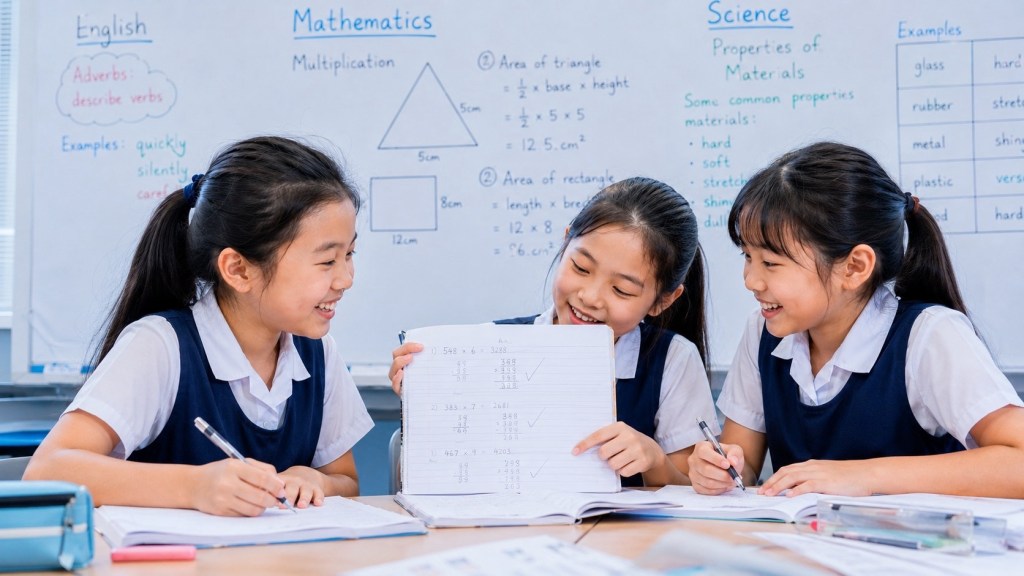
Part of the Mathematics Hub: PSLE preparation.
For a Primary 6 student in 2026, the useful question is: what does PSLE Mathematics require the learner to be able to do?
The 2026 PSLE Mathematics format
The revised 2026 examination has two written papers comprising three booklets, with 45 questions worth 100 marks in 2 hours 30 minutes altogether. Paper 1 does not allow a calculator; Paper 2 does.
The format tells us something important: students need both fluent non-calculator control and the ability to organise longer, more complex mathematical routes.
A syllabus is a map of mathematical capability
- Number sense: quantities, place value and operations must be stable.
- Representation: information must be converted into models, diagrams, equations, tables or other useful forms.
- Relationships: fractions, ratio, percentage, rate and geometry depend on seeing how quantities relate.
- Fluency: routine operations must be accurate enough not to consume all available attention.
- Modelling: language must be translated into mathematical structure.
- Reasoning: the student must choose a route when the method is not announced.
- Transfer: the method must survive when the surface story changes.
- Checking: working and answers must be tested for consistency and reasonableness.
Why Primary 6 is different in 2026
The 2021 Primary Mathematics syllabus applies to Primary 1 through Primary 6 from 2026. That makes 2026 the first PSLE cohort fully carried by this syllabus across all six primary years.
Do not confuse practice volume with mathematical growth
A child can complete many questions while repeating the same failure. A better loop is:
Question → route chosen → working → error classification → repair → retest → unfamiliar transfer.
If the student knows the formula but cannot recognise when to use it, the problem is route selection. If the route is correct but calculation collapses, repair fluency. If familiar examples work but unfamiliar ones fail, repair transfer. If correct work repeatedly loses marks, repair execution and checking.
The PSLE is one checkpoint in a longer mathematics voyage
Primary Mathematics should leave the student with more than a PSLE score. It should leave behind a system that can support algebra, graphs, geometry, statistics and later Additional Mathematics.
Primary 6 Mathematics → | P6 Mathematics Voyage → | Examination Craft →
WhatsApp eduKate Sengkang at +65 8823 1234.
