
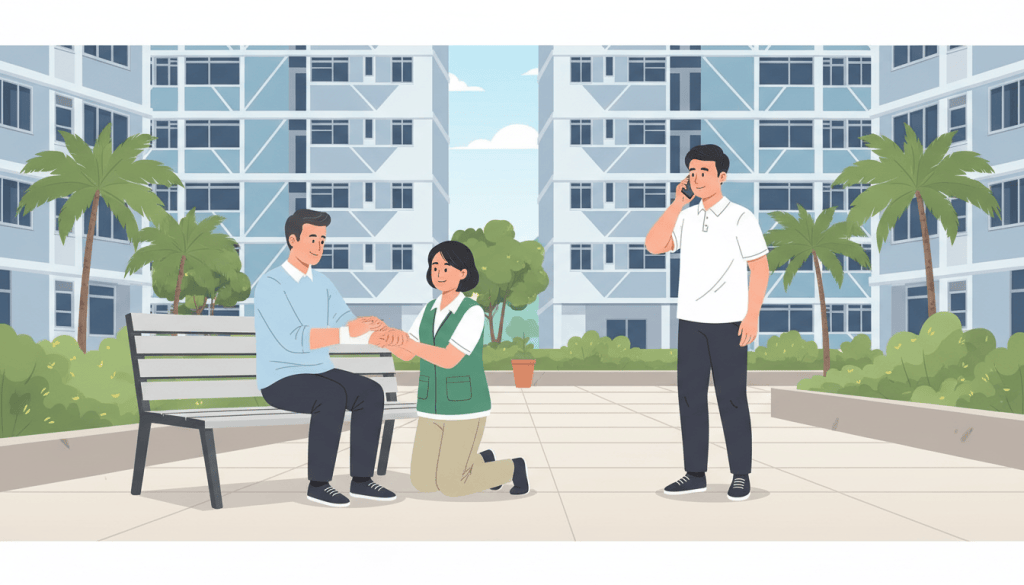
Someone in Sengkang has a deep cut, heavy bleeding, or blood that will not stop after an accident? Call 995 for an emergency ambulance if bleeding is severe, rapidly soaking through dressings, spurting, associated with collapse or another life-threatening injury. If you can reach the wound safely, apply firm, continuous direct pressure with a clean cloth or dressing and follow the SCDF dispatcher’s instructions. Do not spend time washing a heavily bleeding wound before attempting to control the blood loss.
Do not pull out an embedded object such as glass, metal or a knife; disturbing it may worsen bleeding. If an object is embedded, press around the wound without pushing the object farther in, and tell 995 what you can see. Keep the injured person as still and comfortably supported as practical. An apparently small opening may hide a more serious injury.
Quick contacts: 995 for severe bleeding and major injury; a GP or appropriate urgent-care service for a minor wound requiring cleaning, stitches, tetanus assessment or infection review; HealthHub’s wound-care advice for ordinary small cuts. This guide is for Sengkang residents and visitors, not a substitute for trained first aid.
Immediate checklist: the first two minutes
- Check the scene before approaching. Stay clear of moving vehicles, glass, exposed wiring, machinery and any continuing hazard.
- Call 995 when the injury is serious. Say that bleeding is heavy or not controlled, give the location and request emergency assistance.
- Apply firm, uninterrupted pressure. Use clean gauze, a cloth or a dressing directly over a bleeding wound unless an object is embedded.
- For an embedded object, do not remove it. Apply pressure to the surrounding wound, avoiding downward force on the object, and follow dispatcher advice.
- Keep the casualty at rest. Avoid unnecessary walking and movement; help them remain warm and supported.
- Watch for deterioration. Unusual paleness, sweating, weakness, confusion or faintness can accompany serious blood loss.
- Guide responders in. Give the Sengkang HDB block, unit and floor, or the exact shop, roadway or park entrance.
Who to call when bleeding will not stop
- 995 — Singapore Civil Defence Force: for severe bleeding, major trauma, an unresponsive casualty or another life-threatening medical emergency. SCDF Emergency Medical Services.
- 999 — Police: if a violent assault or active security danger is also occurring. Tell both services about the injury when appropriate.
- GP or urgent-care clinic: for a stable smaller wound that may need cleaning, closure, stitches or review, after initial bleeding has been controlled.
- Hospital Emergency Department: for deep injuries, uncontrolled bleeding, major trauma or other serious conditions; call 995 first when life is at risk.
- First-aid training provider: Singapore Red Cross teaches practical wound care and bleeding-control skills that an article cannot demonstrate fully.
What counts as severe bleeding?
Severe bleeding is not defined solely by an exact number of drops or the size of a cut. Warnings include blood coming out rapidly, bleeding that will not stop under firm pressure, a wound associated with major trauma, an injured person who becomes pale or confused, or a rapidly soaked dressing. Blood loss can become dangerous before an onlooker calculates its volume.
The Singapore Red Cross teaches immediate assessment, direct pressure and emergency contact for serious bleeding. A person with major blood loss may require hospital treatment even if they are still able to talk. Do not let a casualty walk away simply because the initial bleeding appears to slow.
There are also reasons for persistent bleeding unrelated to the wound’s size, including anticoagulant medication, bleeding disorders and certain medical conditions. Tell the healthcare team about relevant medicines if readily available.
How to apply direct pressure correctly
Use the palm of your hand over a clean dressing or cloth and press firmly on the bleeding site. Keep pressure steady rather than lifting the dressing repeatedly to inspect the wound. If it becomes soaked, maintain pressure and follow the dispatcher’s advice about adding more clean material or changing approach.
Direct pressure is a first-aid technique, not permission to press on an embedded object, fractured bone fragment or an area where pressure could worsen injury. In those circumstances, describe the wound to 995 and apply pressure around the site if safely possible.
If trained, you may have been taught additional techniques for uncontrolled limb bleeding. Do not improvise a tourniquet with a shoelace or tighten unknown materials around an injured limb. Let the 995 dispatcher guide any specialised intervention, and seek recognised training before an emergency occurs.
Never remove an embedded object yourself
A piece of glass or metal may be holding damaged tissue in a position that limits bleeding. Pulling it out can cause further injury. Do not wiggle, twist or tug at it, even when only a small part is visible.
Support the casualty so they do not fall against the object. If possible, pad around the object rather than pressing on top of it. The medical team will determine how and when removal can be performed safely.
For an eye injury, the rules differ: do not press on the eye or an embedded object, and seek specialist emergency assessment. See the Sengkang chemical eye and trauma guide.
What if bleeding comes from a small cut?
A small, shallow cut is not automatically an ambulance emergency. After controlling bleeding, rinse with clean water or saline, apply an appropriate clean dressing and monitor. HealthHub’s wound-care guide describes cleaning minor cuts, applying pressure and using suitable dressings.
Deep, gaping, contaminated, bite-related or persistent wounds should be assessed by a clinician. A hand wound may need evaluation if movement or sensation is affected. Cuts from dirty objects may also need tetanus advice.
Do not pour alcohol or medicated oil directly into a wound. HealthHub warns that alcohol on broken skin can cause unnecessary pain and delay healing.
Signs that blood loss may be affecting the whole body
- Feeling faint, weak or increasingly sleepy.
- Unusually pale, clammy or cold skin.
- Confusion, restlessness or reduced responsiveness.
- Fast or difficult breathing.
- Collapse or inability to stand.
- Rapid ongoing bleeding or blood-soaked clothing after trauma.
These findings may accompany shock or another serious condition. Call 995 and tell the dispatcher the person’s state. Do not give food, drinks or tablets to a confused, drowsy or seriously injured person who may not swallow safely.
If someone is taking blood thinners
A small cut may bleed longer in a person taking warfarin or other anticoagulants. HealthHub’s warfarin guide advises seeking medical attention if bleeding does not stop after about 15 minutes despite pressure, and immediate attention for serious bleeding.
Tell clinicians the medicine name, last dose if known, and whether the casualty recently fell or hit their head. Do not tell the person to stop or double an anticoagulant dose on the basis of a public article. Medication changes require clinical advice.
Deep cuts to hands, fingers and wrists
A hand injury may damage tendons, nerves or blood vessels, even if bleeding later stops. Inability to move a finger normally, numbness, unusual colour, severe pain or a deep gaping wound warrants timely professional assessment. Keep the hand supported and avoid probing the wound.
Do not attempt to stitch the wound, glue a deep cut or repeatedly bend an injured finger to test whether the tendon works. A clinician can determine whether specialist treatment is necessary.
If the bleeding follows a road accident
Protect yourself from traffic first. Call 995 for major bleeding and provide the road name, direction and closest junction or bus-stop number. For urgent Police assistance related to the collision, call 999 as appropriate.
Do not stand in a live lane to take photographs or stop bleeding. If it is safe to assist from a protected position, keep direct pressure and follow the dispatcher. The Sengkang road accident guide covers the separate Traffic Police and insurance reporting steps.
If a child gets a cut at a playground
Check the location and depth of injury. For heavy bleeding or serious trauma, call 995. For a smaller cut, clean and dress it appropriately and arrange medical assessment if it is deep, dirty, gaping, near a joint or associated with loss of normal movement.
A child may be frightened even when an injury is minor. Explain what you are doing in short sentences, avoid forceful restraint and keep other children clear of broken glass or exposed sharp equipment. Report a dangerous playground defect to the responsible estate manager after medical care is arranged.
Nosebleeds are different from deep cuts
For an uncomplicated nosebleed, standard first aid is to sit upright, lean slightly forward and pinch the soft part of the nose for a sustained period. Do not tilt the head backward or force tissue far into the nostril. Seek urgent assessment if bleeding is heavy, follows major facial injury or fails to settle.
If there is severe blood loss, collapse, major facial trauma or breathing difficulty, call 995. A nosebleed that follows head injury should also be assessed in the context of possible other injuries.
If the wound was caused by an animal bite
Bites may become infected even when they look small. Wash minor bite wounds appropriately and seek prompt medical assessment for punctures, deep wounds or infection concerns. Tell the clinician what animal was involved and where the incident happened.
Do not chase the animal or risk a second bite to obtain its species or photograph. For wildlife response in Sengkang, see the AVS and ACRES wildlife guide.
What to tell 995 from an HDB block
- Location: block, street, unit and floor; or lift lobby, shop entrance or park feature.
- Injury: which body part is bleeding and how it occurred.
- Bleeding: heavy, spurting, continuous or controlled under pressure.
- Condition: alert, confused, fainting or unresponsive.
- Other hazards: embedded object, electrical danger, vehicle collision or continuing violence.
- Medicines: known blood thinners or relevant medical conditions if available.
- Access: locked gate, lift and where a helper can meet responders.
Prevent infection after the immediate incident
Once bleeding has been controlled and a clinician has decided the injury can be cared for at home, keep it clean and covered according to instructions. HealthHub advises seeking further care if redness spreads, swelling worsens, warmth or pain increases, pus appears or fever develops.
Do not assume every cut needs antibiotics. A doctor assesses contamination, wound type, immunisation history and infection signs before recommending treatment. If a wound was caused by a dirty object or it is unclear when the last tetanus vaccination occurred, mention that during the visit.
Four everyday Sengkang examples
A kitchen knife slips while preparing dinner
For a small cut, apply clean dressing and pressure and assess whether medical care is needed. A deep cut or bleeding that will not stop requires urgent evaluation; call 995 if bleeding is severe.
A passer-by is bleeding heavily after a bicycle crash
Stay clear of moving traffic, call 995, apply firm direct pressure if safe and send someone to guide paramedics to the correct road or park connector entrance.
A child cuts a palm on broken playground glass
Remove the child from danger but do not pull glass embedded in the wound. Seek professional assessment and call 995 for significant uncontrolled bleeding.
An older resident on blood thinners has persistent bleeding
Apply firm pressure and seek prompt medical help. Tell clinicians about the medication. If the person becomes faint or bleeding is severe, call 995.
Frequently asked questions
Should I wash a heavily bleeding wound first?
Control serious bleeding with pressure and call emergency services first. Minor wounds can be cleaned after bleeding is controlled.
Should I pull glass out of a cut?
No. Leave embedded objects in place and seek medical care. Press around rather than on the object.
Does blood stopping mean stitches are unnecessary?
Not necessarily. Depth, wound edges, location, function and contamination determine whether medical closure or specialist assessment is needed.
Is every cut a 995 emergency?
No. Minor cuts may be managed with safe first aid and appropriate clinic review. Severe or life-threatening bleeding warrants 995.
Can I use a tourniquet without training?
Do not improvise. For life-threatening bleeding, call 995, apply direct pressure where appropriate, and follow dispatcher instructions on any additional technique.
Related Sengkang emergency guides
- Medical emergency and ambulance 995
- Road accidents and pedestrian injuries
- Burns, scalds and kitchen accidents
- Eye injury and chemical splash
New Sengkang emergency guides (6 November 2026): Pregnancy bleeding, labour and obstetric emergencies · Baby fever and paediatric emergency warning signs · KPE and TPE vehicle breakdowns and EMAS.
Official sources and reviewed date
- Singapore Red Cross — First Aid and CPR: Severe Bleeding
- HealthHub — Wound Care, Cuts and Infection Warning Signs
- HealthHub — Warfarin and Bleeding Precautions
- SCDF — Emergency Medical Services
Reviewed 6 November 2026. This guide provides initial safety steps for Singapore residents; it is not a substitute for hands-on first-aid training or treatment by an emergency clinician. For severe bleeding or major injury, call 995.
