
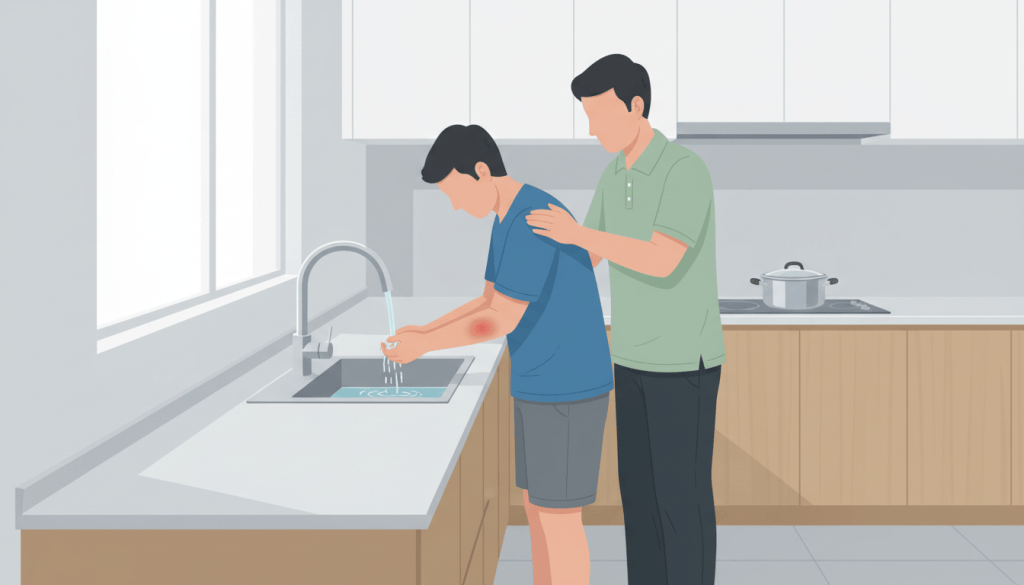
Someone in a Sengkang flat, kitchen, hawker centre or public place has been burned by hot water, oil, steam, fire or electricity? First make sure the source is no longer dangerous. Cool an ordinary thermal burn under cool running water for about 20 minutes where practical, without delaying an urgent 995 call. Do not apply ice, toothpaste, butter or cooking oil. Do not pull off clothing stuck to the wound. Severe burns, electrical burns, chemical burns and burns to sensitive areas need urgent medical assessment.
Call 995 for an active fire, significant injury, breathing difficulty, a major burn or another life-threatening emergency. For small superficial burns when the person is otherwise well, safe cooling and appropriate medical advice may be enough. If you are uncertain whether an injury is serious, describe the burn to the 995 call taker or seek urgent clinical assessment; do not wait for a wound to become obviously charred.
- Cool: gentle cool running water for about 20 minutes where feasible and safe. Singapore MOH advises at least 10 minutes for suitable small burns.
- Remove: rings or tight items near the injury before swelling, only if easily removable; leave stuck clothing in place.
- Cover: a cooled burn loosely with clean, non-adherent sterile dressing or suitable clean cover.
- Do not use: ice, butter, oils, toothpaste, fluffy cotton or broken blister skin.
- Emergency: 995 for serious burns, active fire, severe breathing trouble or other life-threatening conditions.
- Medical evaluation: electrical and chemical burns, charred or large burns, and injuries involving eyes, face, mouth, throat or genital area should receive urgent professional assessment.
The first minutes after a burn or scald
- Check that approaching is safe. Do not enter smoke, touch an energised appliance, go near exposed wires or put your hand into hot oil.
- Stop the heat exposure when safe. Move the person away from the hot liquid or source without causing another injury.
- Call 995 if the injury is severe or there is immediate danger. Ask another person to call while cooling if helpers are present.
- Cool the injured skin with cool running tap water. Aim for about 20 minutes when practical; avoid ice and ice-cold water.
- Remove tight items gently. A ring or watch may become difficult to remove after swelling starts. Do not remove fabric fused or stuck to the skin.
- Cover the cooled area loosely. Use a clean non-stick dressing; avoid tight wrapping, fluff or pressure on blisters.
- Seek the right clinical assessment. Serious, chemical, electrical, extensive or sensitive-area burns need urgent care regardless of a temporary reduction in pain.
Who to call for burns in Sengkang
- 995 — SCDF: emergency ambulance for a major burn, life-threatening injury, serious inhalation injury, electrical accident or another urgent medical emergency. SCDF Emergency Medical Services.
- 995 — fire and rescue: a burning kitchen, battery fire or smoke danger is a fire emergency even if nobody is yet visibly burned.
- Hospital emergency department: for severe burns, electrical or chemical injuries and urgent assessment. MOH burns and scalds guidance.
- GP or polyclinic: for appropriate assessment of a small non-emergency burn, persistent pain or blistering without other urgent danger.
- 6262 6262 — NurseFirst: advice about suitable care for a non-emergency condition; not a substitute for calling 995 during a serious burn or active fire.
Why cool running water is the correct first step
Heat can continue damaging skin even after the person is no longer in contact with the original source. Cooling the area promptly with running water helps limit the depth of injury. Singapore’s Ministry of Health recommends cool water for at least 10 minutes for small first- and second-degree burns; SingHealth recommends 10 to 20 minutes. International burn first-aid guidance commonly uses around 20 minutes when practical.
Cool water means water comfortable enough to flow over the injury, not an ice pack pressed against skin or an extremely cold immersion that causes additional tissue damage. It is better to start useful cooling immediately than to wait for special first-aid materials.
For children, older adults or an extensive burn, avoid cooling the entire person so much that they become dangerously cold. Cool the injury while keeping the rest of the body appropriately warm, and do not delay emergency medical help to finish a specific duration.
Why toothpaste, butter and ice are poor burn remedies
These products can make care harder and may damage skin. Ice or ice-cold water can cause further injury. Butter, oils, ointments and toothpaste can trap heat or make the wound harder to assess and clean. MOH and SingHealth explicitly advise avoiding these household remedies.
A burn first-aid kit does not need to contain unusual home treatments. Access to safe cool running water and clean non-stick dressing is more useful at the start. Later dressings and medicines should be chosen according to professional advice and the nature of the wound.
What to do about clothing, jewellery and blisters
Remove rings, watches, bracelets and loose tight items near the burned area as soon as it is safely possible. Swelling can develop after the accident. If clothing is stuck to the burn, do not pull it away. Cut around it only if it is safe and does not disturb the injury.
Do not puncture or peel blisters. The covering of a blister provides some protection against infection. If a blister opens spontaneously, keep the area clean and seek guidance on suitable wound care. Do not place fuzzy cotton directly onto a burn because fibres can adhere to the damaged tissue.
After cooling, a clean sterile non-adherent dressing can protect the area. Do not wrap tightly or use adhesive tape directly on injured skin.
When a burn needs an emergency department
MOH advises going to an emergency department for burns involving the mouth, throat, eyes, ears or genital area; for burns over a large area of the body such as larger than a hand; for chemical, electrical or lightning injuries; and for deep burns with white, leathery or charred skin. SingHealth similarly emphasises severe and sensitive-area burns.
A serious burn may not hurt as much as a smaller superficial burn if deeper nerves are damaged. Do not use pain alone to decide the injury is mild. If the casualty is having difficulty breathing, is unresponsive or has another major injury, call 995.
The extent and location of injury, age, medical history and cause influence care. Emergency professionals determine the correct hospital, dressing and monitoring plan; a photo guide cannot classify a severe burn with certainty.
If hot soup or boiling water spills onto a child
Move the child away from the hot container, stop exposure, and begin gentle cool running-water cooling as quickly as possible. Keep the rest of a baby or young child warm while cooling the affected area. Do not remove clothing stuck to the skin or apply toothpaste or oil.
If the scald involves a large area, the face, mouth, genital area or another serious feature, seek urgent medical evaluation and call 995 for significant or life-threatening injury. Children may require closer assessment even where the visible injury looks limited.
When reporting to clinicians, say what liquid was involved, approximate temperature if known, time of injury and whether anything was applied to the skin. There is no need to guess an exact temperature.
Cooking oil burns and an active kitchen fire
A splash of hot oil can burn exposed skin. Cool the thermal injury under appropriate running water after moving away from the hazard. But do not pour water onto a burning pan of cooking oil; this can spread the burning oil and create more serious injury.
If there is an active fire, alert occupants, leave by a safe route and call 995. Do not attempt to carry a burning pot to another room or out through a common corridor. Follow the Sengkang HDB fire and evacuation guide for related building safety.
Electrical burns need a different safety check
Do not touch a person who is still in contact with an energised wire or electrical source. The rescuer can also receive a shock. Avoid wet electrical equipment and treat exposed or fallen wires as live. Call 995 for a serious shock, unconsciousness, fire or other immediate danger. Professional responders or qualified personnel must make the scene safe.
A small visible mark does not prove an electrical accident was minor; electricity can cause injuries deeper than the skin. MOH places electrical burns among injuries requiring emergency department assessment. Do not open power panels or repair wiring yourself.
If the person’s source of exposure can be isolated safely without touching dangerous equipment, follow emergency dispatcher guidance. Do not re-enter a hazardous area to retrieve objects or reset circuits.
Chemical burns and cleaning products
A chemical may continue causing injury while it remains in contact with skin or clothing. Avoid exposing yourself to the substance and seek immediate medical advice. Emergency services should be alerted for a serious chemical release, significant injury or trapped person.
Where the chemical can be safely rinsed from the skin with running water, do so while following its safety instructions and the emergency professional’s guidance. Do not neutralise an acid or alkali with another household chemical. This could cause further burns or a dangerous reaction.
Eye exposure requires urgent professional evaluation. Do not rub the eye or apply an improvised solution. Tell emergency services the product name, if known from a safe label, without delaying help.
Smoke inhalation and burns around the face
A person near a fire who develops hoarseness, persistent coughing, difficulty breathing or burns around the mouth and nose needs urgent assessment for possible airway injury. Seek clean air without entering smoke and call 995 for serious symptoms or an active fire.
Do not assume someone is safe because the skin burn looks small. Smoke exposure and airway swelling can create serious internal danger. Give responders the fire location and whether the person had been in an enclosed smoke-filled room.
How to describe a burn to 995
- Exact address: Sengkang block, road, unit and floor; or restaurant, school, mall or park entrance.
- Cause: hot water, oil, fire, electrical source, chemical, steam or unknown exposure.
- Location on the body: face, hand, arm, leg, chest or another region.
- Extent: approximate size, swelling, blistering or visible white/charred skin, without making a diagnosis.
- Condition: consciousness, breathing, other injuries and whether the source remains dangerous.
- First aid: when cooling began and whether any substance was applied.
- Access: the quickest safe entrance or lift for responders.
Examples from everyday Sengkang life
A cup of hot kopi spills on a forearm
Move away from the spill, cool the burned skin with running cool water and remove a nearby watch if easy and safe. Do not apply toothpaste. Seek medical advice for blistering, persistent pain or uncertainty about the extent.
A child pulls a bowl of soup from a table
Stop exposure and cool the area promptly while keeping the rest of the child warm. Seek urgent medical care for a large or sensitive-area scald; call 995 for severe injury.
An appliance gives someone an electric shock and leaves a mark
Avoid contact until the power hazard is made safe and call for urgent help if needed. Electrical burns require emergency department assessment even when the visible mark seems small.
A resident has soot around the face after a corridor fire
Move to clean air and call 995 for serious breathing or inhalation concerns. Do not wait to see whether the person develops a large external skin burn.
Burn prevention in HDB kitchens and homes
- Keep children away from the cooking area and do not leave handles of pots extending over the edge.
- Place hot drinks and takeaway soup away from table edges.
- Check bathwater temperature before placing a child in it.
- Keep iron, hair straighteners and hot appliances out of children’s reach while cooling.
- Know where a safe exit and fire extinguisher are located, but do not fight a dangerous fire.
- Store cleaning chemicals appropriately and never mix them without explicit manufacturer instructions.
- Use approved electrical equipment and arrange professional checks for damaged wiring.
Frequently asked questions
How long should I run cool water over a thermal burn?
For a small ordinary thermal burn, aim for about 20 minutes where practical and safe. MOH specifies at least 10 minutes, while SingHealth recommends 10 to 20 minutes. Do not delay 995 or other urgent care for a severe burn.
Can I use ice or toothpaste?
No. Ice may harm tissue and toothpaste, butter or oil are not recommended burn treatments.
Should I break blisters to release pressure?
No. Do not deliberately pop or peel blisters. Seek appropriate clinical advice.
What if the burned person looks fine after an electrical shock?
Electrical injuries can extend beyond a small visible mark. MOH recommends emergency department assessment for electrical burns.
Do all tiny burns require a 995 ambulance?
No. Minor burns can often be managed initially with appropriate cooling and non-emergency medical advice. Call 995 for serious injuries, fire or other immediate danger.
More Sengkang emergency guides
- HDB fire, smoke and evacuation
- Gas leaks, LPG and piped gas
- Accidental poisoning and household chemicals
- Medical emergency and ambulance
Continue with the November 2026 Sengkang emergency batch: Drowning and safe water rescue · Heatstroke and heat exhaustion · Anaphylaxis and EpiPen. For life-threatening danger, call 995 before reading.
New Sengkang emergency guides: Stroke, heart attack, falls and haze. Stroke and F.A.S.T. signs · Heart attack and chest pain · Elderly falls and head injuries · Haze and breathing problems.
Official sources and review
- Ministry of Health — Mild Burns and Scalds
- SingHealth — Burns First Aid and GPFirst
- World Health Organization — Burns Prevention and First Aid
- HealthHub — Children’s Emergencies
- SCDF — Emergency Medical Services
Reviewed 6 November 2026. This public guide does not replace first-aid training, burn assessment or emergency instructions. Severe, electrical, chemical and sensitive-area burns need urgent professional care; call 995 for a serious emergency.
