
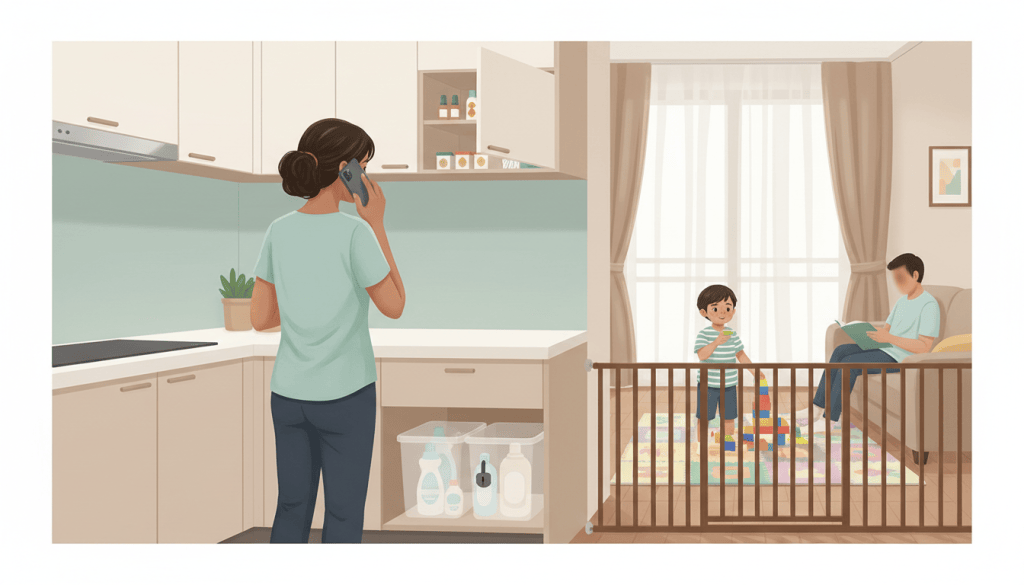
Someone in a Sengkang home may have swallowed medicine, detergent, cleaning fluid, a button battery or another harmful substance? Seek medical assessment immediately, especially when a child is involved. Call 995 for unconsciousness, difficulty breathing, seizures, collapse or another life-threatening emergency. Do not induce vomiting, give milk, offer a home-made antidote or wait for symptoms to appear. The substance and time of exposure matter, so preserve the container information if it is safe.
If hazardous fumes or a chemical spill affect a room, move people away from the exposure and do not enter the affected area to investigate or rescue someone without appropriate protection. Call 995 when there is serious illness, an uncontrolled hazardous release, a trapped person or urgent rescue danger. If a child may have ingested a poison but appears well, hospitals such as KK Women’s and Children’s Hospital advise immediate medical attention rather than observation at home, because some effects can be delayed.
- Collapse, difficulty breathing, seizures or serious chemical exposure: call 995 immediately.
- Suspected ingestion of medicine or household chemicals by a child: seek urgent medical assessment even if the child seems normal.
- Do not: induce vomiting, give milk, invent an antidote or force someone to eat or drink.
- Tell the medical team: age, substance, approximate amount if known, time, symptoms and whether the container is available.
- Possible button-battery or sharp-object swallowing: urgent hospital evaluation; do not wait for pain.
- Fumes or chemical leak: withdraw to safe air without crossing the contaminated area and contact emergency services if there is immediate danger.
First five minutes: suspected poisoning at home
- Check the person’s condition. Is the person awake, breathing normally and responsive? If not, call 995 and follow dispatcher instructions.
- Stop further exposure safely. Move medicines or chemicals away only if you can do so without touching hazardous material or exposing others.
- Do not cause vomiting. Avoid food, milk, drinks or unprescribed treatment unless an appropriate healthcare professional specifically advises it.
- Seek medical assessment promptly. This is especially important for a child after suspected medicine, chemical or foreign-body ingestion.
- Keep the packaging or take a safe photograph of the label. Note the name, strength, active ingredients and amount missing if known.
- Record the possible exposure time. An approximate time is better than delaying care while attempting to establish a precise minute.
- For chemical fumes, retreat from the source. Do not re-enter to investigate. Tell 995 if anyone is seriously unwell or there is a dangerous release.
Who to call in Sengkang
- 995 — SCDF Emergency Medical Services: for severe poisoning symptoms, life-threatening injury, loss of consciousness, breathing difficulty, seizures, dangerous chemical exposure or urgent rescue. SCDF 995 guidance.
- Hospital emergency department: for prompt assessment after suspected toxic ingestion, particularly in children or where the substance could cause delayed injury. KKH Children’s Emergency information.
- Healthcare professional: for evaluation of accidental medication errors when immediate life danger is not evident. Do not delay for routine advice when significant overdose or toxic exposure is suspected.
- 6262 6262 — NurseFirst: general non-emergency healthcare guidance; not a dedicated poisoning hotline and not a substitute for urgent assessment.
- 999 — Police: only when a separate immediate policing or security danger is involved, such as intentional threats or suspected assault.
Why a child can appear well after swallowing something dangerous
The effects of some medicines and poisons are not immediate. A child who has swallowed tablets may continue playing or speaking normally before a serious problem develops. KKH warns caregivers against waiting at home to see whether symptoms begin, especially because some substances can cause delayed organ injury.
Do not decide the ingestion was harmless because the child did not vomit or because only one tablet appears missing. The risk depends on what the substance was, its amount, the child’s size and other factors. A medical professional needs those facts and may recommend tests or observation.
Even a household product normally used safely by adults may be hazardous if swallowed in the wrong way or amount. The correct first action is assessment, not an internet search for a household antidote.
What information to bring to the hospital
- Product name: brand and generic medication name or cleaning product, if known.
- Strength and ingredients: medicine concentration, dose or chemical label; a photo helps when bringing the container is unsafe.
- Time: when the person may have swallowed, inhaled or touched the substance.
- Amount: the number of tablets or volume that may be missing, without guessing if you cannot tell.
- Person: age, approximate weight for a child, known conditions or medicines if relevant.
- Symptoms: changes in breathing, behaviour, swallowing, vomiting, skin or eye irritation.
- What has already been done: whether someone gave food, drinks, other medication or attempted first aid.
Keep original packaging out of children’s reach and do not handle a damaged or leaking chemical container unnecessarily. Tell paramedics or doctors exactly what you know, including any uncertainty.
If a child swallows a medicine tablet
Do not attempt to make the child vomit or give another medicine to counteract it. Contact medical services promptly. The appearance of the tablet alone does not tell you how much of the active ingredient was swallowed.
KKH lists accidental poisoning as requiring prompt medical assessment and warns that medication effects may be delayed. Take or photograph the medicine packaging and count remaining tablets only if doing so is safe and does not delay care.
If the child becomes drowsy, unconscious, convulses or has difficulty breathing, call 995 and follow its instructions. Do not try to keep an unresponsive child upright to drink water.
If someone takes too much of a prescribed or over-the-counter medicine
An accidental double dose, a mix-up between medicines or taking someone else’s tablets should be assessed according to the actual substance and dose. You cannot safely infer the effect from the medicine being available over the counter.
If a potentially harmful amount was taken, seek prompt professional advice or urgent care. Do not wait until the next scheduled appointment if there is a real possibility of overdose. If there are severe symptoms, call 995. Do not attempt to counterbalance one medicine with another.
For ongoing medicine management, pharmacists and prescribing clinicians can help households simplify labelling and avoid duplicate doses, especially when several caregivers give medicines to the same person.
Button batteries, magnets and small dangerous objects
A child who may have swallowed a button battery needs urgent medical evaluation, even if they seem well. KKH also identifies sharp objects, magnets and other hazardous swallowed foreign bodies as reasons for medical attention. Keep loose batteries and detachable toy parts out of reach.
Do not induce vomiting or attempt to retrieve an unseen object by reaching into the throat. Do not delay seeking care while waiting to see whether a battery passes. Tell the healthcare team exactly what item may have been swallowed, and bring matching packaging if available.
Difficulty swallowing, drooling, chest or abdominal pain, vomiting or breathing problems are warning signs. But the absence of symptoms does not prove that a suspected button-battery ingestion is safe.
If cleaning products are swallowed
Detergents, bleach-containing cleaners, disinfectants, descalers and other products may irritate or injure different tissues. They are not interchangeable, and one response cannot safely cover every formulation.
HealthHub advises seeking medical attention promptly after suspected childhood ingestion of cleaning products and not giving milk or inducing vomiting. Bring the label or tell the medical team which substance was involved. Never administer a home-made neutraliser or any chemical to ‘cancel out’ the exposure.
If someone has trouble breathing, collapses or is severely unwell, call 995. Keep other family members from touching or consuming the product. Do not taste it yourself to identify it.
If fumes appear while cleaning a toilet or kitchen
Some household cleaning products can release harmful gases when combined. Do not mix cleaners to make them stronger. If you notice irritating fumes, coughing, eye pain or difficulty breathing, stop the activity and leave the affected area for safe air. Do not try to identify the reaction by sniffing the container again.
If there is a significant chemical release, a person is trapped or serious respiratory symptoms develop, call 995 from a safe location and tell SCDF that chemical fumes may be involved. Do not re-enter a contaminated area to bring out household objects. Responders may need specialist equipment.
For skin or eye exposure, appropriate immediate rinsing may be necessary, but the best approach depends on the chemical and severity. Follow the product’s safety instructions and emergency guidance. Avoid applying other chemicals, ointments or substances as a remedy without professional advice.
If a child bites into a detergent pod
Detergent pods can attract attention because they are small, bright or resemble sweets. They may contain concentrated ingredients. Move the remaining pods out of reach, seek urgent medical advice and do not induce vomiting or give a drink unless directed by the healthcare professional.
Record the product and exposure time and bring the packaging. A child who develops breathing problems, loss of consciousness or severe illness requires 995. Do not assume a small puncture or spilled amount means the contents were harmless.
If an elderly person may have taken the wrong medicine
Medication errors can occur when tablets look similar, doses change after a hospital visit or more than one family member is helping. Make a factual list of medicines taken and the time. The relevant healthcare team can assess whether an urgent evaluation is needed.
Do not tell the person to skip multiple future doses or take extra tablets to ‘balance’ an error without medical guidance. For collapse, serious confusion, breathing difficulty or another life-threatening symptom, call 995.
What if the substance is unknown?
You can still seek help. Explain the location and circumstances: a child was found holding an open pill organiser, a cleaner bottle has leaked or a person became ill in a room with strong fumes. Say what you know and what you cannot confirm.
Do not delay reporting while searching for the exact product identity. If the scene itself is hazardous, responders can manage access and safety. The healthcare team can decide which tests or monitoring are appropriate.
What not to do after a suspected poisoning
- Do not induce vomiting or use a finger to gag the person.
- Do not give milk, food, drinks, saltwater or an unprescribed antidote.
- Do not leave a vulnerable person alone if they may become unresponsive.
- Do not wait for visible symptoms after a child may have swallowed a harmful medicine or chemical.
- Do not mix additional cleaning products to neutralise a spill.
- Do not enter a room with unidentified hazardous fumes to investigate.
- Do not rely on anonymous social media advice in place of urgent medical assessment.
Four Sengkang situations
A toddler is found next to an open medicine box
Look for what may be missing without delaying care, seek immediate medical assessment and bring the label. Call 995 if there are severe symptoms such as collapse or difficulty breathing.
A child may have swallowed a button battery from a toy
Seek urgent hospital evaluation; do not wait for pain or vomiting. Tell the healthcare team what object is suspected and when the child last had access to it.
An adult becomes dizzy after using cleaning products in a small toilet
Leave the area for safe air. Do not return to investigate or mix more products. Call 995 for serious symptoms or hazardous release, and inform responders about the products used if known.
An older relative accidentally takes an extra dose
Identify the medicine, strength and time, and seek professional advice promptly. Do not change other doses without guidance. Severe symptoms require 995.
Prevent avoidable poisonings at home
- Keep medicine and household cleaning supplies in their original labelled packaging.
- Store hazardous products in secure places away from children and pets.
- Never transfer a cleaner into a drink bottle or food container.
- Keep loose button batteries and small magnets out of children’s reach.
- Do not mix household cleaning products unless the manufacturer explicitly directs a safe combined use.
- Use a clear medicine administration record when several adults care for a child or older person.
- Dispose of expired and unused medicines appropriately through healthcare or pharmacy guidance.
Frequently asked questions
Should I wait for symptoms if my child may have swallowed a dangerous tablet?
No. KKH advises immediate medical assessment for suspected poisoning because serious effects may appear later.
Is milk a safe antidote after swallowing a cleaner?
No general milk remedy is recommended. HealthHub specifically advises against giving milk or inducing vomiting after suspected infant poisoning unless directed by a doctor.
Can a button battery be harmless if there is no pain?
Do not assume so. A suspected swallowed button battery warrants urgent medical evaluation even when symptoms are absent.
What if I only breathed in fumes?
Leave the area for safe air and do not re-enter a hazardous space. Serious breathing symptoms or an uncontrolled chemical release require urgent emergency response; call 995.
Who can tell me what the person swallowed?
Bring the actual packaging or an accurate label photo to the healthcare team. Do not taste or smell an unknown substance in order to identify it.
Related Sengkang emergency guides
- Choking, infant first aid and CPR-AED
- Medical emergency and ambulance 995
- Gas leaks, LPG and piped gas
- Home fire, smoke and evacuation
More Sengkang emergency guides (5 November 2026): Family violence, child and elder protection · Mental-health crisis and 24-hour support · Choking, infant first aid and CPR-AED.
Official sources and review information
- KKH — Childhood Injuries and Accidental Poisoning
- KKH — Children’s Emergency: Poison and Foreign-Body Ingestion
- KKH — Throat Objects, Including Button Batteries
- HealthHub — Emergency Care for Children
- HealthHub — Keep Your Home Free from Poison Hazards
- SCDF — Emergency Medical Services
Reviewed 5 November 2026. This page is a practical public guide, not a poison diagnosis or antidote service. Suspected toxic ingestion by a child needs prompt medical assessment even without symptoms. Call 995 for life-threatening symptoms or a dangerous chemical exposure.
