
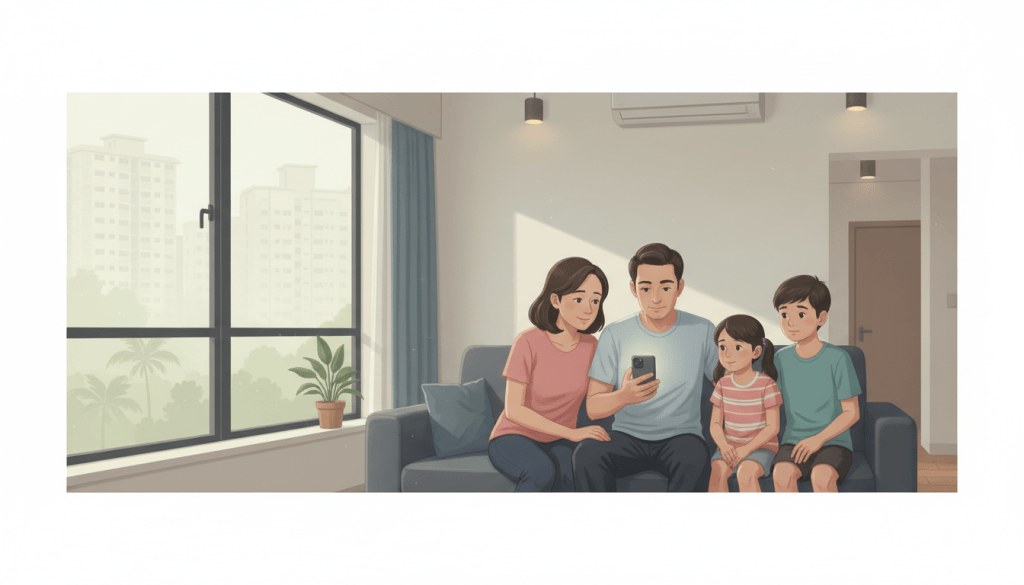
Air in Sengkang looks hazy, smells smoky or is affecting your breathing? Check official air-quality information at haze.gov.sg or the myENV app. For Sengkang, the National Environment Agency groups air-quality readings with the North region. If someone has severe breathing difficulty, chest pain, confusion, collapse or another life-threatening symptom, call 995 immediately. Do not wait for an air-quality reading to reach a particular number before seeking emergency medical care.
For people who are otherwise stable, the important decision is usually how much outdoor exertion to reduce, particularly for children, older adults, pregnant people and residents with chronic heart or lung disease. Look at the current 1-hour PM2.5 reading when deciding what to do soon, and the 24-hour PSI and forecast for broader planning. A smoky smell or an old screenshot is not a reliable substitute for the official figures.
Quick action: severe medical symptoms — 995; current haze readings — NEA, haze.gov.sg or myENV; persistent mild symptoms — seek professional medical advice. This article is a Sengkang-specific guide to interpreting alerts and protecting household members, not a live haze report.
The first five minutes when haze affects your area
- Check symptoms first. Severe breathlessness, chest pain, collapse or new confusion requires emergency help regardless of the published PSI.
- Check the official reading. Open NEA’s haze microsite or myENV app and select the North region for Sengkang.
- Read the 1-hour PM2.5 guidance for immediate outdoor plans. It may change during the day.
- Read the 24-hour PSI and the forecast to decide whether to shorten or postpone longer outdoor activities.
- Adjust exertion to personal risk. Children, older adults, pregnant people and people with existing heart or lung disease may need additional precautions.
- Move activities indoors when appropriate. Keep indoor air reasonably clean and reduce smoke entering from outside when levels are elevated.
- Seek medical advice for persistent symptoms. Do not label worsening breathlessness as ‘just haze’ without considering a serious medical condition.
Who to call or check in Sengkang
- 995 — SCDF emergency ambulance: serious breathing difficulty, severe chest pain, collapse or other life-threatening symptoms. SCDF Emergency Medical Services.
- NEA haze microsite: haze.gov.sg for current regional air-quality readings and government advisories.
- myENV app: regional 24-hour PSI, 1-hour PM2.5 and relevant environmental updates.
- NEA air-quality FAQs: how PSI and PM2.5 are measured and which region applies.
- Healthcare professional: when a child, older person or someone with asthma, COPD or heart disease experiences symptoms that need assessment. Do not use an environmental enquiry service instead of emergency medical help.
Which NEA region covers Sengkang?
NEA groups Singapore into five reporting regions: North, South, East, West and Central. Its published region guide lists Sengkang and Punggol under North, alongside places such as Yishun, Sembawang and Woodlands. It does not publish a unique PSI number for every HDB block.
When someone asks ‘What is the Sengkang PSI?’ the most accurate answer is to check the current North regional reading, while recognising that local visibility and smell may vary within the region. Do not invent an estate-specific figure or copy another part of Singapore’s reading as though it applies precisely to your block.
For Sengkang residents travelling to another estate, the relevant region for that destination may differ. Check the official region selection before comparing two activities.
The difference between 24-hour PSI and 1-hour PM2.5
PSI is Singapore’s Pollutant Standards Index, calculated using a rolling 24-hour average of multiple pollutants. It helps describe longer exposure levels and supports broad health advisories. The index categories are commonly Good (0–50), Moderate (51–100), Unhealthy (101–200), Very Unhealthy (201–300) and Hazardous (above 300).
PM2.5 refers to fine airborne particles. NEA’s 1-hour PM2.5 concentration reading helps show more immediate changes, which can matter during transboundary haze. The 1-hour levels may rise and fall more quickly than the 24-hour PSI. This does not make the 24-hour index wrong; it means the two measures describe different time windows.
NEA’s air-pollution FAQs explain why people should use the 1-hour PM2.5 personal guide for near-term activities and the 24-hour PSI forecast and advisories for longer planning. Avoid comparing a 1-hour PM2.5 number directly to a 24-hour PSI category as if they shared identical units.
What to do at a Moderate PSI
At a Moderate 24-hour PSI, healthy people can generally continue normal activities. However, somebody who feels unwell or has a condition affected by poor air quality should not dismiss symptoms simply because the regional reading is in a moderate category.
Check the 1-hour PM2.5 reading for immediate outdoor activity and follow any personalised medical advice. A child with breathing symptoms, for example, should be assessed on actual condition rather than solely the environmental category.
What changes when PSI becomes Unhealthy?
NEA’s September 2026 haze advisories state that when the 24-hour PSI is Unhealthy, healthy persons should reduce prolonged or strenuous outdoor physical exertion. Older adults, pregnant people and children should minimise prolonged or strenuous outdoor exertion. People with chronic heart or lung disease should avoid it.
These are graded recommendations, not instructions that every person must remain indoors constantly. The appropriate response depends on individual health and activity duration and intensity. Check the current NEA guidance for more severe categories as the situation changes.
A useful household decision is to postpone a strenuous park-connector run while allowing an essential short journey with suitable precautions. Do not treat all outdoor activity as identical.
The 1-hour PM2.5 guide for immediate activity
A short-duration spike in fine particles can matter when someone is about to start an outdoor workout. During haze advisories, NEA’s 1-hour PM2.5 bands include Normal, Elevated, High and Very High. For example, the September 2026 advisories advised healthy adults to reduce strenuous outdoor activity over the following hour when 1-hour PM2.5 was Elevated, with stronger caution for susceptible groups.
The current personal guide and band category should be checked on the official site; it is better to refer to that than reproduce a single fixed table without context. The reading may change during a commute or a school day. Use a fresh timestamped official reading rather than a social media repost.
If someone has asthma or chronic lung disease
Haze can irritate the airways and aggravate underlying respiratory conditions. Keep prescribed inhalers and the individual’s medical action plan available and follow the treating clinician’s instructions. If symptoms remain mild but are worsening, contact a healthcare professional promptly.
For severe breathing difficulty, inability to speak normally because of breathlessness, confusion, collapse or other life-threatening symptoms, call 995. Do not assume that a normal-looking PSI prevents an asthma or cardiac emergency.
If the person uses oxygen or other equipment, maintain their clinician-directed emergency plan, and mention the equipment when seeking help. This article does not prescribe inhaler doses or substitute for personalised medical advice.
Children, older adults and pregnant people
These groups may have different sensitivity to poor air quality or difficulty communicating symptoms. Schools, caregivers and organisers should watch actual symptoms and adapt long outdoor sessions. An ordinary short journey and an endurance sports session carry very different exertion loads.
For a child with a history of asthma or a medical restriction, follow the child’s action plan and healthcare advice, not a generic assumption that other children can complete the activity. Older adults with heart or lung disease should use current NEA advisories to decide whether a longer outdoor journey can be postponed.
Pregnant people are advised to reduce exposure to haze when conditions warrant. Consult their own healthcare professional about symptoms or activity restrictions rather than relying solely on the index.
Does an N95 mask solve all haze exposure?
No mask removes all risk, and proper fit matters. NEA explains that N95 masks are generally not necessary for short commuting between home and school or work, and usually are not needed indoors. Health guidance may recommend a well-fitting N95 or equivalent for certain people and circumstances involving prolonged outdoor exposure during severe haze.
A surgical mask primarily serves different purposes and does not provide the same fine-particle filtration when poorly fitted. Children and people with significant respiratory or heart conditions should seek appropriate advice before using tight-fitting respirators, especially where breathing becomes difficult.
The most reliable first step during high haze exposure is reducing unnecessary strenuous outdoor activity and improving indoor air quality. Masks are an additional measure, not a reason to continue activities contrary to official health advice.
How to keep indoor air cleaner
- Close windows when outdoor air quality is poor if that helps reduce smoke entry and indoor temperature remains safe.
- Use air-conditioning and suitable air filtration where available, maintaining filters properly.
- Avoid adding indoor pollution by smoking, burning incense or other combustion-based activities during haze.
- Plan ventilation decisions around the actual outdoor conditions and indoor comfort rather than keeping windows shut continuously without considering heat.
- Keep routine prescriptions and essential medical devices accessible for vulnerable household members.
- Seek professional help for persistent cough, wheezing or worsening breathing symptoms.
Should schools, tuition centres or community groups cancel outdoor activities?
Education providers, sports organisers and workplaces should use the current official advisories and any sector-specific instructions. A general household page cannot replace an organisation’s safety policy, risk assessment or government direction.
It is useful to separate essential outdoor travel from optional prolonged exertion. A centre may continue indoor lessons while moving a strenuous outdoor activity inside. Decisions should be communicated clearly without inventing a closure order.
If a participant becomes medically unwell, activity decisions are secondary; seek the correct medical assistance. Do not wait for an organiser to confirm a PSI reading before calling 995 in a genuine emergency.
If a person is short of breath at a bus stop or park
Move toward a safe place where they can rest and obtain appropriate help. Severe shortness of breath, chest pain, collapse or confusion warrants 995. Give the bus-stop number, nearby road and direction, or the park’s accessible entrance. Ask staff or bystanders to direct responders without exposing the person to unsafe travel.
If symptoms are milder and the person is otherwise stable, reduce exertion, seek a clean-air environment and arrange prompt medical advice when needed. A phone-screen number does not diagnose what is causing their symptoms.
What if you smell smoke but official readings are not high?
A local fire, burning rubbish or another nearby smoke source can affect a small area without being fully represented by a regional 24-hour average. Visible nearby flames, dangerous smoke entering a flat or breathing difficulty from an active incident requires a different response.
If there is an active fire or rescue emergency, call 995 and follow the Sengkang HDB fire guide. Do not dismiss a current, local fire simply because the North regional PSI is Moderate.
What if social media says Sengkang is ‘hazardous’?
Check the timestamp, original source, reported region and whether the figure is PSI or PM2.5. A screenshot may be from another day, or the message may confuse units. Go directly to NEA’s official haze microsite and compare the current reading and personal guide.
You can share an official link with neighbours instead of forwarding an alarming, unverified graphic. If the page or app is briefly unavailable, seek official NEA announcements rather than guessing a number.
Everyday Sengkang scenarios
A family plans a long outdoor run near a park connector
Check the North region’s 1-hour PM2.5 reading and 24-hour PSI guidance shortly before leaving. During Unhealthy PSI, reduce or avoid prolonged strenuous exertion according to personal health risk. Consider an indoor alternative.
An older resident with heart disease needs an errand
If levels are Unhealthy, minimise exposure and consider delaying a non-essential trip. If they develop severe chest pain or breathing difficulty, call 995; do not regard it as ordinary haze discomfort.
A child begins coughing during outdoor play
Stop the activity and move to a suitable indoor environment. Follow any asthma action plan, and seek medical advice if symptoms persist. Severe breathing problems require 995, regardless of the PSI.
Someone smells smoke at an HDB corridor
Check safely for evidence of a local fire. If there is dangerous smoke or flames, call 995. Regional haze readings do not replace fire-safety judgement.
Prepare your household for the next haze episode
- Bookmark haze.gov.sg and install or update the myENV app.
- Know that Sengkang belongs to the North region in NEA’s air-quality reporting.
- Keep prescribed respiratory medicines available and understand the person’s individual action plan.
- Maintain suitable indoor air filtration and clean filters as recommended by the manufacturer.
- Prepare alternative indoor exercise or social activities for days when outdoor exertion should be reduced.
- Teach children the difference between a haze advisory and a fire emergency.
- Do not share old PSI screenshots as current conditions.
Frequently asked questions
Which PSI region should Sengkang use?
NEA lists Sengkang under its North regional air-quality reporting area.
Is 1-hour PM2.5 the same as the 24-hour PSI?
No. PM2.5 shows short-term fine-particle concentration and PSI combines longer-term concentrations of several pollutants. Use both for their respective purposes.
Does haze always require calling 995?
No. A haze advisory alone is not an ambulance emergency. Call 995 for life-threatening symptoms such as severe breathing difficulty, chest pain or collapse.
Should everybody wear an N95 mask to commute?
NEA’s guidance generally does not require N95 masks for ordinary short commuting or indoors. Precautions should match actual conditions, activity duration and health risk.
What if haze seems worse than the reading?
Check the timestamp and region, and consult official updates. If there is local smoke from a fire, treat that as a separate hazard and call 995 if an emergency exists.
More Sengkang emergency guides
- Medical emergencies and ambulance 995
- Heatstroke and heat exhaustion
- HDB fire, smoke and evacuation
- Heart attack, chest pain and cardiac arrest
Official sources and review
- NEA — Air-Pollution FAQs, PSI and Sengkang North Region
- NEA — Haze and Live Readings
- NEA — 13 September 2026 Haze Activity Advisory
- Ministry of Health — Emergency Care for Breathing Difficulty and Chest Pain
- SCDF — Emergency Medical Services
Reviewed 6 November 2026. This page is not a real-time haze alert and does not claim the current PSI or PM2.5 level. Always use current official NEA readings and seek emergency assistance for life-threatening symptoms.
