
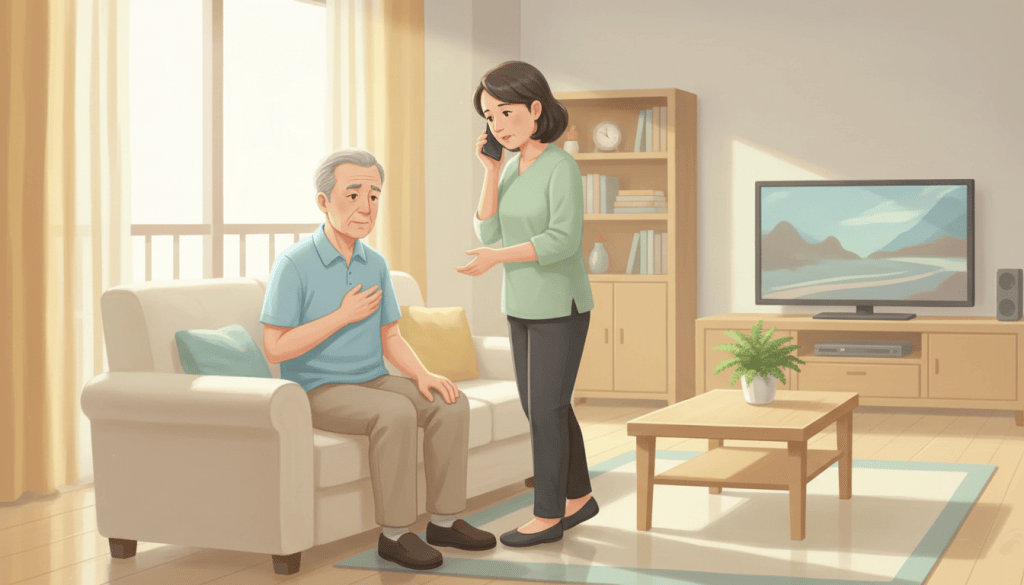
Someone in Sengkang has sudden, severe or persistent chest pain, pressure or tightness, especially with breathlessness, cold sweating, nausea or faintness? Call 995 immediately. A heart attack is a medical emergency and can be fatal. Do not wait for the pain to spread to the left arm, do not try to drive the person to hospital, and do not postpone a call until the pain has lasted a fixed number of minutes.
Help the person stop activity and sit or rest in a comfortable position. Tell the SCDF dispatcher the exact Sengkang address and symptoms. Stay with them, observe their breathing and follow the operator’s instructions. If they become unresponsive and are not breathing normally, begin dispatcher-directed CPR and use an AED if available. Do not perform CPR on an alert person who is breathing normally.
Immediate contact: SCDF emergency ambulance 995. For people with hearing or speech impairments, SCDF emergency SMS at 70995 is available. A general hospital appointment line, a GP booking or a private car journey is not a replacement for an emergency ambulance in a suspected heart attack.
The first minute: signs that should make you call
- Chest pressure or heaviness: squeezing, crushing or uncomfortable tightness that is new, severe, persistent or occurring at rest.
- Breathlessness: sudden shortness of breath, especially with chest discomfort.
- Cold sweat, nausea or unusual dizziness: concerning symptoms when they appear with chest pain or breathlessness.
- Pain elsewhere: discomfort may extend into the arms, jaw, neck, shoulders, back or upper abdomen.
- Sudden collapse: loss of responsiveness with absent or abnormal breathing is a cardiac-arrest emergency.
- No obvious chest pain: some heart attacks produce less typical symptoms, including in women and people with diabetes.
What to do while waiting for 995
- Stop all exertion. Have the person sit or rest in a comfortable and safe position.
- Call 995. State ‘possible heart attack’ and describe the pain, breathing and accompanying symptoms.
- Do not let the person drive. National Heart Centre Singapore says a person with suspected heart attack should not drive to hospital.
- Stay with them. Keep communication calm and monitor whether they can speak and breathe normally.
- Do not give unprescribed medicines. Follow any existing individual emergency plan and the 995 operator’s medication instructions; do not self-prescribe aspirin.
- Make emergency access easy. Tell the dispatcher your block, road, unit, floor or exact public-venue entrance and send someone to meet paramedics if another helper is available.
- Act on sudden collapse. If unresponsive and not breathing normally, follow dispatcher-guided CPR and AED use.
Who to call for chest pain in Sengkang
- 995 — SCDF emergency ambulance: for suspected heart attack, ongoing severe chest pain, serious breathlessness or collapse. SCDF emergency medical services.
- 70995 — SCDF emergency SMS: accessibility service for deaf, hard-of-hearing or speech-impaired persons; include precise location and emergency details.
- Hospital Emergency Department: urgent evaluation is required; if symptoms suggest heart attack, calling 995 is the first action. National Heart Centre Singapore emergency instructions.
- GP or polyclinic: follow-up for stable, non-emergency conditions and risk management; not a reason to postpone 995 during potentially life-threatening symptoms.
Heart attack symptoms may not look like television scenes
Not every heart attack begins with a person clutching their chest and collapsing. The National Heart Centre Singapore describes pain that may feel crushing or heavy, but it also lists new shortness of breath, nausea, light-headedness, cold sweating, palpitations and discomfort in the arms, neck, jaw, shoulders, upper back or stomach.
Some people, especially women, may have less typical warning symptoms and may describe indigestion-like discomfort, unusual fatigue or nausea. People with diabetes may sometimes have heart attacks without the classic severe pain. A bystander cannot safely rule out a heart problem simply because the person is still walking or talking.
There are also many non-cardiac causes of chest pain. That uncertainty is exactly why a serious presentation requires clinical assessment, rather than confident self-diagnosis at home.
Do not use a 15-minute rule to delay calling
Some medical resources describe heart attack discomfort that lasts 15 minutes or more, but this is a description of common symptoms, not a rule to wait 15 minutes before calling. Sudden severe pain, chest discomfort with breathlessness, sweating or faintness, or a concerning worsening pattern calls for prompt emergency assessment.
The Ministry of Health’s emergency advice lists sudden or severe chest pain, difficulty breathing and other new concerning symptoms as medical emergency signs. SingHealth’s chest-pain guidance recommends 995 for ongoing severe chest pain with concerning features.
If symptoms are mild, unusual or intermittent and you are uncertain what they mean, seek timely professional assessment rather than dismissing them. If they become severe, occur with red flags or raise strong concern for a heart attack, call 995 immediately.
Heart attack versus sudden cardiac arrest
A heart attack usually involves a blockage affecting blood supply to part of the heart muscle. A person can remain conscious and breathing, although seriously ill. Cardiac arrest is a different emergency in which the heart stops pumping blood effectively, usually presenting as sudden unresponsiveness and absent or abnormal breathing.
National Heart Centre Singapore and the Singapore Heart Foundation explain that CPR and an AED are used for cardiac arrest, not for a person who is alert and breathing normally with chest pain. However, a heart attack can sometimes lead to cardiac arrest. This is why it is important to remain with the person and monitor any changes.
If the person collapses and is not breathing normally, tell the 995 operator and follow their CPR instructions. Have another helper retrieve an AED if available, and obey the device’s spoken prompts. Do not delay emergency contact to search for equipment.
Why not drive yourself to hospital?
Chest pain can worsen without warning, and the person may faint or develop an abnormal heart rhythm during the journey. Driving while unwell also endangers road users. An SCDF ambulance can assess the person and coordinate suitable emergency care.
The National Heart Centre Singapore explicitly warns people with severe chest pain not to attempt to drive to hospital themselves. There is no requirement to choose a hospital in advance; the ambulance service will determine the appropriate response and conveyance.
Do not assume that a nearby emergency department must be the destination for every cardiac case. Responders determine where the patient should go based on urgency and available care pathways.
What about aspirin, nitroglycerin and familiar heart medicines?
Some patients have a prescribed emergency plan or medications for known heart disease. Follow the person’s existing doctor-directed plan and the advice of the 995 operator. Do not give someone else’s medicine or administer aspirin on the assumption that all chest pain means a heart attack.
The Singapore Heart Foundation’s first-aid guidance advises calling 995 first and following operator direction regarding aspirin for patients where it is appropriate. Some people have allergies, bleeding risks, other conditions or alternative causes of pain. A public article cannot screen those risks safely.
If the person is prescribed nitroglycerin, tell the dispatcher and follow the patient’s specific medical instructions. Do not give additional or unfamiliar doses based on an online guide.
How to explain the symptoms to the dispatcher
- Exact location: HDB block, street, unit and floor; or station, mall or workplace name, level and closest entrance.
- Symptoms: pressure, pain, breathlessness, sweating, faintness, nausea and whether pain radiates elsewhere.
- Timing: when symptoms began and whether they are constant, worsening or recurring.
- Current state: alert or unresponsive, breathing normally or not, able to speak or not.
- Known history: diagnosed heart problems, allergies and relevant prescribed medications if readily available.
- Access: gate, stairs, lift lobby or security desk details for responders.
Chest pain in a public place such as the mall or MRT
If someone becomes unwell while shopping or commuting, help them stop activity in a safe place away from moving vehicles, platform edges or crowds. Ask venue staff to contact their emergency-response team and guide paramedics to the correct entrance. Do not make a severely unwell person walk to meet the ambulance.
If another bystander is available, ask them to locate an AED while you remain with the person and communicate with 995. A nearby AED is helpful if cardiac arrest occurs, but it does not replace assessment and emergency transport for chest pain.
What if a younger adult complains of chest pain?
Age affects probability but does not reliably rule out serious illness. Young adults can have dangerous cardiac or lung conditions, including those unrelated to a classic heart attack. When severe pain, breathlessness, collapse or other major red flags are present, call 995 regardless of age.
Do not assume the person is experiencing anxiety because they are young or visibly stressed. Such a conclusion may delay necessary care. Clinical assessment is needed when symptoms could be life-threatening.
What if symptoms settle after resting?
Improvement does not prove that the episode was harmless. Chest discomfort that recurs, occurs at rest, appears with breathlessness or is changing in frequency or intensity should be assessed promptly. If it is ongoing or concerning for heart attack, call 995.
The person should not resume heavy exercise, drive themselves home or ignore the symptoms simply because the initial discomfort faded. Tell healthcare professionals exactly what happened, including the periods when the pain was absent.
Four Sengkang scenarios
A parent develops chest pressure after climbing stairs
If the pain is sudden, severe or associated with breathlessness, sweating or dizziness, stop activity and call 995. Keep the person resting and do not ask them to climb more stairs to reach a taxi.
A commuter feels faint and sweaty with no obvious chest pain
A serious medical condition is still possible. If symptoms are marked or accompanied by breathlessness, collapse or other dangerous signs, seek urgent help through 995. Tell station staff the exact location.
An older person says their chest discomfort feels like indigestion
Do not automatically dismiss the symptom. New chest or upper abdominal discomfort, especially with sweating, breathlessness or faintness, may need emergency assessment. Call 995 for a concerning presentation.
A person suddenly collapses at a food court
Call 995, assess responsiveness and normal breathing, and follow dispatcher instructions for CPR and AED use when indicated. Ask another person to direct ambulance staff to the exact food-court level and table.
What might happen at hospital?
Emergency clinicians may perform an electrocardiogram (ECG), blood tests and monitoring to distinguish heart attack from other serious causes of chest pain. An ECG can reveal changes in the heart’s electrical activity, while blood tests can detect certain markers of injury.
The timing of tests and any further procedures depend on the findings. The goal is to identify dangerous causes quickly and give appropriate treatment. Family members can assist by bringing relevant medication details and a reliable symptom timeline, without delaying the emergency response.
Prevention and family readiness
- Keep 995 and the correct home address accessible to all carers.
- Learn CPR-AED through a recognised training programme.
- Follow medical advice for managing blood pressure, cholesterol, diabetes and other cardiovascular risk factors.
- Do not smoke, and seek support if trying to quit smoking.
- Plan safe, suitable physical activity in consultation with a clinician where health conditions make exercise uncertain.
- Know the individual’s prescribed medication and emergency plan, but do not share or self-prescribe heart medicines.
- Take new or changing chest symptoms seriously even when a person is usually fit.
Frequently asked questions
Must chest pain last 15 minutes before I call 995?
No. Severe, concerning or persistent chest discomfort with red flags requires prompt emergency attention. Do not use a time threshold as permission to delay help.
Is a heart attack always accompanied by left arm pain?
No. Symptoms vary and may involve breathlessness, fatigue, nausea, back or jaw discomfort, or less typical presentations.
Should I perform CPR on someone with chest pain?
Not if they are alert and breathing normally. If they become unresponsive and are not breathing normally, follow 995 CPR instructions immediately.
Can the patient drive themselves to Sengkang General Hospital?
No. National Heart Centre Singapore advises against self-driving during suspected heart attack. Call 995 for an ambulance.
Should I give aspirin straight away?
Call 995 first and follow the operator and person’s medical plan. Do not administer aspirin without suitable professional direction.
More Sengkang emergency guides
- Medical emergency and ambulance
- Stroke and F.A.S.T. warning signs
- Choking, CPR and AED
- Heatstroke and hot-weather illness
Official sources and review
- National Heart Centre Singapore — Heart Attack
- NHCS — Chest Pain and Cardiac Arrest
- Singapore Heart Foundation — First Aid for Heart Attack
- SingHealth — Chest Pain and Emergency Department Criteria
- Ministry of Health — Visiting Hospital for Emergencies
- SCDF — Emergency Medical Services
Reviewed 6 November 2026. This is general public safety information, not a diagnosis or individual medication instruction. Suspected heart attack or cardiac arrest requires immediate 995 assistance.
