
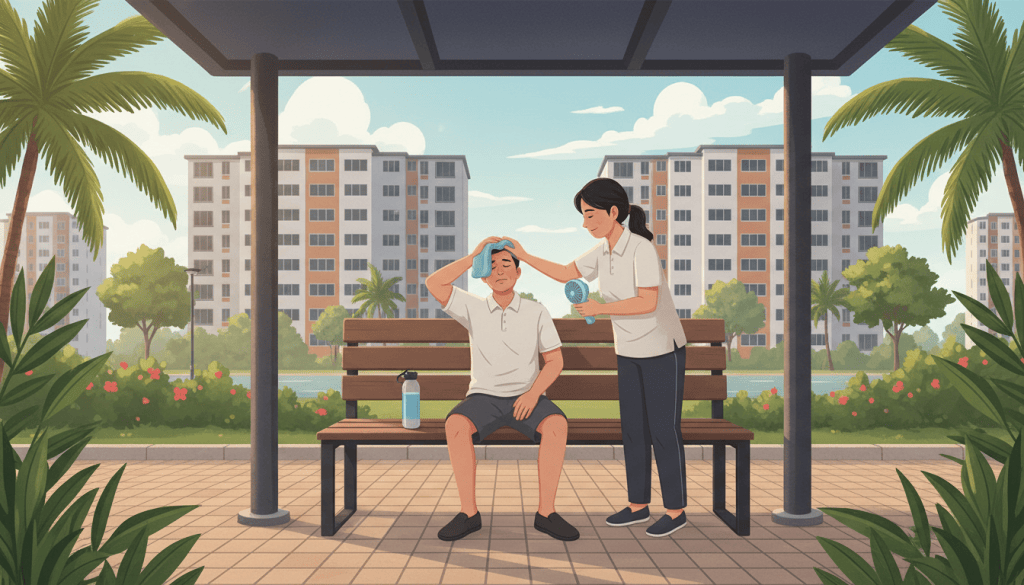
Someone in Sengkang is confused, collapsing, seizing or becoming unresponsive after exposure to heat? Treat this as possible heatstroke, call 995 immediately and start cooling the person without waiting for the ambulance. Move them to shade or a cooler indoor space if safe; loosen excess clothing, wet the skin with cool water and fan them. If available, place cold packs or cold wet towels around the neck, armpits and groin without delaying other first aid.
For someone who is still alert but feels weak, dizzy, nauseated or exhausted in the heat, stop physical activity, help them rest in a cooler place, loosen clothing and cool their skin. Offer frequent small drinks of cool water only if they are fully conscious and can swallow safely. Get medical advice for symptoms that do not improve promptly or become worse. Do not give anything by mouth to an unconscious or confused person.
- Suspected heatstroke: 995 immediately; confusion, seizure, collapse or impaired consciousness are danger signs.
- Start cooling: shade or air conditioning, remove excess clothing, cool water, fans, cold towels or cold packs.
- Heat exhaustion: stop activity, rest in a cool place and hydrate only when fully alert and able to swallow.
- Do not: wait for a measured temperature before calling, or make a drowsy person drink.
- Official conditions: check Meteorological Service Singapore’s heat-stress advisory; it is not a substitute for assessing how the person actually feels.
- For children, older adults and outdoor workers: act early, even if others nearby appear comfortable.
The first 60 seconds: suspected heatstroke
- Call 995 if the person becomes confused, collapses, has a seizure or seems severely unwell after heat exposure. Tell the operator that heatstroke is suspected and describe the person’s actual symptoms.
- Stop activity and move to a safer cool place. Shade or air conditioning helps; do not expose yourself or the patient to a new road or other hazard.
- Loosen or remove excess outer clothing when appropriate while preserving the person’s privacy and dignity.
- Cool actively. Pour or spray cool water on skin and fan, or place cold wet towels and ice packs around the neck, armpits or groin, following the dispatcher.
- Stay with the person and check consciousness and breathing. Update 995 immediately if responsiveness changes.
- Do not force drinks or medicines into a confused, drowsy or unconscious person. If unresponsive and not breathing normally, follow dispatcher-directed CPR.
- Help the ambulance reach the right location. Identify a park entrance, HDB block, sports facility, worksite entrance or other access point.
Who to call when heat illness is suspected
- 995 — SCDF emergency ambulance: heatstroke, collapse, seizures, severe altered consciousness or another life-threatening medical emergency. SCDF emergency services.
- 6262 6262 — NurseFirst: nursing guidance on non-emergency symptoms and suitable care options; not a substitute for calling 995 for heatstroke.
- Medical clinic or hospital: assessment for persistent heat exhaustion, dehydration or medical complications when the condition is not an immediate emergency.
- Workplace first-aid team: alert the trained occupational first aider or supervisor when illness occurs at work, alongside emergency services where required.
- MSS weather information: see the official heat-stress map and heat-stress explanations for preventive planning, not for deciding whether to call 995.
Heat exhaustion versus heatstroke
Heat exhaustion can cause headache, weakness, nausea, dizziness, thirst, muscle cramps and heavy sweating. The person may still be alert. The Singapore First Aid Guidelines recommend rest in a cool environment, removal of excess clothing, active cooling and oral fluids where appropriate.
Heatstroke is more serious because overheating is associated with problems affecting the brain and other organs. Warning signs include confusion, altered behaviour, fainting, seizure, marked disorientation or unconsciousness. The body temperature may be very high, but a bystander should not wait for a thermometer reading before beginning cooling and calling for medical help.
People sometimes think that someone who is sweating cannot have heatstroke. This is unsafe: exertional heatstroke can occur in people who are sweating heavily. Look at the overall condition, especially changes in consciousness. Cooling and emergency assessment matter far more than guessing from perspiration alone.
Why rapid cooling matters
In Singapore’s hot and humid climate, the body can have difficulty releasing heat. The Meteorological Service Singapore explains that high humidity reduces evaporation of sweat, and prolonged exertion adds internal heat. Once serious heat injury develops, continuing exercise or waiting in direct sunlight makes the problem worse.
The Workplace Safety and Health Council’s heatstroke guidance explicitly recommends calling 995, moving the casualty to a shaded or cooler area, loosening clothing, applying cool water and fanning, and placing ice packs in the armpits and groin while waiting for an ambulance.
A fan without water may be less effective during humid conditions than active cooling with water and air movement. If cold packs are not available, cool water and ventilation are still worthwhile. Do not delay emergency contact because you are trying to find the ideal equipment.
Can you give the person water?
Only if the person is fully alert, can swallow safely and has no reason not to drink under a medical plan. Someone with mild heat symptoms may benefit from cool water in small amounts while resting. Do not force large volumes or give oral fluids to a person who is confused, drowsy, vomiting repeatedly or unconscious.
Do not give fever medicines such as paracetamol to treat suspected heatstroke as if it were an ordinary fever. Overheating from heat illness has a different mechanism from infection-related fever and requires immediate cooling and urgent clinical care.
If the person recovers quickly after resting, persistent symptoms or a significant heat-illness event still deserve medical assessment. Return to sport or work should be guided by appropriate professional advice, not simply by a feeling of temporary improvement.
Where heat stress is likely to matter in Sengkang
Sengkang residents may spend time in open parks, playgrounds, school sports activities, park connectors, work sites and walking routes between bus stops and sheltered entrances. Prolonged activity in direct sunlight can increase heat load, particularly when the humidity is high or there is little airflow.
An open, bright path may look comfortable in the morning and become much more demanding after a prolonged walk. The important factors include how long someone has been exerting themselves, their health, acclimatisation, rest and hydration. It is not safe to infer individual tolerance from somebody else’s pace.
For organised outdoor activities, the organiser should know the appropriate sector guidelines and have a way to stop activity and summon emergency help. School, workplace and sport guidance can differ; a simple general-public heat advisory is not a substitute for a trained occupational risk assessment.
Reading Singapore’s heat-stress advisory correctly
The MSS heat-stress map reports the Wet-Bulb Globe Temperature, known as WBGT. It combines temperature, humidity, wind and solar-radiation factors. It is not the same measurement as ordinary air temperature, and the two cannot be directly converted.
For prolonged outdoor activities in the general population, the national advisory classifies WBGT below 31°C as low, 31°C to below 33°C as moderate, and 33°C or above as high heat stress. Under high heat stress, it advises minimising outdoor activity, using shade, taking more or longer breaks, keeping hydrated and cooling actively during breaks.
These categories describe environmental risk, not a medical diagnosis. A person may become seriously unwell at a reading below the ‘high’ threshold because of health, exertion or other factors. Do not say ‘the website shows moderate heat so it cannot be heatstroke’.
Children and infants
Children may not notice or explain early symptoms clearly. Younger children also rely on caregivers to stop activity and provide cooling, hydration and shade. Watch for unusual lethargy, headache, nausea, dizziness or a change in behaviour during outdoor play.
A baby or young child who becomes unusually drowsy, unresponsive or seriously unwell in hot conditions needs urgent medical assessment. Call 995 for life-threatening symptoms and cool the person while following professional instructions. Do not attempt to give fluids to a child who cannot safely swallow.
For routine prevention, plan playground or park outings with breaks in shade and water access, and avoid unnecessarily prolonged strenuous activity during high heat stress. An umbrella or covered area reduces direct sun exposure but does not guarantee a cool temperature.
Older adults and people with medical conditions
The MSS notes that older adults and people with chronic illnesses or recent illness may be more vulnerable. They may not report thirst or discomfort clearly, and some medicines or health conditions can affect fluid management or temperature regulation.
Encourage the person to move to a cooler place and stop activity when they become weak or dizzy. Be careful not to override an existing medical fluid restriction; ask their clinician how to plan hydration in hot conditions. Serious confusion, collapse or seizures require emergency action regardless of age.
Outdoor workers and delivery riders
A person working outdoors may face repeated heat exposure even while performing tasks they regard as routine. The Ministry of Manpower’s heat-stress guidance tells employers and workers to provide cooling, shade, water, and appropriate rest arrangements.
If a worker is drowsy or unconscious, MOM specifically advises calling 995. When alert, the worker should be moved to a cooler place, excess clothing removed and appropriate fluids provided. Ice packs, cool water and wet towels can support rapid cooling.
A supervisor should not insist that a symptomatic worker finishes a delivery or a construction task before taking a break. Workplace reporting and management steps can happen after the person’s medical needs have been addressed.
If the person collapses during sports
Stop play and activate the venue’s emergency response. If heatstroke is suspected, call 995 and start cooling. A teammate can retrieve cold water, wet towels or cold packs while another person provides the exact access point to the dispatcher.
Confusion or collapse can have causes other than heatstroke, including serious cardiac or neurological conditions. The first aider should not insist on a diagnosis before getting help. Follow the dispatcher for breathing assessment, CPR and other immediate care.
What to tell 995 from a park, school or HDB estate
- Address: Sengkang road, block number, sports ground, park name and nearest access route.
- Condition: conscious or unconscious, breathing normally or not, confused or having seizures.
- Activity: outdoor sport, work or prolonged heat exposure, and when symptoms began.
- Cooling: whether the person has been moved to shade, wetted with cool water or given other safe first aid.
- Medical needs: known illnesses or medication restrictions, if readily available.
- Callback: your number, and who can safely meet the ambulance at the entrance.
Four examples from ordinary Sengkang life
A jogger becomes confused on a park connector
Stop the activity, call 995 for suspected heatstroke, move the person into a cooler safe area and begin active cooling while a helper describes the nearest bridge or park entrance to responders.
A child becomes weak and nauseated after long playground activity
Stop play, move to shade or air conditioning, cool the skin and offer small drinks only if fully alert. If the child worsens, cannot swallow safely or becomes confused, call 995.
An older resident seems unusually sleepy after a hot walk
Check responsiveness and breathing. If the person is confused, hard to rouse or seriously ill, call 995 and cool them. Do not assume it is ordinary tiredness.
A worker is still alert but dizzy and sweating heavily
Stop work, seek cool shade and active cooling, offer safe fluids and arrange timely medical assessment if symptoms persist or worsen. A sudden decline in alertness is an emergency.
Prevention checklist for households and organisations
- Check the MSS heat-stress advisory before long outdoor activities, particularly around late morning and afternoon.
- Plan water, shade and rest before exercising or doing strenuous outdoor work.
- Carry appropriate light clothing and use a hat or umbrella when safe and suitable.
- Do not push through dizziness or nausea to complete a route or exercise target.
- Agree on a buddy system during long outdoor activity so someone can identify unusual behaviour.
- Know the emergency access points and 995 location instructions for outdoor venues.
- Discuss heat precautions with a clinician for people with complex medical needs or fluid restrictions.
Frequently asked questions
Is heatstroke always associated with not sweating?
No. Serious heat injury can occur with heavy sweating. Confusion, seizures, collapse or unusual consciousness changes are much more urgent warning signs.
Should I call 995 before cooling?
Call 995 immediately for suspected heatstroke and start cooling at once. If others are present, one can call while another cools the casualty. Neither action needs to wait for the other to finish.
Can a confused person drink a cold bottle of water?
Do not force fluids into someone who is confused, drowsy or unable to swallow safely. Follow the dispatcher and seek emergency care.
Does ‘moderate’ heat stress mean no risk?
No. WBGT classifications describe environmental exposure, not an individual’s health status or fitness. Monitor symptoms and stop activity if unwell.
Is a fever the same as heatstroke?
No. Heatstroke is a dangerous failure of heat regulation linked to excessive heat. Fever medicines do not replace cooling and emergency care for heatstroke.
More Sengkang emergency guides
- Medical emergencies and SCDF ambulance
- Flash floods, heavy rain and lightning
- Water rescue and drowning emergencies
Continue with the November 2026 Sengkang emergency batch: Drowning and safe water rescue · Anaphylaxis and EpiPen · Burns, scalds and kitchen accidents. For life-threatening danger, call 995 before reading.
New Sengkang emergency guides: Stroke, heart attack, falls and haze. Stroke and F.A.S.T. signs · Heart attack and chest pain · Elderly falls and head injuries · Haze and breathing problems.
Official sources and review
- WSHC — Heat Stress Management and Heatstroke First Aid
- Meteorological Service Singapore — Heat Stress Measurements
- MSS — Learn About Heat Stress
- Ministry of Manpower — Heat Stress for Outdoor Work FAQ
- Singapore First Aid Guidelines
- SCDF — Emergency Medical Services
Reviewed 6 November 2026. The guide is public education, not individual medical diagnosis or live WBGT reporting. Suspected heatstroke is a medical emergency: call 995 and begin cooling immediately.
