
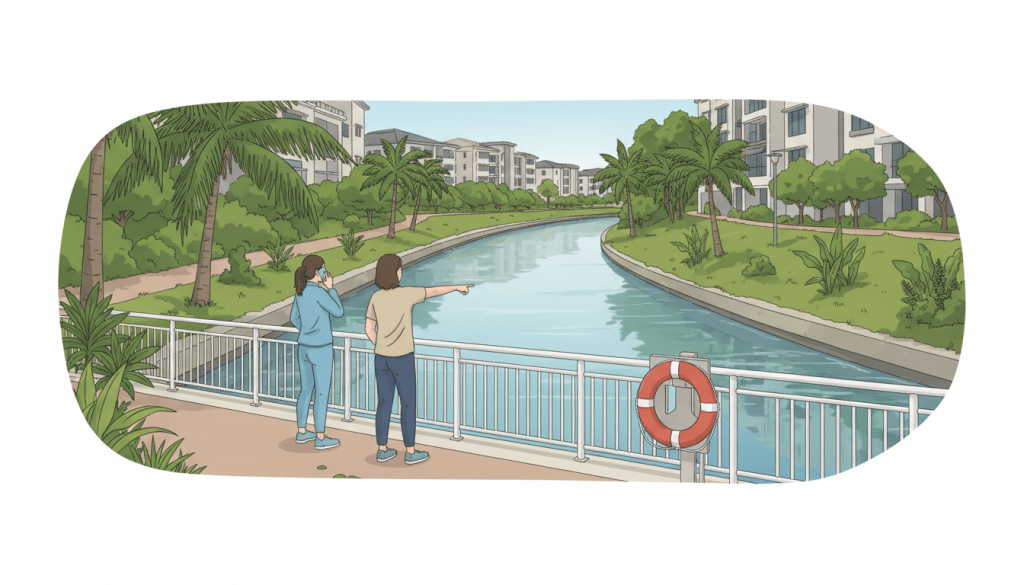
Someone is struggling, submerged or missing in the water in Sengkang right now? Call 995 immediately for SCDF water rescue and emergency medical assistance. Give the closest identifiable park entrance, bridge, footpath, road or HDB block. If you are not trained in water rescue, do not jump or enter the water. Throw a life ring or another suitable flotation device from solid ground if it can be done safely.
Stay on safe ground, keep sight of the person’s last known position, and direct rescuers. SCDF specifically advises bystanders to protect themselves, use available rescue floats or a long object from a stable position, and avoid stretching so far they fall in. If a person is rescued and is not breathing normally, follow the 995 dispatcher’s CPR instructions. If they seem awake but have coughing, breathing difficulty or unusual drowsiness after immersion, seek urgent medical assessment.
- Call: 995 for a water rescue or life-threatening medical emergency in Singapore.
- Do not: jump into a canal, reservoir, pond or river unless you are a trained water rescuer acting within a safe plan.
- From safe ground: throw a suitable rescue float or reach with a long object without losing your footing.
- Location: tell SCDF the nearest path, bridge, waterway, park entrance and which bank you are standing on.
- After rescue: check responsiveness and breathing, follow 995 first aid or CPR guidance, and obtain medical assessment for ongoing symptoms.
- For children: never delay emergency assistance because an incident looked brief or no longer appears dramatic.
First minute: the safest sequence
- Call 995 now. If others are present, point to one person and ask them to make the call while you keep a safe visual reference to the incident.
- Do not enter the water if untrained. SCDF cautions that an attempted rescue can turn one casualty into two.
- Use a reachable flotation aid if it is safe. A rescue ring or float thrown toward the person can help without putting you in the water.
- Reach only from firm ground. A long pole or paddle may help, but do not lean out past a stable edge or stand where the bank could collapse.
- Remember the last position seen. If the person disappears, keep looking toward the same landmark and tell responders when and where they were last visible.
- Direct emergency crews to the right side of the water. A bridge name, path junction or accessible entrance is more useful than simply saying ‘Sengkang park’.
- If a person is brought out, follow the dispatcher’s directions for checking breathing, CPR and immediate medical evaluation.
Who to call when someone is in the water
- 995 — Singapore Civil Defence Force: water rescue and emergency ambulance response. SCDF explains how bystanders should help in water rescues.
- 995 — urgent medical assistance after rescue: especially for a person who is unresponsive, not breathing normally or has serious breathing problems. SCDF emergency medical service guidance.
- Pool lifeguard or venue safety staff: alert them immediately when the incident is in a supervised swimming facility; this is in addition to calling 995 for life-threatening emergencies.
- 999 — Police: use for a separate immediate policing or public-security issue; it is not the primary replacement for SCDF water-rescue assistance.
- 70995 — SCDF emergency SMS: an accessibility service for people who are deaf, hard of hearing or speech impaired; voice calls to 995 are normally the quickest route when possible.
Why jumping into the water can be the wrong response
A person struggling may grab, pull or push unexpectedly. Currents, submerged structures, slippery edges and unknown water depth can overwhelm someone who is a competent recreational swimmer. SCDF’s specialist Disaster Assistance and Rescue Team advises untrained members of the public not to enter the water. The safest response is to call for help and use equipment from the shore if possible.
A canal edge or reservoir embankment can also be hard to climb out of even if the water looks calm. Do not test the water depth or attempt to build a human chain beside a drop. Emergency responders have appropriate training and equipment for conditions that cannot be judged from a footpath.
Do not feel that calling for help is ‘doing nothing’. A precise call with good location details and a clear last-seen position is directly useful to rescue crews, particularly after the person is no longer visible.
How to give an accurate location on a Sengkang waterway
Sengkang has waterside parks, canals, drains and park connectors. An operator cannot always determine which entrance or bank provides access from the name of a broad neighbourhood. Start by giving the name of the park, closest HDB block, road or bridge. Say whether you are on the side nearest a particular road or housing estate.
- Identify the waterbody if you know it: canal, river, pond, reservoir edge or swimming pool.
- Use a fixed landmark: bridge, safety rail, sign, nearby road junction, footpath entrance or lamp-post number.
- Give direction: which way you were walking and which bank the person was last seen from.
- State the timing: how long ago the person entered or disappeared under water, without inventing a precise duration.
- Describe conditions: daylight or darkness, strong current, rain, fallen debris, other people in danger.
- Keep access clear: ask another bystander to meet responders at a safe entrance without leaving a casualty alone.
If you cannot identify the path, tell the dispatcher what you do know and use a phone’s location sharing where available and directed. The SCDF myResponder app provides a Call 995 feature with location support, but a pin does not replace a description of the correct entrance.
How to help from the bank: throw, reach, never overextend
If you see a rescue float, life ring or other suitable flotation device, it may be possible to throw it to a person in distress. Aim where they can reach it without needing to swim further into danger. A bystander should never secure a rope or lifebuoy in a way that could pull them off the bank.
Reaching with a long pole, paddle or similar object may help when the person is close, but only from a stable place. SCDF specifically warns against overreaching and falling into the water. Avoid using damaged equipment or climbing over fencing to make an improvised rescue.
If reaching or throwing cannot be done safely, remain on secure ground and focus on keeping sight of the person and guiding 995 responders. Do not invent more dangerous rescue methods out of frustration.
If the person has gone below the surface
Do not enter deep or fast-moving water to search. Call 995 immediately if not already done, state that the person is submerged or missing, and tell the dispatcher the last exact position. If you can safely continue looking from the bank, do so without getting close to unstable edges.
Describe the last observed clothing, approximate age, time and direction of movement. Rescuers need a reliable location and timeline. Do not circulate a guess that the person has resurfaced elsewhere unless someone has clearly seen that happen.
If someone is taken out of the water
The rescuer or a bystander should assess whether the person responds and is breathing normally. If they are unresponsive and not breathing normally, call 995 and follow dispatcher-directed CPR, including the instructions appropriate to suspected drowning. If trained in water-rescue first aid or CPR, act within that training.
An AED may be useful in certain cardiac emergencies, but it does not replace the breathing support and CPR instructions provided for drowning. Have another person fetch a registered AED if the dispatcher recommends it and help is available. Do not leave an unresponsive person alone simply to search for equipment.
If the person breathes but is confused, unusually sleepy, coughing persistently or struggling to breathe, seek urgent emergency medical assessment. A person who has inhaled water can have complications even after appearing to improve. Do not force water or food into someone who is not fully alert and able to swallow.
What if a rescued person says they feel fine?
The immediate observations still matter: Was there a period of submersion? Did the person cough forcefully or struggle to breathe? Are they still coughing, vomiting, confused or unusually tired? Those facts should be communicated to a healthcare professional.
A person with symptoms after possible water inhalation should not be left alone to ‘sleep it off’. The HealthHub children’s emergency guide treats drowning incidents as medical emergencies and directs caregivers to CPR and 995 when an infant is not breathing. For other ages and symptom patterns, the appropriate clinical assessment is determined by medical staff.
Children and small water containers at home
Water accidents are not confined to rivers and pools. HealthHub specifically notes that infants can drown in toilets, buckets and bathtubs. A small amount of accessible water can still pose a hazard for a baby or young child who cannot lift their head out of it.
Keep a child within direct adult supervision around baths and water containers, and never leave a baby in a tub while answering a call or collecting a towel. Empty buckets and paddling containers after use and keep access restricted as appropriate.
If a child is found unresponsive in water, call 995 and follow emergency instructions rather than trying to estimate how long the child was under. Do not assume they are safe merely because their face is no longer in the water.
Swimming pool incident: what changes?
At a supervised pool, attract the lifeguard’s attention immediately and call 995 for a medical or water rescue emergency. A trained lifeguard can coordinate water entry and appropriate rescue equipment. People who are not trained should not interfere with professional rescue by jumping into the water.
Move bystanders away from the rescue area and provide accurate details about the swimmer, their last position and any medical condition known. If the swimmer has been brought out, use the venue’s emergency procedures and the 995 dispatcher’s instructions.
During thunderstorms or heavy rain near a canal
Waterway incidents can become more complex when rainfall increases runoff or visibility decreases. Avoid flooded paths, railings near rapidly moving water and exposed areas during lightning. A rescuer who attempts to climb down in wet conditions can become the next casualty.
If a waterway looks swollen or a bank is slippery, choose another route, respect closures and keep children close. Residents can check PUB flood safety guidance and Meteorological Service Singapore’s weather warnings for general preparation. Neither site can confirm the immediate underwater condition at a specific spot.
Four Sengkang scenarios
Someone slips from a park-connector edge
Call 995, keep a visual fix on the person and throw a lifebuoy from firm ground if one is available. Do not jump after them unless you are a trained water rescuer operating under a safe procedure.
A child falls into a swimming pool
Alert the lifeguard, call 995 when emergency assistance is needed and follow the trained rescue and first-aid process. Give the pool name, entry point and exact place where the child was last seen.
A person is rescued but keeps coughing
Tell 995 or urgent healthcare staff about the submersion and continuing cough or breathing symptoms. Do not assume recovery is complete simply because the person can talk.
An infant is found unresponsive after a bath
Call 995 immediately, check breathing and follow dispatcher-directed resuscitation. Share the baby’s age, condition, approximate timing and what first aid has already been given.
Practical prevention for families and outdoor users
- Supervise children closely around pools, bathtubs, buckets and water features.
- Respect signs and barriers along park connectors and waterways.
- Do not enter unfamiliar water to retrieve toys, pets or dropped objects.
- Learn CPR and water-safety skills through recognised training.
- Notice the nearest park entrance, bridge and life ring on waterside walks.
- Keep phones accessible for emergencies without walking right to the edge to take photographs.
- Plan for wet weather and postpone a waterside outing when conditions are hazardous.
Frequently asked questions
What is Singapore’s emergency water-rescue number?
Call 995 for SCDF rescue and urgent ambulance assistance. Give the precise waterway location and whether the person is still visible.
Should I dive in if I can swim?
Not merely because you can swim. SCDF explicitly advises untrained members of the public not to enter the water. Help from safe ground with a float or long object if possible.
Can I wait to see whether the person resurfaces?
No. Call 995 immediately and identify their last known position. Time may be critical.
What if the person is awake after being rescued?
Observe breathing and seek appropriate medical assessment, particularly if there is cough, breathlessness, unusual fatigue, confusion or other symptoms.
Is a baby bathtub dangerous if it contains only a little water?
Yes. HealthHub warns that infant drowning can occur in domestic containers, including baby bathtubs and buckets. Continuous adult supervision is important.
More Sengkang emergency guides
- Flash flood, heavy rain and lightning
- Medical emergency and 995 ambulance help
- Choking, first aid and CPR-AED
Continue with the November 2026 Sengkang emergency batch: Heatstroke and heat exhaustion · Anaphylaxis and EpiPen · Burns, scalds and kitchen accidents. For life-threatening danger, call 995 before reading.
New Sengkang emergency guides: Stroke, heart attack, falls and haze. Stroke and F.A.S.T. signs · Heart attack and chest pain · Elderly falls and head injuries · Haze and breathing problems.
Official sources and information date
- SCDF — Diving into DART’s Water Rescue Capability
- SCDF — Emergency Medical Services
- HealthHub — Emergency Care for Children and Accidental Drowning
- SCDF — myResponder and AED Locator
- PUB — Flood Safety Tips
Reviewed 6 November 2026. This guide provides safe bystander actions, not professional water-rescue training or live incident management. In an active water emergency call 995 and follow SCDF instructions.
