
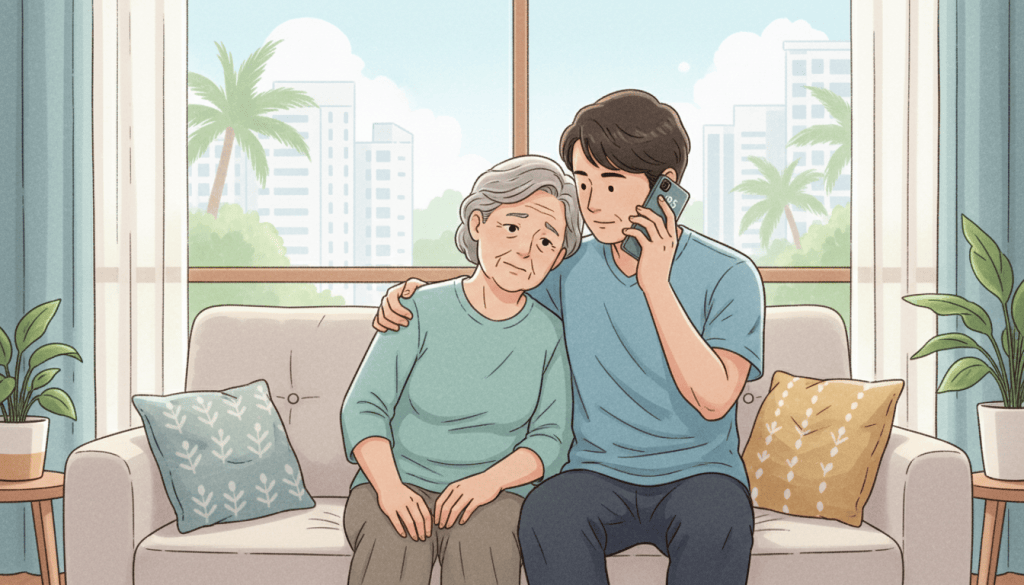
Someone in Sengkang suddenly has a drooping face, weakness in one arm, or trouble speaking? Call 995 immediately for an SCDF emergency ambulance. These are the key F.A.S.T. stroke warning signs. Even one sudden sign is enough to seek emergency help. Do not wait for every sign to appear, do not arrange a routine clinic appointment first and do not try to drive the person to hospital yourself.
Stay with the person, note when they were last known to be well, and tell the dispatcher what has changed. Do not give food, water, aspirin or other medicines unless an emergency professional tells you to. A possible stroke may affect swallowing, and not all strokes have the same cause. If the person becomes unresponsive or stops breathing normally, follow the 995 operator’s resuscitation instructions.
Immediate numbers: SCDF emergency ambulance 995; the SCDF accessibility SMS 70995 is intended for deaf, hard-of-hearing or speech-impaired users. This local guide serves Sengkang, Compassvale, Rivervale, Anchorvale, Fernvale and nearby areas; it is not a live emergency dispatch service.
The first minute: recognise F.A.S.T.
- F — Face: ask the person to smile. One side may droop or move differently.
- A — Arm: ask them to raise both arms. One arm may be weak, drift downward or not lift.
- S — Speech: speech may become slurred, unclear, unusually difficult or absent. The person may also have trouble understanding.
- T — Time: call 995 now. Record the time symptoms began or the last time the person was definitely normal.
- Do not wait for all three signs. Singapore HealthHub says one sudden FAST symptom is enough to trigger a 995 call.
What to do while the ambulance is coming
- Call 995 and state ‘possible stroke’. Explain the sudden face, arm or speech change, the person’s age if known and your exact location.
- Record last known well. This may be the last conversation or activity before symptoms started. If they woke up with symptoms, give when they were last seen normal before sleep, rather than guessing a start time.
- Keep the person safe and at rest. Help them remain in a comfortable position, without unnecessary walking or transfers.
- Give nothing to eat or drink. Stroke may cause swallowing problems. Do not administer aspirin, blood thinners or other medicines without clinical direction.
- Observe and update. Note breathing, responsiveness and any changes in weakness, vision, speech or headache. Call back with a major deterioration if needed.
- Prepare access. Give the HDB block, unit, floor, postal code, gate access and safest lift lobby. Ask someone to meet the ambulance if there is another helper.
- If unresponsive and not breathing normally, follow the dispatcher’s CPR and AED instructions.
Who to call for suspected stroke in Sengkang
- 995 — SCDF Emergency Medical Services: immediate ambulance for possible stroke and other life-threatening medical emergencies. SCDF Emergency Medical Services.
- 70995 — SCDF emergency SMS: accessible communication for qualifying deaf, hard-of-hearing or speech-impaired callers. Include precise location, suspected stroke and the service needed.
- Sengkang General Hospital: the Emergency Department operates 24 hours at 110 Sengkang East Way. However, calling 995 is the first step for suspected stroke, not contacting a general hospital appointment line. SKH emergency visit information.
- Family doctor: for long-term stroke-risk management and follow-up, not for delaying emergency assessment of sudden neurological symptoms.
Stroke symptoms are not always dramatic
A stroke can cause an obvious collapse, but it can also appear as a sudden change in the way someone holds a spoon, walks, speaks or understands. A person may remain awake and insist they feel fine. Other symptoms include new one-sided numbness, sudden vision loss or double vision, severe unexplained headache, loss of balance and unusual dizziness. These symptoms also require urgent assessment, especially when sudden.
HealthHub’s Stroke: Signs and Symptoms explains that different parts of the brain affect movement, speech, vision, sensation and coordination. A person does not have to present with every feature on a poster. F.A.S.T. is a simple recognition tool, not a test that excludes every stroke if negative.
Other conditions can produce similar symptoms. That uncertainty is a reason to report the problem accurately, not a reason to delay. The emergency team assesses whether this is a stroke or another acute illness.
Why the ‘last known well’ time matters
Treatments for stroke depend on the type of stroke, the patient’s condition and timing. Specialists may consider particular interventions for eligible patients after assessment and imaging. It is not possible for a bystander to know who is suitable for which treatment.
A useful statement to the dispatcher is: ‘She was speaking normally at 7:10am, but when I returned at 7:35am her speech was slurred.’ That separates the last known well time from the first observed symptom time. If the person woke up unwell, explain that the last normal observation was the evening before.
Do not spend precious minutes trying to reconstruct every detail before calling. Make the emergency call immediately, then provide the best reliable timeline.
What to tell 995 from an HDB flat or Sengkang public place
- Location: full HDB block, street, unit and floor; for malls, parks or transport stations, the precise entrance or platform.
- Symptoms: which part of the face or body is weak, and any new speech, vision or balance change.
- Timing: last known well and first observed symptoms, both approximate if necessary.
- Current condition: conscious or not, breathing normally or not, vomiting or falling.
- Relevant information: known medication, especially blood thinners, and any previous stroke, if readily known without delaying.
- Access: locked gate, lift location, security desk and where another person can meet paramedics.
Do not give aspirin for a suspected stroke
A common misconception is that all strokes are caused by a blood clot, so an aspirin tablet must help. In reality, strokes may be caused by blocked vessels or bleeding. No bystander should try to determine the subtype without clinical assessment. Giving aspirin or another medicine without a doctor’s direction can be unsafe.
Swallowing itself may also be impaired during a stroke. A drink or tablet can enter the airway, causing choking or aspiration. Do not give food, water or medication until a professional confirms that doing so is safe.
What if the symptoms disappear after a few minutes?
Do not cancel the emergency assessment. Sudden facial weakness, speech changes or one-sided weakness that resolve can still require urgent investigation. A transient ischaemic attack (TIA), sometimes called a mini-stroke, is a warning sign that should not be ignored.
Call 995 for sudden stroke-like symptoms even if they are improving, and tell the dispatcher that the symptoms have stopped or changed. This does not mean the person is ‘all clear’. The urgency comes from the event itself, not whether the patient looks normal when you arrive.
What if the person refuses an ambulance?
A person who has suddenly lost clear speech or understanding may have impaired judgement or difficulty communicating. Explain calmly that you are concerned about a possible stroke and have called for medical help. Do not argue or physically force the person into a vehicle.
Tell 995 exactly what the person says and does; emergency professionals can advise on appropriate next steps. A public guide cannot determine a specific person’s ability to make medical decisions.
If the person falls after a possible stroke
Do not hurry to stand them up. A fall may have caused additional head, hip or neck injury. Report both the neurological signs and the fall to 995. Keep the person safe from moving traffic or other hazards without unnecessarily manipulating the head or neck.
If there is serious injury or the person cannot move, follow professional instructions before attempting transfers. For other fall emergencies, see the Sengkang elderly-fall and head-injury guidance.
Sengkang examples
A parent suddenly cannot finish a sentence
A family member notices that the parent knows what they want to say but cannot form words. Call 995 immediately, note when they last spoke normally and provide the flat address. Do not wait for the speech difficulty to become worse.
An older resident drops a cup and cannot lift one arm
This could be a stroke sign even if the person can still walk. Call 995, ask them to rest, do not provide food or water and tell the ambulance dispatcher the last known well time.
A commuter suddenly cannot see clearly and loses balance
Move them away from an unsafe platform edge and seek urgent medical assessment through 995. Sudden vision and balance changes can be stroke-related even if the face looks symmetrical. Ask station staff to help guide responders.
Someone wakes with one-sided weakness
Do not assume there is nothing to be done because the exact onset was during sleep. Call 995 and report when they were last seen well before bed. Clinicians need the accurate timeline to determine assessment and treatment.
What happens at the hospital
Emergency clinicians assess symptoms and may arrange brain imaging, blood tests, heart monitoring and specialist review. The purpose is to identify whether a stroke is occurring, what type it is and which treatment is appropriate. Hospitals triage patients by clinical urgency, not simply arrival order.
Caregivers can help by providing medication lists, relevant medical conditions and a clear timeline. They should not demand a particular medication or imaging result; the treating team must make those decisions using the patient’s clinical findings.
Recovery and preventing another emergency
After acute treatment, stroke care can involve physiotherapy, occupational therapy, speech therapy and rehabilitation planning. Families may need to adjust mobility arrangements and communication methods at home. Ask the clinical team how to recognise complications, arrange follow-up and support daily function.
Longer-term prevention commonly includes control of blood pressure, diabetes and cholesterol, avoiding smoking, appropriate physical activity and taking prescribed medicines. HealthHub’s stroke-awareness guide describes the S.M.A.R.T. approach. These preventive measures do not replace a 995 call for new sudden symptoms.
Frequently asked questions
Should I call 995 for just one FAST symptom?
Yes. HealthHub explicitly advises calling 995 if even one of the sudden face, arm or speech signs is observed.
What if the person starts speaking normally again?
Urgent assessment is still required. Explain the temporary symptoms to 995 rather than assuming the risk has ended.
Should I let them have a drink before the ambulance arrives?
No. Swallowing may be impaired, so avoid food, water and tablets until a healthcare professional confirms it is safe.
Is it better to drive directly to SKH?
For suspected stroke, call 995 for an emergency ambulance. Paramedics can assess the situation and coordinate appropriate care. Do not insist on a specific hospital destination.
Does F.A.S.T. detect every stroke?
No. Sudden vision loss, severe headache, balance problems and other neurological changes can also be important. Seek urgent assessment for sudden concerning symptoms.
More Sengkang emergency guides
- Medical emergency and ambulance 995
- Choking, CPR and AED
- Road accidents and pedestrian injuries
- Heatstroke and heat exhaustion
Official sources and review
- HealthHub — Stroke: Signs and Symptoms
- HealthHub — Be Stroke Smart and FAST
- Ministry of Health — When to Seek Emergency Help
- SCDF — Emergency Medical Services
- Sengkang General Hospital — Emergency Visit
Reviewed 6 November 2026. This guide provides emergency public information, not a medical diagnosis. Sudden FAST symptoms require an immediate 995 call. Follow the emergency dispatcher and medical team’s instructions.
