
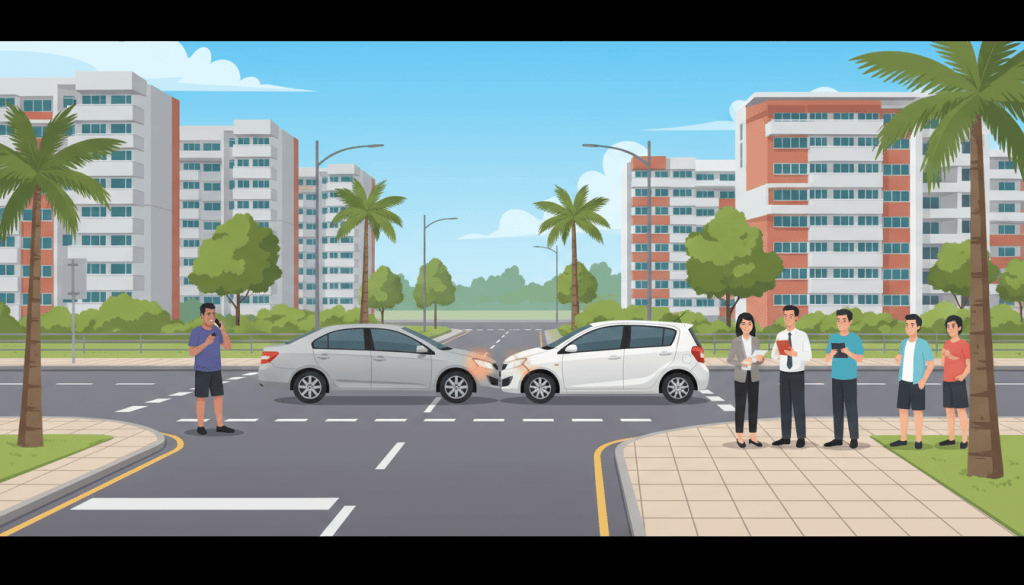
Road accident in Sengkang right now? If anyone is seriously injured, unconscious, bleeding heavily or struggling to breathe, call 995 for an emergency ambulance. Call 999 for urgent Police assistance when there is injury or an active danger to road users. Move to a safe place, warn others only if you can do so without entering traffic, and follow the emergency dispatcher’s instructions.
For a minor collision where everyone is safe, exchange particulars, document the scene when safe and contact your motor insurer. Under Singapore’s Motor Claims Framework, a motor accident normally must be reported to your insurer within 24 hours or by the next working day, even if damage looks minor or you plan to settle privately. A separate Police traffic accident report is required only in specified circumstances.
Quick contacts: 995 for an emergency ambulance; 999 for immediate Police help; 6547 0000 for non-urgent Traffic Police enquiries; your own motor insurer’s official accident hotline for approved towing and accident reporting. This is a practical Sengkang guide for drivers, motorcyclists, cyclists, pedestrians and witnesses.
Immediate checklist: what to do at the scene
- Stop safely. If you are driving, switch on hazard warning lights. Do not stop in a live lane if you can avoid adding danger, and obey instructions from Police or traffic officers.
- Check for injuries. Call 995 for severe injury or a person who needs emergency medical help. If injury creates an urgent Police matter, call 999 too.
- Describe exactly where you are. Give the road, nearest junction, travel direction and nearby HDB block or landmark. For an expressway, use its name, carriageway direction and any nearby exit or lamp-post number.
- Protect the scene without risking yourself. Do not walk into oncoming traffic to take photographs, retrieve debris or redirect vehicles.
- Do not move a seriously injured person unless remaining where they are poses an immediate danger. Follow the 995 dispatcher’s instructions rather than improvising treatment.
- When safe, gather the details. Note vehicle registration numbers, parties’ contact details, time and location; take photographs only if safe.
- Call the insurer and complete necessary reports. For an insured vehicle, follow its motor accident hotline and authorised reporting centre guidance. Determine whether a separate Traffic Police report is required.
Who to call for a Sengkang road collision
- 995 — SCDF emergency ambulance: when someone is seriously injured, unresponsive or faces a life-threatening medical emergency. SCDF emergency medical services.
- 999 — Singapore Police Force: for an accident involving injuries requiring immediate Police assistance, hit-and-run in progress, dangerous obstruction or another active safety threat. SPF contact numbers.
- 6547 0000 — Traffic Police Information Hotline: for non-emergency traffic enquiries, not a replacement for 999 when a person is in danger.
- Your own insurer’s motor accident hotline: for an approved tow truck, claim advice and referral to an authorised accident-reporting centre. Look up the number from your policy documents or the insurer’s official app.
- SPF Traffic Accident Report e-service or Police station: for accidents falling under the mandatory Police reporting criteria; SPF rules and report guidance.
What makes a road accident a medical emergency?
A vehicle collision may involve a person who looks unharmed but is developing serious symptoms. Prioritise real signs of danger: collapse, an unresponsive person, severe bleeding, breathing difficulty, serious head injury or other potentially life-threatening trauma. Call 995 and describe what you actually see. You do not need to decide the person’s diagnosis before asking for help.
Keep out of moving traffic, and do not approach a vehicle that is on fire, leaking hazardous material or likely to move. If safe and instructed, bystanders may support a patient while waiting for emergency responders. Do not pull a seriously injured person out of a vehicle except when there is immediate danger and no safer alternative, and follow the dispatcher’s directions.
If a patient’s condition changes while waiting, update 995. Do not offer food or drink to someone who is unresponsive or unable to swallow safely. These are general precautions, not a substitute for an emergency operator’s advice.
What to say on a 995 or 999 call
The best location description is more precise than ‘Sengkang road’. Different carriageways, slip roads and entrances can be separated by barriers. State whether you are walking, driving or reporting from a nearby building so responders know where you are.
- Road and direction: the named road, junction, direction of travel and any safe identifiable landmark.
- Number of casualties: how many people appear injured, trapped or unable to move.
- Injuries: whether someone is conscious and breathing normally; visible bleeding or other serious signs.
- Other hazards: active traffic, smoke, a fire or vehicles obstructing several lanes.
- Access: whether the scene is at a pedestrian crossing, bus stop, service road or carriageway.
- Callback number: a telephone that dispatchers can reach if they need clarification.
When is a Traffic Police accident report mandatory?
The Singapore Police Force states that a Police traffic accident report must be made if any of the following apply. These rules are separate from the accident report you make to an insurance company.
- The accident involves a fatality.
- At least one involved person is taken from the scene to hospital by an ambulance, or an injured party receives at least three days of outpatient medical leave.
- There is damage to government property.
- A foreign-registered vehicle is involved.
- A pedestrian or cyclist is involved.
- The collision is a hit-and-run.
The current SPF Traffic Accident Reporting page provides these criteria and explains that parties or witnesses may make a report through the official Traffic Accident Report e-service or at a Police station. Do not use the ordinary online crime report form for a traffic accident.
If a new injury or medical-leave requirement becomes apparent after the scene, review the reporting criteria and contact Traffic Police or make the necessary report. Preserve available evidence rather than assuming that a small-looking collision cannot become a reportable matter.
Insurance reporting: the 24-hour or next-working-day rule
The General Insurance Association’s Motor Claims Framework tells motorists to notify their insurer of all accidents, even where there appears to be little damage, within 24 hours or by the next working day. The driver should arrange an insurer-approved accident-reporting centre or workshop as directed. The exact insurer instructions matter, especially for vehicles that cannot be driven.
Report to your insurer even when another driver offers to pay cash or you think nobody will claim. An informal settlement does not automatically cancel insurance reporting duties. Failure to report can have insurance consequences, including disputes over coverage, no-claims discounts or renewal.
If towing is required, contact your own insurer for an authorised provider. GIA specifically warns motorists against accepting services from unauthorised tow operators or workshops arriving uninvited at the scene. Take down their details if necessary, but do not hand over a vehicle simply because someone claims to be ‘the official tow truck’.
What information should a driver exchange?
- Name and contact number of involved parties.
- NRIC/FIN or other identification particulars, exchanged appropriately and securely where required by reporting processes.
- Vehicle registration numbers and insurer details.
- Date, time and exact location of the collision.
- Photographs of damage and the scene, only where taking them is safe.
- Any witness contact details that witnesses agree to provide.
Do not demand access to another person’s unlocked phone, threaten a driver or take photos of injured people for social media. Keep the records necessary for Police and insurer reporting; allow the investigating agencies to determine fault.
If a pedestrian or cyclist is knocked down
Call 995 when there is serious injury and 999 for urgent Police assistance. Because the SPF specifically lists accidents involving a pedestrian or cyclist as reportable, do not dismiss a collision as ‘minor’ merely because no car looks damaged. If the person reports pain or difficulty moving, encourage medical assessment and follow emergency advice.
If you witness the accident, stay clear of the traffic lane. Identify the road and crossing, and offer observations to Police when asked. Do not circulate identifiable footage of the injured person in neighbourhood chat groups; provide potentially useful recordings through official channels.
If a collision happens near an LRT station, mall or bus stop
A station name alone may not describe the road access. Tell the dispatcher whether the accident occurred at a particular crossing, bus-stop bay, drop-off point, service road or lane. If nearby staff are available, ask them to contact their safety team without leaving the casualties unattended when doing so would be unsafe.
Many Sengkang routes include HDB access roads, junctions near transport stations and active pedestrian crossings. There is no universal ‘Sengkang accident hotline’ for all such locations: 995 and 999 handle urgent services, while insurers and Police traffic-report channels handle the administrative aftermath.
If the vehicle has hit a tree, barrier or street fixture
Do not assume no report is needed simply because another driver was not involved. Damage to government property is a mandatory Police traffic-reporting criterion. Tell the responding operator what was struck and where it happened. Do not move a fallen electrical pole, street sign or large branch yourself.
For a roadside obstruction without immediate danger or injury, the relevant authority may need a maintenance report. But never substitute a routine municipal feedback form for calling emergency services when there is an active life-safety risk.
If the other motorist leaves
Do not follow or chase a fleeing vehicle. Note the number plate, vehicle description and direction if you can do so safely, and contact Police. Hit-and-run accidents fall within SPF reporting criteria. Safe dashcam evidence can be shared with investigators and insurers; avoid altering originals.
If the collision appears minor
Once injuries and immediate road dangers have been ruled out, motorists can exchange particulars, safely photograph damage and contact their insurers. Police reporting may not be mandatory if none of the listed criteria applies, but the insurer reporting obligation still exists. Let the insurer advise what to do with the damaged vehicle.
An apparently undamaged bumper does not prove that no damage exists or that an involved person has no injury. Be careful about signing statements that make factual claims you cannot support. Explain what you observed, not what you assume.
Three quick scenarios
A child on a bicycle is struck at a crossing
Move yourself out of traffic, call 995 for serious injury and seek urgent Police help. Give the crossing and road name, provide support only when safe and follow the dispatcher. A cyclist is involved, so the accident falls within the Police reporting categories.
Two parked cars scrape each other, with no apparent injury
Exchange particulars, take safe photographs and call your insurer. If none of the SPF mandatory reporting conditions is present, a Police traffic report may not be required; the insurer report is still required within 24 hours or by the next working day.
A car hits a lamppost on a rainy evening
Move out of danger, do not touch damaged electrical equipment and call emergency services if an immediate hazard or injury exists. Damage to government property triggers a Police traffic report. Arrange insurer-authorised towing if the car cannot be driven.
Frequently asked questions
Is calling 999 the same as making a Police traffic accident report?
No. Emergency assistance and the formal traffic accident reporting process serve different purposes. Follow Police instructions at the scene, then complete a required traffic accident report through the specified channels.
What if I want to settle privately and pay cash?
You still need to comply with your motor insurance accident-reporting requirements, even if parties propose a private settlement.
Do I call 995 if a car is scratched but nobody is hurt?
No. 995 is for medical, fire and rescue emergencies, not routine vehicle repairs. Contact the insurer for an accident without an emergency.
Should I move my car after a collision?
For accidents with injured people, do not casually disturb the scene; follow Police directions, with exceptions for immediate safety needs. For minor accidents without injury, move safely to avoid obstructing traffic where appropriate. Photograph only if it is safe.
What if I did not see the exact impact?
State only the time, location and facts you observed. A witness report is useful without speculation about who caused the collision.
Related Sengkang emergency guides
- Medical emergency and ambulance
- Crime, threats and urgent Police help
- Flash flood, heavy rain and lightning
- Fallen trees and dangerous branches
Official sources and review date
- Singapore Police Force — Reporting Traffic Accidents and Offences
- Singapore Police Force — Emergency and Traffic Police Contact Numbers
- General Insurance Association — Motor Claims Framework
- General Insurance Association — What to Do After a Motor Accident
- SCDF — Emergency Medical Services
Reviewed 4 November 2026. This guide is general public-safety and reporting information for Singapore residents and visitors. It is not legal advice, a substitute for insurer terms or emergency dispatch. Follow the instructions of responders at the scene.
