
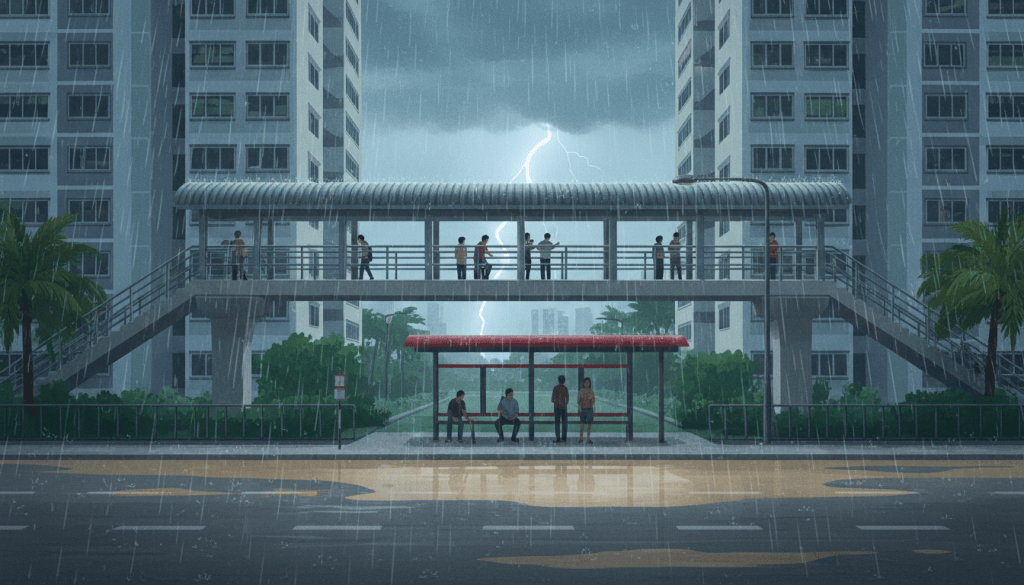
Is heavy rain, rising water or lightning affecting you in Sengkang? Move away from floodwater and exposed outdoor areas first. If a person is trapped, swept away, injured or in immediate danger, call 995 for emergency rescue or medical help. For flood or drainage feedback that does not require rescue, contact PUB via its 24-hour call centre.
Quick action plan: flood, heavy rain and lightning
- Turn back from flooded roads or footpaths. Do not attempt to cross water if you cannot see the ground, drain edges or road markings.
- Move to safe higher ground. Keep children and older residents away from moving water, open drains, waterways and low-lying underpasses.
- During lightning, seek shelter in a substantial enclosed building. Avoid exposed parks, playgrounds, open-air platforms and lone tall trees.
- If anyone is trapped, hurt or in danger from rising water, call 995. Say where they are and whether water or electricity is involved.
- Check official alerts from PUB’s flood channels, myENV and the Meteorological Service Singapore; do not treat an old screenshot as a live warning.
- If safe, report a flood or urgent drainage issue to PUB at 1800 2255 782 (also shown as 1800-CALL-PUB).
Who to call, and which updates to check
- 995 — SCDF: life-threatening flooding, urgent rescue or serious injury. SCDF’s civil defence preparedness guide.
- 999 — Police: immediate policing or security danger; the SCDF handbook also advises residents who believe remaining at home during a flood is dangerous to contact 995 or 999.
- 1800 2255 782 — PUB 24-hour call centre: report flooding, major water interruptions, drainage concerns or urgent water issues. PUB also lists 6521 6470 as an alternative contact.
- PUB Flood Alerts: check PUB’s current flood information via its official Flood-Wise guide and channels.
- myENV app and MSS weather warnings: use Meteorological Service Singapore heavy rain warnings and lightning information for live conditions.
First principle: floodwater may be deeper and faster than it looks
A flooded road is not merely a wet road. You may not be able to see an open drain, an uneven kerb, a damaged surface or the true direction of the current. PUB advises pedestrians not to walk into flooded areas and to move to higher ground when a route is flooded.
PUB’s flood safety advice warns against walking through moving water above ankle height because it can cause a person to fall. In practice, do not enter uncertain floodwater simply because it appears shallow. If someone has a mobility impairment, a walking aid or is carrying a child, the risk may be greater. Turn around rather than test a flooded passage.
For motorists, PUB advises avoiding water above road-kerb level or when road markings are no longer visible. A driver should use an alternative route rather than assume a vehicle can cross. In some circumstances water can immobilise the engine, conceal obstructions or make safe evacuation harder.
If you are walking near Sengkang MRT, LRT, HDB blocks or a park
The practical danger may not be the heaviest rainfall itself but the route you choose: a flooded pedestrian crossing, a sloping access road, a drainage edge hidden under water or an uncovered stretch of walkway during lightning.
- Stop before entering pooled or moving water. Look for a dry, safe alternative route.
- If a safe route is available, move away from the affected area toward higher ground or an enclosed building.
- Do not stand at the edge of an open drain or attempt to photograph rising water from a dangerous location.
- If you are in a park or along a waterway during thunder, leave exposed ground and seek proper indoor shelter.
- Tell your family where you are once you are safe, especially if your regular commuting route is disrupted.
A covered walkway can provide protection from rain without necessarily being adequate protection from lightning. Seek an enclosed building when thunderstorms are nearby rather than standing close to exposed railings, open sides or trees.
If you are driving and encounter a flooded road
The most reliable choice is to avoid the flooded stretch. Do not follow another driver into water as proof that it is safe; conditions can change between vehicles.
- Check PUB flood notices and choose an alternative route before entering an affected road.
- Turn back if the water is above kerb height or lane markings can no longer be seen.
- If your car stalls in floodwater, do not restart the engine. Switch on hazard lights, assess your surroundings and seek safe higher ground if you can exit safely.
- If you or another occupant cannot leave safely or are trapped by rising water, call 995 and follow rescue instructions.
- After passing through water that was assessed safe to cross, PUB advises drivers to check brake response before continuing.
Do not use this article as permission to drive through a flooded road. A road that was passable earlier can become unsafe very quickly. Local signs, road closures and instructions from emergency services and traffic officers take priority.
If water begins entering your flat, shop or ground-floor area
Keep people away from water that could be in contact with electricity. PUB advises that if evacuation becomes necessary, electrical appliances should be disconnected and main switches turned off only when this can be done safely. Do not touch switches or appliances if you are wet or standing in water.
- Move everyone away from the affected area and any electrical hazards.
- If you are dry, on safe ground and can disconnect power without approaching water, follow appropriate safe procedures. Otherwise, leave the electrical system alone and tell responders.
- Move essential documents, medication and a small ready bag to higher ground only if doing so does not delay your escape.
- Follow PUB alerts and instructions from the authorities. If it is becoming dangerous to remain, call 995 or 999 and move to safe higher ground as directed.
- Report the location and nature of the flooding to PUB once immediate life safety is secured.
Avoid touching water near power sockets, extension leads, lifts, electrical equipment and exposed wiring. Water damage to belongings can be assessed later; electrocution and rescue risks come first.
What to say if someone needs flood rescue
Give a specific access point, not merely ‘Sengkang’. Emergency services need to know whether the person is in an HDB unit, car, stairwell, park or road, and whether rising water prevents evacuation.
- Location: block, street, unit and floor, nearby road junction, station exit or other identifiable landmark.
- People: number of people, ages if known and whether anyone is injured, unconscious or has difficulty moving.
- Water: whether it is rising, moving quickly, entering a room or surrounding a vehicle.
- Other hazards: visible electrical wires, gas smell or blocked exit without approaching the danger to verify it.
- Callback: your phone number and whether someone can safely guide responders to the scene.
Do not offer estimates as facts. If you cannot determine the water depth or the cause, say so. Report what you can actually observe.
How to check weather and flood alerts before a Sengkang journey
The MSS Heavy Rain Warning portal shows heavy rain warnings and rainfall information; official guidance says warnings generally offer around 15–30 minutes of lead time, not a guarantee that a particular footpath will remain dry. The two-hour weather nowcast includes a Sengkang forecast area.
PUB’s Flood Safety Tips describe the F.L.A.S.H. approach: follow alerts, learn how to be ready, avoid floods, share updates and help others safely. Its Flood Alerts Telegram channel and the myENV app are better places for current notices than an unverified social media post.
If a child is heading to school, a caregiver is travelling to a medical appointment or an older person is using public transport during a thunderstorm, check the route as well as the destination. The safest decision may be to delay a non-essential journey and reassess official information.
Lightning: what changes when thunder begins
Lightning can strike beyond the heaviest visible rain. An area that is only drizzling can still be unsafe if a thunderstorm is nearby. Move out of open fields, playgrounds, unsheltered park paths, waterfronts and exposed elevated walkways into a proper enclosed building or a suitable enclosed vehicle.
Avoid standing under an isolated tree or beside tall exposed metal structures. If you are caring for children, help them leave the exposed area rather than sheltering under an outdoor umbrella. Follow official notices for parks, sports facilities and public areas.
If a person is injured by a lightning strike, call 995 immediately. Ensure the scene is safe before approaching and follow the dispatcher’s first-aid instructions. The priority is emergency help, not documenting the strike.
Three Sengkang scenarios: decide what to do
The road outside your usual bus stop is flooded
Do not step onto the submerged road to board a bus. Move back to higher ground, follow instructions from transport staff where available and check a safe alternative route. Report a serious flood situation to PUB, especially when it threatens access.
Your car stalls while water is rising
Do not try to restart. Turn on hazard lights and leave for safe higher ground only if exiting is safe. If rising water prevents escape, call 995, give the vehicle’s location and describe the occupants. Do not wait for the water to reach the windows.
You are on an exposed park path when lightning starts
Leave the open area and seek substantial indoor shelter. Do not wait under a tall tree or stop by railings to take photographs. Once sheltered, check MSS alerts before resuming the walk.
Prepare before the next intense downpour
- Know safe alternatives to your usual walk, bus stop or driving route.
- Check that elderly relatives can receive weather alerts or get a phone call from a family member.
- Keep emergency numbers accessible without relying on internet access.
- Avoid storing valuable or essential items directly on the floor in places with known water ingress risk.
- Keep drains clear where you are responsible for maintaining them; report serious public drainage issues through official channels.
- Explain to children that flooded roads, drains and rising streams are not places to play.
Frequently asked questions
Should I call 995 for every flooded road?
No. Call 995 when there is an emergency affecting life or safety, such as someone trapped or seriously injured. For a flooded road with no immediate rescue need, report the location to PUB at 1800 2255 782 and follow official warnings.
Can I walk through ankle-deep water?
PUB particularly warns against moving water above ankle height, but unknown water depth, hidden drains and slippery surfaces are reasons to avoid flooded areas entirely where possible. Use a safe alternative.
What if the road markings have disappeared underwater?
Do not drive through. PUB advises avoiding flooded roads where water is above kerb height or markings cannot be seen. Find another route.
Is standing under a bus-stop or park shelter enough during lightning?
Not always. A roof that keeps off rain may leave you exposed to lightning. Prefer substantial enclosed buildings or suitable enclosed vehicles and follow official safety guidance.
Where can I see Sengkang’s current weather?
Check the Meteorological Service Singapore two-hour nowcast and heavy rain warning portal. The current warning may change quickly, and this page does not display live conditions.
More Sengkang emergency guides
Use the right guide for the situation. If there is immediate danger, call 995 for fire, rescue or a medical emergency, or 999 for urgent Police help, before reading further.
Official sources and review information
- PUB — Flood Safety Tips
- PUB — Contact Us and 24-Hour Call Centre
- Meteorological Service Singapore — Heavy Rain Warnings
- Meteorological Service Singapore — Lightning Information
- Meteorological Service Singapore — Two-Hour Nowcast
- SCDF — 2026 Civil Defence Emergency Handbook
Reviewed: 2 November 2026. This is a general Sengkang safety guide, not a real-time flood alert or a substitute for official instructions. If rescue or urgent medical help is needed, call 995.
