
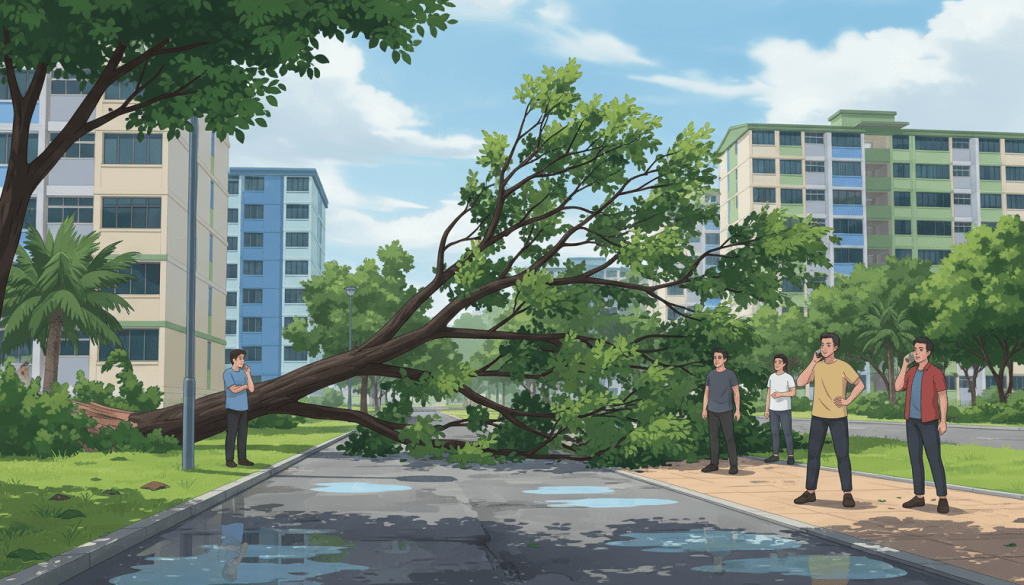
Has a tree fallen, a large branch cracked or a trunk started leaning dangerously in Sengkang? Keep people away from the area. Do not walk beneath hanging branches, touch broken electrical cables or try to clear a heavy fallen tree yourself. If someone is trapped or seriously hurt, call 995 for emergency rescue and ambulance assistance. If the situation presents an urgent Police or road traffic danger, call 999 as appropriate.
For a fallen tree or dangerous branch affecting a public road, park or park connector, contact NParks on 1800 471 7300. For urgent tree hazards in HDB common areas managed by Sengkang Town Council, call its 24-hour EMSU, 6590 9777. For a condominium or privately managed site, contact the managing agent or MCST.
Quick routing: injury or urgent rescue — 995; roadside or public park tree — NParks 1800 471 7300; urgent Sengkang Town Council HDB-estate hazard — 6590 9777; routine municipal tree feedback — OneService app. Call from a safe location and say exactly what is blocked or threatened.
The first 60 seconds: tree fall and branch danger
- Move away from the tree. A second branch or unstable section may still fall after the initial crash.
- Keep others away. Warn nearby pedestrians without standing under the tree or entering the road to direct traffic.
- Look for urgent danger from a safe distance. If a person is trapped, unresponsive or seriously injured, call 995; if active traffic danger requires Police assistance, call 999.
- Do not touch fallen wires. Treat any cable lying across a branch or wet ground as potentially live. Keep the area clear and report it.
- Note the location. Give the park, road, nearby HDB block, bus stop, junction or park-connector segment.
- Call the responsible authority. NParks for roadside and public-park trees; the estate’s town council for its common-area greenery; MCST for private grounds.
- Do not clear the obstruction yourself. Heavy limbs, tensioned branches, roots and overhead vegetation can shift unpredictably.
Who to call for a fallen tree in Sengkang
- 995 — SCDF: for a trapped person, serious injury or urgent rescue. SCDF emergency service guidance.
- 999 — Police: where a fallen tree creates an immediate policing or dangerous road-traffic emergency. SPF contact numbers.
- 1800 471 7300 — NParks: for trees and greenery in public parks, along main roads and other areas managed by NParks. The Singapore Land Authority’s fallen-tree FAQ directs reports of fallen trees affecting public roads to NParks.
- 6590 9777 — Sengkang Town Council EMSU: 24-hour urgent essential maintenance in HDB common areas it manages. SKTC EMSU contact.
- OneService app or chatbot: for non-life-threatening municipal defects or fallen-tree reports where a photograph and location can be provided safely. Official OneService reporting channels.
The key question: where is the tree?
A tree near an HDB estate may be within town council landscaping, part of a park connector, along a public road or on private land. The authority responsible for maintenance depends on the land and tree, not simply whether it is close to a Sengkang postal address.
NParks directs greenery feedback in HDB estates to the respective town council, and private condominium greenery matters to the MCST. For a tree affecting a public road, the Singapore Land Authority says to contact NParks on 1800 471 7300. If you are uncertain, report the exact place and the risk rather than waiting to determine the land boundary.
Do not physically cross an unsafe area to read a planting label or tree tag. An approximate location with a clear landmark is more useful than placing yourself under a cracked canopy for a precise number.
If a tree has fallen across a public road
Move to a safe place off the carriageway and avoid walking among branches to get photographs. Drivers approaching a fallen tree should slow and follow safe alternative routes or traffic officers. A fallen trunk can conceal damage to road surfaces, streetlights or wires.
- Stay out of live traffic lanes and warn companions to keep away.
- Call 995 if someone is injured or trapped, and 999 if an urgent road-safety situation requires Police assistance.
- Report the obstruction to NParks: road name, direction, nearest junction or bus stop, and the extent of the obstruction.
- Give any safe observation about fallen poles or cables, but do not go closer to examine them.
- Follow closures or diversions set by authorities, and do not enter an area that has been cordoned off.
A picture is useful only if you can take it without standing in traffic, under hanging branches or near electrical equipment. Do not risk another accident to document the first one.
If the tree is in an HDB courtyard, playground or common walkway
For an urgent problem in Sengkang Town Council’s managed common areas, call EMSU at 6590 9777. State the HDB block, street, affected playground or linkway and whether the fallen tree blocks an accessible passage, lift lobby approach or emergency vehicle access.
Keep residents away from the damaged canopy, especially children attracted to the unusual scene. Do not allow a group to push or carry branches out of the way. Even if a branch looks light at one end, attached limbs may be under tension.
If the estate is managed by a different town council or a private agent, use that managing body’s contact details. Sengkang’s location does not automatically mean every property falls under the same maintenance service.
If a branch is hanging but has not fallen
A branch that remains suspended after cracking can be particularly unpredictable. Do not stand underneath to judge whether it is firmly attached, and do not shake the tree or throw objects at the branch to bring it down.
Move people away from the fall zone and report the situation promptly to the responsible authority. Give a clear account of what you can see: an attached branch split at its base, a limb resting on another tree, or a tree leaning toward a path. Avoid stating that a tree is certain to fall if the condition has not been professionally assessed.
The correct response may involve inspection, cordoning off an area, pruning or removal by an authorised crew. Only qualified personnel should assess and carry out tree work involving dangerous limbs.
If the tree is touching an electrical cable
Stay back. You cannot tell by looking whether a cable is energised, and water or damaged branches can create a dangerous contact path. Do not touch the tree, wire, metal fence or nearby pooled water. Tell emergency services or the electricity operator precisely where the suspected electrical hazard is located.
If somebody is injured or there is an immediate life-safety threat, call 995 from a safe place and follow its instructions. A general power interruption can be reported through SP Group, but do not treat a live-wire danger as a routine blackout repair. Leave the scene to the appropriate responders.
After a thunderstorm: is the path really safe?
A storm may pass while damaged branches remain unstable. Do not assume a walkway has become safe simply because the rain has stopped. Fallen leaves or a small branch on the path may be harmless, but they do not prove the rest of a damaged canopy is secure.
If you must travel after heavy rain, respect park closures and temporary barriers and avoid passing beneath visibly hanging limbs. Where the weather is still stormy, follow MSS lightning guidance and move to proper shelter rather than inspecting trees outdoors.
A parks map or tree inventory can help identify places and plant species for normal recreation; it is not a real-time assessment of whether an individual tree is safe after a storm.
How to report the exact tree without going near it
- Roadside: road name and carriageway, nearest junction, bus stop, lamp post or recognised landmark.
- HDB estate: block number, estate street, playground, fitness corner or linkway, and which side of the block.
- Park: park name, named entrance, nearby trail junction or feature.
- Park connector: known connector name and adjacent bridge, road or estate landmark.
- Danger: suspended branch, fully fallen trunk, exposed roots, blocked access, damaged railing or possible wire contact.
- People: whether someone is injured, trapped or using the only accessible route.
- Photographs: take from a secure distance only if the authority asks and doing so is safe.
How OneService fits into fallen-tree reports
The official OneService app accepts reports of municipal defects including fallen trees, and routes feedback to the relevant public agency. You can provide a location, description and photo and later track whether the case was acknowledged, worked on or resolved.
However, OneService’s published normal response expectations for routine municipal feedback are not a guaranteed emergency response time. Do not rely on a routine form when a person is trapped, serious injury has occurred or an active road danger demands immediate help. Call the relevant emergency service or urgent maintenance contact instead.
Examples around Sengkang
A branch blocks the path to an HDB lift lobby
Keep people out of the obstruction, especially wheelchair users who may need another accessible route. Report it to the managing town council’s urgent maintenance service. If there is an injury or an immediate rescue concern, call 995.
A tree lies across a public road after wind and rain
Stay off the carriageway and notify NParks at 1800 471 7300. Give the road name and direction. If traffic is exposed to immediate danger, call 999 for urgent Police assistance. Do not direct vehicles from the live lane.
A large branch hangs over a playground
Keep children away and report the hazard to the park or estate manager. Do not pull the branch down, climb the tree or photograph from beneath it.
A leaning tree appears inside a condominium
Contact the managing agent or MCST. The owner or agent should arrange professional inspection; do not assume the HDB town council is responsible for private grounds.
Preventive habits for residents
- Report damaged trees and hanging limbs promptly without attempting home-made repairs.
- Keep the area around access roads and emergency paths clear when safe to do so.
- Respect closure signs after storms and when tree works are in progress.
- Do not attach heavy objects, banners or wires to a tree without appropriate authorisation.
- Teach children to stay away from cracked or suspended branches and from downed electrical cables.
- Use an exact location when reporting, so the correct authority can find the tree without delay.
Frequently asked questions
Do I call NParks or Sengkang Town Council?
Contact NParks for public roadside trees and areas it manages. For HDB common greenery within Sengkang Town Council’s management, call SKTC’s EMSU for urgent hazards. Private condominiums use their managing agents.
Is NParks 1800 471 7300 an ambulance number?
No. It is the NParks contact for parks and greenery matters. For serious injury or rescue call 995.
Can I pull a branch out of the road?
Do not attempt to move a heavy or unstable tree section, particularly near traffic, tensioned limbs or suspected wires. Report the location and let trained crews assess it.
What if I cannot tell whose land the tree is on?
Describe the hazard and location to NParks, the estate manager or OneService as appropriate; agencies can help route the report. If immediate danger exists, use emergency services rather than delaying over land ownership.
What if the rain has already stopped?
A damaged tree can remain dangerous after rain stops. Avoid hanging limbs and follow official closures until the area has been cleared.
Related Sengkang emergency guides
- Heavy rain, flash floods and lightning
- Power outage and electrical hazards
- Medical emergency and ambulance
- Road accident and traffic reporting
Official sources and review information
- Singapore Land Authority — Report Fallen Trees Affecting Public Roads
- National Parks Board — Contact Us and Greenery Feedback Routing
- Sengkang Town Council — 24-Hour EMSU
- OneService — Municipal Feedback for Fallen Trees
- Meteorological Service Singapore — Lightning Information
Reviewed 4 November 2026. This is a reporting and safety guide, not a professional assessment of tree stability. The agency with maintenance responsibility can vary by land ownership. For life-threatening situations, call emergency services first.
