
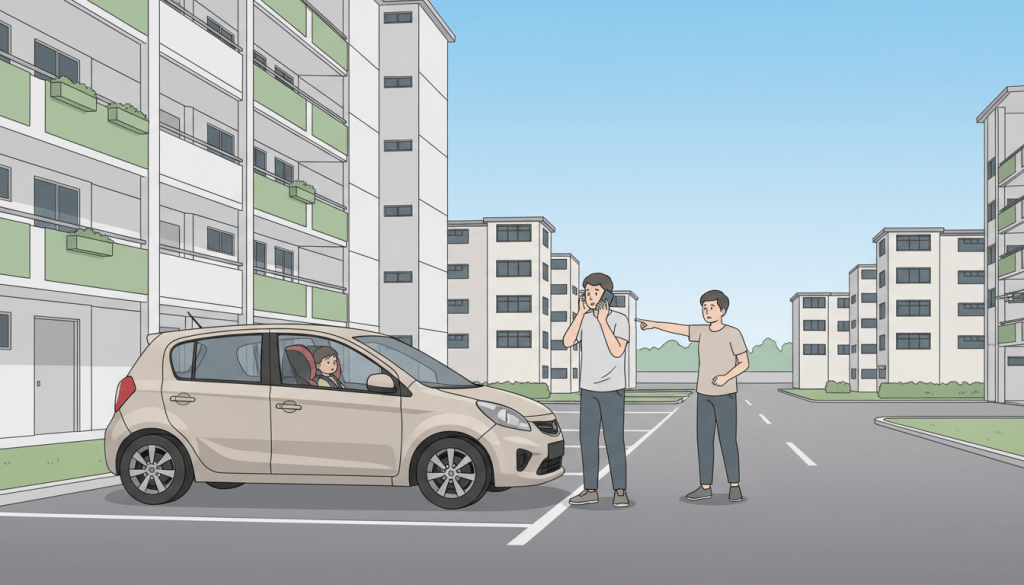
A baby or young child is locked inside a car in a Sengkang HDB car park, shopping-centre car park or roadside parking area? Call 995 immediately for urgent rescue assistance, especially if the doors cannot be opened, the child is distressed or there may be dangerous heat exposure. Tell SCDF the exact car-park location, level, parking-lot number if known, vehicle description and whether the child is responsive. Do not leave the vehicle unattended or wait for a locksmith while a child may be in danger.
A parked vehicle can become dangerously hot even when it does not feel extreme outside. Children can deteriorate before they can explain what is wrong. A child who becomes unusually quiet, very drowsy, confused, weak, unresponsive or distressed needs urgent rescue and medical assessment. Stay where you can see the child, keep bystanders and moving vehicles clear, and follow the 995 dispatcher’s instructions. If a second adult is present, they may try the immediately available spare key or manufacturer-supported remote unlock without delaying professional rescue.
- Call now: 995 if a child is trapped in a locked vehicle or is at risk of serious heat illness.
- Give location: HDB block, car park name, deck/level, lot, vehicle colour and nearby entrance.
- Keep watch: stay in safe sight of the child and monitor breathing, movements and responsiveness.
- Do not delay: waiting for an ordinary car locksmith, going home for spare keys or discussing who caused the lockout.
- Do not improvise hazardous rescue: breaking glass around a child can cause serious injury; follow trained responder or dispatcher instructions when possible.
- After release: assess the child for overheating or distress and seek clinical advice. For collapse, abnormal breathing or loss of responsiveness, follow 995 CPR instructions.
The first 60 seconds: the practical rescue sequence
- Confirm the child is still inside and identify the hazard. Stay clear of traffic and do not climb over moving cars to reach the vehicle.
- Call 995 immediately when the doors cannot be opened and the child may be endangered. Say ‘child trapped in locked car’ and describe the child’s apparent condition.
- Give the precise Sengkang location. A multi-storey car park’s deck and lot, or the HDB block and side facing a named road, help rescuers locate the car.
- Stay in view of the child. Watch whether they are alert, crying, responding, becoming drowsy or having difficulty breathing.
- Have another adult try safe, immediate access options if available. A trusted spare key or vehicle app may work, but must not delay rescue.
- Keep the area clear. Do not allow other people to crowd the windows or obstruct responders’ access.
- Follow SCDF instructions about rescue and post-release care. If the child becomes unresponsive, inform the dispatcher immediately.
Who to call for a child trapped in a car in Sengkang
- 995 — Singapore Civil Defence Force: urgent rescue and medical assessment when a child is trapped and faces danger, especially heat exposure or illness. SCDF Emergency Medical Services.
- 999 — Singapore Police Force: immediate Police and security threats, including suspected abduction or another active crime. SPF emergency contacts.
- Building security or car-park management: ask a second helper to guide responders to the vehicle, assist with safe access and keep traffic away; management is not a replacement for 995.
- Vehicle manufacturer or professional locksmith: useful for a routine adult lockout when no person is in danger; not the first or only action for a trapped child.
- Child’s medical team: after the child has been released and assessed, particularly if overheating, dehydration or other symptoms are possible.
Why you should not wait for a child to look ill
A child cannot always recognise or communicate dizziness, confusion or increasing body temperature. A baby strapped into a child seat may be unable to move to a cooler place, open a window or reach the door mechanism. The interior temperature can rise in bright weather, even when the outside air feels tolerable.
An emergency plan should not depend on a fixed claim such as ‘it is safe for five minutes’ or ‘the shade makes it safe’. Vehicle insulation, sunlight, ventilation, interior colour, time and local conditions vary. It is the child’s vulnerability and inability to exit that matter.
Singapore HealthHub’s child-safety guidance advises caregivers never to leave a child alone in a car. A locked-in child is a genuine rescue concern; seeking help promptly is more appropriate than waiting for an exact heat-stress threshold.
A locked car is not the same as an ordinary vehicle breakdown
A driver who accidentally locks the keys in a car with no people or animals inside can usually contact an authorised locksmith, insurer’s roadside assistance or the vehicle manufacturer. That is a property-access problem, not automatically a 995 rescue emergency.
A young child who cannot exit creates an immediate human safety issue. Do not treat the situation as a routine key-replacement job simply because the parent thinks a spare key is not far away. Contact SCDF where danger is possible and let trained responders determine the right response.
What if the child looks awake and is smiling?
A responsive child may be in less immediate distress than an unconscious one, but that does not establish that the interior is safe or that they can wait through a long rescue delay. Children can become overheated before they display obvious warning symptoms.
Keep the child in view and tell 995 their current state. Explain whether the air conditioning appears to be on or off, how long they may have been inside and whether any door can open. Do not claim that the child is completely safe because they waved at you through the glass.
Warning signs of overheating or heatstroke
- Unusual sleepiness, confusion, weakness or difficult-to-wake behaviour.
- Hot skin, marked discomfort, nausea or vomiting.
- Severe dizziness, fainting or collapse.
- Seizure or loss of consciousness.
- Rapid or abnormal breathing.
- Reduced responsiveness to a parent’s voice, especially in an infant.
The Singapore HealthHub children’s emergency guide lists poor responsiveness, listlessness, abnormal skin colour and breathing distress as reasons to seek emergency care. The Meteorological Service Singapore heat-stress guidance helps plan outdoor activity but cannot tell you the current temperature or safety inside a particular parked car.
What to tell the 995 dispatcher
- Car park: name, street, HDB block or shopping-centre car park, deck and lot number if known.
- Vehicle: type, colour and where it is parked; registration number may help if available without delay.
- Child: approximate age, whether they are strapped in a seat and whether they appear responsive.
- Conditions: open-air or sheltered car park, visible sun exposure, engine or air-conditioning status if known.
- Timing: last certain time the doors were unlocked and how long the child may have been inside.
- Access attempts: whether another key or safe app unlock is immediately available, without delaying rescue.
- Other dangers: smoke, running engine in an enclosed area, approaching vehicles or unsafe traffic.
Can you break the window yourself?
Broken glass can injure a child, especially when they are seated close to a window. Modern vehicle windows, tinted films, side airbags and other design features also make improvised access unpredictable. Do not start breaking windows as an ordinary first response when a trained rescue response can be activated.
Call 995 and follow the operator’s instructions. Rescuers have specialist equipment and can manage where and how a vehicle is opened while reducing risks to the occupant. In a truly immediate life-threatening situation where professional help cannot arrive before the harm occurs, emergency decisions depend on the circumstances; this article cannot direct a universal DIY glass-breaking method.
Avoid gathering a crowd of well-meaning helpers all attempting different entry methods. A single clear caller, one adult maintaining visual contact and space for responders is usually much more useful.
What if the car has a remote unlock app?
A working vehicle app or spare key can sometimes restore access quickly. Ask a second adult to try only if the authorised person already has access and can do so without distraction or delay. Do not walk away from the vehicle to troubleshoot phone accounts while the child remains inside.
Mobile signal, vehicle battery status, data connection or account authentication can prevent remote functions from working. Do not assume that an app will unlock a car simply because it worked yesterday.
HDB multi-storey car parks: find the right deck
A responder entering an HDB multi-storey car park may not see the correct vehicle from the ground level. Give the car-park block, deck number, lot number and whether the car is near a particular staircase or lift. Some car parks have separate entries or connecting bridges.
Ask another person to wait at the vehicle entrance if safe while the caller remains with the child. If there are separate traffic ramps, use the access direction indicated by the dispatcher rather than sending the rescue crew to the wrong side.
Mall or shopping-centre car parks
Tell the control room or security staff what is happening and ask them to meet SCDF at the correct car-park level. Keep the exact lot and zone sign available. If parking is automated or there are multiple basements, mention the ramp or lift bank closest to the vehicle.
Do not let a management call replace emergency contact. The security team may help with traffic access, but trained rescue and medical assessment should not be delayed when a child faces danger.
What if the engine is running?
A running engine does not guarantee that conditions inside a vehicle are safe. The air conditioning may fail, controls may be inaccessible or the car may be inside a poorly ventilated area. Do not attempt to reach through machinery or tamper with vehicle electrical systems from outside.
If there is smoke, unusual exhaust accumulation or a suspected carbon-monoxide hazard in an enclosed car park, tell 995. Keep bystanders away and do not create an additional fire or traffic hazard while trying to open the car.
If the child is released and seems overheated
Move the child to a safer cooler environment and obtain medical assessment according to their condition and 995 guidance. If the child is very drowsy, confused, breathing abnormally or unresponsive, emergency care remains necessary after removal from the car.
Cooling the body with appropriate cool water, wet cloths and airflow can be useful for suspected serious heat illness while medical help is coming. Do not put food or drink into the mouth of an unconscious or swallowing-impaired child. Do not assume that a child is fine simply because they stopped crying.
The Sengkang heatstroke guide explains the distinction between heat exhaustion and heatstroke; a child trapped in a vehicle needs individual medical assessment, not a diagnosis based on a generic chart.
If the child becomes unresponsive
Update 995 immediately. Once the child is safely accessible, follow dispatcher instructions for checking responsiveness and breathing. If they are unresponsive and not breathing normally, the operator can direct appropriate paediatric CPR and other emergency first aid.
Do not shake an infant or try to give water to revive them. Singapore paediatric life-support guidance uses scene safety, response, sending for help and appropriately trained resuscitation. A bystander should not improvise a technique while emergency instructions are available.
If you discover an unattended child in someone else’s car
Do not assume that a parent is nearby or that an unattended child is safe. If the child cannot exit and appears to face danger, call 995. Ask mall or car-park management to help identify the vehicle’s owner, but do not leave the scene or delay contacting responders.
Describe what you actually see: the child’s approximate age, whether doors appear locked, the car location and the child’s behaviour. Do not photograph and broadcast the child’s face or vehicle registration on social media. Official responders can determine how to approach the situation.
If there is a separate crime or deliberate harm concern, Police 999 may be appropriate. A bystander does not need to diagnose intent before requesting rescue for an endangered child.
Three common Sengkang scenarios
A toddler accidentally locks the door while the parent retrieves the stroller
Remain by the car, call 995 when the toddler is trapped and cannot be reached, and give the exact HDB car-park location. Ask another adult to try a spare key if immediately available. Watch the toddler’s responsiveness and follow rescue instructions.
A baby is seen alone in a car at a basement car park
Report the situation to 995 when there may be danger and to car-park security for access assistance. Do not assume basement shade makes an unattended baby safe. Give the correct basement level and parking zone.
The child is rescued but is lethargic and has been in a warm car
Seek urgent medical assessment and follow SCDF guidance. Continue monitoring breathing and consciousness; do not dismiss drowsiness as ordinary sleepiness after possible heat exposure.
How to prevent a vehicle lockout involving a child
- Never leave an infant or child alone in a parked vehicle, even briefly.
- Before closing a door, check that the keys or phone needed to unlock it are with the responsible adult.
- Keep an age-appropriate child restraint fitted and used correctly during travel.
- Do not assume the child can open central locking, electric windows or child-safety locks.
- Make a habit of checking the rear seats whenever leaving the vehicle.
- Know the car park’s block, level and lot so an emergency address can be given quickly.
- Keep a plan for a trusted spare key or manufacturer-approved access method, without relying on it instead of emergency services.
Frequently asked questions
Should I call 995 if a child is locked in a parked car?
Yes, when the child cannot be released and may be endangered. State the situation and the child’s condition and follow the dispatcher’s instructions. Call immediately for signs of distress or overheating.
Is a shaded multi-storey car park safe enough to wait?
Shade does not prove a locked vehicle is safe for a child. Avoid delaying rescue to rely on assumptions about the temperature or time remaining.
Can I wait for an ordinary locksmith?
Not as the only response while a child faces danger. Contact 995 and follow emergency guidance. An authorised remote unlock can be attempted by another adult without delaying rescue.
Can I smash the nearest window?
Improvised glass-breaking can injure the child. Call 995 and follow trained rescue instructions whenever possible. The appropriate response depends on the immediate danger.
What if the locked car is empty?
An ordinary adult vehicle lockout without anyone at risk is a roadside-assistance or locksmith matter, not generally a life-threatening SCDF rescue emergency.
Related Sengkang emergency guides
- Heatstroke and dangerous overheating
- Baby fever and childhood emergency warning signs
- Road accidents and pedestrian injuries
- Expressway vehicle breakdowns and EMAS
Explore the next Sengkang emergency guides: Lost wallets, NRICs and passports · Sengkang MRT and LRT disruptions · Falling concrete and unsafe HDB ceilings.
Related Sengkang emergency guide: Locked out with a vulnerable person trapped inside.
Official sources and review
- Singapore Civil Defence Force — Emergency Medical Services and 995
- HealthHub — Children’s Emergency Care Warning Signs
- Meteorological Service Singapore — Heat Stress Advisory
- Singapore Police Force — Emergency Contact Information
- Singapore Paediatric Life Support Guidelines 2026
Reviewed 6 November 2026. This is a child-safety guide, not a real-time rescue or locksmith service. If a child is trapped and may be endangered, call 995 immediately and follow SCDF instructions.
