
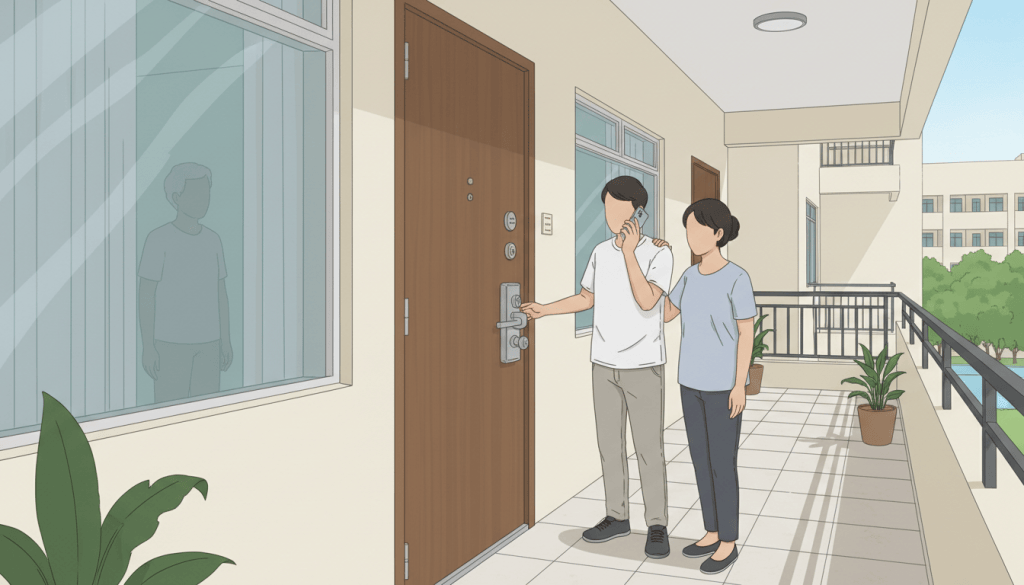
Locked outside your Sengkang HDB flat while a young child, elderly parent or another vulnerable person is alone inside and cannot open the door? First assess the danger. If someone is trapped with fire, smoke, a switched-on stove, serious illness, possible collapse or another immediate threat, call 995 for SCDF rescue and medical assistance. Tell the dispatcher the exact block, unit and floor, who is inside, whether you can speak to them and what makes the situation urgent. Do not delay emergency help for a locksmith quotation.
For an ordinary lockout where everyone is safe, contact a trusted spare-key holder, your landlord or managing agent, or an appropriate professional locksmith. Sengkang Town Council’s 6590 9777 Essential Maintenance Service Unit deals with urgent common-area maintenance in estates it manages, not generally private flat-door lockouts. If a forced entry, break-in or another active security incident is occurring, use Police 999 for immediate Police help.
- Vulnerable person trapped with immediate danger: SCDF 995; state exact unit, floor and risk.
- Person inside is unresponsive or seriously ill: call 995 immediately; follow medical dispatcher instructions.
- Fire, smoke, gas or dangerous electrical conditions: move to safety, call 995; do not attempt a hazardous improvised entry.
- Ordinary non-emergency HDB lockout: trusted spare key, verified locksmith, owner or landlord.
- Common corridor gate or building-access fault: relevant town council EMSU or private building management.
- Security threat or break-in: Police 999 for immediate assistance.
The first five minutes: decide whether this is an emergency
- Check who is inside. Can the child, older person or disabled resident respond, and are they able to leave or unlock the door?
- Ask about immediate hazards if safe to communicate. Is there smoke, cooking heat, gas smell, water near electricity or a medical problem?
- Call 995 if life safety is at risk. SCDF’s emergency medical-services guidance explicitly includes ‘someone is trapped in the house’ as an example of an incident to describe to its operator.
- Give accurate location details. HDB block, road, unit and floor, nearest lift or staircase, and whether the corridor or grille gate is locked.
- Do not attempt a risky entry. Avoid climbing outside windows, balconies or ledges, and do not break glass near a child.
- Keep a safe communication line. Stay within hearing distance when possible without putting yourself at risk.
- For routine lockouts only, arrange authorised access. Contact a trusted key holder or legitimate locksmith rather than occupying emergency dispatch resources.
Who to call when locked out of a Sengkang flat
- 995 — SCDF: urgent rescue where a child or vulnerable adult is trapped in danger, a resident collapses or fire/medical emergencies occur. SCDF Emergency Medical Services.
- 999 — Singapore Police Force: a break-in, immediate threat or other urgent Police matter; not ordinarily a misplaced house key. SPF contacts.
- Trusted spare-key holder: someone already authorised to enter, when this can resolve a non-emergency lockout safely.
- Verified locksmith: for an ordinary private door lockout with no person at risk; confirm business identity, price range and proof-of-occupancy requirements.
- Landlord or property agent: for a rented flat, ask about authorised entry and an approved repair service.
- 6590 9777 — SKTC EMSU: essential HDB common-area maintenance such as relevant shared access systems in estates it manages; not a blanket emergency locksmith service for private units. SKTC official EMSU.
A locked door is not automatically a life-threatening emergency
Sometimes an adult closes the door and discovers the keys are still on the dining table. If no person, pet or safety hazard is trapped inside, that is normally a property access problem. A locksmith or owner can help restore access; emergency responders need to remain available for fires, serious injuries and genuine rescue needs.
The important distinction is not whether the resident is anxious or inconvenienced. It is whether the closed door prevents someone from escaping a dangerous situation or prevents urgent aid from reaching an injured, ill or vulnerable person.
If a toddler is alone beside an operating stove, for example, the danger may be immediate even if the child was speaking normally moments ago. Do not wait until a visible fire starts.
If a baby or toddler is inside
A young child may be unable to turn a lock or follow verbal instructions, and can become frightened or approach unsafe appliances. If no authorised adult can reach them and there is a realistic immediate danger, call 995 promptly. Explain the child’s age and whether you can see or hear them.
Do not tell the child to climb onto a table or chair, open a high window or attempt to reach a latch by using household tools. Even when the child understands you, those directions could create a fall hazard.
A second adult may try an existing spare key or appropriate building access arrangement without delaying SCDF. One caller should remain available for the emergency operator and responders.
If an older parent or person with dementia is inside
A resident living with dementia may not know how to open the front door, or may be unable to describe their condition clearly. Ask simple questions if you can communicate through the door. If you cannot establish their safety, they are reporting distress, or they may need urgent medication or care, tell 995.
Do not assume that silence means they are asleep. There may be hearing difficulty, confusion, a fall or another problem. Equally, a routine delay in answering is not automatic evidence of a medical crisis. The key is what you know about the person’s vulnerability and the current circumstances.
If they are in immediate danger or not responding and you have a credible medical concern, emergency services should assess the situation rather than a neighbour forcing entry with tools.
If the person inside has collapsed
Call 995. Explain when the person was last responsive, their medical history if known and whether the door is locked or blocked. If you have a medical alert device or another communication pathway, tell the operator, but do not delay the call to search for the device.
SCDF responders can coordinate entry and emergency treatment. A bystander should not climb a neighbouring balcony, lean from an upper-floor ledge or attempt to break high glass to gain access.
If a serious medical emergency is confirmed, use the dispatcher’s instructions and keep the corridor clear for rescue equipment.
If smoke or fire is coming from the flat
Move yourself and neighbours away from the fire and call 995 immediately. If a child or vulnerable adult is inside, give their exact location and access problem to the operator. Do not open a hot door or enter dense smoke on your own.
The SCDF emergency handbook advises residents to seek safe shelter or evacuate according to conditions and to tell dispatchers where people require rescue. The correct emergency approach depends on whether the exit is blocked, smoke is present and which part of the building is affected.
The Sengkang HDB fire and evacuation guide offers related building procedures.
If the stove is on but there is no visible smoke yet
A stove that may be unattended behind a locked door can become hazardous, especially when a child or person with limited mobility is alone. Do not simply wait to see whether the cooking finishes. Tell 995 what appliance may be operating and whether gas or a flame is involved.
If a gas smell is present, avoid sparks and switch operation near the suspected leak; move to a safe place before calling. For a confirmed piped gas service concern, City Energy’s separate emergency hotline is 1800 752 1800. Immediate life danger remains a 995 matter.
Can a locksmith open the door faster than SCDF?
A nearby locksmith may sometimes arrive quickly, but timing varies and a locksmith is not trained to manage a fire, unconscious patient or hazardous gas atmosphere. In a genuine life-safety emergency, calling 995 gives SCDF the opportunity to triage and dispatch the appropriate response while other safe access options are considered.
If no emergency exists, a verified locksmith is often the practical route. You can ask about call-out charges, labour, replacement parts, after-hours fees and how the provider verifies that you are entitled to enter.
Do not rely on a locksmith’s advertised arrival time to decide that a trapped infant or unwell older person can safely wait.
Why not climb through the window or balcony?
Sengkang includes high-rise flats. An attempt to access an upper-floor unit from a balcony, window ledge or neighbouring flat can create a fatal fall risk. A household member who is not trained in rope access or rescue should never attempt this.
Even a low window may have glass, grills, security fittings and hidden hazards. A person trying to climb through can become injured or create an entry point for someone else to fall. Leave difficult access to trained responders or properly authorised professionals.
How to assess the lockout without a risky inspection
- Door: main door, grille gate, digital lock or corridor access system.
- People: who is inside, approximate age, mobility and ability to respond.
- Hazard: active cooking, smoke, gas smell, electricity, water leak or medical problem.
- Communication: whether a person can answer a phone, intercom or voice from a safe location.
- Access: whether an authorised spare key exists and who holds it.
- Location: HDB block, road, unit, floor and nearest lift or staircase.
- Urgency: what makes the matter life-threatening rather than a routine misplaced key.
Digital locks, flat batteries and jammed doors
A digital door lock can fail because of battery issues, a faulty component or a damaged latch. Follow only the manufacturer’s published non-destructive emergency-access instructions if you are authorised to do so and the situation is not dangerous. Do not bypass security systems by prying a lock or using improvised electrical contacts.
A qualified locksmith or manufacturer-approved technician can assess a defective lock. In rented accommodation, notify the landlord or agent so the repair and any replacement are properly authorised.
A failure that affects a whole building’s shared access door is different from one family’s digital lock. Report a shared access problem to the management team responsible for that common equipment.
What if a neighbour can hear somebody calling for help?
If the person inside is asking for medical help, reports being unable to breathe, appears seriously injured or may be in danger, call 995 and give the exact unit. Do not delay emergency contact while waiting for the occupant’s relatives to return.
A neighbour who hears a faint noise but is unsure whether someone is actually in distress should report what they genuinely heard. The emergency operator can ask clarifying questions. Avoid entering someone else’s unit or using force based solely on a guess.
When should Police be involved?
Police 999 is appropriate for an immediate threat such as a person forcibly breaking into a flat, violence in progress or another urgent security issue. If the person asking for entry cannot establish their right to enter, a legitimate locksmith should verify occupancy or authorisation before opening the door.
A routine dispute between a landlord and tenant about keys is not automatically an emergency policing matter. Seek appropriate legal or property-management advice for access disputes, and call Police only when there is an actual crime or immediate safety concern.
What to tell 995 on the phone
- Address: ‘Block [number], Sengkang [road], unit [number], floor [number]’.
- Access problem: main door, grille, digital lock or both doors locked.
- Person inside: age, known vulnerability and current ability to respond.
- Immediate concern: child alone, unresponsive parent, smoke, running stove or other danger.
- Time: when the person was last seen safe or when the door became locked.
- Other helpers: whether authorised family or management can open the unit.
- Safe meeting place: nearest lift lobby and your callback number.
If there is no emergency: choosing a locksmith safely
- Confirm that every occupant is safe and that no urgent medical or fire danger is present.
- Contact a trusted family member, landlord or approved service first.
- Select a provider whose business identity and contact details can be verified independently.
- Ask for a written estimate or clear explanation of call-out, after-hours and replacement charges.
- Prepare proof that you are the owner, tenant or otherwise authorised to enter.
- Do not agree to unnecessary destructive work without understanding the alternatives.
- After access is restored, test the door and arrange a permanent repair where needed.
Examples in Sengkang
A parent steps into the corridor and the toddler locks the grille
Speak to the child from a safe place and call 995 when the child cannot be reached or may face danger. Ask another adult to locate an authorised spare key without delaying emergency help.
An older resident does not respond and the flat is locked
If there is a credible medical concern, contact 995 and give the last known response time and medical needs. Do not attempt to climb in through a window.
An adult is safely outside after forgetting keys
This is ordinarily a locksmith or spare-key matter. Contact the owner or authorised provider and confirm fees; do not use 995 solely for convenience.
Smoke is visible behind a locked apartment door
Move away, alert others and call 995 immediately. Tell the dispatcher whether anyone is believed to be inside. Do not force open a hot door or enter smoke.
How to prevent another lockout
- Keep a trusted, authorised spare key in a secure arrangement.
- Check digital-lock battery status and follow maintenance instructions.
- Explain to caregivers what to do if a child closes a door unexpectedly.
- Make a clear plan for older relatives with mobility or cognitive difficulties.
- Keep the HDB block and full postal address accessible in a phone and on a household emergency card.
- Repair a sticking latch before it fails completely, through an authorised professional.
- Do not hide spare keys in obvious public locations or share access codes indiscriminately.
Frequently asked questions
Will SCDF open my door because I lost my keys?
A normal, safe lockout is not ordinarily an emergency rescue. Call 995 when somebody inside is trapped in danger, seriously ill or requires urgent help.
Can the Sengkang Town Council EMSU unlock my flat?
Its role is urgent common HDB estate maintenance. Do not assume it provides private locksmith services. Contact an authorised locksmith or owner for routine flat-door access.
Should I break a window to reach a child?
Do not attempt a hazardous improvised entry. Call 995, explain the urgency and follow trained rescue instructions.
What if the person is alive but cannot reach the door?
Tell 995 about their mobility, communication and medical condition. Serious entrapment or inability to obtain needed medical care warrants emergency assessment.
Should I call 999 for a lost key?
Not ordinarily. Police 999 is for urgent Police and security emergencies, not a routine access problem.
Related Sengkang emergency guides
- Child trapped in a locked car
- HDB fire, smoke and evacuation
- Medical emergency and ambulance
- Stuck in a lift and lift breakdown
Explore more Sengkang emergency guides: Suspicious parcels, bomb threats and Police help · Carbon monoxide poisoning and indoor fumes · Discoloured tap water and drinking-water advisories.
Official safety and contact references
- SCDF — Emergency Medical Services and Call Information
- SCDF — Civil Defence Emergency Handbook
- Singapore Police Force — Emergency and Non-Emergency Contact Numbers
- Sengkang Town Council — Essential Maintenance Service Unit
- City Energy — Piped Gas Emergency Hotline
Reviewed 7 November 2026. This guide cannot assess a private lock or guarantee an emergency response for a routine lockout. Call 995 for a genuine urgent rescue or medical danger. Never attempt dangerous high-rise access.
